
Contact us

AI Idea Validation Workflow and Best Practices

17 mins read

ai proof of concept
Blog Calculator Widget Logo

Estimate Your Software Project Cost

Describe your idea — get a budget breakdown in minutes.

Get Your Estimate

McKinsey reports that only about 30% of organizations have reached advanced AI maturity levels, supported by governance, compliance, dedicated budgets, and monitoring.

Businesses are struggling to build a mature AI strategy, primarily due to common AI adoption challenges that stem from a lack of a clear vision and technology expertise. Many teams don’t yet know where AI fits in their business workflows, what it can realistically do, or whether the idea holds up outside a slide deck.

A reliable way to close that gap and shape a real AI business case is an idea validation workflow. It offers a structured, low-risk way to test whether an Artificial intelligence concept is technically sound and worth pursuing.

In this article, we’ll share insights on this topic from our leading specialists who have just successfully hosted a webinar, “Prove It Before You Build It: AI Demos that Validate Business Ideas.” Here, we will explain how to figure out what kind of AI adoption actually fits your business, how a discovery phase and proof of concept (PoC) work in practice, and what it takes to move from a validated idea to a working product.

AI Adoption Levels: Understand What Fits You Most

Before shaping your AI concept, determine what level of AI adoption you actually need. Clearly defining the business use case is essential, as 37% of executives at organizations with low AI maturity cite it as a major obstacle to AI adoption. After that, you may decide whether you need a comprehensive AI system with autonomous reasoning or whether simpler AI (or even non-AI) automation would fit.

 Book Icon

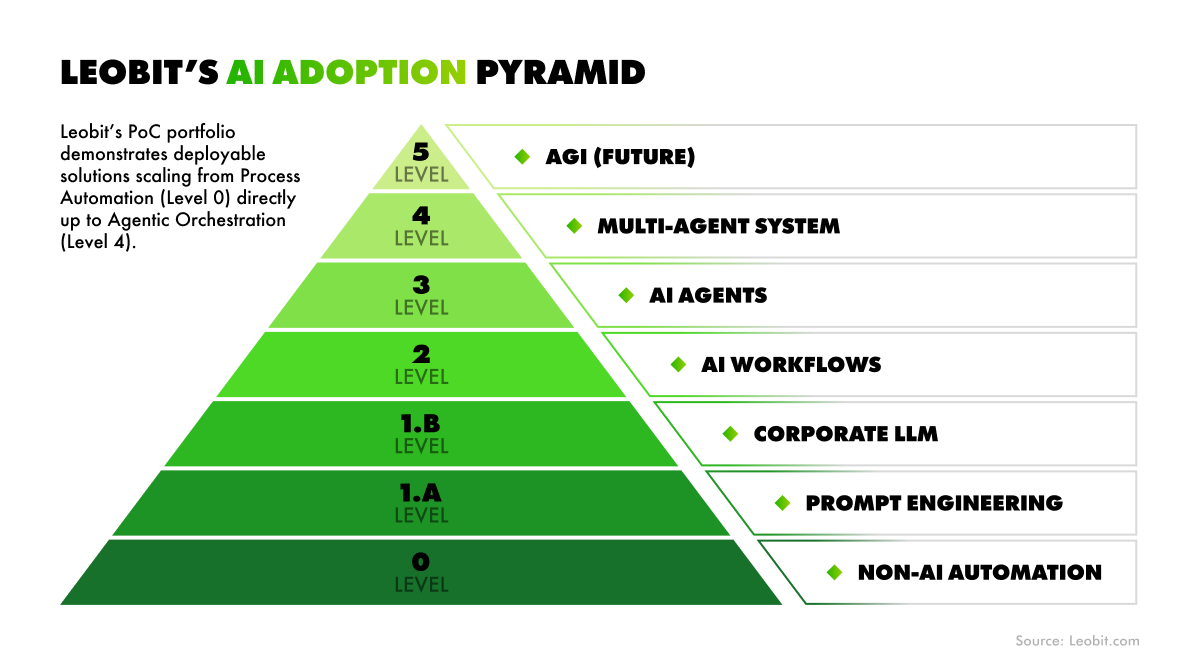
That’s where the AI adoption pyramid comes in. It outlines different levels of AI complexity and autonomy, with each level representing a more advanced stage of AI implementation.

ai maturity levels
AI adoption pyramid

Below, we outline the key AI adoption levels from our experience.

  • Non-AI automation. Rule-based scripts and workflows that don’t involve AI at all. These are primarily defined by deterministic logic that automates a repetitive task. For example, a simple automated script can route an invoice to the right approver based on its amount without involving AI at all.
  • Prompt engineering. Using an existing large language model, such as GPT-5, Claude, Gemini, or Llama, as-is, guided by carefully designed prompts to handle tasks like drafting content, answering questions, or summarizing text. This approach relies on well-crafted instructions rather than custom model training.
  • Corporate LLM. A model customized or fine-tuned on your organization’s own knowledge base. It builds responses based on your terminology, policies, and context instead of relying on generic public knowledge. Typical examples of AI solutions from this level are AI chatbots used in customer support, e-commerce order intake, or HR management.
  • AI workflow. A structured sequence of AI-assisted steps connected into a single process. Think of it as a constructor that combines AI-powered and traditional tasks into one workflow. For example, a workflow can support document intake, data extraction, validation, and routing from start to finish.
  • AI agents. Intelligent AI-powered systems that support particular workflows. Unlike AI workflows that are still governed by predefined rules, AI agents are more flexible and capable of handling non-typical scenarios. For example, when faced with an unusual customer request, an AI agent can go beyond its curated knowledge base and source information independently in the corporate CRM if it has access to it.
  • Multi-agent systems (agentic AI). Multiple AI agents work together, with each one responsible for a specific part of a larger task. Together, they solve problems that would be difficult for a single agent to handle. These agentic AI systems can make decisions and act independently within predefined boundaries. In most cases, one orchestration agent coordinates the others, assigning tasks such as data extraction, analysis, decision-making, and response generation.
 Book Icon
  • AGI (Artificial General Intelligence). A future, currently theoretical level, at which a system could match or exceed human capability across essentially any intellectual task.

Choosing the level that actually fits your business is the first real decision in AI idea validation. What goes next is a narrower idea examination.

Validating an AI Adoption Idea With a Discovery Phase

Once you know roughly where your idea sits on that spectrum, you need to outline the requirements and develop a roadmap to achieve your goals. A comprehensive discovery phase helps you get there. Typically, it includes four crucial components:

  • Scoping defines what the idea needs to do and for whom
  • UI/UX design prepares sketches and wireframes, defining how users interact with the AI-powered feature
  • R&D experiments provide a practical way to test assumptions directly against real technology
  • Assessment helps you evaluate the idea’s feasibility, cost, and business value against what’s technically achievable

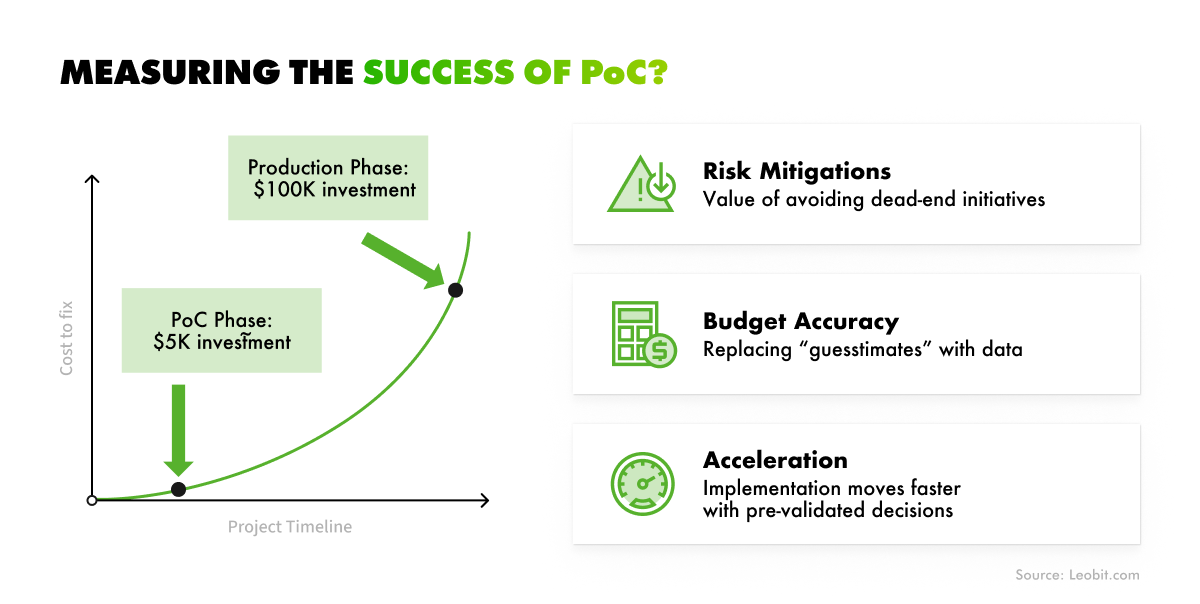
Based on Leobit’s experience, the R&D experiment is the most revealing and practical of these steps. Its output is a proof of concept that shows whether the technologies you’re considering can support your idea’s implementation. A well-crafted AI PoC helps you demonstrate that your idea can be implemented effectively, with the right model, data pipeline, and architecture, before committing to full-scale development that may require significant effort and budget.

 Book Icon

A Roadmap for Validating Your Idea with an AI PoC

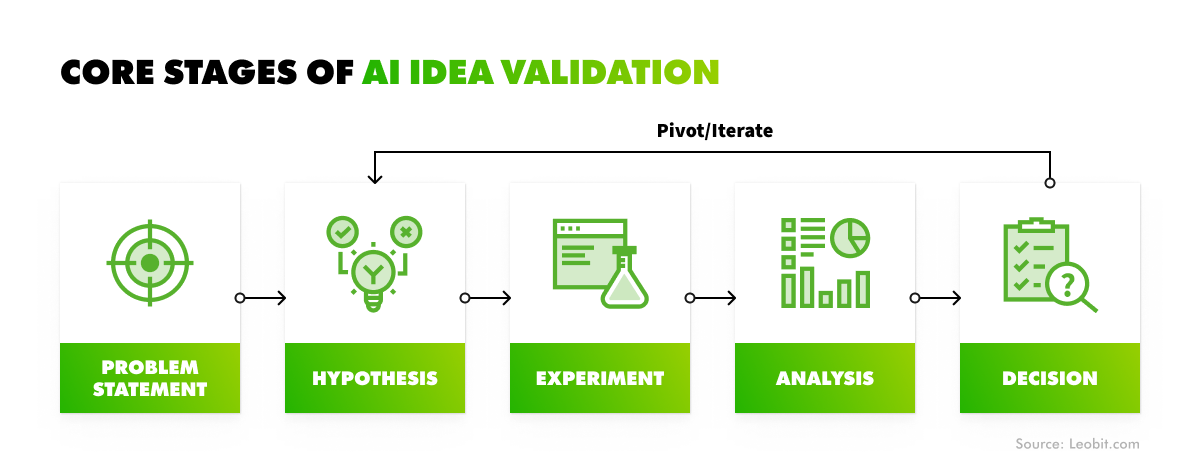
The ultimate goal of the AI idea validation process is to collect as many insights as possible. Ideally, it should help you assess the feasibility, business value, ROI potential, and long-term viability of your idea.

artificial intelligence idea
AI idea validation steps

To ensure that nothing is missed, follow this step-by-step approach.

1. Start with a clear problem statement

Always start by defining a problem with maximum precision, down to the most detailed metrics. A vague problem makes it impossible to judge success. When experimenting with an AI PoC, clear success metrics are crucial for final assessment and determining whether the idea is worth pushing to production.

2. Craft a testable hypothesis

Form a hypothesis about which solution is most likely to solve your problem. For example, if your goal is to cut healthcare appointment scheduling time, one possible hypothesis is that an AI voice agent for support teams can handle patient requests, check clinicians’ calendars for available time slots, and automatically offer those options.

If you expect this to reduce scheduling time by 50%, you’ve defined a clear hypothesis that gives your proof of concept a measurable goal, instead of a general direction.

3. Experiment with a PoC

This is where your team builds a proof of concept, a lightweight implementation focused on testing your hypothesis. Depending on the problem’s complexity, it can take anywhere from a few hours to a few weeks. The result isn’t meant to be production-ready. At this stage, the goal is to validate the idea as quickly as possible and get an honest answer about whether it works.

4. Analyze the outcomes

Upon building a working PoC, measure results against the hypothesis. Depending on your goal, you can consider many metrics. For instance, you can focus on the model’s target accuracy, latency, edge-case handling, or the PoC’s overall alignment with business workflows.

A PoC that falls short of expectations can be sometimes more valuable than one that appears to work perfectly. If everything goes smoothly, hidden issues may only surface later in production. A PoC that fails to deliver expected outcomes, on the other hand, exposes flaws of the idea early, before you’ve invested significant time and money. It gives you a clear view of the risks and weak points, making it much easier to refine the idea or the approach to its implementation.

Yurii Shunkin | Head of R&D Department at Leobit

Yurii Shunkin

Head of R&D Department at Leobit

5. Make a decision

Review the results of your experiment and decide whether to move forward, stop the initiative, or change your approach. If you choose to continue, don’t treat the PoC as the foundation of your production system. It was built quickly to test an idea, not to support a real-world workload.

AI implementation
Measuring the success of an AI PoC

In most cases, the optimal approach is to start from scratch while reusing some architectural patterns, technical decisions, and lessons learned during the PoC.

6. Pivot (optional)

Sometimes the original hypothesis doesn’t hold up, but the experiment reveals a better angle – a different model, a narrower scope, or a different user flow that would work better.

For example, suppose your team built an AI solution to automate document formatting, but the results were inconsistent because the tool occasionally failed to detect existing formatting. Instead of trying to support every document type, you could narrow the scope and optimize the model to just a few, such as SOWs, NDAs, and MSAs. You won’t automate your entire document workflow, but you’ll solve one of its most time-consuming parts.

A pivot isn’t a failure; it’s often the most valuable outcome of a PoC because it redirects effort before a large investment goes in the wrong direction.

 Book Icon

Best Practices to Accelerate AI Idea Validation through PoC Development

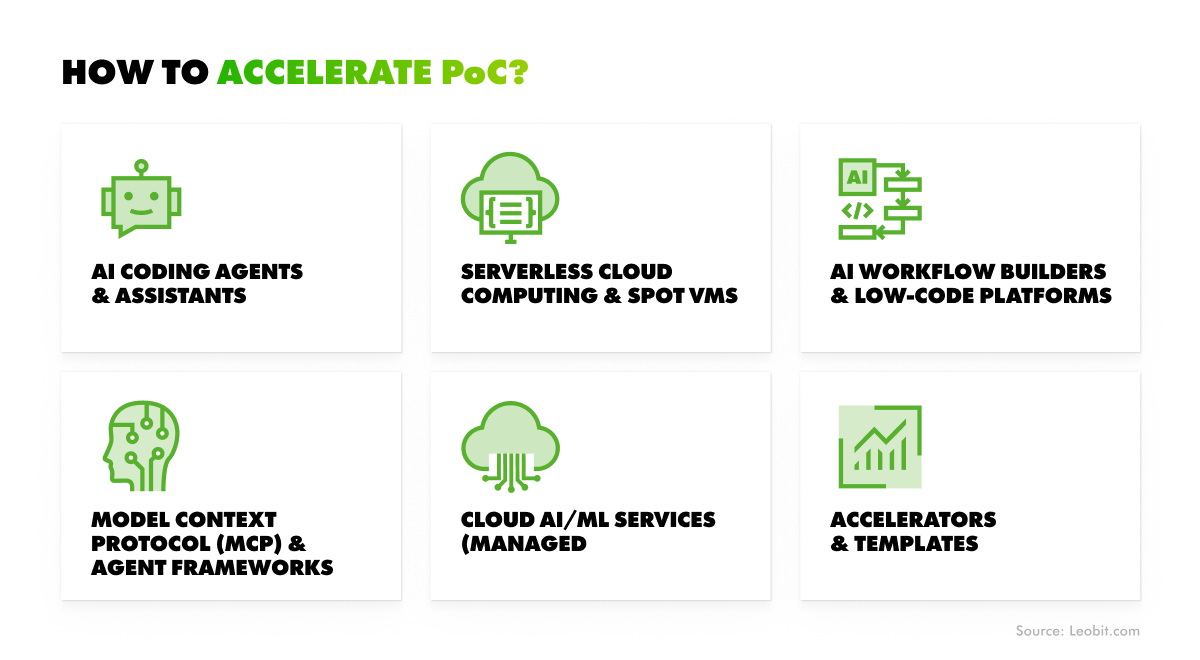
Speed matters in AI idea validation because the whole point is to get a reliable answer quickly, before committing heavy resources. Our specialists share several tips and best practices that help teams move faster with PoC experiments.

ai adoption challenges
Ways to accelerate the development of AI PoC

Let’s explore such practices in more detail.

Use AI coding agents and assistants

Tools that generate, review, and refactor code alongside developers significantly speed up the actual build phase of a PoC. Some examples of such solutions:

  • GitHub Copilot — a coding assistant that provides inline code suggestions and autocomplete directly in the IDE, speeding up workflows with boilerplate and repetitive code
  • Claude Code — an agentic coding assistant that can plan, write, test, and refactor across a whole codebase
  • Cursor — an AI-native code editor that generates code from natural language prompts and applies multi-file edits
 Book Icon

Consider serverless cloud computing and spot VMs

When building a PoC, you don’t need guaranteed and stable uptime. Spot VMs reduce cloud compute costs and work well for short-lived experiments, even though they may be interrupted occasionally. Serverless computing similarly removes the overhead of provisioning infrastructure that you’ll only need for a few weeks.

 Book Icon

Apply AI workflow builders or low-code systems

Tools like Azure Logic Apps let teams connect AI services, data sources, and business logic through a visual interface. This reduces the amount of custom code needed to build a proof of concept. While this approach isn’t always the most reliable fit for production, it makes it much faster to build and iterate on a PoC, which is exactly the goal at this stage.

Use the MCP agent framework

MCP (Model Context Protocol) is an open standard that standardizes how AI models connect to external tools, data sources, and systems. It provides a single interface for integrations that models and tools can reuse. This reduces the time and effort required to write custom integration code to enable an AI component’s PoC to interact with business systems during testing.

 Book Icon

Rely on managed foundational AI models

About a month after GPT-4 was released in March 2023, OpenAI CEO Sam Altman said that training the model had cost more than $100 million. Not every model demands this level of investment, but the example above illustrates just how complex and expensive training from scratch can get.

Using a foundation model through a managed service removes months of infrastructure and data-preparation work. Most PoC projects don’t need comprehensive, business-specific outputs. In the majority of cases, the general knowledge built into a managed foundational model is enough.

Use accelerators and templates

Pre-built templates for common AI use cases, such as document analysis, chatbots, and text summarization, provide a reliable starting point for a PoC. Instead of building core components from scratch, development teams can reuse proven foundations and focus on the unique aspects of the solution they are validating.

That’s why our R&D team actively develops and experiments with reusable proof-of-concept frameworks for common AI use cases, such as image recognition and document information retrieval. These foundations help us build future PoCs faster.

Leobit’s Experience in AI Idea Validation

One of the major obstacles to AI idea validation is the lack of talent required, a problem cited by 27% of low AI maturity companies. To address this challenge, Leobit continuously invests in AI expertise. Our team has a strong portfolio of customer-facing AI solutions and regularly strengthens its technical capabilities through AI experimentation.

Below, we describe some examples of Leobit’s AI PoC development projects.

CV converter

Leobit’s R&D team identified a clear problem: manually converting employee and candidate CVs into the company’s corporate template was slow and inconsistent. We decided to build a solution that combines the capabilities of an LLM with document intelligence tooling to address this issue.

Our specialists used GPT-4o and Azure Document Intelligence to extract data from CVs, while Spire.Doc handled document formatting. A ReAct-based loop allowed the system to reason through its output and refine it before producing the final result.

The outcome of this two-week PoC project was a working solution that extracts information from CVs and automatically formats it into a standardized corporate template, reducing manual data entry by 70%. Overall, the framework performed well enough to be adapted for future client work beyond HR, including consulting and fintech use cases.

 Book Icon

Sentiment analysis solution

Leobit’s team saw a need for a fast way to gauge tone and mood in customer and internal communications and decided to solve the problem using AI-powered sentiment analysis. We built a PoC that connects to the Azure Language API for opinion mining, emotional tone detection, and sentiment scoring.

The result is a tool that scores text as positive, negative, neutral, or mixed and flags the dominant emotion behind it. The framework developed during this short project can be reused across industries such as healthcare, e-commerce, marketing, government, and HR.

 Book Icon

Voice agent for appointment scheduling

Leobit’s team saw a need for a faster, more natural way to handle appointment scheduling for call centers and support teams across industries like healthcare, real estate, and insurance. We assumed that an AI voice agent capable of processing user inputs and providing appointment suggestions upon analyzing the schedule would be a sound solution.

Our R&D team built a PoC that connects to ElevenLabs ConvAI to ensure real-time voice interaction and calendar updates. As a result, we’ve built a voice agent that can book, reschedule, and manage appointments through natural conversations.

The tool effectively syncs calendar changes as the call progresses and is available 24/7. The framework created during this short project can be reused for applications across various industries, beyond the scope of domains our tool covers.

 Book Icon

Invoice and receipt parsing solution

After analyzing common challenges in financial management and expense documentation, our team decided to build an AI-powered solution for extracting structured data from invoices and receipts. We developed a PoC that combines OCR with Azure Document Intelligence to process predefined document formats and extract key information automatically.

The result is a solution that scans invoices and receipts and converts them into structured data, reducing manual data entry by 80% while improving processing speed and accuracy. The framework built during this short project can be adapted to other document types and business scenarios across industries such as fintech, legal, healthcare, and more.

 Book Icon

RAG-powered voice assistant

Leobit’s team successfully launched Leora, an AI-powered sales assistant designed to handle customer communication. To make interactions with Leora faster and more natural, we decided to build an AI-powered voice assistant capable of responding in real time while staying grounded in accurate, contextual information. We developed a PoC that combines the Azure OpenAI Realtime API for low-latency voice streaming with RAG-based context retrieval to deliver fast and reliable responses.

As a result, our team has developed a voice assistant that holds real-time conversations while pulling in relevant contextual data from the corporate knowledge base. The framework created during this project was applied to enhance our own tool and can be reused for our customers during their projects across industries.

 Book Icon

Final Thoughts

AI idea validation is a structured, low-risk way to test whether a concept holds up before committing your business resources to it. The pillars of this approach are a clear problem statement, a testable hypothesis, an experiment with a working PoC, and a thorough assessment of its results.

Whether a PoC yields positive or negative results, its main value lies in the information it provides. That information helps you decide whether to move forward, refine your approach, or abandon the initiative. The key point is avoiding the common trap of building a full-scale solution around an idea that was never properly tested.

However, as long as technical expertise remains one of the biggest barriers to AI adoption, validating an AI idea requires access to specialists with the relevant expertise.

Whether you’re exploring your first AI use case or validating a more ambitious agentic system, Leobit can help. Contact us, and we’ll gladly help you validate and implement your AI idea.

FAQ

Most AI PoC projects run from a few hours to a few weeks, depending on complexity. Simple prompt-engineering experiments can take days or even hours. Anything involving custom data pipelines, configurations, or model fine-tuning can take up to a few weeks.

Involvement from both sides is necessary. Developers run the technical experiment, but business stakeholders need to define the problem statement and success metrics upfront. They should also be involved in assessing the results afterward. Validation without business input just produces a technically working demo with no clear AI business case.

A failed PoC usually means the original hypothesis was wrong, not that the underlying problem is unsolvable. Such an experiment provides the necessary data to refine the idea. Based on PoC results, the team can narrow the project scope, choose a different model, or establish a different approach to implementing the idea.

A PoC is a fraction of full-scale development cost, since it skips production-grade infrastructure, security hardening, and scalability work. The exact cost depends on the model and data involved, but the point is to spend a small amount to avoid a much larger loss later.

No, treating a PoC as a foundation for a full-scale product is not a reliable approach. A PoC is built fast to test an idea, not to carry a real workload. Most teams rebuild from scratch for production while carrying over the architectural decisions and lessons learned from the PoC.

A successful PoC doesn’t move straight to production. Instead, it is a sign for you to move to proper planning. Start by assembling a full AI development team and start rebuilding the solution with production-grade architecture, security, and scalability in mind. Reuse only the model choices and technical decisions validated by the PoC.