
Contact us

What Is MCP and Why Does It Matter for Your AI Strategy

Inna Fishchuk, Market Data Analyst

17 mins read

What Is MCP and Why Does It Matter
Blog Calculator Widget Logo

Estimate Your Software Project Cost

Describe your idea — get a budget breakdown in minutes.

Get Your Estimate

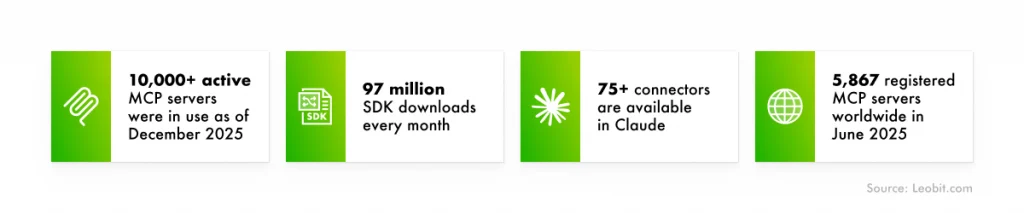
In just over a year, the Model Context Protocol went from a little-known acronym to a key part of AI infrastructure. By December 2025, more than 10,000 active MCP servers were in use, while monthly SDK downloads had surpassed 97 million. Few technical standards achieve that level of adoption so quickly.

The reason is simple: an AI agent is only as useful as the systems and data it can access. And enterprise adoption is accelerating. Gartner predicts that 40% of enterprise applications will include task-specific AI agents by the end of 2026, up from less than 5% in 2025. To work effectively, those agents need a reliable and consistent way to connect to the systems where business data and tools reside. MCP is designed to provide that connection.

This guide explains MCP in practical terms, including the integration challenges it solves, the business benefits it can deliver, the risks organizations need to manage, and the right way to approach adoption.

But let us start from the basics.
What is the Model Context Protocol (MCP)?

The Model Context Protocol, or MCP, is an open standard created and released by Anthropic, a US-based safety and research company, in November 2024. It allows AI assistants and agents to connect to external tools, data sources, and business systems through a single shared interface. In simple terms, MCP gives AI a common language for interacting with the software your organization already has in place or a new one being built to work with AI from the start.

One way to think about MCP is as a universal adapter. It is often described as the USB of AI, while Leobit engineers have compared it to the HTTP of the AI era: a shared context layer that enables models, tools, and data sources to exchange structured information in real time. Before MCP, each connection between an AI model and a business system typically required a separate custom integration. MCP replaces that fragmented approach with a standardized way for them to communicate.

MCP is no longer controlled by a single vendor. In December 2025, Anthropic donated the protocol to the Agentic AI Foundation under the Linux Foundation. OpenAI and Block joined as co-founders, while Google, Microsoft, AWS, Cloudflare, Bloomberg, and other major technology companies became supporting members. As a result, MCP is now developed as a vendor-neutral standard under open governance.

MCP in numbers
MCP in numbers

This broad support is already reflected in the available ecosystem. Claude alone offers more than 75 connectors, while the same MCP servers can work across other compatible platforms. Organizations can use it to build integrations without tying their AI infrastructure to a single provider or depending entirely on one vendor’s roadmap.

Why Does MCP Matter Now?

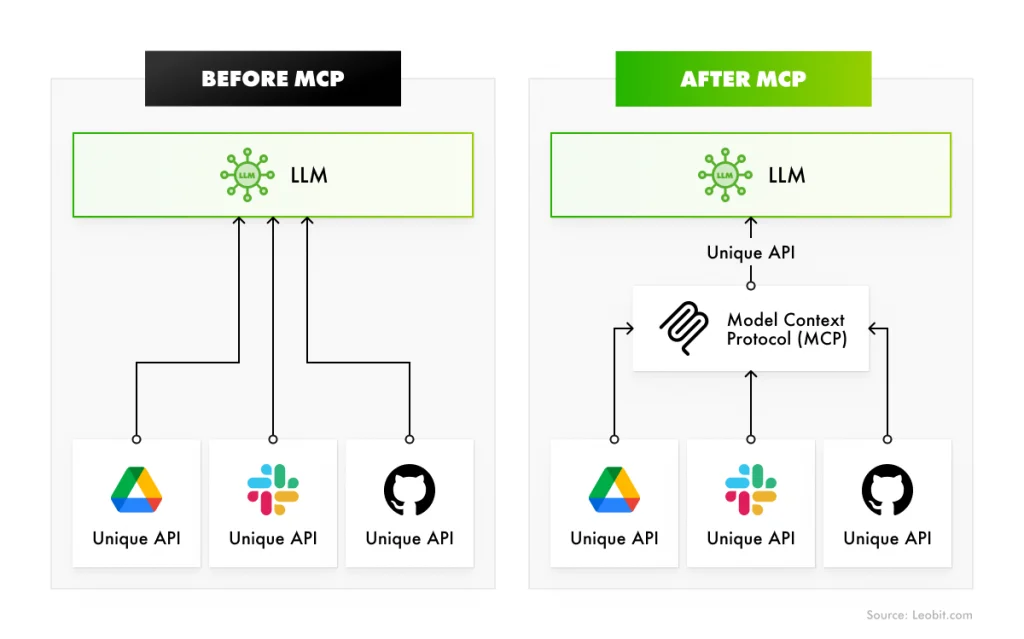
MCP matters because it simplifies the integration of AI models with business systems. Instead of an M×N integration problem, it creates a much simpler M+N model.

Here, M represents the number of AI models or tools you use, while N represents the systems they need to access. Without a shared standard, every model requires a separate integration with every system, so the number of connections grows exponentially. With MCP, each model and system only needs to support the protocol once, allowing integrations to be reused across the entire ecosystem.

Consider a company using five AI tools that need access to ten internal systems. A traditional approach could require up to 50 custom integrations, each of which must be built, tested, secured, and maintained separately. With MCP, the same setup requires five MCP clients and ten MCP servers, for a total of 15 reusable components. When the company adds an eleventh system, it only needs to connect that system once for all compatible AI agents to access it.

Before vs. After MCP

This difference directly affects enterprise AI costs. The model itself is rarely the most difficult or expensive part of implementation. Much of the effort goes into connecting it to live business data and keeping those integrations working as systems, APIs, and AI tools evolve. Every custom connection becomes another piece of code the organization must maintain. MCP replaces much of that repeated work with a common interface.

The timing also matters because the MCP ecosystem is expanding quickly. As of July 2026, the system can boast 53,542 servers worldwide, and adoption continues to grow. As more ready-made connectors become available, organizations can spend less time building integrations from scratch and move more quickly from an AI concept to a working solution.

How Does MCP Work?

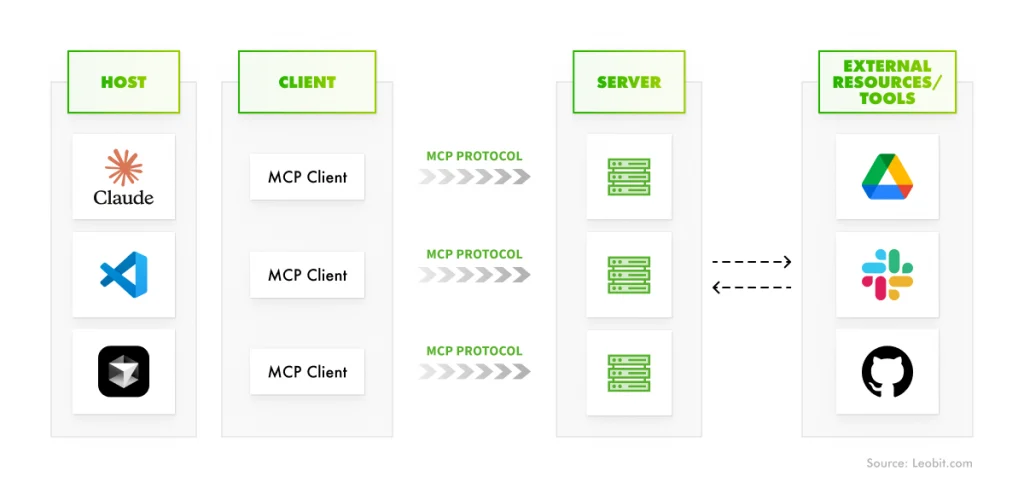
MCP works through three main components:

  • MCP host. It is the AI application your team interacts with, such as a chat assistant, coding tool, or internal AI agent.
  • MCP client. It is the component within that application that communicates using MCP.
  • One or more MCP servers. Each server connects the AI to a specific external tool, data source, or business system.

In practice, users rarely need to think about the client. From a business perspective, the host and servers are what matter most. The host is where employees perform their work, while the servers act as gateways to company systems. One server might connect to Slack, another to Google Drive, and another to an internal database.

How MCP works
How MCP works

When the AI needs information or must perform an action, the host sends a standardized request through the MCP client to the relevant server. The server accesses the connected system and returns structured information that the AI can understand and use.

A real-world example of this approach is Leonardo, an enterprise-grade workplace assistant that operates as a Slack bot and connects conversational AI with company data through an MCP-based architecture. This allows Leonardo to access systems such as Slack and Google Drive within the same conversation, providing employees with relevant information and responses in under three seconds.

An employee asks a question in plain language, and Leonardo identifies the relevant source, retrieves the necessary context, and provides an answer. There is no need to build a new integration for every question or workflow because the underlying systems are already available through standardized MCP connections.

 Book Icon

The difference between traditional integrations and MCP becomes clearer when the two approaches are compared directly:

Before MCP
With MCP

Integrations

A custom build for every model-and-tool pair

One shared interface that models and tools can reuse

When a system changes

Every related integration may need to be updated

Update the server once, and every connected agent benefits

Switching models

Connections often need to be rebuilt for the new model

Existing MCP connectors continue to work

Adding a new tool

Another custom integration must be created

Connect the tool once and make it available to every compatible agent

One of MCP’s most important advantages is that its servers are model-agnostic. The same Slack, Google Drive, or database server can work with hosts powered by Claude, GPT, Gemini, or another MCP-compatible model. Organizations can build a connection once and reuse it across different AI applications.

What Business Benefits Does MCP Deliver?

MCP reduces the cost and time required to connect AI to business systems. At the same time, it makes AI agents more capable, reusable, and portable across different models. The practical result is clear: organizations can build agents that work with real business data and perform useful tasks faster and at a lower cost.

This matters in a rapidly expanding market. IDC projects that global AI spending will reach $1.3 trillion by 2029, with more than one billion AI agents deployed worldwide by the same year. At that scale, agents will only deliver value if they can reliably access business systems and data. MCP provides a standard way to make those connections.

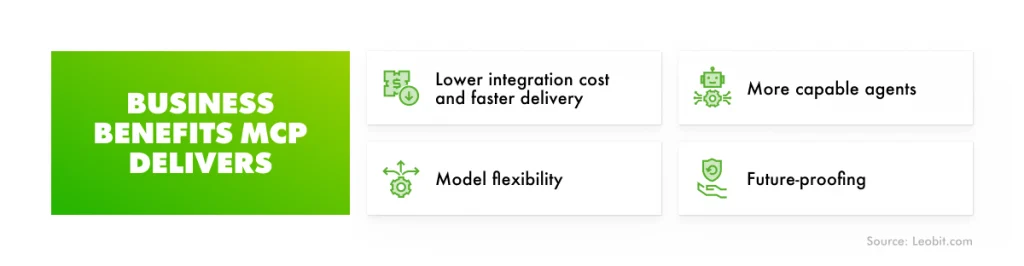
The main business benefits of MCP include:

Business benefits MCP delivers
  • Lower integration costs and faster delivery. Reusable MCP connectors reduce the need for one-off integrations. Development teams can spend less time building and maintaining technical connections and more time improving workflows and business outcomes. New agents can reuse existing connectors, shortening the path from an initial idea to a working solution.
  • More capable agents. Agents connected to live business systems can work with current data rather than relying on static or outdated information. This is what turns AI from a limited demonstration into a practical tool for everyday work. The potential returns are significant: 97% of business leaders report positive ROI from AI implementations, while AI can increase employee productivity by around 30%.
  • Greater model flexibility. MCP connectors are model-agnostic, allowing organizations to switch between or combine foundation models such as Claude, GPT, and Gemini without rebuilding their integrations. As models evolve, businesses can select the best option for each use case while preserving the integration work they have already completed.
  • Better long-term protection. MCP is a vendor-neutral standard governed under the Linux Foundation and supported by major AI and technology companies. This reduces the risk of investing in connectors that depend entirely on one vendor’s proprietary ecosystem or roadmap.

The common benefit is greater control. MCP enables organizations to build integration capabilities once and reuse them as models, tools, and business requirements change, rather than starting from scratch each time the technology evolves.

Yet, despite all the benefits MCP can bring, the protocol also has several shortcomings worth knowing.

What Are the Risks and Security Concerns of MCP?

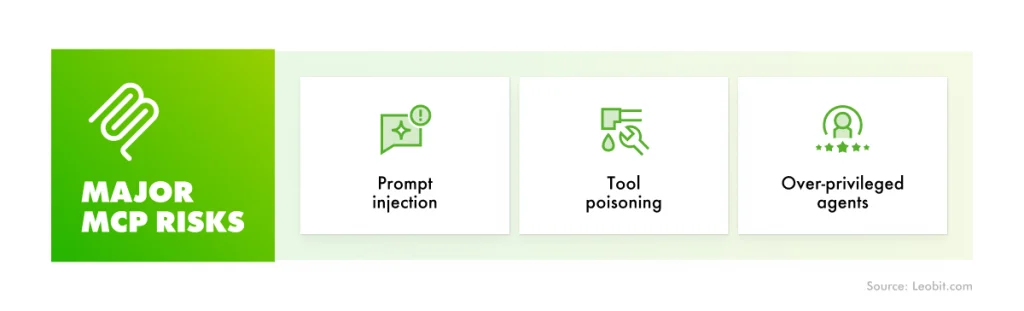
The main security risks associated with MCP are prompt injection, tool poisoning, and excessive agent permissions. Because an AI agent acts on the instructions and data it receives, a malicious server or carefully crafted input may manipulate it into exposing information or performing an unsafe action. The same access to live tools and data that makes MCP valuable also creates its largest security surface.

Three risks deserve particular attention:

Major MCP risks
Major MCP risks
  • Prompt injection. Attackers can embed malicious instructions in content that an agent processes, such as a support ticket, document, email, or web page. The model may interpret those instructions as legitimate and act on them. Security researcher Simon Willison identified this as a structural challenge for MCP in April 2025, and it remains one of the most widely discussed risks in the ecosystem.
  • Tool poisoning. Harmful instructions can be hidden inside a tool’s metadata or description. Because the model uses this information when deciding how to use the tool, a legitimate-looking connector may quietly influence the agent’s behavior or direct it toward unsafe actions.
  • Over-privileged agents. The potential damage caused by a compromised agent depends on the level of access it has. An agent with broad permissions may be able to read sensitive data, modify records, or trigger important workflows. A tightly scoped agent, by contrast, has a much smaller blast radius. The OWASP MCP Top 10 identifies excessive permissions as a foundational security risk.

These concerns do not make MCP inherently unsafe. They mean that security and governance must be built into its implementation from the start. Organizations should apply the principle of least privilege, giving each agent access only to the systems and actions required for its role. High-impact or irreversible actions should require human approval.

Third-party MCP servers should also be reviewed before they are connected to production systems. This includes assessing their code, ownership, permissions, update process, and data-handling practices. For remote connections, organizations should use strong authentication and authorization controls, including the OAuth 2.1 mechanisms supported by MCP.

The business stakes are significant. Gartner predicts that more than 40% of agentic AI projects will be canceled by the end of 2027 due to factors including unclear business value, rising costs, and inadequate risk controls. Strong governance can therefore determine whether an MCP initiative scales successfully or stalls before reaching production.

The practical takeaway is simple: treat MCP servers as production infrastructure. Apply the same security reviews, access controls, monitoring, and change-management processes used for any system that handles business data. With these safeguards in place, you can scale MCP-based solutions with greater confidence.

How Should You Adopt MCP?

The most effective way to adopt MCP is to treat it like any other new business capability: start with one high-value use case, connect a small number of trusted systems, validate both the benefits and the safeguards, and gradually expand. A company-wide rollout is not necessary to demonstrate value.

The market is already moving in this direction. Deloitte projects that 50% of companies using generative AI will launch agentic AI pilots by 2027. For many organizations, the question is no longer whether to explore AI agents, but how to connect them securely and effectively to business systems.

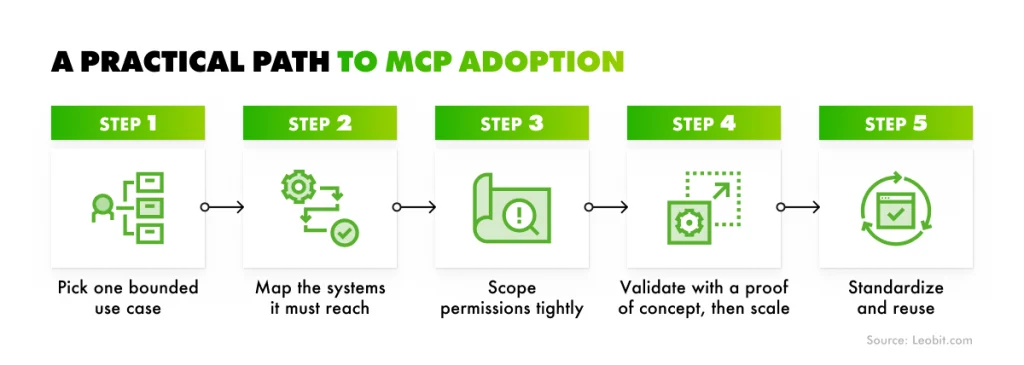
A practical adoption path includes five steps:

  • Choose one clearly defined use case. Start with a workflow where access to live data is essential, such as customer support triage, sales operations, or internal knowledge retrieval. A narrow scope makes the business value easier to measure and the risks easier to control.
  • Map the required systems. Identify the small set of tools and data sources the workflow depends on, then expose each one through an MCP server. Begin with systems your organization already trusts, manages, and understands.
  • Limit permissions from the start. Give the agent only the access required to complete its task. Any action that changes data, triggers a transaction, or communicates with a customer should include appropriate human review. Security controls are easier to implement at the beginning than to add later.
  • Validate the approach before scaling. Use a proof of concept to test both business value and security safeguards on a limited footprint. Leobit typically delivers an MCP proof of concept within four to eight weeks, followed by a production-ready solution in two to four months.
 Book Icon
  • Standardize and reuse successful connectors. Once the first MCP connections are in place, future agents can reuse them. This is where the M+N advantage begins to compound: every system connected once becomes available to the AI solutions you build next.
Step-by-step path to MCP adoption
Light Bulb Logo

Pro tip: Treat every third-party MCP server as software that may access sensitive business data. Before connecting it, verify who publishes and maintains it, what systems and permissions it requires, and whether its tool descriptions and updates can be authenticated. A brief review at this stage can significantly reduce the risk of tool poisoning later.

How Leobit Can Help You Adopt MCP

Leobit provides end-to-end development and integration of MCP-based AI agents, from identifying the right initial use case to delivering a secure, governed, production-ready solution. With more than six years of AI experience and over 40 agentic AI projects delivered, Leobit brings proven expertise to every stage of adoption.

The company has been recognized as a Top AI Code Generation Company by Clutch and continues to deepen its AI expertise through advanced certifications, including undergoing the Anthropic certification process and having Anthropic Claude Certified Architects.

Leobit has also tested MCP in its own products. Leonardo, the company’s enterprise workplace assistant, uses an MCP-based architecture to connect conversational AI with enterprise systems in real time. As a result, clients benefit from implementation patterns already proven in a live solution rather than approaches based only on theory.

 Book Icon

The technical approach is designed to preserve flexibility and control. Leobit works with MCP alongside frameworks such as LangChain and Semantic Kernel and supports foundation models, including Claude and GPT. This allows businesses to select the best model for each use case and change models later without rebuilding the underlying integrations.

Security and governance are built into the implementation process. Leobit is certified to ISO 9001:2015 and ISO 27001:2022 and applies principles such as least-privilege access, tightly scoped permissions, and human review for high-impact actions. The governance practices described earlier are therefore part of the delivery approach from the beginning.

Conclusion

MCP is quickly becoming the connective layer between AI models and the systems businesses rely on every day. Replacing fragile, one-off integrations with a shared, open standard can reduce integration complexity, lower long-term costs, and give organizations greater flexibility as AI models and platforms evolve. More importantly, it enables AI agents to work with real business data and take meaningful action across enterprise systems.

However, successful adoption requires more than connecting tools to a model. Organizations should begin with a focused, high-value use case and build security, access controls, human oversight, and governance into the solution from the outset. This is what turns a promising experiment into a reliable AI capability that can scale across the business.

Whether you are exploring your first AI agent or expanding an existing agentic ecosystem, Leobit can help you connect AI to your business systems securely, efficiently, and without unnecessary vendor lock-in.

FAQ

MCP, or the Model Context Protocol, is an open standard that lets AI assistants and agents connect to your tools, data, and business systems through one shared interface. It works like a universal adapter for AI, sometimes described as the USB-of AI or an HTTP of the AI era, so a model can reach the software your organization already uses without a separate custom integration for each one.

MCP was created by Anthropic and released in November 2024 as an open standard. In December 2025, Anthropic donated it to the Agentic AI Foundation under the Linux Foundation, with OpenAI and Block as co-founders and companies such as Google, Microsoft, and AWS as supporters. It is now developed as a vendor-neutral standard under open governance.

Not necessarily because MCP is model-agnostic. The same MCP servers work across different AI models, including Claude, GPT, and Gemini. They are also supported in a growing range of hosts such as Microsoft Copilot, Cursor, and VS Code, which means you can build a connection once and reuse it wherever your teams work.

A traditional API integration is a custom, point-to-point connection that you build and maintain for each pairing of a model and a system. MCP is a shared standard instead, so a single server can serve many models and tools at once. That is what turns the M×N integration problem into a much simpler M+N one.

Yes. Leobit has delivered more than 40 agentic AI projects over 6+ years of AI work and has applied MCP in its own products. Its Leonardo workplace assistant uses an MCP-based architecture to connect conversational AI with enterprise systems in real time, so clients benefit from implementation patterns already proven in a live solution.

Leobit has been recognized as a Top AI Code Generation Company by Clutch and is deepening its AI expertise through the Anthropic certification process, with Anthropic Claude Certified Architects on the team. For security and quality, the company is certified to ISO 9001:2015 and ISO 27001:2022.

Leobit provides end-to-end development and integration of MCP-based AI agents, from choosing the right first use case to delivering a secure, production-ready solution. The team works across frameworks such as LangChain and Semantic Kernel and models including Claude and GPT, so you can select the best model for each job while keeping security and governance built in from the start.