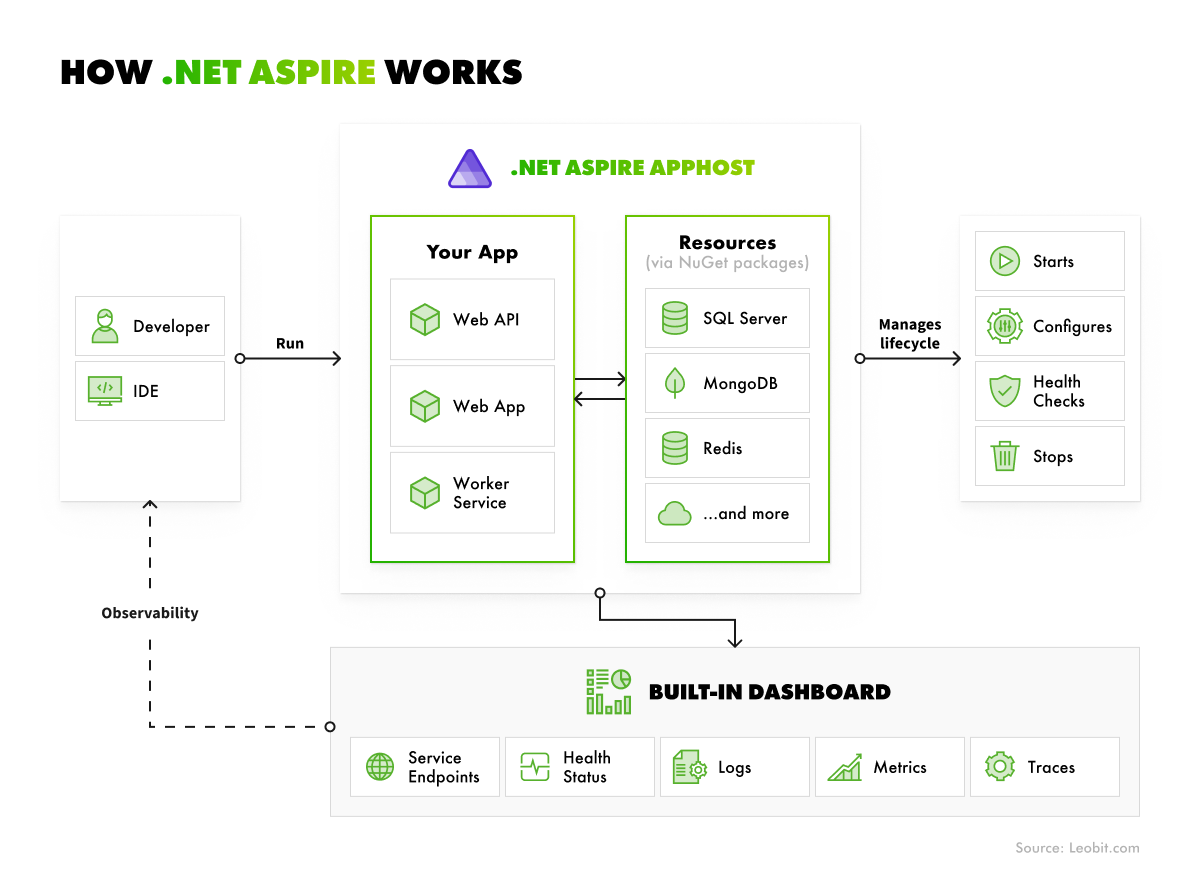
.NET Aspire helps businesses build manageable and flexible distributed architectures that can be deployed across both cloud and on-premises environments. Below are some of the key benefits of the .NET Aspire cloud-native stack.
Simplified local multi-service orchestration
A typical distributed .NET app might depend on an API service, a background worker, a Postgres database, a Redis cache, and a message queue. Without Aspire, running this locally usually means maintaining a Docker Compose file, keeping environment variables in sync across services, and manually starting dependencies in the right order.
Aspire’s AppHost replaces all that with a single C# project: developers define the services and their dependencies in code, then run one command to start the entire system. Adding a new service usually means adding a few lines to the AppHost project. Your specialists should typically reference the new project, define its dependencies, and set any required environment variables. There’s no need to manually edit YAML files, update port mappings, or troubleshoot container networking.
This makes multi-service orchestration easier and more straightforward for software engineers, enabling teams to manage increasingly complex infrastructures without unnecessary effort. It also allows companies to establish more efficient, cost-effective practices for managing cloud resources, which is especially important given that organizations waste over 27% of their cloud spend.
Built-in observability
Every Aspire project comes with OpenTelemetry-based tracing, structured logging, and health checks configured by default. The dashboard surfaces all of it in one place: a request that touches the API, then a queue, then a downstream worker shows up as a single connected trace. As a result, a software engineer can see exactly which service introduced a delay or threw an error.
For a business, it means a much faster incident response. By using Aspire’s dashboard, developers can save time spent grepping through separate log files for each service and manually reconstructing the timeline.
The business impact is significant. Companies lose an average of $300 million per year to unplanned outages, while a single major incident is associated with an average 3.4% drop in stock price. The faster teams can detect and resolve such issues, the lower the cost of downtime.
Faster onboarding for distributed systems
Around 44% of organizations say onboarding new developers to a project takes 2 or more months. This becomes even more challenging with distributed systems. Typically, a software engineer joining such a project has to reconcile outdated architecture diagrams with the actual codebase and figure out how several independent services communicate. The missing pieces often come from colleagues who have worked on the project longer or from trial and error.
Aspire’s dashboard considerably shortens and simplifies these processes. It surfaces every live service, its current health status, its dependencies, and real-time traffic in a single view, updated as the system runs. Rather than being told how the architecture fits together, a new engineer can observe it directly, tracing a request as it moves from an API through a queue to a downstream worker, in real time.
That shift, from documentation-dependent to directly observable, is what compresses onboarding time, accelerating the project and providing the engineering team with a reliable, self-documenting foundation.
Reduced boilerplate for common integrations
Wiring up something like Postgres or RabbitMQ from scratch usually involves writing connection string management, retry-and-backoff logic for transient failures, and a health-check endpoint for every service that touches that dependency.
This manual, repetitive work adds hours to developers’ workload, and mistakes or omissions in the process easily accumulate into tech debt, a major source of frustration among software engineers, according to Stack Overflow.
 Leobit