
Contact us

What Is a Forward Deployed Engineer and Why Your AI Project Needs One

Inna Fishchuk, Market Data Analyst

14 mins read

What Is a Forward Deployed Engineer?
Blog Calculator Widget Logo

Estimate Your Software Project Cost

Describe your idea — get a budget breakdown in minutes.

Get Your Estimate

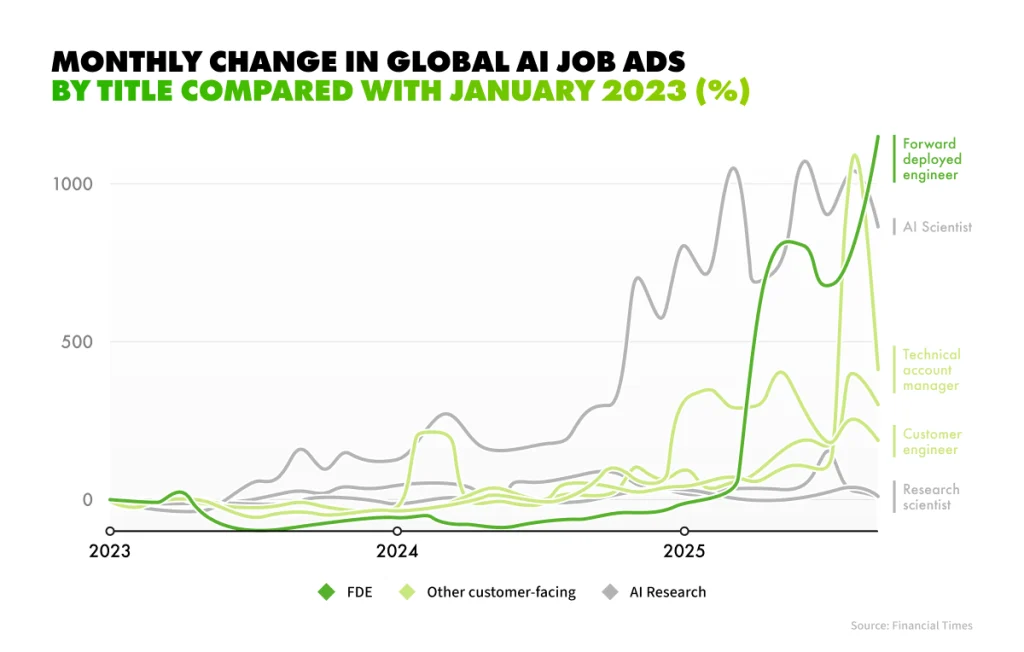
MIT’s State of AI in Business 2025 report shows that monthly job listings for forward deployed engineers increased by more than 800% this year, part of a broader shift toward customer-facing technical roles in AI and enterprise software. Companies are hiring for this role faster than for any other AI position.

The reason is simple. The same MIT research shows that the organizations capturing real value from AI share one habit: they treat integration into daily workflows as seriously as the technology itself. AI delivers returns when it is built around how your teams actually work, and that takes an engineer who sees those workflows from the inside.

So what is a forward deployed engineer (FDE)?

FDE is a software specialist embedded directly in your team who adapts AI systems to your real workflows and is measured on business outcomes rather than shipped tickets. For most companies, the practical question is how to bring in this expertise while frontier AI labs are competing for the same talent.

This article explains what a forward-deployed engineer actually does, how the role differs from a traditional software engineer, and how to tell whether this model fits your business.

What Is a Forward Deployed Engineer?

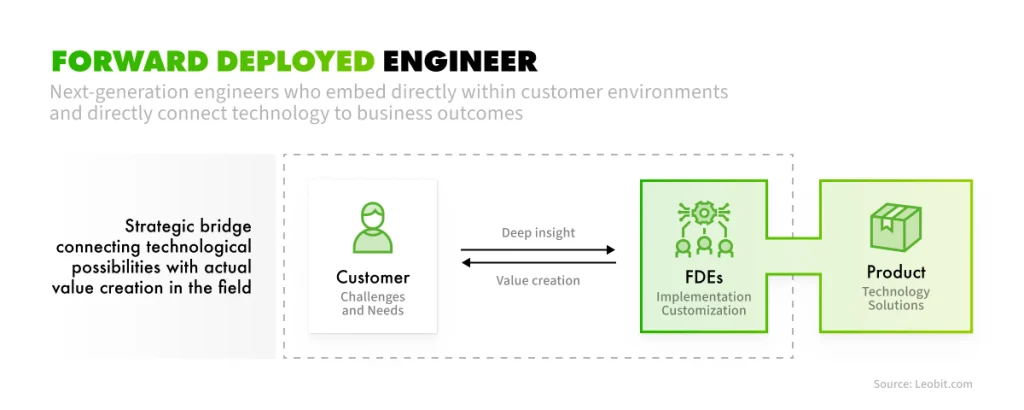
A forward deployed engineer role combines hands-on engineering with the responsibilities of a consultant. An FDE joins a company’s team, studies how its people actually work, builds and ships production software against the company’s systems and data, and carries responsibility for a business result. The title describes the position literally. The engineer is deployed forward, to the place where the software has to prove itself.

Forward deployed engineer explained

Palantir, a US software company that builds data analytics platforms for governments and large enterprises, created the role in the early 2010s. Its platforms had to work inside institutions with very different processes, from banks to defense agencies, so Palantir sent engineers to the customer instead of sending requirements back to headquarters. The model proved durable. Today Anthropic, OpenAI, and Salesforce all build dedicated FDE teams, and OpenAI’s forward deployed engineering group alone is expected to reach 50 engineers.

The role spread through enterprise AI for a practical reason. AI succeeds, or stalls, where a general-purpose model meets a specific business process, and that point sits inside your company, not inside the vendor’s office.

What does a forward deployed engineer do day to day?

A forward deployed engineer splits time between observing and building. In a typical week, an FDE:

  • Participates in your team’s meetings and sees how work actually gets done
  • Builds and ships production code against your systems, data, and constraints
  • Adapts AI models, agents, and integrations to your edge cases
  • Collects feedback from the people using the system and turns it into the next iteration

The defining trait is proximity. A traditional delivery setup passes requirements through layers of documentation. An embedded engineer compresses that loop to a conversation.

Forward Deployed Engineer vs. Software Engineer vs. Solutions Architect

The difference comes down to what each role is accountable for. A software engineer is accountable for working code, a solutions architect for a sound design, and a forward deployed engineer for a business outcome. All three write or shape software. Only the FDE owns what happens after it ships.

Software engineer
Solutions architect
Forward deployed engineer

Primary focus

Building features from a defined backlog

Designing the system and integration approach

Owning a business outcome end to end

Where they work

Product or vendor team

Mostly the design and pre-sales phase

Inside the client’s team and workflows

Success metric

Shipped, working code

An architecture the team can build on

A measurable business result

Main deliverable

Code and features

Design decisions and documentation

Working software, adopted in production

Contact with end users

Occasional

Limited

Daily

None of these roles replaces the others. A complex project needs all three. The FDE earns its place in situations where requirements cannot be fully specified upfront, because they live in the heads and habits of the people doing the work. AI projects are the clearest example of this. An analysis of 1,000 forward deployed engineer job postings found that companies consistently ask the role to combine production coding with direct, ongoing customer ownership, a pairing neither classic role covers.
This accountability for outcomes explains why demand for the role is growing fastest in AI and enterprise software. When a technology is new, powerful, and unfamiliar to most teams, the companies that benefit first are the ones that bring the expertise inside. So let’s take a look at the gains of embedding such a role.

Writing code is no longer the main bottleneck. The harder part is understanding which problem is worth solving and how to make the technology work within real business processes. That’s what makes forward deployed engineering different: it requires strong technical expertise, but also the business judgment to understand the client’s domain and decide what actually needs to be built.

Serhii Harntsarik

Serhii Harntsarik

SDO Director at Leobit

Why Are Companies Embedding Forward Deployed Engineers?

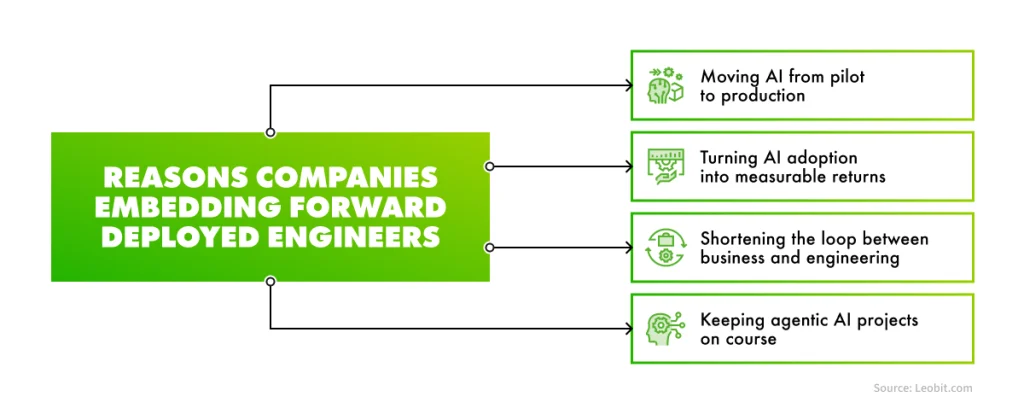
Companies embed forward deployed engineers because the model converts AI capability into measured business results. The pattern is consistent across industry research: value concentrates in organizations that integrate AI into real workflows, and the FDE is the role built to do exactly that.

Reasons companies embed FDEs

The benefits fall into four areas.

Moving AI from pilot to production

An embedded engineer gives an AI initiative what pilots usually lack: someone inside the workflow accountable for getting the system into daily use. Gartner found that about 30% of generative AI projects were abandoned after proof of concept, most often over unclear business value and data quality. Those are context problems, and context is precisely what an FDE works with. Teams define the business value alongside the people who own it , and the data issues surface in week one instead of month six.

Turning AI adoption into measurable returns

Adoption alone no longer differentiates anyone. McKinsey’s State of AI research shows that 78% of organizations already use AI in at least one business function, while only about a third have scaled it across the enterprise and 39% report an impact on EBIT. The companies in that last group did the integration work. An embedded engineer is the most direct way to join them, because the role’s success metric is the business result itself.

Shortening the loop between business and engineering

The same McKinsey research found that redesigning workflows is the practice most strongly associated with EBIT impact from generative AI. Workflow redesign requires someone who can see the workflow. An FDE attends the standups, watches where work slows down, and ships an improvement against it the same week. Requirements stop being documents and become conversations.

Keeping agentic AI projects on course

Agentic AI systems act inside live business processes, so they demand closer engineering attention than a chatbot pilot. Gartner projects that over 40% of agentic AI projects will be canceled by the end of 2027, mainly where costs and value drift apart. An embedded engineer keeps the agent’s scope tied to a concrete process and its performance visible to the people who depend on it, which is how successful projects stay on course.


These benefits are real, and so is the investment. Embedding an engineer is a deeper commitment than buying a tool or commissioning a feature, so it pays off where the conditions call for it. The practical question is how to recognize those conditions in your own company.

When Does a Business Need a Forward Deployed Engineer?

A forward deployed engineer fits when the success of an AI initiative depends on the context that lives inside the company: its workflows, its data, and the habits of the people who do the work. The clearer that dependency, the stronger the case for embedding. Four signs usually indicate it.

An AI pilot works in demos but has not reached daily use

This is the most common trigger. The prototype performs well in controlled conditions, stakeholders approve it, and then usage flattens because the tool does not quite match how the work actually flows. The gap between a promising prototype and an adopted tool comes down to integration. Closing it requires someone who sits with the people the tool is meant to serve, finds the friction, and reshapes the system around it. That is the FDE’s core job: turning business problems into AI solutions that run on the company’s data and within its systems.

The roadmap includes AI features the in-house team has not shipped before

Agents, RAG pipelines, and LLM integrations reward prior production experience. The difference between a working demo and a dependable feature hides in details such as evaluation, guardrails, cost control, and failure handling, and teams usually learn those details the slow way on their first project. An embedded specialist brings that experience in without a months-long hiring cycle, and the in-house team absorbs it by working side by side.

Workflows are too specific for off-the-shelf tools

Standard AI products cover standard processes. If operations include steps shaped by the industry, its regulations, or years of accumulated practice, packaged tools will keep almost fitting. Embedded engineering closes the distance between “almost working” and “actually working,” because the engineer builds against the real process instead of a generalized version of it.

The business needs AI results it can measure

If the goal is a number, such as processing time, cost per case, or conversion, someone has to be accountable for that number. A conventional delivery setup measures output in shipped features and leaves the business result to the client. The FDE model moves that accountability to the engineer, which changes what gets built and in what order. This is also why mature FDE engagements define success criteria and quality thresholds before development starts, as a separate phase of the process.

When a simpler setup is enough

Not every AI task needs an embedded engineer. A well-bounded integration of an AI API into an existing product, an internal tool with a narrow scope, or a one-off automation can be handled well by a conventional development team working from a clear specification. The FDE model earns its cost where ambiguity is high, and the outcome matters to the P&L. Where both are low, standard delivery is the economical choice.

Why FDE Talent Is Hard to Find

There are two routes to bringing forward deployed expertise into a team: recruiting in-house or partnering with a third-party vendor experienced in AI transformation. Both lead to the same working model. They differ in speed, cost of entry, and how much proven practice arrives on day one.

Recruiting in-house is a real option, and for companies planning years of continuous AI work, it can be the right long-term investment. It is also the harder path right now. Demand for the role grew more than 800% this year, frontier AI labs compete for the same candidates, and OpenAI’s forward deployed engineering group alone is expected to reach 50 engineers. Recruiting takes months, senior FDE compensation reflects the scarcity, and the first engagement still lands on an engineer who is new to embedded delivery in your specific domain.

Monthly change in global AI ads by title

This is why referring to an experienced third-party vendor is often the more practical route. A vendor that has already carried AI projects to production brings more than a person. They bring a tested delivery process, engineers who have seen the typical failure points, and a team behind the individual when the project needs an architect or a review engineer. The evidence supports this path. The MIT State of AI in Business 2025 report found that AI deployments built with specialized external partners reach production roughly twice as often as purely internal builds.

When evaluating a vendor for forward deployed engineering, the signals that matter are:

  • A production AI track record rather than demos
  • Certified engineers on current AI platforms
  • A delivery process with success criteria defined upfront
  • A genuinely embedded model where the engineer joins the client’s workflows instead of working from a separate backlog

The next section shows how Leobit structures exactly that.

How Leobit Delivers Forward Deployed Engineering

Leobit provides forward deployed AI engineers who work directly with client business and engineering teams to bring AI use cases into production. They start by understanding the business process, data, and existing systems, then build and integrate the solution within the client’s environment.

Depending on the use case, this can include AI agents that automate multi-step tasks, RAG assistants grounded in company knowledge, or LLM integrations with ERP, CRM, Microsoft 365, databases, and third-party APIs. Leobit also implements the evaluations, guardrails, and monitoring needed to keep AI outputs reliable after release.

This model is particularly useful when AI needs to become part of existing business processes rather than operate as a standalone tool. An engagement can start with a single forward deployed engineer working on one workflow or pilot, expand into a forward deployed team for larger initiatives, and grow into a dedicated team for long-term development and support.

Leobit has applied this approach across real-world AI projects, including an intelligent shipping orchestration platform that cut manual effort for a global logistics enterprise by nearly 64%, an AI-powered contract management solution on Azure that reduced contract review time for the client’s legal and compliance teams by up to 50%.

Throughout the engagement, clients retain control of their code, data, credentials, and intellectual property. Source code stays in the client’s repositories and credentials in their vaults, while Leobit delivers within ISO 27001:2022-certified practices and supports HIPAA, GDPR, and CCPA compliance requirements where applicable.

Conclusion

The forward deployed engineer exists because AI creates value at the point where it meets real work, and that point sits inside the company. The companies capturing measurable returns from AI are the ones that put engineering accountability there. The role’s growth is the market recognizing what the research keeps confirming: integration is what separates AI that people adopt from AI that only impresses in a demo.

For most businesses, the fastest way to apply this model is an embedded engagement with a partner that already runs it. Leobit’s forward deployed engineers work inside client teams, define success in business metrics before development starts, and carry AI solutions to production on the client’s own data and systems.

If there is an AI initiative on the roadmap, or a pilot waiting to reach daily use, get a consultation to assess where embedded engineering would create the most value in your delivery.

FAQ

A forward deployed engineer is a software engineer embedded in a client’s team who builds and ships AI solutions against the client’s real systems, data, and workflows, and is accountable for a measurable business outcome rather than a feature list.

A software engineer builds features from a defined backlog and is measured on shipped, working code. A forward deployed engineer works inside the client’s organization, shapes the requirements through direct observation, and is measured on the business result the software produces.

No. A consultant analyzes and recommends, while an FDE actually builds software. The FDE writes production code, stays through implementation, and remains accountable until the system is in daily use. Consulting skills are part of the job. The deliverable is working software.

In-house hiring carries senior AI engineering compensation plus a months-long recruiting cycle in a market where demand grew more than 800% in a year. Partnering with a vendor converts that into a predictable engagement cost that starts delivering within weeks, which is why many companies begin with an embedded vendor engineer and build internal capability in parallel.

Yes, when the model is embedded by design. A dedicated team that joins the client’s workflows, defines success criteria upfront, and owns business outcomes operates as a forward deployed team. Leobit offers this as a defined engagement format, from a single FDE to a full forward deployed team that can grow into a long-term dedicated team.