 Leobit
AI-Native QA Across the
Software Testing Life Cycle
Get broader test coverage and faster feedback from the same QA team. Our ISTQB-certified engineers use AI at every phase of the testing lifecycle and review each result before it reaches your project.
6-10x
faster time to accepted output in QA and testing
100%
of AI output reviewed by a QA engineer
30+
QA engineers with ISTQB and Anthropic certifications

Digital App & Innovation

ISTQB Platinum Partner
.our understanding
WHAT AI-NATIVE QA
MEANS AT LEOBIT
AI-native QA is the testing stage of the AI-native SDLC. AI takes over repetitive testing work: first drafts of test cases, checklists, test data, bug reports, and release reports. It also analyzes data from previous test cycles, selects and prioritizes tests, and points testing effort to the areas with the highest defect risks. QA engineers review and approve every output and spend the freed time on risk, exploratory testing, and complex scenarios.
One AI Kit for every QA engineer
Our QA team works from AI Guide documentation that covers every stage of the SDLC and STLC. It includes a prompt library, templates, and team guidelines, so every engineer on your project applies the same practices and quality standards.
A QA engineer reviews every AI output
AI prepares the draft, and a QA engineer reviews and approves it.
You see where AI is used
Clients see where and how AI is used in their project.
.what we offer
AI TESTING SERVICES WE PROVIDE
AI QA Assessment
We review your testing process, tools, and automation suite, identify the STLC phases where AI adds speed and coverage first, and agree on the KPIs to measure the result.
AI-Assisted Test Design
We generate test cases, checklists, BDD scenarios, boundary values, and negative scenarios from your requirements, user stories, or API specifications. A QA engineer reviews each case before it enters the test suite.
AI-Assisted Test Automation
We write automated tests in Playwright, Cypress, or Selenium from manual test steps and plain-language descriptions, set up self-healing locators, and analyze flaky tests.
AI Defect Triage and QA Reporting
With AI support, we accelerate Root Cause Analysis by quickly identifying and analyzing various types of issues, detect duplicates, group failures by root cause, and draft release reports and quality scorecards for your stakeholders.
Dedicated QA Team
Our QA engineers join your delivery team and work with the same AI Guide, prompt library, and templates.
.maturity
THE THREE LEVELS OF TEST AUTOMATION MATURITY
Our QA engineers join your delivery team and work with the same AI Guide, prompt library, and templates.

01 Manual testing
QA engineers design test cases by hand, update them after every code change, and create scenarios that reflect real user interactions.

02 Script-based automation
Automated tests follow a fixed script. The automation engineer defines every check, its logic, and its pass conditions. The tests need regular maintenance as the application changes.

03 AI-native testing
AI analyzes the DOM, element behavior, and previous runs. It adapts tests to UI and code changes, predicts where defects are likely, and suggests unstable tests or new scenarios. QA engineers make the decisions.
.comparison
TRADITIONAL VS. AI-NATIVE STLC IN A SPRINT
In a traditional 14-day sprint, QA waits for developer builds, and most testing is compressed into the days after code freeze. In an AI-native Software Testing Life Cycle (STLC), test cases are generated from user stories before developers finish the code. Validation runs continuously inside the sprint.

.the economics
HOW AI AFFECTS QA SPEED, COVERAGE, AND COST
AI increases the output of every QA engineer: more work done, broader coverage, and faster feedback within the same team.
For the business, this means shorter release cycles, faster feedback to developers, less routine QA effort per release, and consistent documentation that keeps team knowledge in the project.
Faster output
Test cases, checklists, test data, and reports start from an AI draft that the engineer refines. The largest gains are in test case design and reporting.
Broader coverage
AI suggests boundary values, negative scenarios, and edge cases that are easy to miss under time pressure.
Earlier defect detection
Requirements are checked for gaps and contradictions before development starts, when defects cost less to fix.
Less maintenance
Self-healing locators and flaky-test analysis reduce the time spent fixing automation.
Faster triage
Duplicate detection and failure clustering lead the team to root causes sooner.
More expert work
Freed capacity goes to exploratory, security, performance, and usability testing, where human judgment matters most.
.our expertise
AI ACROSS THE 7 PHASES OF THE SOFTWARE TESTING LIFE CYCLE

AI supports every phase of the STLC. QA engineers own the decisions in each of them.
- 1. Requirements analysis. Defects are caught before development starts
- 2. Test planning. More complete risk coverage
- 3. Test case design. Fewer missed scenarios and More coverage of edge cases
- 4. Test data and environment. Lower compliance risk
- 5. Execution and automation. Faster creation of automated test scenarios and lower maintenance effort
- 6. Defect management. Faster reporting and triage
- 7. Test closure and reporting. Less time on reporting
WHAT AI DOES AT EACH STLC PHASE

1. Requirements analysis
Reviews requirements and user stories for ambiguities, contradictions, and gaps; helps draft acceptance criteria

2. Test planning
Drafts test strategies and plans, supports risk analysis, estimates test effort from feature descriptions and historical data, and prepares risk-based test strategy documents for your review

3. Test case design
Generates test cases, checklists, boundary values, equivalence classes, and negative scenarios from user stories, BDD scenarios, or API specifications; finds duplicate or redundant cases in existing suites

4. Test data and environment
Produces privacy-safe synthetic test data and data-preparation scripts

5. Execution and automation
Generates Playwright, Cypress, or Selenium scripts from manual test steps, heals broken locators, analyzes flaky tests, and reviews scripts for anti-patterns

6. Defect management
Standardizes bug reports, classifies and prioritizes incoming reports, flags duplicates before they are logged, clusters failures by root cause, and suggests probable root causes from logs, stack traces, and test data

7. Test closure and reporting
Generates release reports and quality scorecards, tracks trends in defect density, pass rates, and coverage, flags release risk from the open defect profile, and supports retrospectives and knowledge bases
.roles
HOW DOES AI CHANGE THE QA ENGINEER'S WORK?
The QA engineer reviews and refines AI drafts instead of writing every test artifact from scratch. The engineer makes the decisions, and the time saved goes to exploratory, security, performance, and usability testing.
| Task | Without AI | With AI |
| Requirements review | Requirements are reviewed manually in Jira, and edge cases are easy to miss | AI runs a gap analysis and generates edge cases; the engineer validates them |
| Writing test cases | The engineer drafts every case from scratch | The engineer reviews and refines proposed cases, boundaries, and negative scenarios |
| Automation setup | Page Objects and boilerplate code are written by hand, and scripts need frequent maintenance | AI generates modular test code and predicts where scripts need refactoring |
| Bug reports | Reports are written and formatted by hand, and duplicates are found by searching | Drafts are standardized, duplicates flagged, and failures grouped by cause |
| Release reporting | Metrics are gathered and summarized manually | The report is drafted from the results; the engineer verifies it and adds context |
.measured
HOW MUCH FASTER IS QA IN AN AI-NATIVE SDLC?
In our AI-native SDLC, QA and testing tasks reach accepted output 6 to 10 times faster than in traditional delivery and 3 to 4 times faster than in AI-assisted delivery.
How we measured. Time to accepted output covers AI generation, human review, and rework, from task assignment to approved completion. We compared three approaches (traditional, AI-assisted, and AI-native) on the same models and identical acceptance criteria, with blinded grading. The gains concentrate on project-specific work. On routine generation, the result is on par with well-prompted AI, so the value comes from the system applied to the work where project context matters.
KPIs we track, before and after AI adoption:

Time per test case and per report

Requirements and test coverage

Defect detection rate and escaped defects

Automation growth and maintenance effort

Cost per release cycle
HOW WE ADOPT AI IN YOUR QA PROCESS
01
ADOPTION
QA engineers use AI assistants and LLMs in their daily work.

02
PROMPTING
The team masters agent frameworks for complex testing flows.
03
ORCHESTRATION
AI agents run connected quality loops across the testing workflow, and QA engineers approve the results.
.security
HOW DO WE KEEP YOUR DATA AND CODE SAFE WHEN AI IS USED IN TESTING?

HUMAN IN THE LOOP
A QA engineer reviews and approves every AI output.

DATA SECURITY
No client data or source code goes to public models. We use approved enterprise tools and follow NDA and compliance requirements.

HALLUCINATION CONTROL
Review checklists, traceability to requirements, and pilot validation help us catch errors in AI outputs.

TRANSPARENCY
You see where and how AI is used in your project.
.tools
AI AND TEST AUTOMATION TOOLS WE USE IN TESTING
We use approved enterprise AI tools and follow NDA and compliance requirements.

Test automation frameworks
- Playwright
- Cypress
- Selenium
- Mabl

CI/CD
- GitHub Actions
- Jenkins
.case studies
QA AND TEST AUTOMATION CASE STUDIES
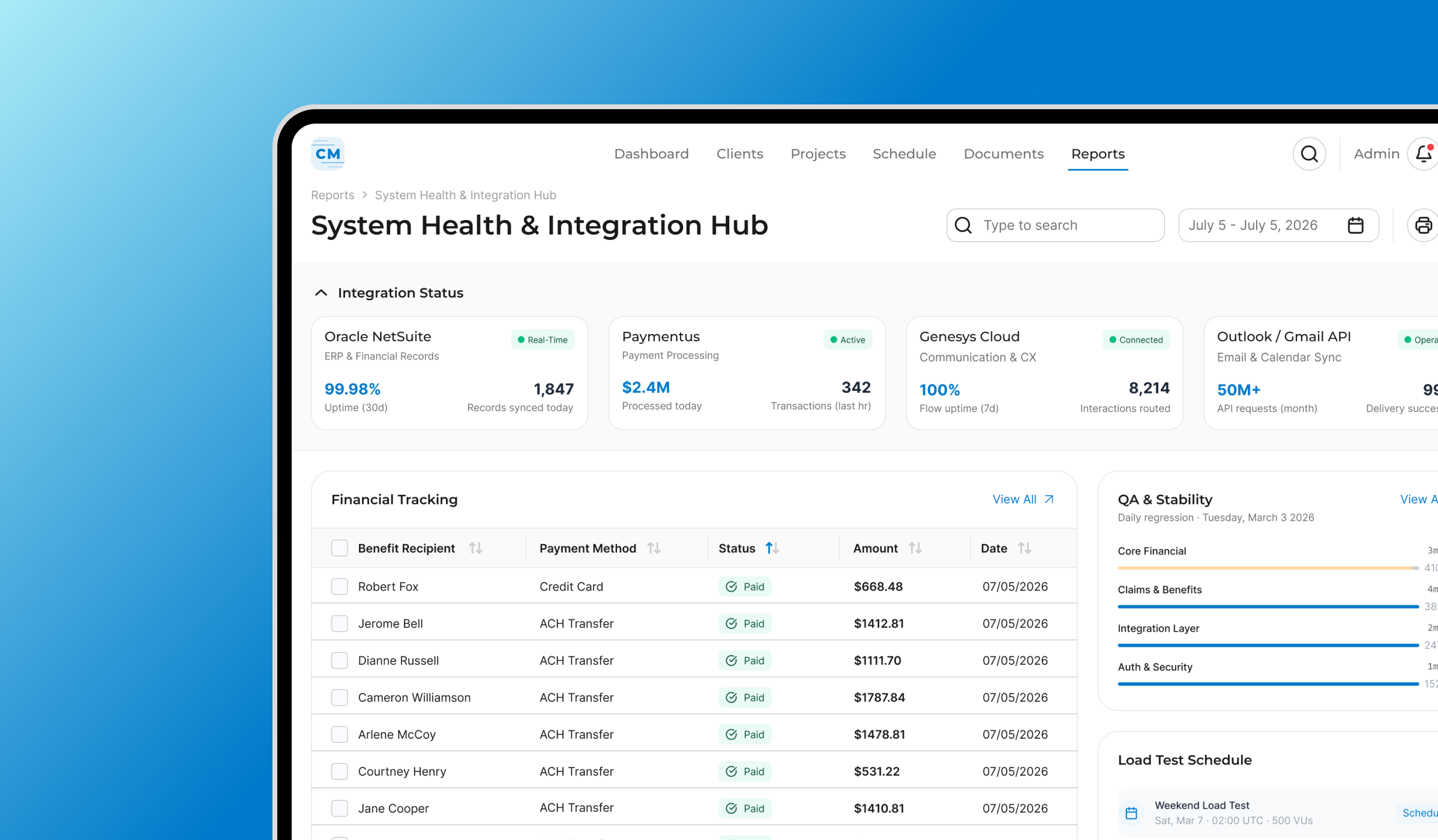
Disability Claims Insider Web Platform
QA services for a US insurance company’s live platform. Regression testing now takes 4 hours instead of 3 days.

Legal Case Management Platform
281 automated test scripts built in Mabl, a cloud-based intelligent test automation platform, and run on a nightly schedule. Automation removed 40+ hours of manual testing per cycle.

Next-Gen Platform for Franchise Industry
Automated and manual testing for a US startup’s digital advertising platform, with compatibility checks across devices and browsers.
.our leaders
OUR QUALITY ASSURANCE LEADERS

Andriy Zablotskyy
QMO Director

Vira Prysliak
Software Quality Control Engineer

Liudmyla Lozynska
Senior QA Engineer
.why us
WHY CHOOSE LEOBIT FOR AI TESTING
- ISTQB Platinum Partner
- 30+ QA engineers with ISTQB and Anthropic certifications, who combine classic QA discipline with practical AI skills
- Testing experience across web, mobile, desktop, and IoT/embedded software
- AI Guide, prompt library, templates, and team guidelines shared by the whole QA team
- Testing Center of Excellence: Quality Management Office (QMO)
- In-house lab with 60+ real smartphones and tablets
- ISO 9001:2015 and ISO 27001:2022 certified
- Coverage across different time zones with offices in Austin (US), London (UK), Lviv (Ukraine), Tallinn (Estonia), and Kraków (Poland)
AI TESTING FAQ
It is the sequence of QA activities in a project. At Leobit, it has seven phases: requirements analysis, test planning, test case design, test data and environment, execution and automation, defect management, and test closure.
The use of AI and machine learning to support testing: test case generation, risk identification, test selection and prioritization, and analysis of data from previous test cycles. It also supports self-healing automation scripts.
No. AI handles repetitive work, and engineers make the decisions. A QA engineer reviews and approves every output.
No client data or source code goes to public models. We use approved enterprise tools and follow NDA and compliance requirements.
Review checklists, traceability to requirements, and pilot validation are built into our process to help our specialists catch errors early.
