 Leobit
AI in
Law and
LegalTech
Legal work lives in documents, and so does the risk. Leobit brings AI to legal software development: tools that review contracts, answer questions using your own case files, and cite every source while preserving attorney-client privilege.
Since 2014
in legal software development


AI-certified engineers

Top Artificial Intelligence Award Winner

Top Generative AI Company

ISO 9001:2015

ISO 27001:2022

Gold Stevie Award 2026

Top 1000 Companies 2025
Top .NET Developer 2026
Top Generative AI Company

Global Business Tech Awards

Apps & Software

Digital & App Innovation
Data & AI

Platinum Partner

Artificial Intelligence
.what we do
Why Law Firms and LegalTech Companies Build on AI
Legal work is reading, drafting, and checking documents under privilege and a deadline. A general model can draft a clause or summarize a brief in seconds, which is exactly why using it without safeguards can be dangerous in this field. A tool that invents a case citation or misreads an indemnity clause does not save time. It creates liability.
Capability is no longer the hard part. Trust is. We build legal AI that answers questions using your own documents and case law, shows the passage it relied on, and routes anything bound for a court or a client through a lawyer first. The model is deployed privately, so privileged material never leaves your control or trains someone else’s system.
Leobit has built legal software since 2014, across case management, contracts, eDiscovery, and compliance. That experience helps us understand which tasks a model can handle independently, which it should assist with, and which should always remain under human control.

Grounded, not guessing
Every answer links back to the source passage.

Privilege-safe by default
Private Azure OpenAI deployment; your data never trains a public model

Human-in-the-loop
Nothing reaches a court or client without a lawyer’s sign-off

Legal domain
Case management, contracts, eDiscovery, and compliance

Microsoft-native security
Entra ID, SSO, AES-256 encryption, ISO 27001

Auditable by design
A searchable record of who saw what, when, and on what basis
.top use cases
Top 5 AI Use Cases
We Deliver for Legal Clients

Contract review and deviation detection
We build engines that compare an incoming contract against your approved templates, flag every clause that deviates from the approved standard, and explain the deviation in plain language. On one enterprise build, this cut legal and compliance review time by up to 50 percent.

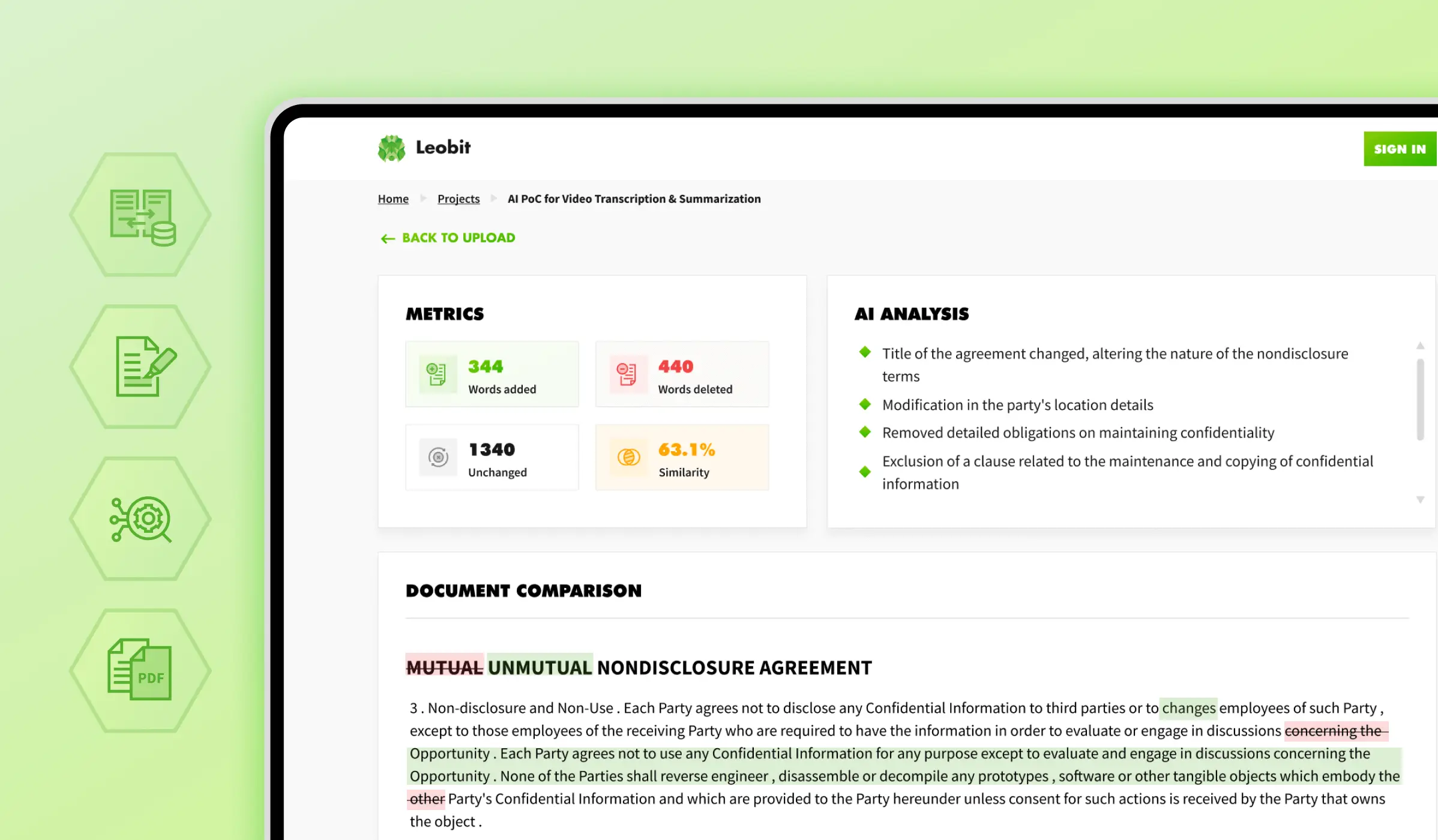
Document comparison and version analysis
Whether comparing two versions of a 90-page agreement, a regulation against last year’s text, a redline nobody trusts, our comparison tools parse each format, highlight changes word by word, and return a similarity score, so determining what actually changed takes seconds.

Legal research and knowledge retrieval
A research assistant grounded in your matter files and a verified case-law set answers questions and provides supporting citations.. If the source is not there, it says so rather than inventing one, which is the difference between a usable legal tool and a malpractice risk.

Drafting and document automation
We build drafting tools that assemble first drafts from clause libraries and matter data, then leave review and final judgment to the lawyer. The blank page disappears; the professional judgment stays where it belongs.

eDiscovery and review at scale
When a matter produces a million documents, manual review is the bottleneck. We build classification, prioritization, and PII redaction models that surface the relevant and potentially privileged material first and document every call for the record.
Have a workflow that eats billable hours?
Tell us the bottleneck. We will scope an AI proof of concept against your own documents.

.what we offer
AI Solutions We Build for Legal Software
The work typically falls into three areas: documents, knowledge behind them, and operations that keep a practice running. We build grounded, privilege-safe AI for each, and you can start with one area without committing to all three.

Contracts and documents
- Contract review and clause deviation detection
- Document comparison and change analysis
- Drafting and template automation
- eDiscovery and review acceleration

Knowledge and research
- Legal research assistants with cited answers
- Knowledge retrieval across firm and matter documents (RAG)
- Virtual legal assistants for client intake

Practice operations
- Case and matter management with AI summaries
- Compliance and obligation monitoring
- Smart time capture and billing support
.business impact
What Changes for the Practice
Law firm leaders tend to measure AI impact in billable hours and realization. Move the routine reading off the lawyer’s desk, and the numbers below start to shift:

Hours on document review

Research time per matter

Compliance exposure

Contract turnaround

Realization and write-offs

Error and oversight risk

Matter throughput
.our clients
Who We Build Legal AI For

Law firms
Caseloads keep growing, but the number of lawyers to handle them rarely does. The review, research, and drafting tools we build absorb the repetitive work, so associates spend more time on work that requires legal judgment.

LegalTech product companies
Your platform is judged on whether its AI can be trusted in front of a regulator. We build the grounded, citable, privilege-safe features that make that claim defensible, and ship them as part of your roadmap.

Alternative legal service providers and eDiscovery vendors
Review at volume is your product. We build the classification, prioritization, and redaction models that let a fixed team process far larger document volumes.

In-house legal and compliance teams
Corporate legal teams operate through contracts and obligations. We build contract review, intake, and monitoring that keep the business moving and the risk visible, as we did for a Swedish enterprise’s legal and compliance group.

Courts and public-sector legal
Case management in the justice system carries heavy information loads and real consequences. We build secure, accessible systems for prosecutors, defenders, and the people they serve, including dedicated victim portals.

Corporate procurement and contracts teams
Every vendor agreement is a small negotiation. We build clause- deviation and approval tools that let non-lawyers handle the routine and escalate only what needs a lawyer.
.our process
Cloud services
We provide

Discovery and consulting
We map your workflows, your document sources, and your confidentiality obligations before any model is chosen. Privilege, data residency, and bar-association ethics rules are treated as design inputs, not afterthoughts.

Solution and architecture design
We design a grounded architecture that prioritizes retrieval from verified sources over open-ended generation, and decide where a human sign-off is mandatory. Model choices follow from your data and your risk tolerance.

Data preparation and training
We structure contracts, matter files, and case-law sets into a clean, searchable knowledge base, and tune the system to cite rather than improvise. Sensitive data is encrypted from day one.

Integration and testing
We connect the tools to your DMS, practice management, and Microsoft 365 environment. Testing covers accuracy, hallucination rate, bias, and security, with a measured benchmark before anything goes live.

Compliance and ongoing assurance
Every model is checked against the rules that apply in your markets, including the EU AI Act and GDPR in Europe, and ABA guidance, state-bar requirements, and CCPA obligations in the United States, and your own professional-conduct duties. We deliver explainable outputs with source citations, monitor for drift, and keep an audit trail your risk committee can stand behind.
.integrations
Works With the Legal Tech You Already Use
Your firm already lives in a document management system, a practice platform, and Microsoft 365. The AI we build plugs into those, instead of asking anyone to learn a new place to work.

Practice and document management
- Clio
- iManage
- NetDocuments
- ClientRock

Documents and e-signature
- DocuSign
- OpenXML
- PDF tooling

Productivity and identity
- Microsoft 365
- SharePoint
- Teams
- Entra ID (SSO)

Research and review
- LexisNexis
- Everlaw
- ThoughtRiver

Billing and finance
- LawPay
- Intuit
.case studies
Legal and LegalTech Сase studies
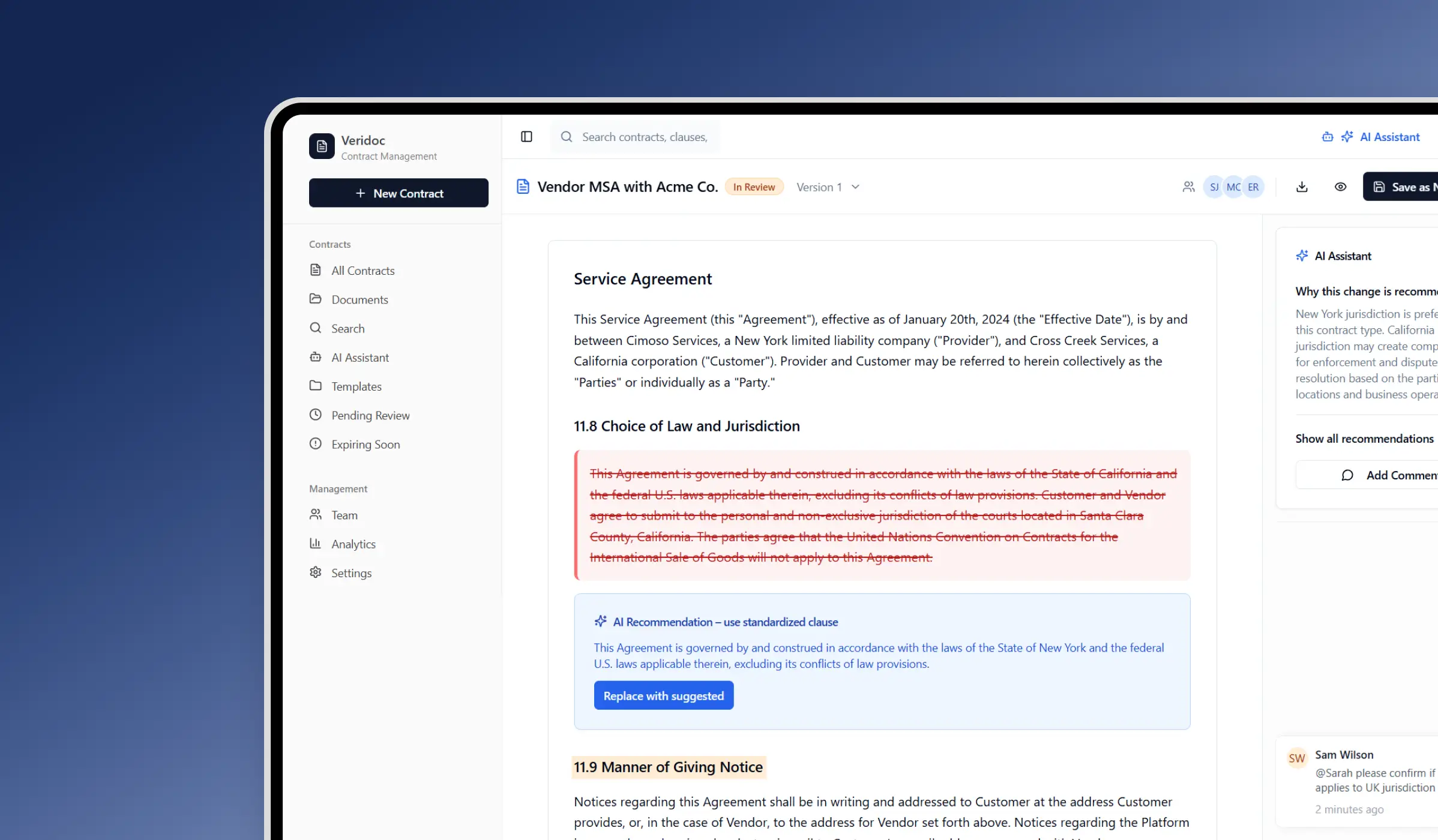
Custom web development that helped a Swedish enterprise reduce contract review time for its legal and compliance teams by up to 50%

Legacy system reengineering and modernization that helped a U.S. leading criminal case management provider achieve 54% user growth and expand its service to 600+ organizations
.tech stack
Legal Software
Tech Stack

.NET stack
- .NET Core / 10
- ASP.NET Core
- Blazor
- .NET MAUI
- EF Core

AI and ML
- Azure OpenAI
- Azure AI Document Intelligence
- NLP
- RAG
- Vector search

Cloud
- Azure
- AWS
- GCP
- AKS
- Serverless

Backend
- .NET Core
- Node.js
- Ruby
- PHP
- Python

Frontend
- Angular
- React
- Vue.js
- JavaScript
- TypeScript

Mobile
- Flutter
- Swift
- Kotlin
- iOS
- Android

Databases
- MS SQL
- PostgreSQL (pgvector)
- MongoDB
- CosmosDB
- SQLite

Security
- Entra ID
- SSO
- AES-256
- TLS
- ISO 27001 controls
.core ai solutions
Our Core Legal AI Solutions
All Solutions
Delivery Effort
Data Needs
Contract Review Engine
Compares contracts to golden templates and explains every clause deviation.
Document Comparison Tool
Parses any format and returns word-level changes with a similarity score.
Legal Research Assistant
Answers from verified sources with citations, and declines when the source is missing.
Knowledge Retrieval (RAG)
Grounded Q&A over firm and matter documents, with the passage shown.
Drafting Automation
Assembles first drafts from clause libraries and matter data for a lawyer to finalize.
eDiscovery Classifier
Prioritizes relevant and privileged documents and redacts PII at scale.
Compliance Monitor
Tracks obligations and flags deadlines and regulatory changes.
Virtual Legal Assistant
Handles intake and routine client questions, escalating anything
substantive.
Matter Summarizer
Produces cited summaries of long matter files and correspondence.
Billing and Time Capture
Drafts time entries from activity and supports realization review.
.why leobit
Why Leobit for Legal Software Development and AI
Leobit has shipped legal software since 2014. We treat trust as something engineered into the system, not a line buried in the terms of service.
- Legal software development since 2014, across case management, contracts, eDiscovery, and compliance
- Microsoft Solutions Partner for Digital and App Innovation and for Data and AI
- ISO 9001:2015 and ISO 27001:2022 certified
- Compliant with GDPR, CCPA, PCI DSS, and OWASP from day one
- 2025 awards: Silver Stevie Award, Global Tech Award for Artificial Intelligence, Clutch Top 1000 Global Service Provider, and Top .NET Developer
FAQ
It removes the manual load from high-volume document work such as contract review, legal research, and document classification, so legal teams spend their time on judgment rather than retrieval. The result is faster turnaround on routine matters and fewer missed details in large document sets.
Contract review, eDiscovery, and document automation. These are document-heavy, repeatable tasks where a well-scoped model reduces hours of manual reading and cuts the risk of human oversight on large volumes.
Through custom LLM development: model design, training, fine-tuning, and integration into existing legal software. Fine-tuning on a firm’s own documents and terminology is what makes the output usable in practice rather than generic.
Yes. AI features are built inside the same secure development lifecycle as the rest of the platform, with data encryption, multi-factor authentication, regular backups, and threat modeling. Solutions are developed in compliance with GDPR, CCPA, ISO 9001:2015, and ISO 27001:2022.
Yes. AI capabilities integrate with existing legal infrastructure and common tools such as Clio, DocuSign, LexisNexis, NetDocuments, ThoughtRiver, and Everlaw, so you extend current workflows instead of replacing them.
Your historical documents such as contracts, filings, and case records, plus the categories you want the model to recognize. If the data is unstructured or incomplete, a Proof of Concept is the right first step: it validates the use case on a limited scope before a full build.
No. It handles retrieval, first-pass review, and classification, while the legal professional keeps decision authority and sign-off. AI produces drafts and surfaces relevant material, and a person reviews and approves.
Contract review and analysis tools, virtual legal assistants for client interactions, document automation platforms, eDiscovery support, and legal research assistants, each configured to a firm’s practice area and document set.
Contract review and analysis tools, virtual legal assistants for client interactions, document automation platforms, eDiscovery support, and legal research assistants — each configured to a firm’s practice area and document set.
