Contact us

AI-Native Business Analysis: How Spec-Driven Development Sets the Foundation for Your Software Project

19 mins read

SDD
Blog Calculator Widget Logo

Estimate Your Software Project Cost

Describe your idea — get a budget breakdown in minutes.

Get Your Estimate

Google’s 2025 DORA report found that 90% of developers now use AI at work. The data on code quality is less encouraging. GitClear analyzed 623 million code changes from 2023 to 2026, the years AI coding agents went mainstream. Duplicated code blocks rose 81%, and error-masking constructs, which hide failures instead of surfacing them, rose 47%. Each duplicate is one more place where your next bug fix can miss a copy.

The quality of AI-generated code is bounded by the quality of the context the agent works from. When requirements live in a chat window, that context disappears the moment the session ends, and the next agent starts guessing again. Spec-driven development (SDD) fixes this, and it starts with AI-native business analysis (BA), which turns requirements into versioned artifacts that live in the repository alongside code and tests.

This article covers the core benefits of AI-native BA and spec-driven development, the technology frameworks behind them, and where they fit in an AI-native software development lifecycle.

What Is AI-Native BA and What Is Its Role in Spec-Driven Development?

AI-native BA is requirements work that ends in a versioned, repository-based specification, written for AI agents to execute.

The underlying job stays the same as in more traditional business analysis. BA specialists still run stakeholder interviews and define acceptance criteria with the client, then record them in the software requirements specification. But high-level descriptions no longer fit this approach. The systematic use of AI in business analysis sets two critical requirements for the specification:

  • Precision is the quality bar for an AI-native spec. If your requirement says “users should be able to export their data,” the agent decides the file formats and the permissions model for you. If it says “the system SHALL export the selected records as CSV, Excel, or PDF, and WHEN a user lacks read access to any selected record THEN the export fails with a permissions error naming the record,” the agent has nothing left to guess.
  • Specs are defined in a machine-readable format. Specs are written as properly structured Markdown, with headings and numbered requirements an agent can reference, because that is the format a model parses reliably.

Together, these two requirements change what a good spec looks like. Precision removes the guesswork, and structure makes it properly accessible for AI agents.

What is spec-driven development?

SDD is an approach in which AI agents build software from a versioned specification stored in the same Git repository as the code and tests. Software development agents use that file as a single source of truth: the architecture agent plans from the spec, and implementation agents build from the same file. Your tech lead validates feasibility before any of them starts.

So the BA sets the ceiling for everything downstream. A precise specification gives agents the context they need to accelerate development while maintaining quality. It also provides engineers with a clear baseline for review and validation, making the entire process more efficient and predictable.

 Book Icon

Where the spec lives and why that matters

The placement of your spec is crucial to this approach. The spec file goes into the same repository as the code and the tests.

Context stored alongside the code stays with the project. It remains available when a context window resets, a developer leaves, an agent switches models, or the project moves to a new team. Context kept only in a chat thread is much easier to lose. Once the session ends, the reasoning behind key requirements may disappear with it, leaving the next engineer with the code but little explanation of why it was built that way.

 Book Icon

How the business analyst role changes

The business analyst still works close to the client and still writes the requirements down. What changes is who reads them and how precisely.

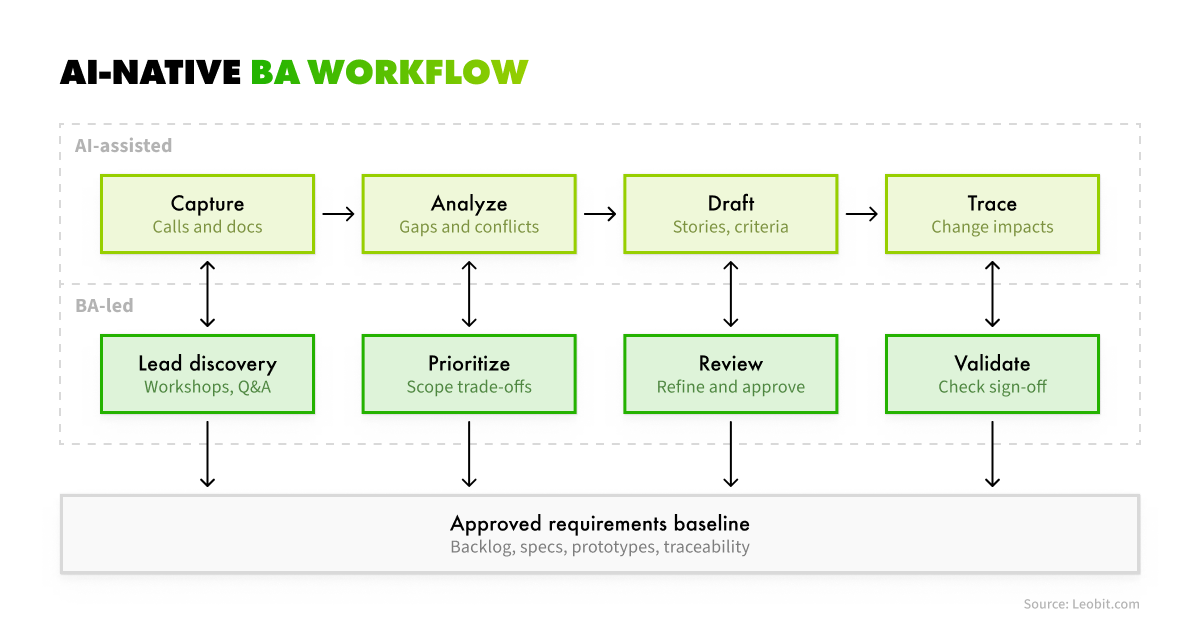
The BA writes requirements into the spec file. They can use AI for requirements gathering, such as pulling data from meeting recordings or customer files, but a human must thoroughly evaluate and organize that data. A solution architect assesses the technical feasibility of what’s specified, and the tech lead validates that assessment against the actual codebase. The architect feeds the specs to a planning agent, which turns them into an architecture blueprint for review. Implementation agents then write code from the same specs, and developers validate the result.

spec driven development examples
Responsibilities in the AI-native BA workflow

The BA deliverable used to be a document that someone read once before a kickoff. It is now a machine-executable context that every agent on the project reads on every run.

High-level descriptions do not carry a project anymore. I write requirements the way I would hand them to an engineer who can’t ask me a follow-up question, because that is exactly the position an AI agent is in. Every open point gets confirmed with the client and written into the spec in a format the agent can read. Skip that step and the agent fills the gaps on its own, which you pay for later in rework.

Iuliia Berezenko | BAO Director at Leobit

Iuliia Berezenko

BAO Director at Leobit

Spec-Driven Development vs. Vibe Coding: What Is the Difference?

Spec-driven development fundamentally differs from vibe coding, another common approach to software development involving AI agents.

For many teams, vibe coding becomes the baseline for developing an early prototype. It works well for demos, but it never has a requirements layer that can become the foundation for a solution that works and delivers real business value.

In vibe coding, the description of what the software is supposed to do exists only as long as the chat session, which is fine when the goal is to learn whether something is possible at all. It typically stops being fine the moment someone has to keep the result running.

 Book Icon

The table below explains the core differences between vibe coding and specification-driven development, helping you understand the best use cases for both approaches, as well as their limitations.

Vibe coding
Spec-driven development

Where requirements live

In the chat thread

In the repository, beside code and tests

Who can read them

Whoever ran the session

The whole team and every agent

Survives a context reset

No

Yes

Traceability

None

Requirement to commit

Onboarding an engineer

Re-explain from scratch

Point them at the spec

Review target

The generated code

The spec first, then the code against it

Where it fits

Prototypes, spikes, internal tooling

Production software that gets maintained

At scale, vibe coding costs you knowledge. Every solution stays inside a chat instead of becoming a reusable engineering asset. Patterns drift between sessions because no agent can see what the last one decided. Six months later, nobody can answer why something was built the way it was, including the person who built it.

In contrast, spec-driven development gives teams a quality foundation. It records every project requirement and organizes it in a defined hierarchy.

What Are the Benefits of Spec-Driven Development?

Spec-driven development raises first-pass acceptance of AI-generated code, because the agent works from written requirements instead of inferring them from a prompt.

The gains compound in five areas:

  • Speed measured as accepted output. Lines generated are misleading numbers. What matters is how much output survives review without rework. Across internal delivery metrics, Leobit’s AI-native SDLC delivers 3 to 10 times faster time to accepted output than traditional or ad hoc AI-assisted development.
  • Consistency across sessions and agents. Every agent reads the same specification, so the fourth feature follows the same patterns as the first.
  • Structure. A clear hierarchy of requirements that a human or a machine can navigate.
  • Traceability. You can follow a requirement from the client conversation to the spec to the commit that implemented it. In regulated industries like healthcare or fintech, this becomes a strong compliance benefit.
  • Organization that supports long-term growth. Every accepted solution becomes a reusable context for the next piece of work.

The economics shift accordingly. Ad hoc AI use has a low entry cost and a rising cost of ownership, because rework, maintenance, and security debt accumulate with every release. Spec-driven work moves investment to the start of the project and reduces the cost of every feature after it.

It’s important to note that the approach works for new greenfield projects and for ongoing ones that need updates or complete modernization.

How Does Spec-Driven Development Work on a New Project?

On a greenfield project, you create the repository and the specification tree at the same time, so every requirement enters the codebase as a structured file from day one.

The repository is organized from scratch so the agents can navigate it: a folder per domain area, with numbered requirements inside each file. All new requirements go into the spec files, never only into a ticket or a call. The architecture agent plans from those specs, and implementation agents build from the same source.

The discipline is simple to state and easy to break. Suppose you are building a multi-tenant real estate platform, where every property management company runs on one deployment with its own isolated data. Before any code exists, the repository already holds spec files for tenant provisioning, lease management, payments, and maintenance requests. Each file states what the feature does, and which data must never cross a tenant boundary. In week three, the client asks for late-fee rules on overdue rent, configurable per property management company. That requirement goes into the payments spec as a numbered item carrying the calculation, the grace period, and the scope it applies to. Your tech lead confirms feasibility against it, and the planning agent picks it up on the next run.

If that request had stayed in a meeting summary, the agents would have built one global fee rule. Nothing in the repository told them the rule belongs to a tenant. Your team would find out this issue during the second client onboarding.

How Does Spec-Driven Development Work on an Existing Codebase?

On an existing project, you write specifications over the current system, and every change after that is based on them.

Change requests and bug fixes are collected in the same spec files. When your tech lead receives a request, they validate the requirement and add it to the repository that defines the project context. No change enters the codebase outside the defined process.

Suppose you inherit a complex software solution, like a logistics shipment tracking platform, that has been in production for eight years. The documentation stopped matching reality somewhere around year three. The first pass writes specs over what the system actually does now, one file per module, including the rate calculation rules that exist only in the code and in the memory of the engineer who wrote them. That pass is the expensive part of the work, and you do it once.

This is where the delta model earns its place. A well-designed spec change describes only what you add, modify, or remove. The specification stays current instead of growing into a document nobody reads.

So when a carrier changes its fuel surcharge formula, the spec change runs a few lines: requirement 4.2 is replaced with the new formula, and the rule it supersedes is deleted. The implementation agent works from the updated file. The next agent to touch pricing reads the rule that is in force today.

Paste the new formula in as an extra section and leave requirement 4.2 sitting where it is, and the file now holds two pricing rules. The agent will follow one of them. You will not know which one until an invoice comes out wrong.

Which Spec-Driven Development Framework Should You Choose?

Teams typically use out-of-the-box frameworks for spec-driven development. These frameworks provide commands and workflows that spec-driven development AI agents use to create, read, and update specs. They also define how you should organize the requirements hierarchy within the spec file.

Three frameworks dominate the category: OpenSpec, GitHub Spec Kit, and BMAD-METHOD. All three are MIT-licensed and free to adopt.

OpenSpec
GitHub Spec Kit
BMAD-METHOD

Maintainer

Fission AI

GitHub

BMad Code, LLC

Core idea

Agree in writing on one change before coding it

Agent-neutral spec format plus project-wide rules

Full agile methodology run by specialized AI agents

Unit of work

Single change proposal

Feature, bug, or idea assessment

Product, planned then sharded into stories

Workflow

Explore, Propose, Apply, Archive

/speckit-specify, /speckit-plan, /speckit-implement, /speckit-converge

Clarify, Plan, Build and Verify, Learn and Adjust, looping back to Plan

Spec change model

Delta only: states what is added, modified, or removed

Full spec per feature

Full planning documents, then decomposed

Spec syntax

Plain Markdown scenarios, such as “The app SHALL… WHEN… THEN…”

Templated Markdown

Templated Markdown per agent role

Agent support

30+ tools

30+ agents via integration keys, including GitHub Copilot, Claude Code, and Codex

Claude Code and Codex plugin marketplaces

Ceremony

Low

Medium: fixed flow, flexible adherence

High: every change routes through multiple phases and agents

Token cost

Lowest: each change is a small delta proposal with few artifacts

Mid-range

Highest by a wide margin: each change passes through several agents

Best fit

Existing codebases and incremental work

New projects and teams that want shared rules

Large new products and regulated work that needs a decision trail

Weak spot

Needs high-reasoning models and clean context

More ceremony than a small change warrants

Too heavy for teams of two or three

Here’s a conclusion:

Choose OpenSpec if the codebase already exists and you want the lowest-friction way to stop an agent guessing. The delta format is the differentiator, because a change describes only what moves, so specs stay readable.

Choose GitHub Spec Kit if you are starting something new and several people need to follow the same standard. It is the only one of the three with first-party backing from a platform vendor, which matters for a tool your team still has to be using in two years.

Choose BMAD-METHOD if planning carries as much weight as agentic coding. It fits projects with a completely new product, an unclear problem, or a decision trail that must hold up to an audit. The BMAD-METHOD might be an inefficient choice for a simple bug fix that doesn’t require the framework’s planning complexity.

How to Start with Spec-Driven Development

You do not need to restructure your whole delivery process to find out whether this works for you. These are some crucial steps that will help you start with spec-driven development successfully:

  1. Pick one upcoming change to handle. A medium-sized feature with clear boundaries is ideal.
  2. Choose the framework that matches your codebase. Codebase maturity and complexity matter most, because they decide whether OpenSpec, Spec Kit, or BMAD-METHOD fits you best.
  3. Have the BA write the spec at implementation precision. After that, have the tech lead validate feasibility before any agent touches it.
  4. Commit the spec in the same pull request as the code. If the spec lands separately, it will drift.
  5. Review the gap between spec and result. When the output is wrong, tighten the spec rather than the prompt. Prompt fixes help once. Spec fixes help every time.
 Book Icon

Where Does Spec-Driven Development Fit in an AI-Native SDLC?

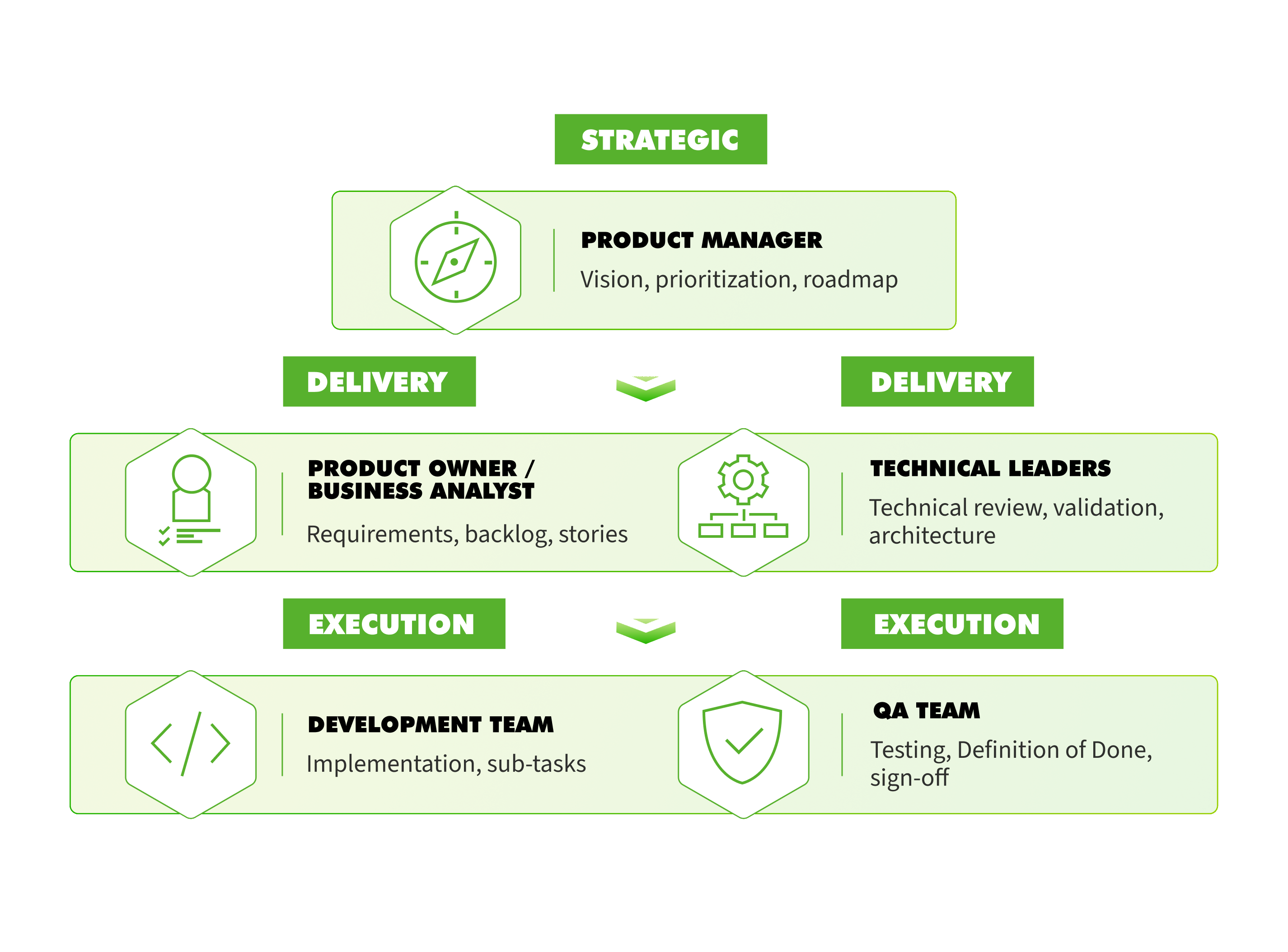
Spec-driven development is the context layer of an AI-native software development lifecycle. Without versioned specifications, everything built on top of it runs on guesswork. Clear specifications anchor a well-run project. The diagram below sets out the ownership structure.

specification-driven development
Ownership structure spec-driven development

In an AI-native SDLC, requirements, code, testing, and status reporting move through one governed system, where your repositories, architecture decisions, and documentation form a single shared project context. Of all the context an agent receives, the specs are the part it acts on directly. Other project materials provide background, while the specs supply the instructions.

The research points the same way. The Productivity-Reliability Paradox identifies specification-driven governance as the mechanism that lets AI-augmented teams keep their velocity gains without paying for them in reliability.

Theory alone does not make this approach work. To get the most from spec-driven development, you need a skilled team that has already applied an AI-native SDLC to their own delivery. That’s where Leobit can come in handy.

How Can Leobit Help You Adopt AI-Native BA and Spec-Driven Development?

Leobit builds the requirements layer your agents read on every run. Our AI-native business analysis and requirements management service defines ownership, communication lines, the backlog hierarchy, and the Definition of Ready. Then, our specialists configure AI skills to your project standards and connect them to Jira or Azure DevOps. A business analyst reviews every story before it enters the backlog. Our teams write stories about 12 times faster than by hand, with 2 to 3 times more acceptance criteria and edge cases.

Specifications govern one stage. Leobit’s AI-native SDLC applies the same governed approach across requirements, design, engineering, testing, release, and project management. Your source code stays in your repositories, and every AI-assisted change is recorded in Git history, which gives spec-driven work traceability from requirement to commit.

Across most of the projects, we recommend starting with a defined workflow or project rather than changing the entire delivery process at once. Leobit can configure and test the approach on a limited scope, measure its impact, refine the requirements and AI workflows, and then expand it across additional stages of the SDLC. We apply the same approach internally across our software projects, where AI-assisted story creation has reduced story-prep time while helping teams identify more acceptance criteria and edge cases.

Leobit uses a broad technology stack for spec-driven development, with particular focus on Microsoft-backed technologies. In particular, our company is a Microsoft Solutions Partner for Digital & App Innovation and for Data & AI. Earning and maintaining both designations required high Partner Capability Scores across Microsoft’s performance, skilling, and customer success categories. That track record shows we can build custom solutions on Microsoft services and deliver business value with AI and data. We also hold ISO 9001:2015 for quality management and ISO 27001:2022 for information security.

Final Thoughts

The teams getting clean output from AI agents are rarely the ones with the best prompts or the newest model. They got there because a business analyst wrote down what the system was supposed to do, with enough precision for an agent to execute, and put that file where the next agent would find it.

That puts business analysis at the center of AI-native development. Requirement precision and the discipline of recording every change as a delta both need an owner, because a specification that drifts out of date is worse than no specification. The agent follows it anyway.

Pick one upcoming feature and write the spec at implementation precision before any agent touches it, with your tech lead validating feasibility and the spec committed in the same pull request as the code. When the output comes back wrong, tighten the spec rather than the prompt. Teams that work this way spend more time on requirements than they used to, and less time rewriting what the agents produced.

If you need help setting up a requirements process your agents can work from, choosing the most fitting framework for spec-driven development, or adopting an AI-native SDLC across your delivery, Leobit can help. Contact us to discuss your needs and build the context layer before the code starts depending on it.

FAQ

Test-driven and behavior-driven development both start by writing a check the code must pass. Spec-driven development starts earlier, with the requirement itself written at implementation precision and stored in the repository. TDD verifies that the code does what the test says. BDD describes behavior in language the business side can read. Neither carries the full requirement or the reasoning behind it, which is the context an AI agent needs before it writes anything. The three work together: the spec defines what to build, and TDD or BDD verifies the result.

No. Your backlog keeps its user stories, and acceptance criteria stay where your team already reads them. What changes is the precision and the home of the authoritative version. AI acceptance criteria are written for execution, not interpretation. Each criterion names the trigger, the condition, and the expected result, in structured Markdown an agent can parse without guessing. The spec file in the repository holds that version, and the ticket links to it.

Partly, it can. AI works well on the gathering end: it pulls requirements from meeting recordings, support tickets, and existing documentation, then drafts them in a structured format. It cannot be the final author. A model cannot tell which stakeholder had the authority to decide, which constraint is negotiable, or what the client meant but never said. Your business analyst evaluates the draft, confirms every open point with the client, and commits the version the agents build from.

Yes. Leobit’s AI-native business analysis and requirements management service builds the specification layer your agents read on every run: ownership, backlog hierarchy, the Definition of Ready, and AI skills configured to your standards and connected to Jira or Azure DevOps. A business analyst reviews every story before it enters the backlog. We have introduced AI-native SDLC, where AI is systematically applied across all phases of the project, meaning that we have tested this approach on our own delivery first.