5 pm CET/ 10 am CST
Yurii Shunkin
Yurii Shunkin
Live Webinar "Prove It Before You Build It: AI Demos That Validate Business Ideas"
Contact us

Comparing Vibe Coding vs. AI-Augmented Software Engineering

19 mins read

Comparing Vibe Coding vs. AI-Augmented Software Engineering

Want a quick tech consultation?

Yurii Shunkin

Yurii Shunkin

R&D Director at Leobit

Contact Us

By 2028, 90% of enterprise software engineers will use AI code assistants, up from less than 14% in early 2024, according to Gartner. There are different approaches to AI-assisted coding, and vibe coding is a trending one. In fact, the valuation of vibe coding startups grew by 350% in 2025, highlighting surging demand for this approach.

But can vibe coding truly replace traditional custom software development practices that rely on more structured AI augmentation?

The short answer is no. There are many scenarios where vibe coding falls short compared to established development approaches.

In this article, we provide a comprehensive overview of vibe coding, compare it with a more traditional AI-augmented custom software development, and define the cases where it excels, as well as where it is not the right fit.

What Is Vibe Coding?

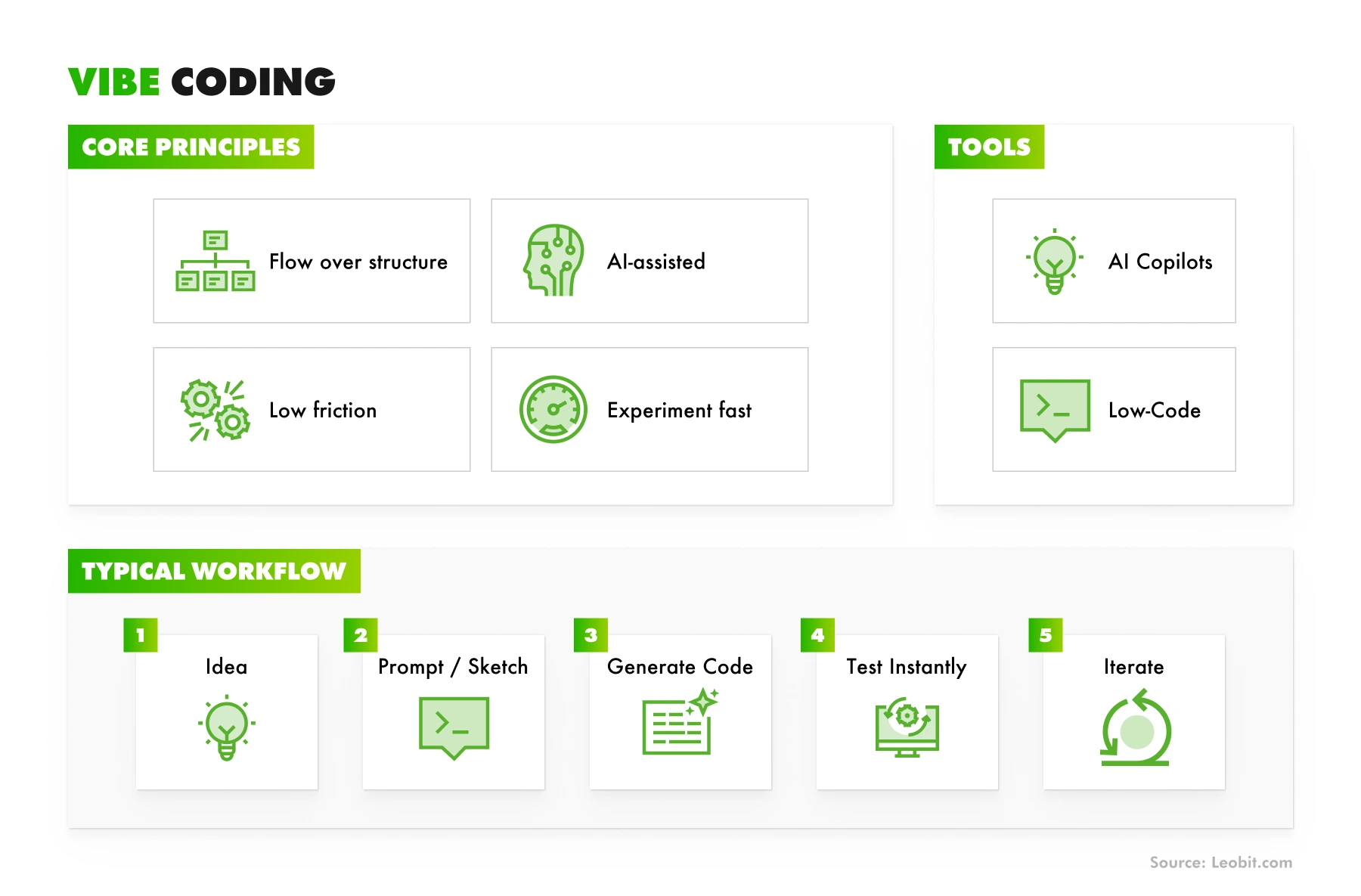
Vibe coding is an emerging approach to software development that prioritizes speed, intuition, and continuous iteration over rigid planning and predefined structure. Designed with simplicity and creativity in mind, it proposes that developers begin with an idea and rapidly translate it into working code. In this approach, the solution is refined in real time based on feedback, testing, and evolving requirements.

At the core of vibe coding is the flow where developers experiment freely and make incremental improvements rather than follow a strictly linear process. Therefore, vibe coding shifts development from a plan-first mindset to a build-and-discover process.

Like many modern software development approaches, vibe coding relies heavily on AI-powered code assistants such as GitHub Copilot and Claude Code to accelerate development. However, unlike traditional custom software engineering, which depends on structured practices and deep technical expertise, vibe coding emphasizes rapid, intuition-driven experimentation. In an ideal scenario, this approach allows people with limited technical backgrounds to quickly build small, functional applications using AI tools.

vibe coding vs traditional programming
Core principles of vibe coding

Last year witnessed the impressive boom in vibe coding, highlighted by multiple success stories of companies releasing AI-powered vibe coding platforms. For instance, Sweden’s Lovable achieved $130 million in ARR with a team of just 60 people, exceeding $2 million in revenue per employee.

However, by the end of 2025, the cracks in vibe coding started to crop up as early adopters of this approach moved past the prototype stage.

By 2026, the initial “honeymoon” phase appears to have ended, giving way to a more established understanding that it does not replace traditional engineering practices, but rather complements them. All because of certain pitfalls and limitations of vibe coding that become more relevant with growing project complexity.

What Are the Limitations of Vibe Coding?

Vibe coding can lower the barrier to software development, but it also introduces significant trade-offs. Quite often, rapid development with vibe coding translates into technical debt and other software inefficiencies that accumulate over time.

  • Code quality and maintainability. AI-generated code may be functional, but it is often messy and poorly structured. In rapid, improvisation-driven vibe coding workflows, developers may struggle to read or understand its logic, which creates significant maintenance challenges as the project grows.
  • Security vulnerabilities. Models routinely produce code with common weaknesses, like unsanitized inputs or exposed credentials, without flagging them as risks. Without thorough human oversight, this may introduce security risks.
  • Debugging difficulty. The logic of code generated by AI tools without the supervision of technical experts is often difficult to understand. When something breaks, developers often struggle with debugging AI-generated code.
  • Scalability ceiling. AI tools excel at small, self-contained tasks but struggle with large, interconnected systems where architectural decisions compound over time. In such cases, architectural planning and technical oversight, as well as workflows that are typically deprioritized in vibe coding, become essential.
  • Compounding errors. In coding, issues tend to accumulate and grow over time. A flawed early decision can quietly propagate through hundreds of subsequently AI-generated lines before anyone notices, contributing to a technical debt.
  • Context window limits. Models often lack a complete picture of your codebase, leading to code that conflicts with or duplicates what came before. Once again, thorough planning and oversight from technical specialists help solve these problems before they accumulate. But such factors are not prioritized in vibe coding.
  • Intellectual property and licensing risk. AI coding models trained on open-source corpora may reproduce code carrying copyleft or attribution-required licenses, such as GPL or LGPL, without any indication to developers. This creates additional liability risks, as the copyright status of AI-generated code remains legally unsettled in most jurisdictions. This means that companies in regulated industries cannot rely on vibe coding’s output without formal legal review and software composition analysis.

Over-reliance on AI-assisted development often leads companies to significant problems, given the fact that such solutions are still far from being flawless. In particular, the StackOverflow research on bugs in AI coding reveals that artificial intelligence created 1.7 times as many bugs as humans.

This does not imply that software development teams should avoid AI assistants in software development. Rather, these tools should be adopted in a controlled and intentional manner that mitigates the risks of AI-generated code.

How Can You Mitigate the Core Challenges of Vibe Coding

Experienced software developers apply certain practices to maximize the quality of outputs provided by AI coding assistants. These are the ones we suggest applying based on our hands-on expertise at Leobit.

  • Prioritizing input quality. The quality of the prompt is vital for getting efficient AI outputs. By investing time in defining precise instructions, software engineers reduce the number of coding iterations and improve the final output.
  • Introducing a mandatory planning phase. Before using an AI assistant, the specialists should request that it outline a detailed plan for task completion. By reviewing this plan, they can identify inaccuracies or redundant steps before the tool proceeds with execution.
  • Defining the concept internally first. Another useful practice for vibe coding prompt engineering is to provide the AI tool with foundational context about the solution’s concept. This leads to more accurate and relevant results than relying on generic prompts.
  • Minimizing output volume. Concise, high-value AI outputs should be prioritized over large volumes of generated text or code. For instance, in test coverage, specialists should focus strictly on core scenarios that require validation rather than request exhaustive, low-value test suites.
  • Focusing on context and session management. To get the most relevant outputs, developers should declare current library versions and add documentation from official websites as context. Another important practice involves creating new chat sessions for unrelated tasks, which helps prevent context degradation.
  • Choosing appropriate models for different tasks. We suggest using advanced, higher-capacity models for initial planning and architecture. Meanwhile, routine tasks, such as bug fixing or writing code based on an established plan, can be handled by standard generative AI models.
 Book Icon

With the right approach involving thorough planning and rigorous output verification processes, AI code generation tools can be effectively integrated into development workflows. However, this approach may reduce the speed and fluidity characteristic of vibe coding. It is more aligned with a traditional approach known as AI-augmented software development.

What is AI-Augmented Development?

AI-augmented software development is an approach where developers use artificial intelligence to support software engineering processes, while maintaining full human control over the critical workflows. This particularly involves architecture and design decisions, enforcement of coding standards, and system validation. Rather than replacing developers, AI acts as a collaborative assistant.

One of the key benefits of such an approach is the acceleration of routine tasks such as boilerplate code generation, documentation, refactoring, and test case development. In fact, the use of agentic AI can increase employee productivity in the technology sector by 45%.

 Book Icon

A key characteristic of AI-augmented software engineering is its focus on long-term quality. Code is not produced purely for speed or experimentation, but within a disciplined framework where each step is properly organized and reviewed. AI supports these processes, but does not replace them. Therefore, AI-augmented development is a balanced evolution of traditional software development practices rather than a complete reinvention.

Vibe Coding vs. AI-Augmented Software Development: An Ultimate Comparison

Let’s take a closer look at how vibe coding performs against a more traditional AI-augmented software development across the most critical areas.

Development speed

Rapid development is one of the most notable advantages of vibe coding. In fact, this approach largely relies on AI solutions, with 80% of employees reporting that such technologies increase their productivity. The use of artificial intelligence minimizes manual mapping, while real-time, dialogic engagement with AI fosters a seamless development rhythm. As a result, developers can go from idea to working prototype in hours.

AI-augmented development is typically a more time-consuming approach than vibe coding. Still, it can deliver solid speed while adding discipline. Experienced developers using AI as a force multiplier, for boilerplate, scaffolding, and research, move nearly as fast, but retain architectural control. Structured workflows like requirements gathering and code reviews add some overhead, but it usually pays off, especially in larger and more complex projects. In particular, such upfront effort prevents the costly rework that rapid vibe-coded projects eventually demand.

Therefore, vibe coding app development may offer short-term speed advantages. However, in the long run, particularly in larger projects with greater architectural complexity, these gains can be offset by the need to fix, optimize, and maintain vibe-coded components. That’s where AI-augmented development gains an edge.

Software quality and maintenance

Vibe-coded outputs tend to show decent quality, especially for simple tasks. However, they often lack coherent structure across a full codebase. Functions can be duplicated, and naming conventions can drift, ultimately contributing to a growing technical debt. Once the software breaks, fixing and debugging such a poorly-organized architecture can become a significant problem. Developers often struggle to understand the AI-generated code and logic. Maintenance burden grows with every feature added without a coherent plan.

Code written by experienced software engineers assisted by AI tools typically demonstrates higher quality when it is guided by clear standards, peer reviews, a well-defined architecture, and comprehensive test coverage. In contrast, code produced using vibe coding practices is generally less consistent and reliable. While such an approach is more time-consuming, it often involves documentation of each step and clear architecture mapping. Because software engineers know what they ship, debugging and maintenance remain tractable even as the codebase grows. AI handles the repetitive; humans own the structure.

In sum, AI-augmented development gets a clear edge over vibe coding in terms of software quality and long-term maintainability. This difference is conceptual, as vibe coding typically trades long-term stability for short-term speed.

Development cost

Vibe coding looks cheaper upfront. AI tools typically cost a fraction of a senior developer’s salary. In addition, vibe coding practices often involve small teams, sometimes even without deep technical expertise, shipping features that once required entire engineering departments. However, vibe-coded projects tend to accumulate hidden costs in refactoring, bug fixes, and eventual rewrites. For instance, in 2024, companies allocated 15% of their IT budgets to mitigating technical debt, a problem that often arises from development shortcuts.

AI-augmented software engineering carries moderate upfront costs. You pay for skilled developers, tooling, and proper process, but these are increasingly offset by the productivity gains AI brings to the team. While AI-augmented development is typically more expensive than vibe coding in the short term, its long-term efficiency and reliability can make it more cost-effective. This is particularly relevant to larger and more complex projects.

Overall, the cost-effectiveness of vibe coding depends heavily on the project type and long-term objectives. For complex, scalable, or long-lived systems, the structured codebase, clear architecture, and maintainability of AI-augmented development typically result in lower total cost of ownership over time.

Security and compliance

Vibe coding can introduce real risk because AI models often generate plausible code, not safe code. In fact, 40% of business executives cite security concerns as one of the major obstacles to AI adoption. Common vulnerabilities like SQL injection, improper authentication, and insecure data handling can slip through unnoticed. Such AI coding security risks may become a serious liability for any product handling sensitive data or operating in a regulated industry.

Meanwhile, when done well, AI-augmented development bakes security in from the start. Developers treat AI-generated code as untrusted input by default. They typically review the codebase through the lens of threat modeling, running security audits, and applying compliance frameworks just as they would for hand-written code. AI can assist here, as it is often used to help engineers identify vulnerabilities or generate test cases.

 Book Icon

AI-augmented software engineering has a significant security advantage over vibe coding. In fact, in projects dealing with sensitive or private data, vibe coding requires significant additional oversight that contradicts the key principles of this approach.

Let’s summarize the findings of this chapter in the table that compares vibe coding and AI-augmented software development.

Vibe Coding
AI-Augmented Development

Approach

Describe intent in natural language; accept AI output with minimal review

AI assists at every stage; engineers review, validate, and own all decisions

Development speed

Fastest early on; slows as complexity and technical debt accumulate

Slightly slower upfront; consistent pace maintained as the project evolves

Code quality

Duplicated functions, drifting conventions, growing technical debt

Clear architecture, peer review, documentation, and test coverage

Cost

Low upfront; hidden costs from refactoring, bug fixes, and rewrites accumulate over time

Moderate upfront; lower total cost of ownership for complex, long-lived systems

Security

Vulnerabilities like SQL injection or broken auth can slip through unnoticed

Threat modeling, audits, and compliance frameworks applied from the start

Maintainability

Difficult; developers often can’t reason about or debug AI-generated logic

High; engineers own every decision, making debugging and iteration tractable

 Book Icon

When to Choose Vibe Coding for Your Project?

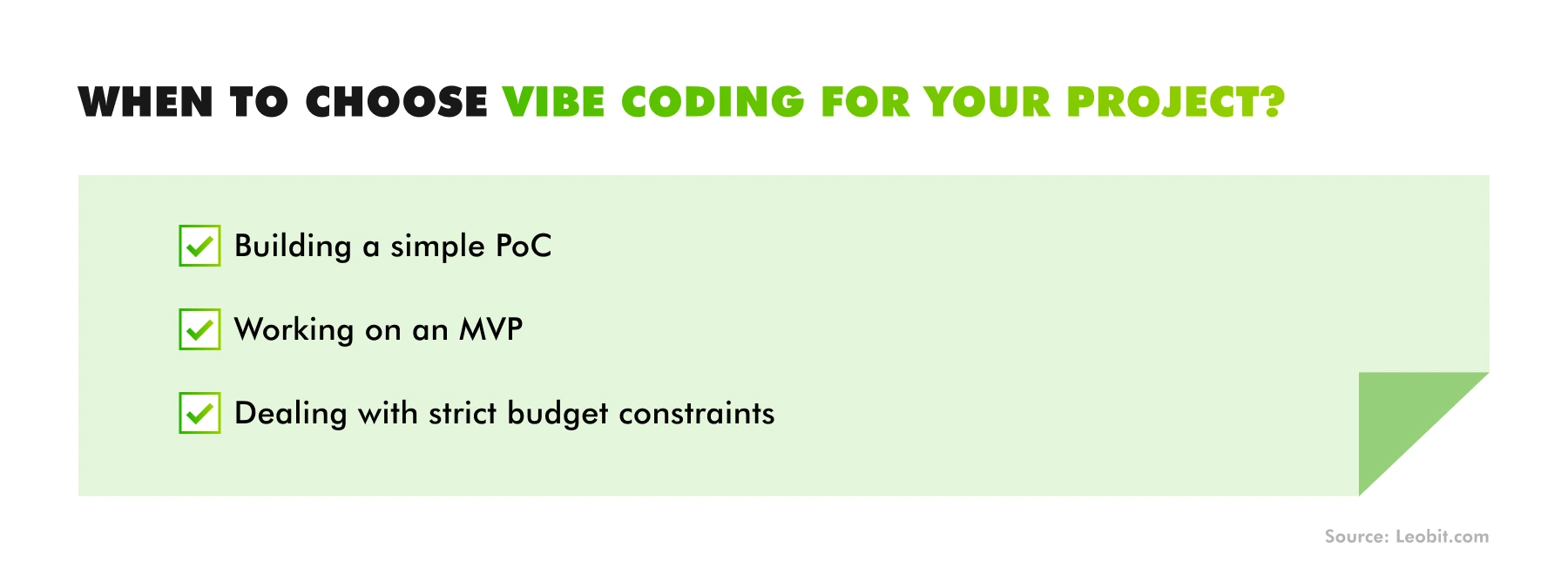
Despite its many drawbacks, vibe coding can be effective in certain scenarios where speed and cost-effectiveness are especially vital.

vibe coding vs traditional coding differences
Optimal vibe coding use cases

Let’s explore optimal use cases for this approach in more detail.

Building a simple proof of concept

A proof of concept (PoC) is typically built to answer one main question: Does this idea work? Vibe coding is a natural fit for some PoC projects because it allows development teams to spin up a functional demo in hours. Software engineers test the core assumption and can proceed with optimizing the code if everything works, or discard the code entirely if it does not. Therefore, if the project doesn’t need clean architecture of long-term maintainability and the entire goal is to learn fast and move on, vibe coding can fit.

Working on an MVP

When development speed matters more than long-term app stability and maintenance, vibe coding can offer early-stage teams a real advantage. With vibe coding tools and practices, even a small team can ship a working product, gather user feedback, attract investors, and iterate quickly. Optimally, such an MVP should be genuinely minimal, and there should be a plan to rebuild or refactor once traction is proven.

 Book Icon

Dealing with strict budget constraints

Sometimes, project budgets are so constrained that hiring experienced engineers and running a complete development cycle becomes difficult. In such cases, vibe coding allows bootstrapped founders, solo builders, and small teams to achieve outcomes beyond their typical resource capacity.

When the alternative is not building at all, rapid and cost-effective development with AI tools can become an option, especially for short-term or smaller apps. However, if the product evolves and scales, teams will need to address architectural inefficiencies introduced by vibe coding and invest in a comprehensive software modernization.

 Book Icon

When Is It Better to Choose AI-Augmented Software Development?

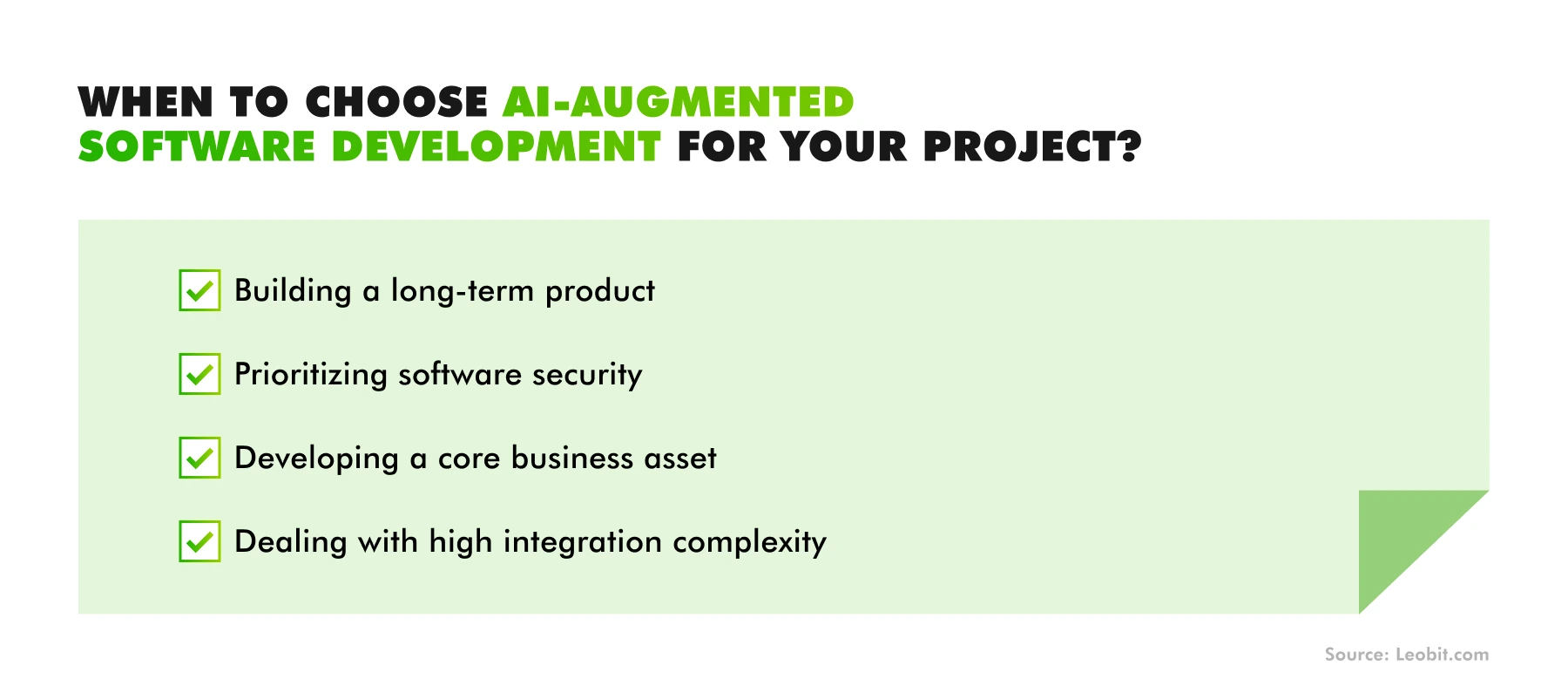
AI-augmented software development surpasses vibe coding in many aspects, especially when software quality and its long-term promises matter.

ai-assisted software development
Optimal use cases for AI-augmented software engineering

Below are scenarios where it’s clearly the better choice, and where a vibe coding approach may otherwise lead to poor outcomes.

Building a long-term solution

Software that needs to evolve over time, with new features and changing requirements, needs a solid foundation. AI-augmented development provides exactly that. Engineers use AI to move fast while deliberately shaping the architecture, keeping the code clean, documented, and navigable long after the original team has moved on.

In addition, tools like Claude Code and Cursor help software engineering teams with long-term maintenance and onboarding new specialists on the project. They provide detailed notes that explain the logic behind specific sections of a codebase, helping developers to quickly analyze and understand how the code works.

The result is a codebase that becomes easier to extend and maintain over time, instead of accumulating technical problems and rework.

Product’s security is non-negotiable

Any product handling personal data, financial information, healthcare records, or operating under regulatory frameworks requires security to be built in from the start. That’s where rapid and intuitive practices peculiar to vibe coding may fail.

Meanwhile, AI-augmented development combines the benefits of using artificial intelligence with rigorous human oversight. It typically involves workflows like threat modeling, security audits, and compliance reviews. These workflows can still be accelerated with AI that helps surface vulnerabilities and generate test cases, while developers retain responsibility for validating and approving every decision.

Building a core business asset

If you are building a fundamental software solution for your business, such as a proprietary platform, a competitive differentiator, or a system that generates revenue flows, relying on vibe coding is not the most reliable choice. The cost of bugs, software inefficiencies, and poor resource management in a business-critical asset is likely to be very high for your business.

To combine speed and control, development teams can rely on AI-augmented development, which allows them to understand, own, and manage every part of the system. AI handles the repetitive work; humans retain accountability for the architecture. That combination is a far stronger foundation for anything mission-critical than a codebase nobody fully comprehends.

 Book Icon

Developing an app with high integration complexity

Apps that connect with multiple third-party APIs, legacy systems, enterprise infrastructure, or complex data pipelines demand precision and deep understanding of how each piece interacts. Vibe coding falls short here because AI models lack system-wide awareness. They typically operate within a limited context window and cannot reason about how a new integration affects the broader architecture, creating code that works in isolation or breaks under real-world load.

On the contrary, the AI-augmented approach brings architectural judgement and cross-system knowledge to integration workflows. AI accelerates routine workflows, such as generating boilerplate integration code. Meanwhile, control over the system and its integrations remains a human responsibility.

Final Thoughts

The vibe coding trend has introduced many promises to software development, particularly the ability to build applications quickly with minimal technical expertise. However, like many trends that generate early excitement, its limitations have become more apparent over time. Its intuitive, AI-heavy approach can lead to overlooked errors, security gaps, and poorly-structured architectures that may be difficult to understand and maintain. Ultimately, all these issues often contribute to technical debt, as well as performance and data protection issues.

That said, vibe coding can be effective in specific scenarios, such as MVP or PoC development. It can also fit projects with tight budgets where the solution is simple, short-term, or is expected to be completely refined over time. In most cases, however, it falls short compared to more structured approaches like AI-augmented software development. In particular, AI-augmented development is a stronger choice for:

  • Products that need to evolve over the long term
  • Software with strict security requirements
  • Platforms that serve as core business assets
  • Solutions with complex integrations

Overall, a more structured approach that balances speed with quality is often the better path forward. Leobit, a company with strong expertise in AI development and adoption, can support you in this journey. As a Microsoft Solutions Partner for Data and AI, we bring deep expertise in leveraging AI technologies with a focus on both quality and efficiency. Our specialists can use AI assistance to build your custom software solutions fast and with focus on quality. We can also help you address issues caused by vibe coding through technical audits or software modernization services.

Contact us to discuss your needs and find out how we can help you.

FAQ

Vibe coding is a software development approach that is focused on speed, intuition, and experimentation. It relies heavily on AI tools to quickly generate and iterate on code with minimal upfront planning. Quite often, it doesn’t require strong technical skills and prioritizes experimentation and the “development flow.”

No, vibe coding is not a replacement for traditional software development. This approach has certain limitations that often translate into poor software quality, scalability and maintenance issues, and security gaps. This is particularly relevant to complex and long-term systems. Overall, vibe coding works best as a complementary approach to custom software development.

Vibe coding is a strong fit for:

  • Simple PoC projects
  • MVPs
  • Simple or short-term apps in case you face significant budget constraints

There are many cases where vibe coding is not the optimal development approach. However, the most critical ones include projects involving:

  • Long-term products
  • Core business assets
  • Solutions with high security demands
  • Systems with multiple complex integrations

In such cases, we suggest relying on AI-augmented software engineering, which combines speed and reliability.

We at Leobit are actively using AI solutions, such as Claude Code or GitHub Copilot, to accelerate development cycles. We have a well-defined framework for using AI in software development workflows, including clear practices for prompt engineering, code review, and AI input planning.

With experience as a Microsoft Solutions Partner for Data and AI, Leobit can help you build or modernize software of various types, balancing speed with high engineering quality.