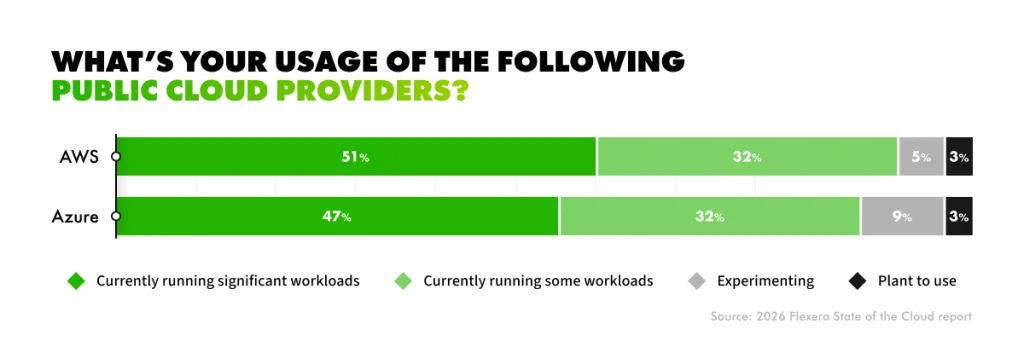
The race between Amazon Web Services and Microsoft Azure isn’t slowing down. Both platforms are now deeply embedded in how companies build and scale AI, with adoption levels that are nearly identical. According to Flexera’s latest State of the Cloud report, AWS still holds a slight lead in active enterprise workloads, with 84% of organizations running production systems compared to Azure’s 82%.
Azure vs. AWS cloud usage
But the gap narrows when you look beyond what’s already deployed. Azure edges ahead when future plans and experimentation are included, suggesting that many teams are still deciding where to place their long-term bets.
At the same time, demand for AI services is accelerating across both ecosystems. Use of generative AI in public cloud environments has jumped from 50% in 2025 to 58% in 2026, while traditional machine learning workloads continue to grow. As more organizations move from experimentation to real-world deployment, the differences between AWS and Azure AI offerings are becoming more important.
This article breaks down how the two platforms compare across core AI services, strengths, and use cases, so you can decide which one fits your needs.
Azure AI vs. AWS AI: Who Wins the Battle?
Choosing between Azure AI and AWS AI isn’t about picking a clear winner. Both platforms offer mature, rapidly evolving ecosystems with overlapping capabilities and distinct strengths. In most cases, the better choice depends on your existing stack, team expertise, and the type of AI workloads you plan to run.
So let’s compare what each platform offers in terms of services and AI capabilities.
Generative AI: Azure OpenAI Service vs. Amazon Bedrock
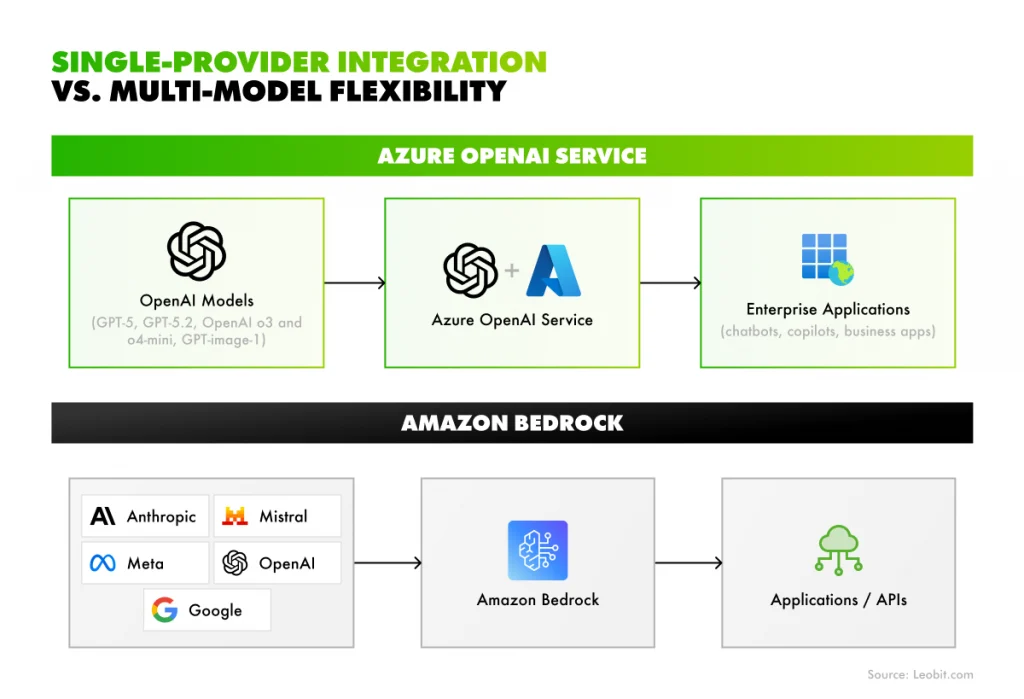
Azure OpenAI Service and Amazon Bedrock represent two fundamentally different approaches to enterprise generative AI. Azure OpenAI Service is built around an exclusive partnership with OpenAI. Thanks to it, Azure can give companies managed access to the full GPT model family, including GPT-5, GPT-5.2, reasoning models like o3 and o4-mini, image generation (GPT-image-1), and real-time audio models, all within Azure’s compliance and security boundary. Amazon Bedrock takes a provider-agnostic approach: it offers nearly 100 serverless foundation models from Anthropic, Meta, Mistral AI, Google, OpenAI, NVIDIA, and others through a single unified API.
Both platforms are experiencing rapid enterprise adoption. According to Microsoft’s Q1 FY2026 earnings report, Azure revenue grew 40% year over year, driven by demand across all cloud workloads, including AI services. Azure AI Foundry has grown to support more than 70,000 customers, processing 100 trillion tokens per quarter. On the AWS side, Amazon reported in its Q4 FY2025 earnings call that Bedrock has reached a multibillion-dollar annualized run rate, with over 100,000 companies actively using the platform.
This architectural difference creates distinct trade-offs. Azure OpenAI gives you the earliest access to new OpenAI releases and tight integration with Microsoft 365, Dynamics 365, and Azure AI Foundry model catalog (over 11,000 models, including 10,000+ open-source models from Hugging Face). A new v1 API introduced in August 2025 allows developers to use the standard OpenAI client with minimal code changes. Azure also ships built-in content safety filters by default on every deployment.
Bedrock’s strength lies in model flexibility. In December 2025, AWS announced its largest single model expansion, offering 18 fully managed open-weight models. It was followed in February 2026 by six more frontier-class models powered by Project Mantle, providing OpenAI-compatible API endpoints out of the box. On safety, Bedrock Guardrails can be applied via the ApplyGuardrail API to any model (including self-hosted and third-party) while Azure’s filters are configured at the deployment level.
Azure’s single provider innovations vs. AWS’s multi-model flexibility
As for the pricing, both platforms offer pay-per-token on-demand and provisioned throughput options, but the structures differ. Azure OpenAI provides three tiers:
Standard (pay-as-you-go per token)
Provisioned (PTUs) with hourly billing and up to 85% savings via annual reservations
Batch for async workloads
Bedrock offers a similar set of tiers: Standard, Priority, Flex (50% discount), and Reserved. Plus, it also offers Intelligent Prompt Routing that automatically directs requests to cost-optimal models within a family, claiming up to 30% cost reduction. Batch inference on Bedrock is also discounted by 50% compared to on-demand. Both platforms’ per-token rates vary significantly by model, so your AI development team should compare costs for their specific model choices using either the Azure pricing calculator or the Bedrock pricing page.
In short, Azure OpenAI Service is the stronger choice for organizations committed to the OpenAI model family and deeply integrated into the Microsoft stack, while Amazon Bedrock suits teams that prioritize multi-provider flexibility and want the ability to swap models as the market evolves.
ML platform: Azure Machine Learning vs. Amazon SageMaker
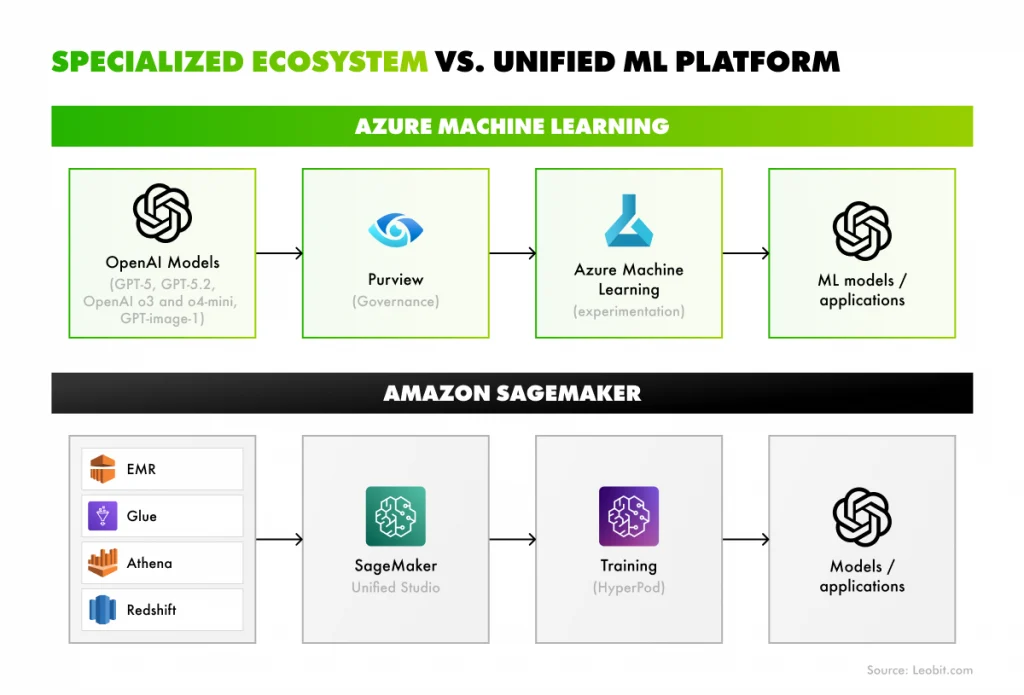
Azure Machine Learning and Amazon SageMaker have evolved from model-training services into broad ML lifecycle platforms, but they’ve taken architecturally distinct paths. Azure ML operates as a workbench layer within Azure AI Foundry, keeping a clear separation of concerns: data engineering lives in Microsoft Fabric, governance in Purview, and ML experimentation in Azure ML. They are all connected but distinct.
Amazon SageMaker took a different route: following a major restructuring in 2024, it absorbed Amazon EMR, AWS Glue, Athena, and Redshift into SageMaker Unified Studio, with the original ML service renamed to SageMaker AI.
The platforms diverge most at the training scale. SageMaker HyperPod provides persistent GPU clusters with automatic fault detection and node replacement, which are critical for multi-week LLM training runs. In 2025, AWS added instance-level GPU utilization tracking and rolling updates with automatic rollback for inference. Azure ML takes a different approach with managed online endpoints that abstract infrastructure entirely, handling scaling, OS patching, and node recovery, but there’s no direct equivalent to HyperPod’s persistent fault-resilient training clusters.
For responsible AI and automation, Azure ML ships a Responsible AI dashboard that combines error analysis, interpretability, causal inference, and fairness assessment. Though they are currently limited to scikit-learn-compatible models in MLflow format. SageMaker counters with serverless model customization announced at re:Invent conference in 2025, including an agent-led experience where developers describe customization needs in natural language.
Azure Machine Learning vs. Amazon SageMaker
Regarding pricing, both platforms primarily charge for underlying compute. Azure ML has no additional service fee beyond the VMs used for training and inference, with savings available through 1- or 3-year Azure Reserved Instances. SageMaker AI pricing follows the same compute-based model, but adds options like Flexible Training Plans for predictable GPU capacity and Spot Instances on HyperPod with up to 90% discount for fault-tolerant workloads. In June 2025, AWS announced up to 45% price reductions on P4 and P5 GPU instances across SageMaker AI.
You should also consider that Azure ML is going through a mid-SDK transition. SDK v1 was deprecated in March 2025, with support ending in June 2026. Teams with existing v1 codebases need to plan migration, as all new features are exclusive to v2.
In short, Azure ML fits teams that want a focused ML workbench with deep Microsoft ecosystem integration, while SageMaker suits organizations that need a unified data-to-model platform with large-scale training infrastructure like HyperPod.
NLP: Azure AI Language vs. Amazon Comprehend
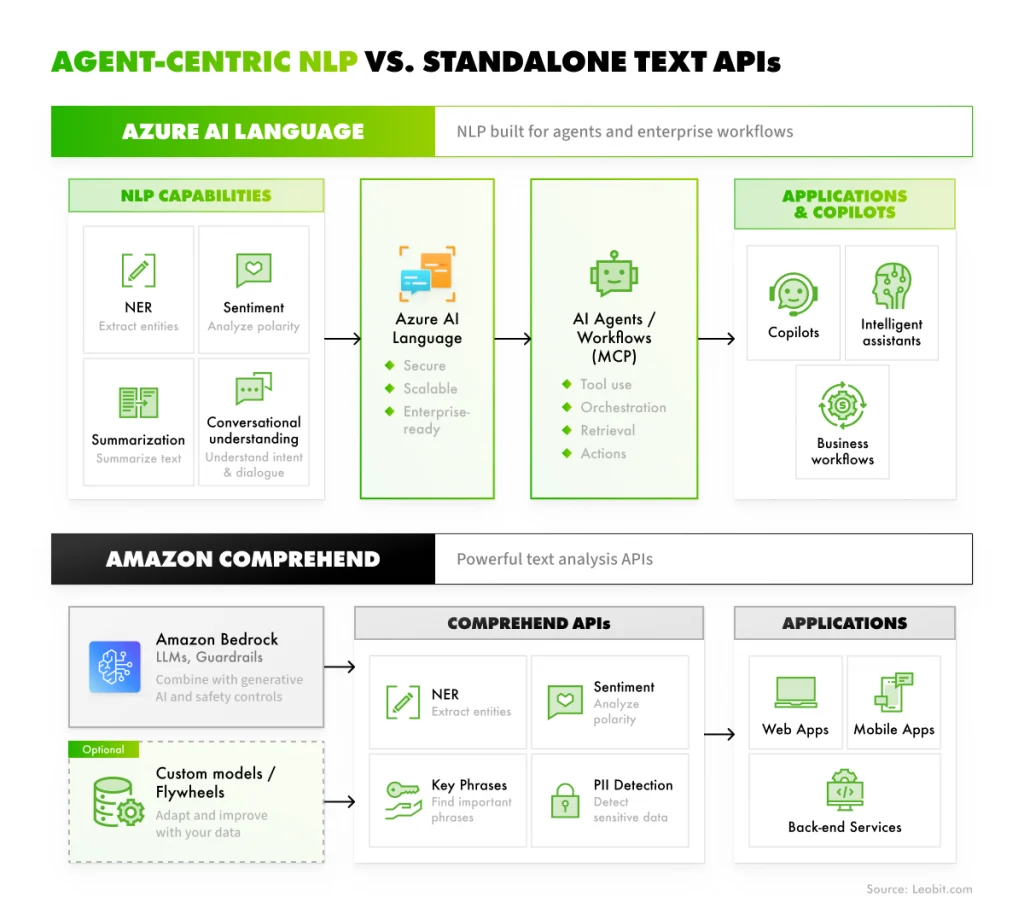
Azure AI Language and Amazon Comprehend both provide pre-trained NLP APIs for common tasks like entity recognition, sentiment analysis, key phrase extraction, PII detection, and language detection. Yet, they’re heading in different architectural directions.
Azure AI Language is part of Foundry Tools, Microsoft’s unified AI platform. Beyond standard NLP, it includes:
Abstractive and extractive summarization for both documents and conversations
Conversational Language Understanding (CLU) for multi-turn intent recognition without additional model training
Custom models for NER and text classification
In 2025, Microsoft added an Azure Language MCP server that connects NLP capabilities directly to AI agents through the Model Context Protocol. This is a clear signal that Azure is positioning NLP as a building block for agentic workflows, not just standalone APIs. However, you should note that Azure Language Studio is scheduled for deprecation, with all features migrating to Microsoft Foundry.
Amazon Comprehend takes a more traditional approach: pre-trained ML models for entity recognition, sentiment, key phrases, and PII detection, plus custom classification and custom entity recognition via AutoML. Comprehend also offers toxicity detection for content moderation and a specialized Comprehend Medical service for extracting clinical information from medical text. For custom model management, Flywheels simplify orchestrating training and evaluation of new model versions over time.
Azure AI Language and Amazon Comprehend both provide pre-trained NLP APIs for common tasks like entity recognition, sentiment analysis, key phrase extraction, PII detection, and language detection
As for the pricing, both services use pay-per-request models measured in character-based units. Azure AI Language bills per text record (1,000-character units) and offers 5,000 free text records per month across core features, including sentiment analysis, NER, key phrases, and summarization. Amazon Comprehend charges per 100-character unit (3-unit minimum per request) with a 12-month free tier of 50,000 units per API per month. Custom models on Comprehend add $3/hour for training and $0.50/month for model management, while Azure charges for custom model training compute separately.
However, there’s a notable platform shift happening on the AWS side. Starting from April 30, 2026, topic modeling, event detection, and prompt safety classification will no longer be available to new Comprehend customers. AWS recommends migrating these workloads to Amazon Bedrock using LLMs for topic detection and Bedrock Guardrails for prompt safety. This signals that traditional NLP APIs are increasingly being absorbed into generative AI platforms on both clouds.
In short, Azure AI Language is the stronger fit for companies building agent-driven NLP workflows within the Microsoft ecosystem, while Amazon Comprehend remains a solid choice for standalone text analysis. Though teams should plan for Amazon Comprehend’s evolving feature footprint.
Vision, image, and video services: Azure AI Vision vs. Amazon Rekognition
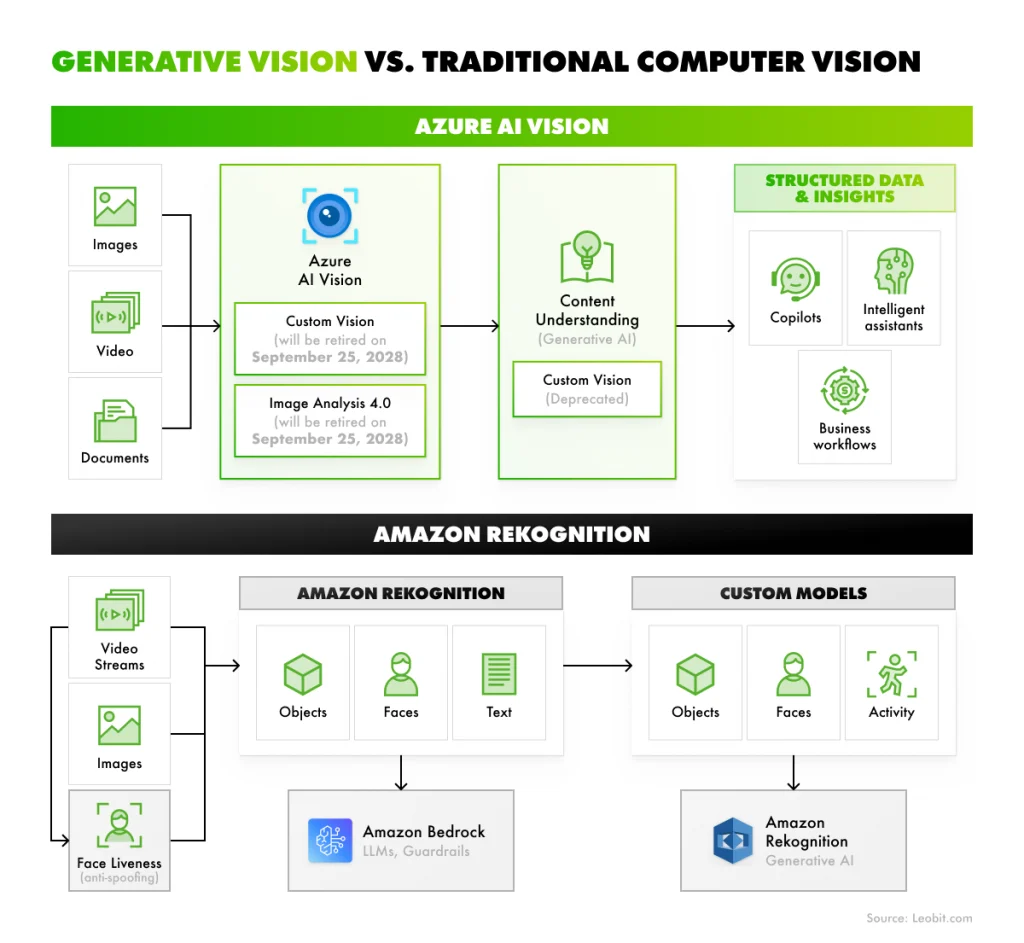
Azure AI Vision sits within Foundry Tools and provides image analysis features, including object and scene detection, captioning (dense and standard), people detection, multimodal embeddings, and synchronous OCR. For video, the separate Azure AI Video Indexer extracts metadata like scenes, faces, spoken text, and topics from both live and uploaded sources.
However, Azure’s vision stack is in transition. For instance, Image Analysis 4.0 is deprecated and will retire on September 25, 2028, and Azure Custom Vision will retire on the same date. Microsoft recommends migrating custom image models to Azure ML AutoML or using generative models from the Foundry catalog. For document and video extraction, the newer Azure Content Understanding uses generative AI to extract schema-defined structured fields — signaling Microsoft’s shift from traditional CV toward generative approaches.
Amazon Rekognition takes a more stable, traditional deep-learning approach. It covers object/scene detection, text extraction, celebrity recognition, content moderation, and PPE detection for images. In addition, it can perform stored and streaming video analysis with person tracking and activity detection.
A notable differentiator is Face Liveness. It is an anti-spoofing feature that detects whether a real person (not a photo or mask) is present during identity verification. This feature was updated in July 2025 with improved accuracy and a faster challenge mode. For custom use cases, Rekognition Custom Labels trains domain-specific models with as few as 10 images via AutoML. However, AWS has also begun cutting features. For instance, people pathing was discontinued in October 2025.
Azure AI Vision vs. Amazon Rekognition
Speaking of Azure AI pricing vs. AWS AI pricing, both use pay-per-API-call models. Azure AI Vision charges per transaction, with a free tier of 5,000 transactions/month. Amazon Rekognition uses tiered per-image pricing (volume discounts above 1M images/month) with a 12-month free tier covering 5,000 images/month for most APIs and 1,000 face metadata storage entries/month. Custom Labels on Rekognition adds training ($1/hour) and inference ($4/hour) costs.
In a nutshell, Azure is actively consolidating its vision services into generative AI–powered tools within Foundry, while Rekognition maintains a traditional CV-first architecture with a more stable API surface. So, if you are building identity verification workflows will find Rekognition’s Face Liveness more mature. But, if you need flexible document and video extraction, you may benefit from Azure’s generative AI direction with content understanding.
Speech and Voice AI: Azure AI Speech vs. Amazon Polly
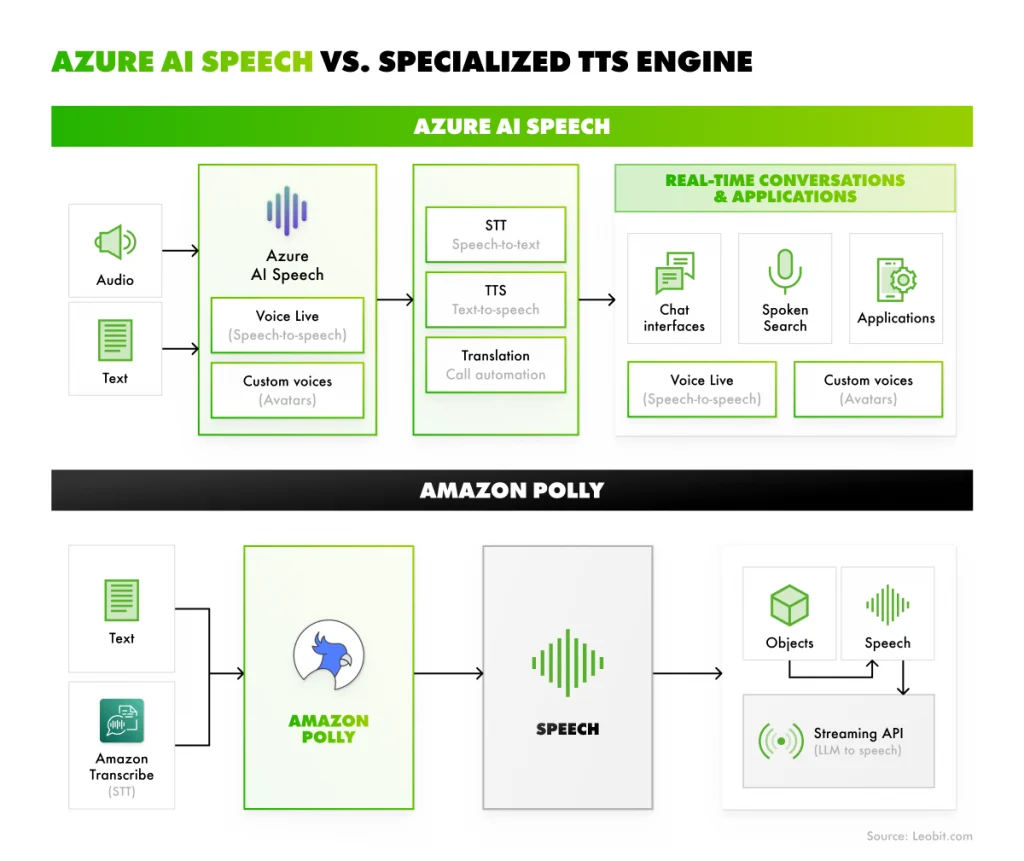
Azure AI Speech and Amazon Polly cover different parts of the speech AI stack, which makes any direct comparison a bit tricky. Azure AI Speech is a unified speech platform covering speech-to-text (STT), text-to-speech (TTS), speech translation, pronunciation assessment, and real-time voice agents. Amazon Polly is TTS-only. For STT on AWS, teams use the separate Amazon Transcribe service.
Azure Speech provides real-time, fast, and batch transcription with custom model support, real-time diarization, and automatic language detection. On the TTS side, it offers neural voices with SSML control, custom voice cloning via professional voice fine-tuning, and video avatar creation for synthetic talking-head videos. A key 2025 addition is Voice Live, a low-latency, speech-to-speech feature designed for real-time conversational AI agents. Azure Speech also supports on-premises deployment via containers for compliance-sensitive workloads.
Amazon Polly focuses exclusively on TTS with four voice engines: standard, neural, long-form, and generative. During the last year, AWS significantly expanded the generative engine by adding 31 voices across 20 locales with polyglot support that maintains vocal identity across languages. In March 2026, Polly launched a Bidirectional Streaming API that allows streaming text input from an LLM and receiving synthesized audio simultaneously. Polly’s narrower scope means less platform complexity, but if you also need STT you must integrate Amazon Transcribe separately.
Azure AI Speech vs. Amazon Polly
Regarding pricing, Azure Speech bills per second for STT and per character for TTS, with free tiers for both (5 hours/month for STT, 500K characters/month for TTS). Amazon Polly charges per character with rates varying by engine from $4/million characters (Standard) to $100/million characters (Long-Form) with a 12-month free tier that scales from 100K to 5M characters depending on engine.
In short, Azure AI Speech is the stronger choice for companoes that need a unified speech platform and STT, TTS, translation, and real-time voice agents in one service. Amazon Polly excels as a dedicated TTS engine, particularly for LLM-powered conversational apps leveraging its new Bidirectional Streaming API, though teams will need Amazon Transcribe for the STT side.
Conversational AI and chatbots: Azure AI Bot Service vs. Amazon Lex
Azure’s conversational AI stack is mid-transition, while Amazon Lex is doubling down on generative AI enhancements within a stable architecture.
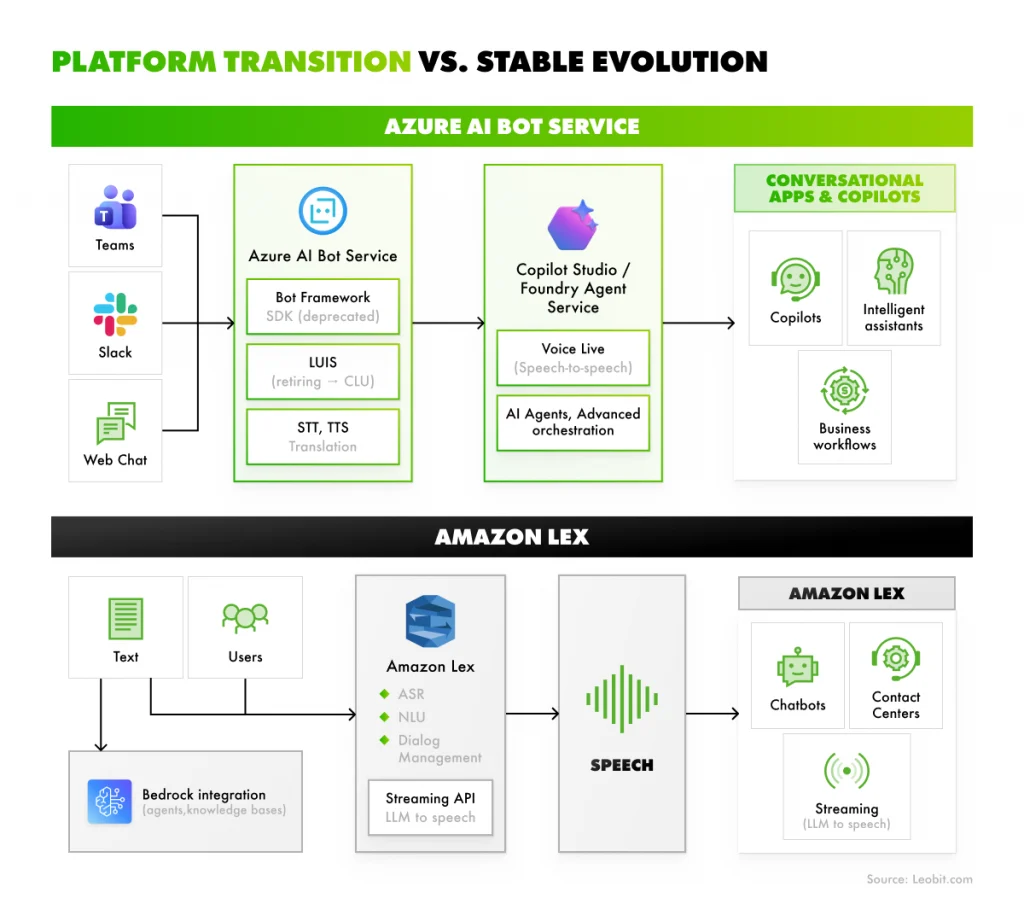
Azure AI Bot Service provides the hosting infrastructure and channel connectors (Microsoft Teams, Slack, Facebook Messenger, telephony) for deploying chatbots. However, its underlying development framework is shifting: the Bot Framework SDK has been archived and is no longer maintained, with support tickets ending December 31, 2025.
Microsoft now directs developers to two paths:
Microsoft Copilot Studio, a low-code platform for building conversational agents with visual dialog flows, multi-model support (including GPT-5 and Anthropic models), and native Microsoft 365 deployment
Amazon Lex V2 takes a more stable approach, powered by the same conversational engine as Alexa. It provides ASR and NLU capabilities with a visual conversation builder, multi-turn dialog management, and native integration with Amazon Connect for contact center use cases. In 2025, AWS added several generative AI enhancements:
Assisted NLU uses LLMs to improve intent classification while staying within configured intents
AMAZON.BedrockAgentIntent enables seamless connection to Bedrock Agents and Knowledge Bases.
Lex also supports global resiliency via multi-region bot replication for disaster recovery.
Azure AI Bot Service vs. Amazon Lex
As for pricing, Azure AI Bot Service charges per message on premium channels (such as Microsoft Teams), while standard channels (such as web chat) remain free. Copilot Studio uses separate per-message licensing tied to Microsoft 365 plans. Amazon Lex charges per request (e.g., text or speech) with a 12-month free tier covering 10,000 text and 5,000 speech requests per month.
In short, companies using Microsoft 365 and Copilot, should evaluate Copilot Studio as the strategic path forward for conversational AI. Amazon Lex is the stronger choice for businesses building contact center bots on AWS, particularly with its Bedrock integration for generative AI–powered conversations.
AI agents: Azure Foundry Agent Service vs. Amazon Q
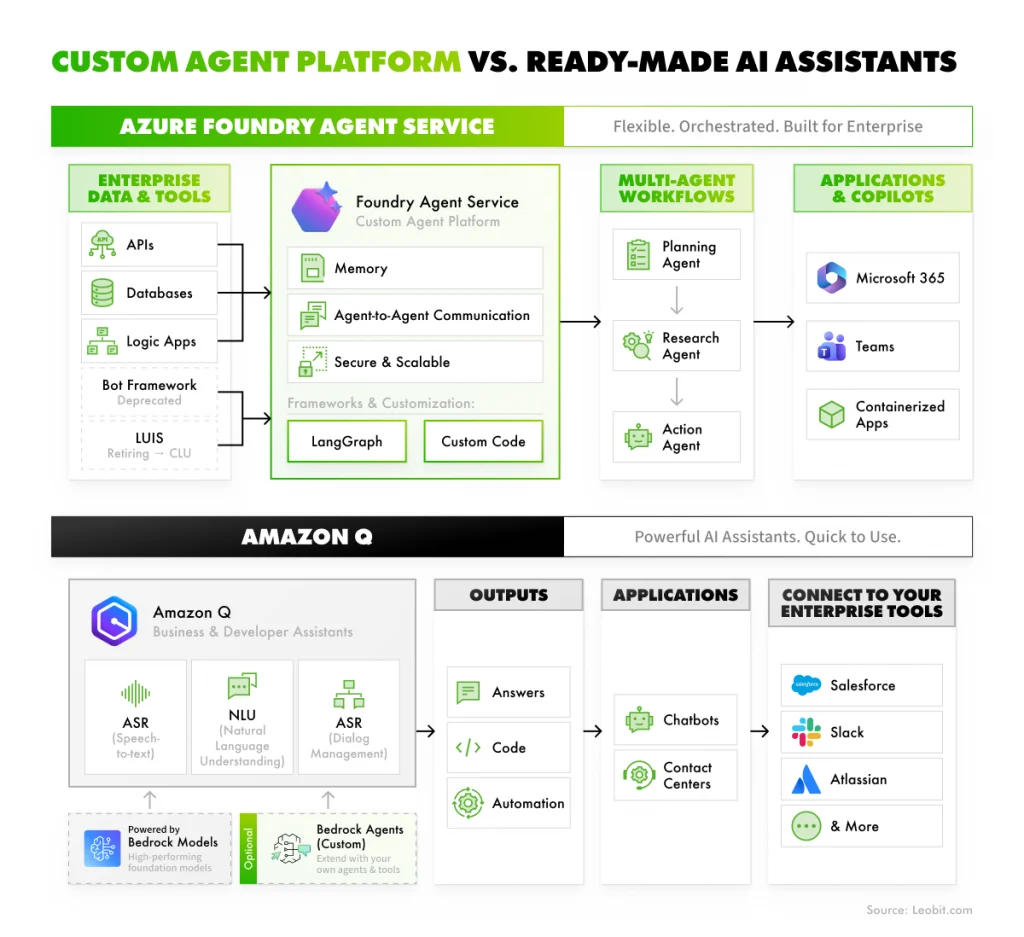
Azure Foundry Agent Service and Amazon Q represent fundamentally different approaches to enterprise AI agents. One is a platform for building custom agents, while the other is a suite of pre-built AI assistants.
Foundry Agent Service is a fully managed platform for designing, deploying, and scaling custom AI agents. Developers can create no-code prompt agents in the Foundry portal or build hosted agents using any framework, be it Microsoft Agent Framework, LangGraph, or custom code. Agents connect to enterprise data and actions through a tool catalog with over 1,400 connectors via Azure Logic Apps, and can access knowledge through Foundry IQ powered by Azure AI Search.
Recent additions include multi-agent workflows, persistent memory, and Agent-to-Agent (A2A) protocol support for cross-agent coordination. Microsoft states that more than 10,000 organizations already use the service, with agents being published to Microsoft 365, Teams, or containerized deployments.
Amazon Q takes a different approach. It’s a family of pre-built, generative AI-powered assistants rather than an agent-building platform. Amazon Q Business connects to over 50 business tools (SharePoint, Salesforce, ServiceNow, Slack, Atlassian) and delivers permission-aware answers, content generation, and task automation grounded in enterprise data. Amazon Q Developer focuses on software development, namely code generation, testing, debugging, security scanning, and application modernization. Both products are built on Amazon Bedrock and use multiple foundation models under the hood.
For teams that need to build fully custom agents on AWS, the equivalent of Foundry Agent Service is Bedrock Agents, which provides tool use, knowledge bases, and orchestration, but requires assembling components like Lambda and Step Functions separately.
Azure Foundry Agent Service vs. Amazon Q
As for the pricing, Foundry Agent Service charges based on the individual models and tools accessed. This means that there’s no separate per-user fee for the agent platform itself. Amazon Q Business uses per-user subscription pricing: $3/user/month (Lite) or $20/user/month (Pro), plus index capacity charges. Amazon Q Developer offers a free tier with limits and a Pro tier at $19/user/month.
In short, Foundry Agent Service is the platform for companies that want to build and orchestrate custom AI agents with full architectural control (especially within the Microsoft ecosystem). Amazon Q is the faster path for organizations that want ready-made AI assistants for knowledge work and software development without building agent infrastructure from scratch.
Data & AI platform: Azure Databricks vs. Databricks on AWS vs. AWS Data and AI stack
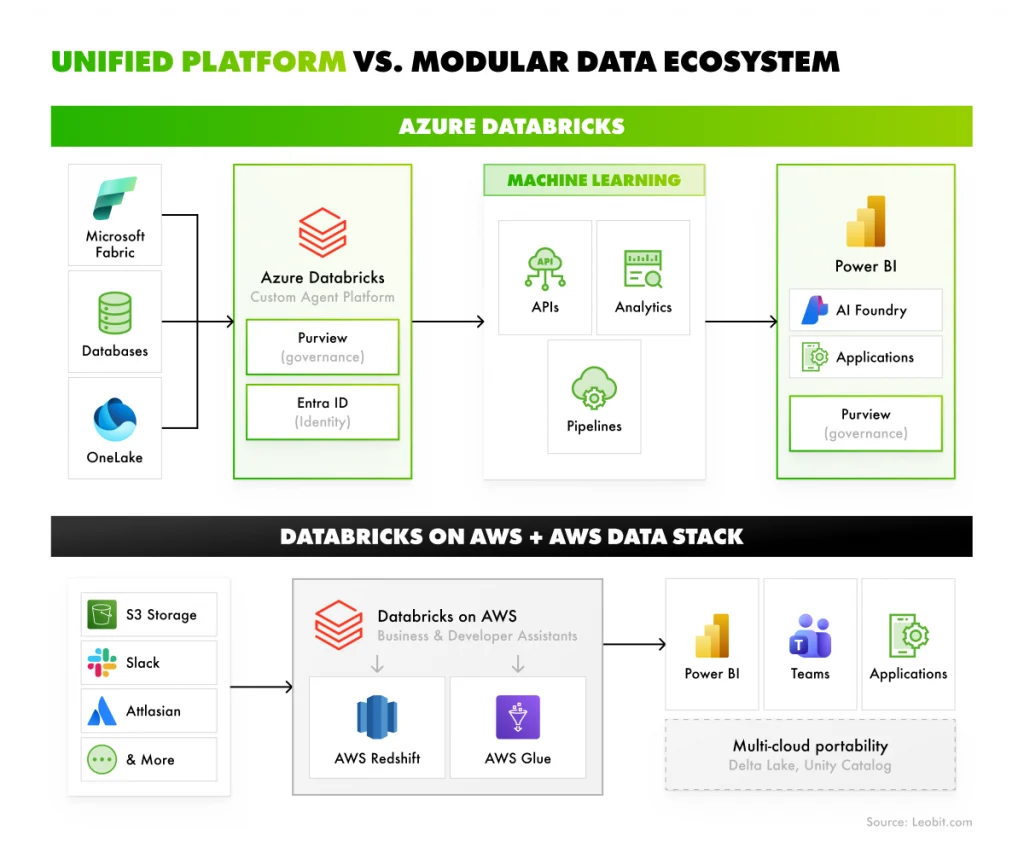
This comparison requires a different framing than the previous sections since there’s no exact one-to-one match. Azure Databricks is a first-party Azure service co-engineered by Microsoft and Databricks that serves as a unified platform for data engineering, analytics, and AI.
On AWS, the equivalent capability is typically Databricks on AWS combined with native services like SageMaker, Glue, and Redshift, rather than a single integrated product. Since both run the same core Databricks engine (Apache Spark, Delta Lake, MLflow, Unity Catalog), the key differentiator is ecosystem integration, not the platform itself.
Azure Databricks benefits from deep native integration with the Microsoft stack. It connects directly to Microsoft Fabric and OneLake, allowing Power BI, Fabric data warehouses, and Databricks ML pipelines to operate on the same data without duplication. Governance extends through:
Microsoft Purview for cross-platform data lineage
Microsoft Entra ID for seamless SSO and RBAC
Azure AI Foundry for model deployment and agent orchestration
Databricks on AWS integrates with S3 for storage, CloudWatch and CloudTrail for monitoring, and connects to the broader AWS data ecosystem: Glue for ETL, Redshift for warehousing, and SageMaker for ML. However, these integrations require additional configuration compared to Azure’s first-party experience.
The trade-off is multi-cloud flexibility. Databricks on AWS (or GCP) gives organizations the ability to run the same lakehouse platform across clouds with portable Delta Lake tables and Unity Catalog for cross-cloud governance. This is a genuine advantage for multi-cloud strategies.
Azure Databricks vs. Databricks on AWS vs. AWS Data and AI stack
Regarding pricing, both use a consumption-based model measured in Databricks Units (DBUs), with costs varying by workload type (jobs, SQL analytics, all-purpose compute) and instance tier. Azure Databricks supports Azure Reserved Instances for predictable base workloads, while Databricks on AWS can leverage EC2 Spot Instances for 60–80% savings on batch compute.
To sum up, Azure Databricks is the natural choice for organizations invested in the Microsoft ecosystem. Fabric, Power BI, Purview, and AI Foundry integration make it a unified data-to-AI platform. Databricks on AWS suits teams that need multi-cloud portability or are deeply embedded in AWS-native data services.
When to Choose Azure AI?
Azure AI is often the easier choice if you’re already in the Microsoft ecosystem. It connects smoothly with tools many teams already use and simplifies the process of building and deploying AI features. Instead of starting from zero, you get a set of ready-to-use services that are designed to work together.
Here are several reasons to choose Azure AI.
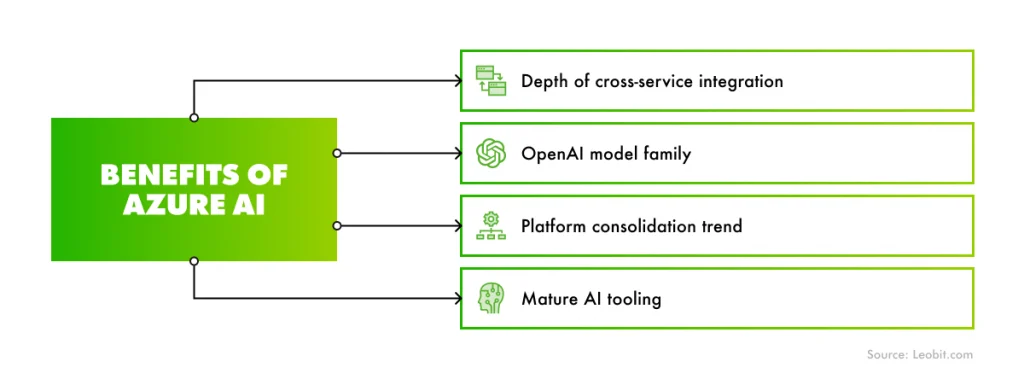
Depth of cross-service integration. If your company already runs on Microsoft 365, Dynamics 365, or the Power Platform, Azure AI doesn’t introduce a new ecosystem, but extends the one you already have. For instance, Azure Databricks feeds directly into Microsoft Fabric and Power BI without data duplication. Azure ML plugs into Purview for governance and Entra ID for access control. Foundry Agent Service publishes agents straight to Microsoft 365 and Teams. This integration also extends to pricing simplicity. For example, Foundry Agent Service charges only for the models and tools accessed, with no separate per-user platform fee, while Azure ML has no additional service fee beyond the underlying compute.
OpenAI model family. Azure OpenAI Service provides the earliest access to new releases (GPT-5, o3, GPT-image-1), enterprise-grade content safety filters enabled by default, and a v1 API that lets teams migrate from OpenAI’s direct API with minimal code changes. So, if your company has standardized on OpenAI and needs compliance boundaries around it, this is a meaningful differentiator.
Platform consolidation trend. Microsoft is actively retiring legacy services like Custom Vision, Image Analysis 4.0, Bot Framework SDK, LUIS, and Language Studio, and migrating everything into Foundry. This creates short-term migration overhead for existing users, but in the long term, it means a single platform for models, agents, tools, and observability. Teams starting greenfield AI projects benefit from this consolidation immediately; teams with legacy Azure AI investments need to factor in migration timelines (e.g., LUIS retiring March 2026, Custom Vision retiring September 2028).
Mature AI tooling. Responsible AI dashboard in Azure ML offers integrated error analysis, interpretability, causal inference, and fairness assessment in a single pane, which is valuable for regulated industries where model auditability is a hard requirement.
Benefits of Azure AI
That said, Azure AI is a strong fit if your company wants tight integration and a unified platform built around familiar Microsoft tools. It may require some adjustment if you’re coming from legacy services, but for most teams, the long-term benefits of consolidation and enterprise-ready AI capabilities outweigh the trade-offs.
When to choose AWS AI?
AWS AI is the stronger choice when flexibility, control, and multi-provider support matter more than tight platform integration. It’s particularly well-suited for organizations that operate across multiple clouds or want to avoid locking into a single ecosystem.
Here are several reasons to choose AWS AI.
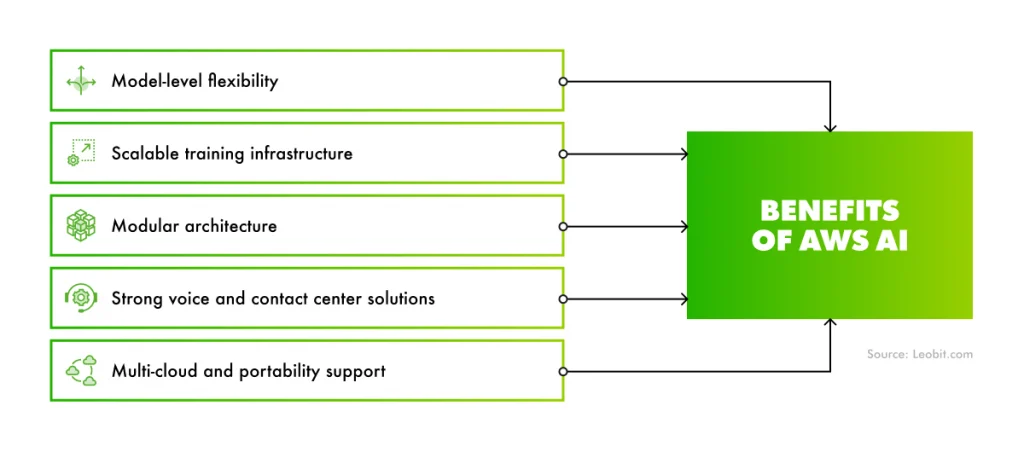
Model-level flexibility. Amazon Bedrock provides access to nearly 100 serverless foundation models from Anthropic, Meta, Mistral AI, Google, OpenAI, and others through a single unified API. This allows your AI development team to swap models as the market evolves without rewriting application code, and Intelligent Prompt Routing can automatically direct requests to cost-optimal models within a family. So, if you don’t want to bet on a single model provider, this architectural neutrality is a genuine differentiator, especially as the performance gaps between frontier models continue to narrow.
Scalable training infrastructure. SageMaker HyperPod offers persistent, fault-resilient GPU clusters with automatic node replacement, which is critical for long-running training jobs. For teams training or fine-tuning foundation models over multi-week runs, HyperPod’s resilience (with up to 90% savings via Spot Instances) and AWS’s recent 45% price reductions on P4/P5 GPU instances make a compelling cost-performance case.
Modular architecture. Another pattern worth noting is AWS’s modular, assemble-your-own-stack philosophy. While Azure consolidates into Foundry, AWS keeps services distinct. Services like Lex, Comprehend, Rekognition, Polly, and Bedrock Agents are designed to be used independently. This requires more integration effort, but gives teams full control over how they assemble their AI stack. For engineering-heavy teams, this flexibility is often worth the trade-off.
Strong voice and contact center solutions. AWS provides a more integrated path for voice-based applications through Amazon Connect and Lex, along with Polly for text-to-speech. Recent additions like low-latency streaming for speech generation make it a strong choice for real-time conversational systems and contact center automation.
Multi-cloud and portability support. AWS is often a better fit for organizations with multi-cloud strategies. Tools like Databricks on AWS support portable data architectures, while Bedrock Guardrails can be applied across different models, including third-party and self-hosted ones. This makes it easier to maintain consistency without being tied to a single platform.
Benefits of AWS AI
That said, AWS AI is a strong fit for teams that value flexibility, deep customization, and the ability to build across multiple providers and environments. It may require more setup and engineering effort, but it gives you greater control over how your AI stack evolves.
Leobit has delivered more than 10 AI-driven projects across industries, backed by a team of 20+ AI specialists. This includes work in machine learning, generative AI, and conversational systems such as chatbots. Our engineers regularly work with cloud-native AI services, helping clients move from early experimentation to fully deployed solutions.
Beyond client projects, Leobit invests heavily in internal research and development. Our R&D team continuously builds Proof of Concept projects to test new ideas, validate technical approaches, and explore emerging AI capabilities. These PoCs are built using real AI technologies and serve as a practical way to assess feasibility before scaling into production.
Leobit also holds ISO 9001:2015 and ISO 27001:2022 certifications, and is an ISTQB Platinum Partner. This combination of technical expertise, structured processes, and ongoing R&D allows Leobit to effectively evaluate and implement AI services across both Azure and AWS environments.
Conclusion
After eight head-to-head comparisons, one thing is clear: there’s no universal winner between Azure AI and AWS AI. Both platforms now cover the full AI stack, and the differences come down less to raw capability and more to how each ecosystem is built.
Microsoft is moving toward a unified, tightly integrated platform centered around Foundry and its broader ecosystem. AWS continues to favor a modular approach, giving teams more flexibility and control at the cost of additional integration work.
In practice, the decision usually comes down to your existing stack, your need for flexibility, and how you plan to scale AI in the long term. There’s no one-size-fits-all answer only what fits your architecture, team, and goals.
If you’re weighing Azure vs. AWS for your next AI initiative, it helps to look beyond feature lists and evaluate what will actually work in your environment. The Leobit team can help you assess your options, validate your approach, and design a solution that fits. Сontact us, and we will help you pick the best AI cloud platform that matches your engineering reality.
FAQ
Azure has an advantage if you plan to use OpenAI models in an enterprise setting. It offers early access, built-in safety features, and tight integration with Microsoft products. That said, AWS provides access to multiple model providers through Bedrock, which can be a better fit if you want flexibility.
Yes, and many organizations do. A multi-cloud approach lets you combine strengths, for example using Azure for integration with Microsoft tools and AWS for model experimentation or training. It requires more planning but can offer more flexibility.
It depends on your use case. Azure can be more cost-efficient for teams already in the Microsoft ecosystem due to simpler integration and pricing. AWS may offer better cost-performance for large-scale training or when using Spot Instances and flexible infrastructure options.
AWS typically has an edge for large-scale or long-running training jobs, thanks to services like SageMaker HyperPod. Azure ML is strong for managed workflows and enterprise governance, but may not match AWS in raw training infrastructure flexibility.
For many teams, yes, especially if they already use Microsoft tools. Azure’s services are more tightly integrated, which reduces setup and learning curve. AWS offers more control, but that often comes with additional complexity.
Not always, but it can significantly reduce risk and speed up delivery. A partner like Leobit can help you choose the right architecture, avoid common pitfalls, and move from idea to production faster.
Oleksandr is a full-stack software engineer specializing in .NET, Angular, and Blazor with over 4 years of hands-on experience and strong cloud expertise in Azure and AWS. He combines solid architectural skills with a growing focus on AI-powered solutions to build scalable, high-quality applications.
Nearly 90% of organizations are already piloting or deploying generative AI in their quality engineering practice, according to the World Quality Report 2025. ...
Lenovo’s 2026 CIO Playbook, with research by IDC, found that 46% of AI proofs of concept (PoCs) have progressed into production, so just over half have ...
MIT’s State of AI in Business 2025 report shows that monthly job listings for forward deployed engineers increased by more than 800% this year, part of a ...
The .NET ecosystem continues to flourish in 2026, with over 478,000 packages on NuGet that have been downloaded over 800 billion times. Numbers from ...
This year’s studies suggest that 31% of organizations across Norway, Sweden, Denmark, and Finland plan to increase spending on external IT service providers ...
Leona, Leobit’s AI agent designed to find promising cooperation opportunities and automatically send requests for proposals (RFPs), has helped our sales ...
Gartner estimates that generative AI cost projections can be off by 500% to 1,000% when organizations fail to account for how costs scale. They also predict ...
 Leobit