Contact us

When, Why, and How to Run an AI Readiness Assessment

16 mins read

When, Why, and How to Run an AI Readiness Assessment
Blog Calculator Widget Logo

Estimate Your Software Project Cost

Describe your idea — get a budget breakdown in minutes.

Get Your Estimate

With 64% of businesses viewing AI as the key driver of innovation, AI adoption is rapidly becoming a strategic priority across industries. But expectations and production are two very different things. Despite massive investment and growing enthusiasm, around 74% of companies across industries struggle to achieve and scale value from AI adoption. The gap between ambition and execution remains stubbornly wide.

All because of common AI adoption challenges, such as talent shortage and fragmented data infrastructure. But beneath these issues lies an even more fundamental problem: many companies simply aren’t ready for full-fledged AI adoption in the first place.

While often overlooked, AI readiness is the foundation on which successful technological implementation is built. Without it, even well-funded initiatives tend to stall or fail.

In this article, we break down the key indicators of AI readiness and offer practical guidance and a framework to help you assess whether your organization is truly prepared for AI adoption.

What Is an AI Readiness Assessment?

An AI readiness assessment is a comprehensive evaluation of an organization’s data, technology, processes, and skills to determine how prepared it is to effectively adopt AI. It helps companies shape a clearer, more practical implementation roadmap and avoid common pitfalls, such as fragmented data and outdated systems. In the oil-field services and equipment (OFSE) sector, for example, 50% of executives cite these issues as the main reason AI initiatives fail to scale.

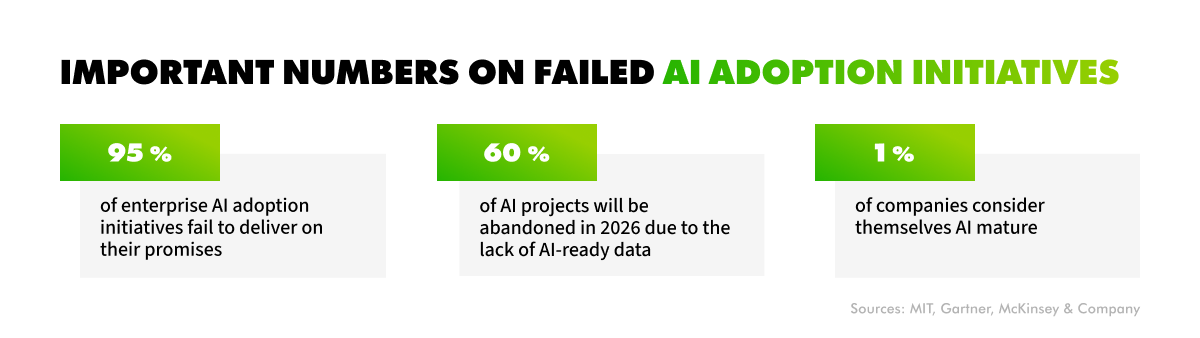
Below, we provide more statistics on failed AI adoption initiatives. Many of these could be resolved if companies conducted a comprehensive AI feasibility assessment.

gen ai readiness assessment
Statistics on failed AI adoption initiatives

AI readiness assessments don’t follow a universal template. Different stakeholders look at them through very different lenses, depending on their responsibilities, risks, and business goals.

  • Enterprises looking to integrate AI into existing systems need assessment to avoid costly missteps when scaling operations.
  • Startups building AI-driven software from scratch use assessment to validate their infrastructure before committing resources.
  • IT teams assess data readiness for AI, system compatibility, and model deployment capabilities.
  • Executives use assessment to make knowledgeable strategic decisions about where and how to invest in AI.
  • Product teams turn to assessment when exploring AI features that can meaningfully improve user experience and automation.

In short, if your organization is seriously considering AI adoption at any level, a readiness assessment is where that journey should begin.

The 6 Core Dimensions of AI Readiness

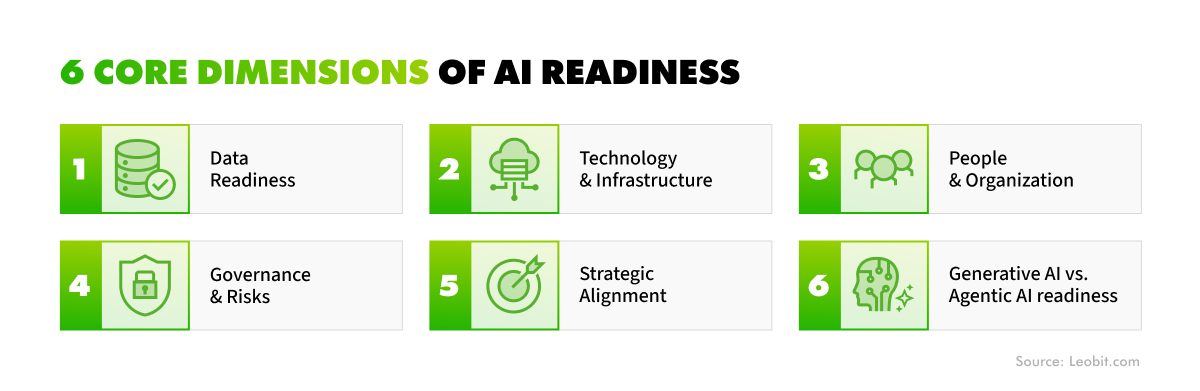
An AI readiness assessment typically analyzes six connected areas that should be addressed as foundational for the long-term success of your AI adoption initiative.

enterprise ai readiness assessment
6 dimensions of AI readiness assessment

Data readiness

Data is the raw material AI runs on, and its quality determines everything downstream. The AI readiness assessment involves evaluating whether your data is:

  • Accessible
  • Consistent
  • Structured

Common problems here include siloed data across departments, inconsistent data labeling, a lack of well-defined data governance workflows, and insufficient volume of data for the use cases you are targeting. In fact, an IBM study on the ingenuity of generative AI found that 42% of business executives see the lack of proprietary data as a major obstacle to successful AI adoption. Synthetic data generation can help fill that gap, as this practice has already demonstrated strong results in AI-powered healthcare systems. Meanwhile, other data challenges have their own fixes, but you need to spot them first through an AI readiness assessment.

Technology and infrastructure

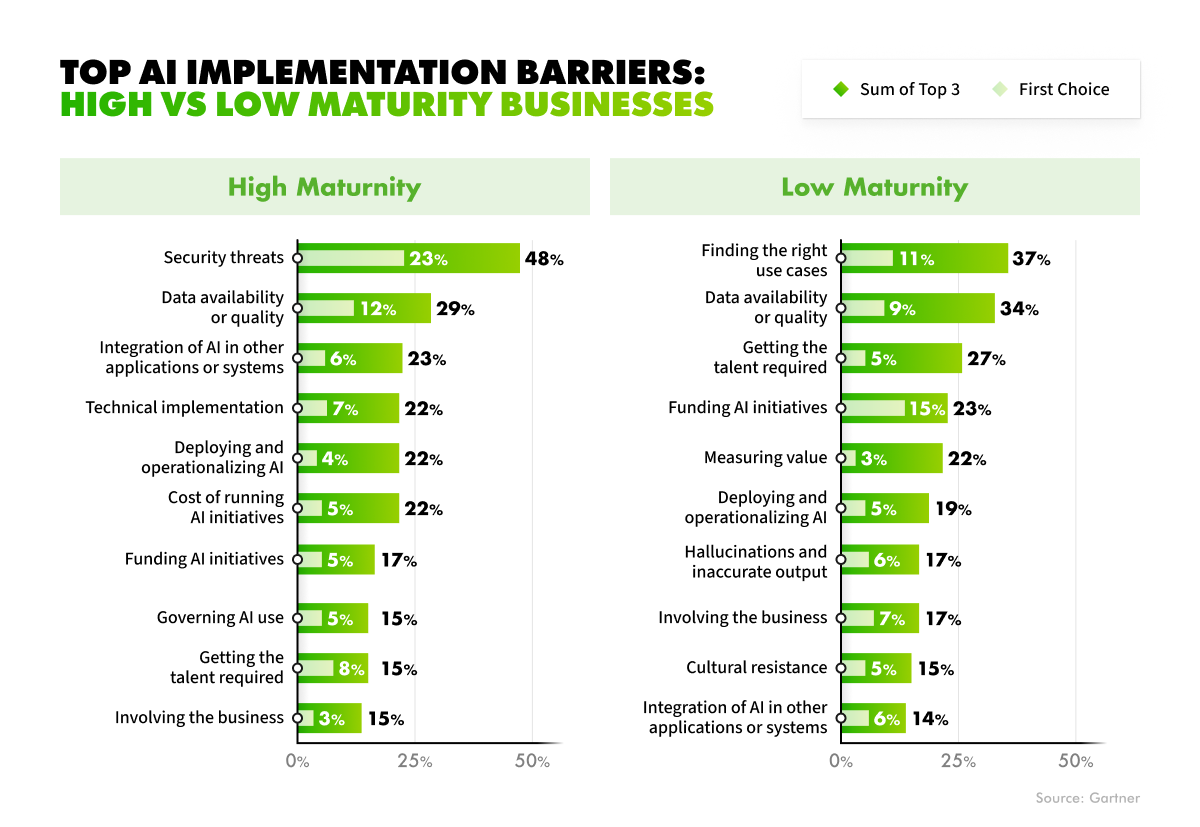
AI doesn’t operate in a vacuum. It needs compute power, an integration-friendly architecture, and scalable infrastructure to operate at scale. In particular, Gartner’s survey on AI adoption shows that 23% of executives at high AI maturity companies identify integrating AI into applications and systems as one of the top three barriers to adoption. In low AI maturity organizations, this challenge is also significant, cited by 14% of executives.

gen ai readiness assessment
Top AI adoption obstacles: High vs. low AI maturity businesses

This dimension of AI readiness assessment involves exploring your current technology stack, cloud capabilities, API infrastructure, and the compatibility of existing systems with AI tooling. If specific parts of your infrastructure are not prepared for AI integration, consider a comprehensive software modernization.

 Book Icon

People and organization

Successful implementation of AI technology does not guarantee success. Around 15% of executives at low AI maturity companies identify cultural resistance as one of the top three obstacles to adopting this technology. Beyond culture, organizations also need the right skills, capacity, and structure to implement and sustain AI effectively.

This dimension of AI readiness assessment covers everything from data science and engineering talent to change management capabilities and cross-functional collaboration. It helps organizations identify skill gaps, uncover where teams get stuck, and clarify roles and training needs. As a result, they get a clear AI transformation roadmap to make sure the right people and structure are in place before rollout.

Governance and risk

Around 15% of executives in companies with high AI maturity cite governance of AI use as one of the top AI implementation barriers. Deploying AI without a governance framework is like building without permits: it might move fast early on, but the problems compound over time. The AI readiness assessment examines this dimension to outline the organization’s approach to:

  • Compliance with regulations like GDPR, HIPAA, the EU AI Act, or SOC 2
  • Data privacy practices for collecting, storing, accessing, and protecting sensitive data
  • Model transparency practices that support explainability and auditability
  • Risk identification and mitigation practices for AI systems
  • AI ethics practices aimed at preventing biased or harmful outcomes at scale

A solid approach to AI governance is both a safeguard against legal liabilities and a competitive and reputational necessity.

Strategic alignment

One of the key aspects of AI readiness is aligning AI adoption with the company’s organizational structure and overall strategy. Around 37% of executives at companies with low AI maturity cite this as one of the three major barriers to successful AI implementation. To address this challenge, an AI readiness assessment examines whether AI initiatives are clearly tied to business objectives. It also evaluates leadership commitment, along with how AI efforts are prioritized and resourced.

A critical factor here is treating AI as a strategic initiative embedded across the organization rather than as a standalone IT project. Otherwise, it becomes much harder to generate long-term value from AI adoption. A well-organized project discovery phase can help here. It provides the company with a clear understanding of where AI can create real business value and how to align it with strategic priorities.

Agentic AI vs. Generative AI readiness

Readiness requirements can vary significantly depending on the type of AI you’re adopting.

Generative AI is the most widely applied type of AI, with 90% of companies across industries already using it. Its major capability is creating new content, such as tasks, images, or videos, as well as summarizing information. The adoption of generative AI requires robust data governance and a clear use-case definition.

Agentic AI is a more advanced type of artificial intelligence system built around autonomous or semi-autonomous agents that can plan and carry out multi-step tasks. It can handle sequences of actions, proactively make decisions, and sometimes operate with limited human input. In fact, such solutions can outperform traditional generative AI by 34% in task completion time.

However, this productivity and autonomy come with tradeoffs. Agentic AI adoption is typically more challenging and comes with stricter requirements. It needs clear process documentation, strong oversight, and a solid risk management framework. Transparency is also important so teams can understand how and why the system reached a particular decision.

Overall, understanding which type of AI system you’re building shapes every other dimension of your readiness assessment.

 Book Icon

How to Run an AI Readiness Assessment

An efficient AI readiness assessment methodology uses a structured process to show where your organization stands and what needs to change before AI can deliver real value. Here are its essential stages.

1. Evaluate the scope and team preparation

Evaluate your AI adoption initiative in the broader organizational context by defining its scope and running the assessment accordingly. Around 42% of business executives cite the lack of a clearly defined business case as the major AI adoption obstacle. Clarify whether you are evaluating the entire organization, a specific department, or a particular use case. This is vital for your assessment not to lose focus.

Once the scope is set, involve the right people. A meaningful AI readiness assessment requires input from across the organization:

  • IT and engineering departments should be responsible for the infrastructure
  • Legal and compliance specialists should be responsible for governance
  • Product and business leaders should be involved in evaluating strategic alignment
  • HR department and technical leads can contribute to the assessment of employee skill gaps

No single team has the full picture, so the AI readiness assessment becomes everyone’s business.

2. Collect evidence

This phase moves from assumption to evidence. The objective is to build a factual baseline across the six readiness dimensions: data, infrastructure, people, governance, strategy, and AI type. To do so, combine primary assessment methods, such as a technical audit that provides a clear picture of your infrastructure’s AI readiness, with stakeholder self-reporting. In particular, run structured interviews with functional and technical leads, review documents outlining existing governance and compliance frameworks, and conduct skills gap analyses across impacted teams.

Qualitative findings should be paired with quantitative indicators. Data quality scores, system availability records, audit outcomes, and process SLA adherence provide important data that make your AI readiness conclusions defensible and actionable rather than perception-based.

3. Identify structural and tactical gaps

With evidence in hand, the next step is to distinguish between the two types of gaps. Structural gaps are deep and foundational issues, while tactical gaps are more surface-level problems.

Structural gaps
  • No dedicated AI ownership or accountability
  • Data infrastructure built for reporting, not inference
  • Legacy governance frameworks that are not designed for AI
  • Talent architecture is misaligned with AI roles
  • AI strategy disconnected from the business unit
Tactical gaps
  • No baseline data quality metrics
  • No model lifecycle management process
  • Vendor and tool sprawl without integration standards
  • No feedback loops on model performance
  • Change management not planned ahead of deployment
  • No sandboxed experimentation infrastructure

This distinction matters because it shapes how you prioritize. Structural gaps usually need to be resolved before you start an AI adoption initiative. Tactical gaps can often be addressed in parallel with early-stage implementation.

4. Create a roadmap

An AI readiness assessment for business shouldn’t end with a report nobody revisits. Otherwise, your company may end up among the 61% of organizations that see no measurable Earnings Before Interest and Taxes (EBIT) impact from their AI initiatives.

The real value of an assessment lies in turning the findings into a prioritized roadmap that shows what needs improvement, in what order, and at what level of investment. A well-structured roadmap helps distinguish quick wins and short-term gaps from larger initiatives that require additional budget or full-scale organizational change.

Based on AI readiness assessment results, you can assign ownership to specific teams, set realistic timelines, and define the milestones that signal readiness for the next phase of AI adoption. Think of it less as a project plan and more as a decision-making tool that keeps AI initiatives grounded in what’s actually possible.

 Book Icon

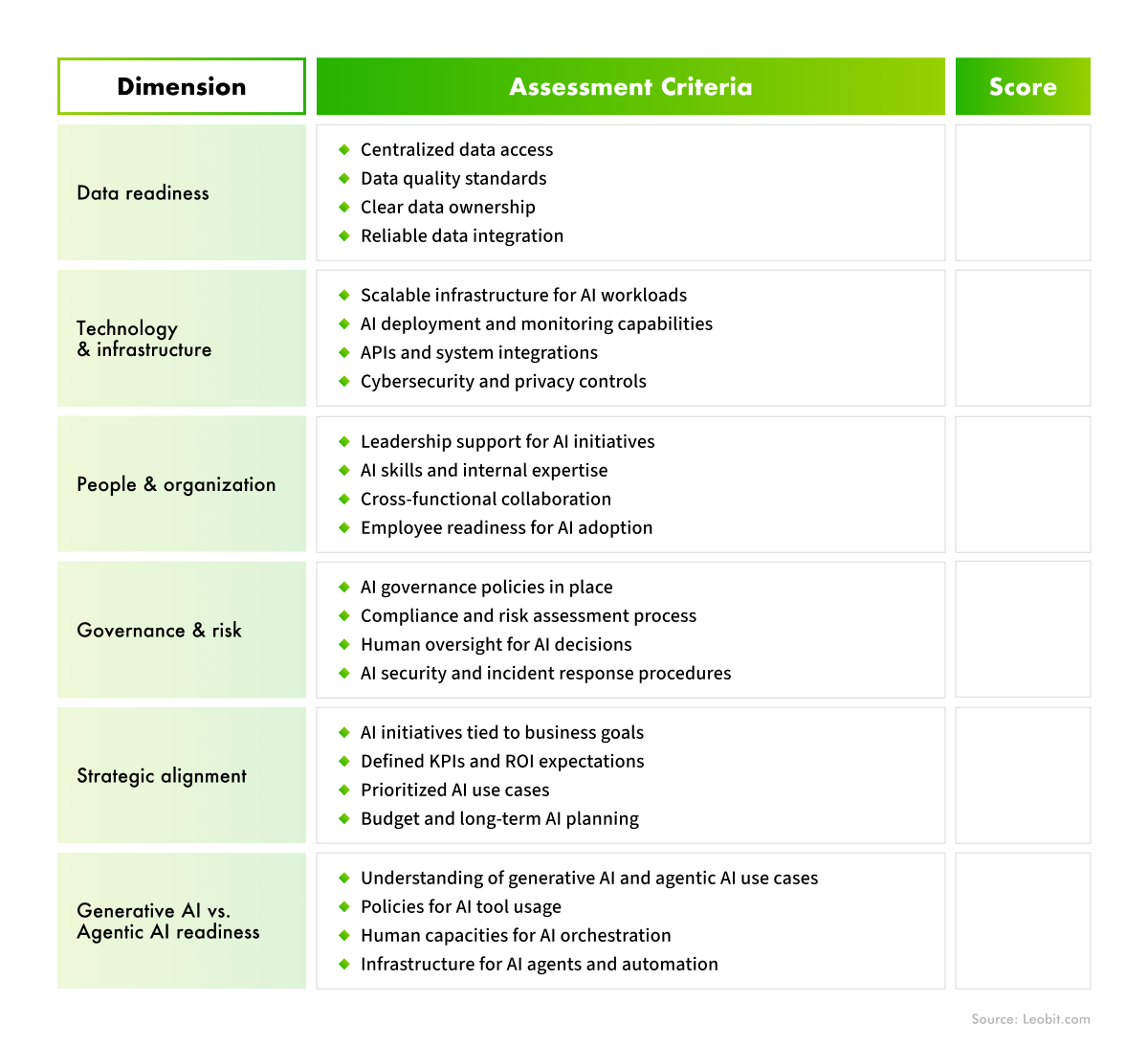
Sample AI Readiness Assessment Checklist

Below is a sample checklist for AI readiness assessment across the 6 key dimensions and their core components. Scoring principles look as follows:
1 – Not in place
2 – Early-stage
3 – Partially established
4 – Mostly established
5 – Fully established

Using these scoring methodology, specialists assess AI readiness across the dimensions and criteria presented on the scorecard below.

ai readiness assessment framework
Sample AI readiness assessment checklist scorecard

With such a checklist, reviewers can assign a separate score across all six dimensions. In such an AI readiness framework, the interpretation for these scores will look as follows:

Average Score
Readiness Level

Score interpretation

1.0-1.9

Very low readiness

Score interpretation

2.0-2.9

Low readiness

Score interpretation

3.0-3.9

Moderate readiness

Score interpretation

4.0-4.5

High readiness

Score interpretation

4.6-5.0

Advanced readiness

Important note: This scorecard uses simple averaging as a baseline for illustration. In practice, scoring should be weighted to reflect the industry, risk profile, and the type of AI being deployed. Also, critically low scores in certain dimensions, particularly Governance in regulated industries, should be treated as blockers rather than averaged out. A weak governance foundation does not become acceptable because other dimensions score well.

There’s no universal format for an AI readiness checklist. Its structure and scope can vary depending on the organization, industry, and business goals. What matters most is not the format, but whether the assessment delivers practical insights and clear next steps for AI adoption.

Common Mistakes with AI Readiness Assessment

The AI readiness assessment helps you identify existing gaps that can prevent your organization from successful AI adoption. However, interpreting the assessment and taking appropriate actions is as important as running the assessment itself. Let’s take a closer look at the common mistakes businesses make when interpreting and acting on the results of an AI adoption readiness assessment.

Mistaking pilot success for production readiness

Some businesses think that a successful pilot automatically means they’re AI-ready. In reality, a pilot is just a first step. An artificial intelligence readiness assessment is still an essential step aimed at exploring whether AI can actually be scaled across the organization.

Even when everything runs exceptionally well, it doesn’t automatically mean an organization is ready for large-scale adoption. Pilots are often run in controlled environments. Even when they are launched in real-world conditions, they’re usually limited in scope – with fewer users, smaller datasets, and less operational complexity.

What works well in a controlled, small-scale setting can break down once it’s fully rolled out and embedded into real business processes. At scale, systems have to handle unpredictable user behavior, varying levels of AI literacy, traffic spikes, and much larger data volumes. Without the right infrastructure, governance, and internal workflows in place, these pressures can quickly expose gaps that weren’t visible during the pilot phase.

Building governance after the deployment

Suppose you have run an AI readiness assessment and managed to identify the key issues with security, compliance, accountability, and risk management. Addressing these questions is important, but governance shouldn’t be treated as something to figure out later. Its role is too critical to postpone.

The governance framework is a vital aspect of AI adoption because:

  • AI errors scale instantly across systems and decisions
  • Regulatory requirements are active and expanding across jurisdictions
  • Liability is undefined without clear ownership structures
  • Stakeholder trust, once compromised, is difficult to restore

Therefore, AI governance should be part of the readiness assessment from the beginning, not an afterthought.

Treating AI readiness as a one-time exercise

AI adoption readiness assessments should be conducted on a regular basis. Business priorities evolve, regulations become more stringent, new models emerge, and internal capabilities shift – so AI systems must continuously adapt to these changes.

Organizations that assess readiness once and move on tend to find themselves building on assumptions that no longer hold. Regular reassessment helps spot problems earlier, see whether past investments actually improved capabilities, and adjust AI initiatives before the costs of misalignment start piling up.

How Can Leobit Help You with AI Readiness Assessment and Adoption?

Without strong AI adoption and engineering expertise, it’s often hard for organizations to understand where they really stand across the key dimensions of AI readiness. And without that clarity, AI initiatives are often built on assumptions rather than evidence. What’s needed first is a solid baseline.

Leobit helps establish that baseline. We have deep experience in building custom AI solutions and are a Microsoft Solutions Partner for Data & AI. We also use custom AI agents in our internal operations. Our corporate LLM, with agents tailored for sales, marketing, and HR, was recognized with a Global Tech Awards win in the Artificial Intelligence category.

We combine technology consulting, technical audits, and business analysis to assess AI readiness in a structured, practical way. Beyond assessment, Leobit can support the full AI adoption journey. Whether you need to modernize your infrastructure for AI or build an agentic AI solution with strict alignment with your organizational structure and strategic goals, we are ready to help.

Final Thoughts

An assessment for AI readiness often becomes a key differentiator between AI initiatives that deliver measurable value and those that stall after the pilot. The organizations that get AI right don’t move faster than everyone else; they start with a clearer picture of where they actually stand.

Understanding gaps across data, infrastructure, people, governance, strategy, and AI maturity gives leadership a solid foundation for decisions that scale. The assessment itself is relatively straightforward – the hard part is turning it into consistent action over time.

Leobit can take that burden off your shoulders by running a tailored AI readiness assessment and helping you act on its findings. Contact us to discuss your goals and prepare your organization for AI adoption that delivers value.

FAQ

Leobit combines deep experience in AI development, technology consulting, technical audits, and business analysis to assess AI readiness across the core dimensions. We help organizations identify structural and tactical gaps, prioritize what needs to change, and build a roadmap for AI adoption. As a Microsoft Solutions Partner for Data & AI, we also support the full journey beyond assessment, from infrastructure modernization to custom AI software development.

Look for a provider with hands-on AI delivery experience. They should assess all readiness dimensions and produce prioritized, actionable findings rather than a generic AI readiness index. Industry experience matters, especially in regulated sectors where governance gaps can stop adoption altogether. A good provider doesn’t just deliver a report – they help you act on it too.

AI readiness assessment evaluates whether an organization is prepared to begin or scale AI adoption – it identifies gaps that need to be closed before initiatives move forward. AI maturity assessment measures how advanced an organization’s existing AI capabilities already are.

Start by defining the scope of your AI initiative. Follow with a stakeholder research and analyze both qualitative and quantitative inputs. Assess results in the context of risk and industry specifics rather than relying on average scores across dimensions, and pay particular attention to governance as one of the most critical areas. Run AI readiness assessments regularly to ensure your system adapts to changing conditions and requirements.