But what are actually the best ways to enhance logistics and supply chain management through AI adoption?
In this article, we explore AI use cases in logistics in more detail, explain their value for business, and share insights on common challenges.
Benefits of Using AI in Logistics and Supply Chain Management
A recent Hyperscience survey on AI adoption in logistics and transportation reveals that 70% of industry leaders are willing to invest in AI-optimized systems. The respondents whose organizations are already using AI highlight the key benefits of its adoption:
39% emphasize the positive impact of AI adoption on data quality, highlighting its ability to ensure consistency, standardization, and accuracy
31% say that AI can optimize supply chain decisions by analyzing large volumes of complex data, such as real-time traffic patterns, weather conditions, shipment tracking, and historical trends, leading to smarter route planning and more accurate demand forecasting
28% emphasize that AI reduces errors, especially in repetitive tasks like data entry, invoice processing, and document management
25% highlight AI as an effective way to increase flexibility, particularly during peak demand periods, which is likely driven by improved warehouse automation, faster risk detection, and better inventory management
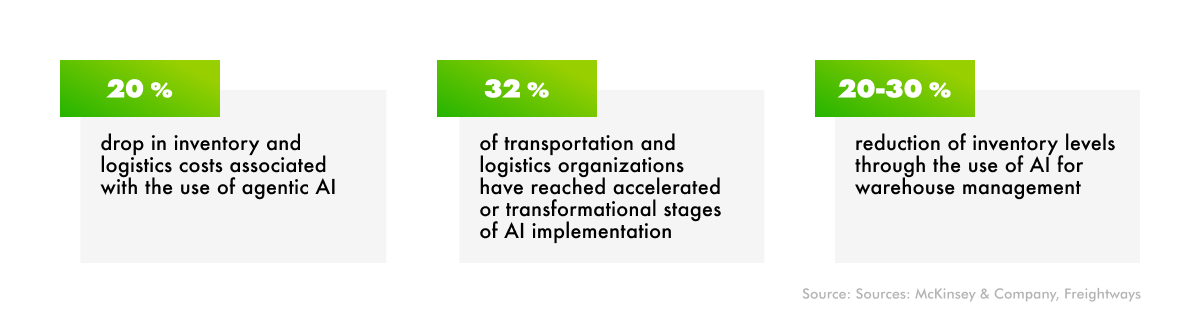
The image below also highlights key statistics on the adoption of artificial intelligence in logistics and its impact on operations.
Important numbers about the use of AI in logistics and supply chain management
Still, 74% of companies across industries struggle to achieve and scale value from AI adoption. One of the most important steps in overcoming this challenge is identifying the most suitable business case for artificial intelligence.
Top Use Cases for AI in Logistics and Supply Chain Management
AI features can be integrated into a wide range of logistics and supply chain management applications. Examples of common AI logistics use cases include integrating such functionality in transportation management systems (TMSs), warehouse management systems (WMSs), customer relationship management platforms (CRMs), and enterprise resource planning platforms (ERPs). They are also commonly used in fleet tracking, shipment visibility, and risk monitoring solutions. Such capabilities help companies automate decisions, improve accuracy, and gain real-time operational insights.
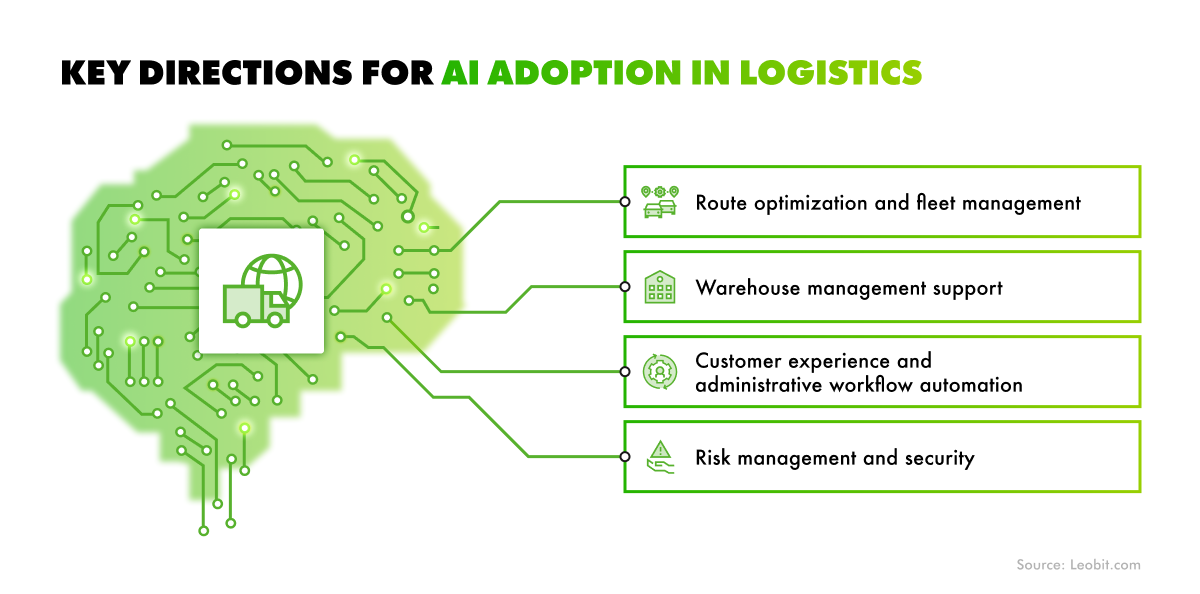
Basically, AI logistics use cases can be divided into the categories presented in the image below.
Top use cases for AI in logistics
Let’s take a closer look at these categories and the practical use cases already helping logistics businesses work faster, smarter, and more efficiently.
Route optimization and supply chain management
McKinsey states that a last-mile operator with a fleet of more than 10,000 vehicles generated $30–$35 million in savings by deploying AI-powered dispatcher agents, based on an investment of just $2 million.
The point is that there are many inefficiencies and challenges in what seems like a simple process: taking goods from point A to point B. The intelligent adoption of AI models helps logistics businesses optimize routes, improving the speed and cost-effectiveness of transportation operations.
Dynamic route planning
AI algorithms integrated into routing engines can simultaneously analyze hundreds of variables. They consider multiple factors, such as driver availability, vehicle capacity, delivery priority, historical traffic patterns, and fuel costs, to suggest optimal routes.
With AI route optimization, drivers choose the fastest, safest, and most fuel-efficient routes. This smart assistance reduces the load on human operators and ensures that the shipment is delivered in the optimal way. This translates into more efficient and cost-effective deliveries, as well as improved employee and customer satisfaction.
Real-time traffic and weather adaptation
AI models integrated into fleet management systems can collect and process significant amounts of information from various sources, including live traffic feeds, weather forecasts, and driver notes. Such a logistics data analytics solution uses this information to provide drivers and operators with real-time route updates and suggestions.
Instead of calling dispatch to report a highway closure, a driver can just adhere to suggestions of a system that delivers route updates and calculates alternatives before the vehicle reaches the bottleneck. This feature is especially critical to time-sensitive freight operations where any delay can mean a failed shipment.
Fuel consumption optimization
Fuel is often cited as one of the highest operating costs in any logistics business. For example, in 2022, it could account for around 40–63% of total energy costs in maritime logistics. AI systems help logistics businesses reduce fuel consumption by optimizing route selection for fuel efficiency.
Models can flag inefficient driver behaviors like excessive idling or hard braking. They also recommend optimal refueling stops based on price data along the route. Even small improvements in fuel consumption can make a noticeable difference in long-term costs for logistics companies.
Real-time shipment tracking
AI-powered tracking goes beyond a GPS dot on a map. Artificial intelligence models can aggregate data from carriers, ports, customs, and ground logistics to build a unified view of every shipment’s status across the entire supply chain.
As a result, both logistics operators and customers receive more accurate delivery estimates based on live conditions rather than static schedules. This improves transparency and reduces inbound support volume. Instead of contacting a support agent to check a shipment status, customers can use an AI assistant to access the information they need.
IoT-integrated cargo monitoring
For sensitive freight like pharmaceuticals, fresh food, electronics, or hazardous materials, location tracking alone isn’t enough. IoT sensors in containers or pallets track temperature, humidity, shocks, light, and tampering. AI monitors such workflows and alerts if something goes wrong immediately.
For example, if a refrigerated truck carrying vaccines exceeds 8°C for a few minutes, such cargo-tracking technology notifies logistics operators. This helps catch problems early and keeps shipments in usable condition, improving the overall quality of delivery services.
Warehouse management support
A study by Mecalux and the MIT Intelligent Logistics Systems Lab reveals that around 90% of warehouses apply automation beyond basic, routine workflows. AI adoption stands out here as a way to make this automation more intelligent. Below are the key AI use cases in warehouse management.
AI-driven inventory management
AI systems continuously analyze sales velocity, seasonal demand patterns, supplied lead times, and stock levels to maintain optimal inventory in warehouses at all times.
With these monitoring capabilities, warehouse managers and operators are informed about potential stockouts before they occur. AI models can also recommend reorder quantities and identify slow-moving inventory. The result is leaner stock, fewer emergency orders, and less waste.
Computer vision for quality control
AI-powered vision systems can accelerate item inspection. Cameras installed in warehouses or on conveyor lines help with monitoring goods. Such footage is then processed by AI models in real time to catch issues like:
Damaged packaging
Wrong labels
Size mismatches
Foreign objects
All the problematic items are flagged so that specialists can remove them from the line. As a result, fewer defective items reach customers. This logistics automation helps businesses reduce the number of returns and secure their reputation.
AI slotting systems can recommend optimal storage locations for various items. They base their decisions on factors like:
Order history
Item weight
Product dimensions
Pick frequency
As a result, high-velocity items get positioned closest to packing stations. Items frequently ordered together get slotted near each other. This helps warehouse managers use space more efficiently and keep picking workflows better organized.
Amazon, a global logistics leader, went even further in applying AI to warehouse operations. In 2019, the company introduced Xanthus and Pegasus, AI-powered robots that can move goods across the warehouse while helping optimize the use of warehouse space.
Risk management and security
A single disrupted shipment can cascade across an entire supply chain. For instance, a container with irreplaceable production line equipment gets stuck in a port. This may cause an entire factory production line to stop for a few days. In such conditions, proactive risk management becomes a genuine competitive advantage. That’s where artificial intelligence systems, including agentic AI solutions with capabilities for proactive reasoning, can make a difference.
Cargo theft and fraud detection
With cargo theft rising by 27% in 2024 in the US alone, logistics companies need more effective ways to respond to these threats. AI systems can help with this because they monitor shipment patterns, location data, access events, and transaction behavior. They flag anomalies that signal ongoing theft or fraud.
For instance, such intelligent transportation systems can detect:
Unusual route deviations
Unexpected stops in non-delivery zones
Billing patterns that are inconsistent with historical data
Upon receiving such a notification, logistics operators get a window to intervene before a loss is confirmed. With a proper response strategy, this feature can significantly reduce cargo theft risks.
Predictive maintenance for vehicles and equipment
A single broken vehicle can disrupt the entire delivery schedule. One delay pushes back multiple deliveries, creating a chain reaction in tighter routes where several stops end up late just because one vehicle went out of service.
AI models can improve the efficiency of predictive vehicle and equipment maintenance by analyzing telematics data, engine diagnostics, mileage, and component wear patterns to forecast when a vehicle or piece of equipment is likely to require attention. Smart logistics solutions can create optimal maintenance schedules that consider low-utilization windows. This ensures optimal resource allocation and availability across the entire supply chain.
External risk analysis
Warfare near the Strait of Hormuz has led to major global supply chain disruptions, pushing oil prices up and causing significant losses for many businesses. This example shows how important supply chain risk modeling has become.
Risk management powered with AI in logistics can analyze and forecast the impact of different external threats, such as:
Geopolitical disruptions
Port congestion
Supplier financial instability
Natural disasters
Regulatory changes
Based on this analysis, AI models can generate risk scores and help logistics teams spot weak points before they turn into real problems. As a result, companies become more resilient to disruptions.
Regulatory compliance monitoring
Businesses operating in the logistics industry should navigate a solid list of rules, standards, laws, and regulations. AI assistants integrated in a digital supply chain management software help them keep track of:
Customs regulations
Hazmat requirements
Trade sanctions
Import/export rules
While most of the above-mentioned regulations are dynamic, AI compliance assistants track their updates in real time and automatically validate shipment documentation against applicable rules before goods move. With such support, companies can reduce the risk of customs holds, penalties, and rejected shipments. This is particularly important for businesses with international supply chains or those involved in cross-border logistics.
Customer experience and administrative workflow automation
Around 82% of logistics business administrators indicate that manual document processing has a heavy to extreme impact on their operational efficiency. Many such workflows are high-volume, repetitive, and rule-based, which makes AI an optimal assistant for automating them.
AI-powered customer support and chatbots
Logistics customer support deals with a huge volume of repetitive inquiries, such as where a shipment is, why it’s delayed, and how to file a claim. AI can help logistics and transportation companies deal with this problem. In fact, Gartner reveals that 20% of logistics leaders have reduced agent staffing due to AI. Such numbers may not seem sufficient at first. Still, they reflect a broader shift. Business leaders increasingly see AI not as a replacement for human specialists, but as a support tool that can boost employee productivity by up to 60%.
AI-powered assistants can handle customer inquiries around the clock without wait times, pulling tracking data and account information to give accurate, personalized responses. When facing more complex issues, they can escalate them to human agents while providing quick suggestions and support for information search.
Intelligent document processing
Paperwork still takes a significant part of administrative workflows in logistics. For example, 32% of organizations still rely heavily on paper documentation, and 53% cite document compatibility as a major administrative challenge in logistics. AI-powered document processing systems can help logistics companies handle this problem by extracting, validating, and routing the information automatically.
This approach ensures greater administrative consistency and that all necessary materials are saved in the appropriate systems. Additionally, logistics businesses reduce manual data entry, which is often a major source of errors and delays.
Bill of lading and invoice extraction
Bills of lading and freight invoices are particularly high-value targets for AI automation, given their volume and the cost of errors. AI models paired with optical character recognition (OCR) systems can pull shipper and consignee details, important numbers, cargo descriptions, weights, charges, and reference numbers with high accuracy. If properly trained, they can understand industry context and handle even non-standardized or handwritten descriptions.
Other AI agents can automatically reformat the extracted information, flag potential issues, or populate the data for necessary reports or dashboards. This helps logistics companies save both time and costs while maintaining greater accuracy in reporting and cost estimates.
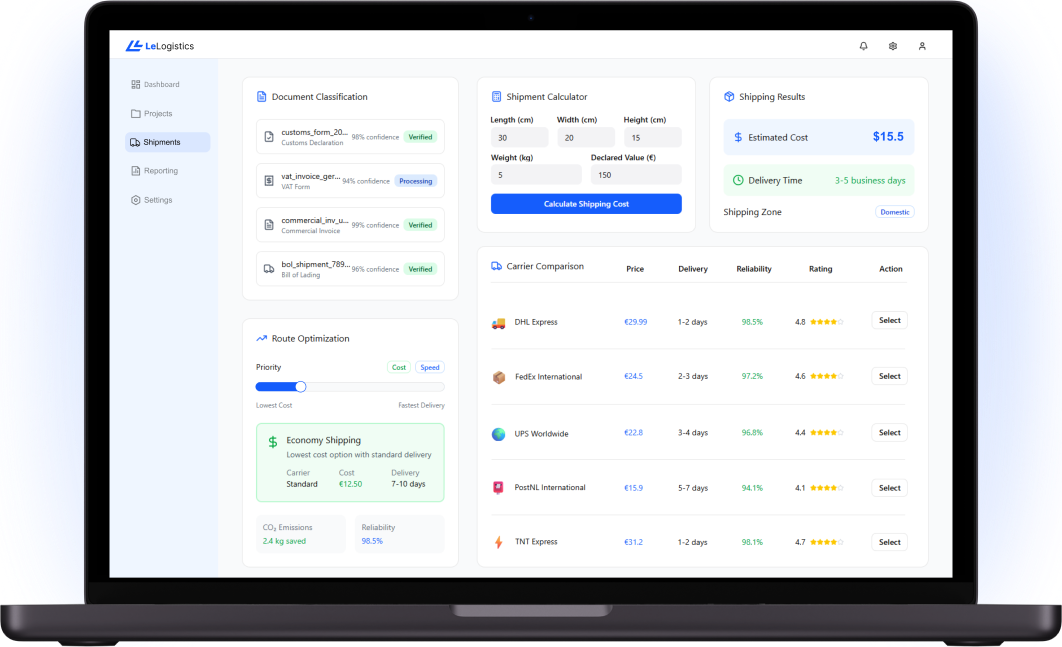
An example of such an AI-powered tool is Leobit’s invoice and receipt parsing solution. It uses a custom classification model to identify the type of document to be parsed and uses the functionality of Azure AI Document Intelligence to extract data from receipts and invoices and deliver it in a well-organized and consistent format.
According to Gartner, 75% of analytics workflows will be enhanced and automated by generative AI. In logistics and supply chain management, AI’s analytical capabilities can significantly improve planning. In particular, demand forecasting AI models can process historical order data, market trends, seasonal patterns, and promotional calendars to generate more accurate demand predictions.
Logistics optimization tools powered with such capabilities help companies reduce stockouts and align supply chain capacity with changing conditions. For example, AI-powered capacity planning can help logistics companies schedule truck driver workloads more efficiently to match expected delivery demand.
Carrier and partner performance analytics
AI-powered analytics can also help logistics companies select the most reliable partners and carriers. They can aggregate data such as on-time delivery rates, damage rates, invoice accuracy, and communication responsiveness across all partner relationships. This ensures more data-driven contract negotiations and stronger partner management. It also helps identify underperforming partners and make timely adjustments to optimize the supply chain. This approach applies across the entire supply management cycle.
For instance, an AI model can assess storage conditions or the reliability of a specific warehouse and assign it a quality score. Instead of completing the entire evaluation manually, a logistics operator gets an objective overview of the facility’s strengths and weaknesses, supporting a more informed decision on whether to engage it as a partner.
Challenges of Adopting AI in Logistics
Despite many possibilities that AI brings, only 13% of logistics businesses have managed to achieve a full-fledged and successful adoption of artificial intelligence in the industry. This is largely due to the common implementation challenges specific to the logistics and supply chain industry.
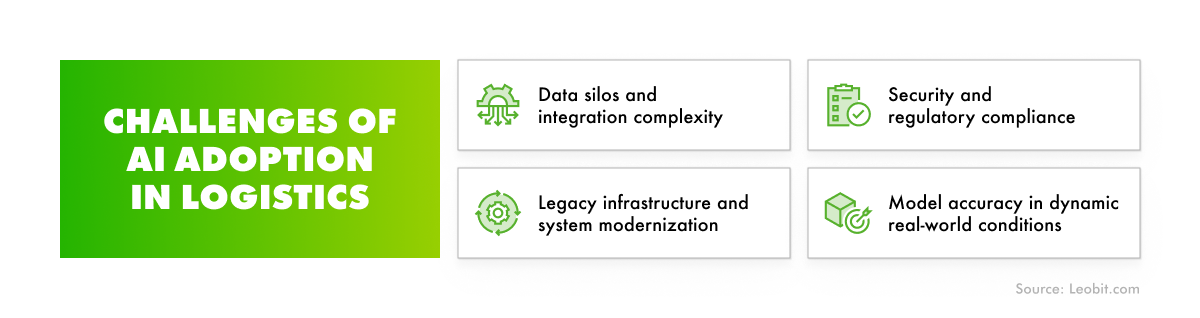
Common AI adoption challenges in logistics and supply chain management
Let’s take a closer look at some of them:
Data silos and integration complexity
Logistics and supply chain networks typically consist of many interconnected components. With fragmented systems across transportation providers, warehouses, procurement partners, and last-mile delivery operators, managing end-to-end distribution becomes complex. Each part of the chain often relies on its own domain-specific software, and data is stored in different formats and systems. Building a unified view of operations becomes difficult, while AI models often lack access to the consistent data required for accurate predictions and effective automation.
The long-term solution is to achieve full system interoperability through a unified data layer that consolidates information for AI-driven analysis. Connecting disconnected systems and building this foundation takes solid engineering effort, but it leads to more reliable AI performance and a clearer, centralized view of operations. Over time, this investment pays off through better coordination, consistent decision-making, and more effective end-to-end supply chain management.
Legacy infrastructure and system modernization
Over 47% of logistics executives report that integration with existing systems is a major barrier to AI adoption. Many organizations still rely on legacy TMS and ERP platforms that were not designed with AI capabilities in mind. These systems are often rigid, costly to modify, and poorly compatible with cloud-based AI tools.
The long-term solution is comprehensive software modernization aimed at making infrastructure AI-ready. However, large-scale upgrades can disrupt ongoing operations, which is especially risky in a dynamic logistics domain. For this reason, a gradual and strategic modernization approach is often a safer and more practical choice than full system replacement.
Around 45% of business executives express concerns about the accuracy and bias of AI models, identifying this as a major barrier to AI adoption. This challenge is especially relevant in logistics and supply chain management. AI solutions may perform well during testing, but real-world conditions are far more complex and constantly changing. Factors like weather, demand spikes, traffic congestion, and geopolitical disruptions can quickly affect outcomes. As a result, models trained on historical data lose accuracy over time.
To maintain reliable performance, companies need to invest in continuous development, regular retraining, and fine-tuning of their models. Another vital step involves setting up a strong monitoring framework that detects performance and data drift. Without these safeguards, AI systems can produce outdated or misleading recommendations, which may negatively impact logistics operations.
Security and regulatory compliance
Logistics businesses handle large volumes of sensitive data, including shipment details, customer information, and payment records flowing through their operations. Therefore, security is a major concern, with 54% of executives citing it as a significant barrier to AI adoption in logistics and supply chain management. At the same time, global logistics operations must comply with a wide range of regulations, including customs rules, data privacy laws, and transport safety standards. These requirements vary significantly across countries and can also change frequently.
AI systems must be designed with such constraints in mind from the start. One possible approach is an agentic AI solution, where different agents are responsible for specific workflows and oversight tasks. For example, one agent can handle document processing and organization, another can monitor outputs to ensure compliance, and a higher-level agent can coordinate and govern the entire system. Building such multi-agent systems is complex and requires significant upfront investment. An alternative approach is to maintain strong human oversight, supported by AI-powered security and compliance monitoring tools. While this adds complexity to deployment and scaling, strong controls are essential for any AI system in logistics.
How Leobit Can Help You Leverage AI in Logistics
Successfully adopting AI in supply chain management and logistics can be challenging. There are many points where issues can arise, from tailoring AI capabilities to business-specific workflows to ensuring the security of sensitive data exposed to models. To address these challenges, you will require strong AI expertise combined with deep industry knowledge.
In addition, Leobit brings over 10 years of experience in logistics software development, building solutions that improve operations across the supply chain. We have helped companies build solutions that improve supply chain visibility, automate operational workflows, support route and delivery management, and connect logistics processes across different systems and stakeholders.
Below are several examples of how we have helped logistics and supply chain companies implement successful software.
Intelligent shipping orchestration platform
Leobit helped a large logistics and transportation company from Sweden build an intelligent shipment tracking solution. The platform uses multiple AI agents to support workflows like shipment monitoring, carrier selection, and document management, along with built-in compliance management. In particular, an AI agent can respond to regulation-related questions by retrieving relevant information from a curated knowledge base.
After adopting the solution, the company improved the accuracy and efficiency of routine operations. The automation capabilities also reduced manual work by nearly 64%.
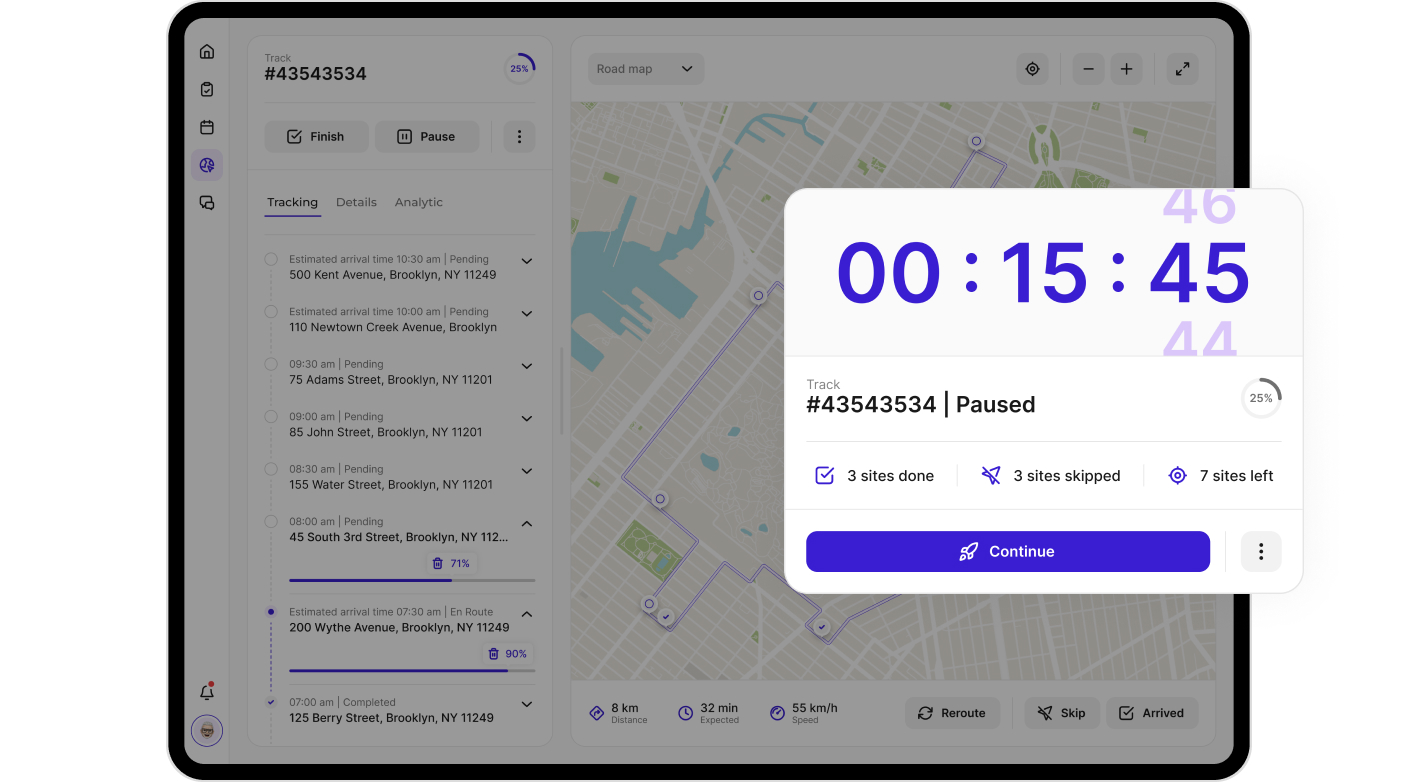
Our specialists helped a logistics software provider migrate their smart container management app from Android to Flutter, expanding it to multiple platforms and modernizing the UI/UX. The app features dynamic dashboards that help users monitor the proper placement of approved waste containers. It also includes capabilities for optimizing and tracking waste collection routes in real time.
Screenshot: Logistics route optimization solution
After the migration, the platform helped its users achieve cost savings of up to 35–40% through more efficient waste management workflows.
AI has a variety of implementations in logistics and supply chain management – dynamic route planning, warehouse automation, routine administrative task support, risk management, etc. With smart logistics solutions like these, companies can significantly improve efficiency, speed up delivery times, and enhance shipment quality as well as overall service.
At the same time, the path to meaningful results isn’t straightforward. Data silos, legacy infrastructure, and model reliability in dynamic real-world conditions remain genuine barriers to successful adoption of AI in logistics.
Partnering with an experienced software development company can help you minimize these challenges. Leobit is exactly such a company.
Whether you want to build a custom AI solution for supply chain management, automate logistics processes, or modernize an existing platform to make it AI-ready, our team can help. We also provide AI consulting for supply chain and logistics companies that need a clear adoption strategy. That way, you get a realistic roadmap that supports your business goals while helping you avoid technical debt.
Contact us to discuss your needs and find out how we can help you leverage AI in logistics.
FAQ
The most impactful AI applications in logistics include route optimization and supply chain management, warehouse automation, security and risk management, as well as customer support and administrative workflow. These use cases help improve efficiency, reduce costs, and increase accuracy across core logistics operations.
The most common barriers are data silos across fragmented systems, legacy TMS and ERP platforms that aren’t AI-ready, and AI models that lose accuracy as real-world conditions change. Security and regulatory compliance add another layer of complexity, especially for companies operating across multiple countries.
Results vary by use case, but the numbers are significant. One last-mile operator generated $30–$35 million in savings from a $2 million AI investment. Leobit’s intelligent shipping platform reduced manual work by nearly 64%. A route optimization solution our team worked on also helped users achieve cost savings of 35–40% by optimizing waste management workflows.
Start by identifying the specific workflows where AI can solve a specific problem. From there, assess whether your data infrastructure can support AI reliably, and consider whether you need to modernize legacy systems first. Working with a partner that understands both the technology and the logistics domain can shorten the path from strategy to production.
Roman has a deep passion for a wide array of subjects, spanning from market insights to in-depth technical examinations of complex projects. He dives deep into technical aspects of various solutions to extract valuable insights for business purposes, and he enjoys sharing tips and tricks with business owners to help them leverage advanced technologies effectively.
Vitalii is an experienced solution architect with a strong background in designing scalable, high-performance architectures. He uses modern technologies, including AI, .NET, and cloud-native services to help Leobit customers design and build software solutions tailored to their business needs. In addition to his technical expertise, Vitalii takes part in the company’s R&D efforts, drives internal excellence initiatives, and plays a key role in presales activities.
Nearly 90% of organizations are already piloting or deploying generative AI in their quality engineering practice, according to the World Quality Report 2025. ...
Lenovo’s 2026 CIO Playbook, with research by IDC, found that 46% of AI proofs of concept (PoCs) have progressed into production, so just over half have ...
Leona, Leobit’s AI agent designed to find promising cooperation opportunities and automatically send requests for proposals (RFPs), has helped our sales ...
Gartner estimates that generative AI cost projections can be off by 500% to 1,000% when organizations fail to account for how costs scale. They also predict ...
A 2025 DORA survey found that 90% of software engineers now use AI in their daily work. These numbers show that AI adoption has become a universal standard in ...
AI features rarely fail during a demo. They usually fail a few months after launch, when finance asks why the AI assistant is costing far more than anyone ...
Open WebUI has over 376 million downloads since its release in 2023, a scale of adoption that puts it among the most widely deployed open-source AI projects to ...
Lviv, Ukraine, August 2026 — Leobit has introduced an AI-native software development lifecycle (AI-native SDLC), a delivery model that embeds AI into the ...
6 mins read
We use cookies to enhance your browsing experience. By agreeing, you accept our Privacy and Cookies Policy.
By ignoring or closing this banner, we will only collect essential cookies necessary for the website to function properly.
 Leobit