Contact us

What Is AI-First Software Development and How Can Your Business Benefit from It?

19 mins read

ai adoption strategy
Blog Calculator Widget Logo

Estimate Your Software Project Cost

Describe your idea — get a budget breakdown in minutes.

Get Your Estimate

With 23% of highly AI-mature businesses citing system integration complexity as a key barrier to implementation, the need to design AI-centered architecture from the start is becoming increasingly hard to ignore. In fact, Gartner predicts that by 2028, organizations sustaining an AI-first strategy will achieve 25% better business outcomes than their competitors.

What does committing to that approach actually mean in practice?

AI-first development is a strategic shift that goes beyond technical decisions and changes how products are built and scaled.

This article breaks down what AI-first development is, key characteristics that define it, and the main benefits of this approach compared to adding AI to your product as an afterthought. We also provide a few practical tips for building genuine AI-first software.

What Is an AI-First Approach to Software Development?

AI-first software development is a strategic approach that treats AI as a foundational layer of a product, rather than an optional feature that can be added later. The entire software development lifecycle is designed from day one to use AI workflows. The team builds the rest of the system – APIs, databases, UI, business logic – around what the AI model needs.

Two areas where the AI-first approach is especially visible are the application’s business logic and architecture.

In an AI-first system, a development team does not write business logic as explicit rules and conditions. Instead, the specialists define it by the capabilities of an AI model that decides, ranks, or generates outputs based on learned patterns rather than hardcoded logic.

Software engineering specialists also make all critical architectural decisions, such as data infrastructure, storage schemas, and API design, with AI model requirements in mind from the outset. AI-first systems typically require three core components: models that generate outputs, pipelines that feed those models data in real time, and feedback loops. The rest of the product is built around the capabilities for orchestrating these components.

AI-first development is relevant to both startups that build products with AI as the core value proposition and established enterprises rethinking their operations around AI.

Key Characteristics of an AI-First Software Development Approach

An AI-first strategy to product development is recognized by how the team treats AI in day-to-day decisions. Basically, there are three critical characteristics that separate the development of an AI-first product from running AI integration experiments alongside the main product.

AI is a fundamental strategic component

According to the IDCA report, 87% of professionals and leaders in the tech industry view AI as their organizations’ top strategic priority. However, the AI-first approach goes further than mere prioritization. In this model, AI is the major decisive factor for every major business decision, including pricing, hiring, and go-to-market strategy.

ai adoption strategy
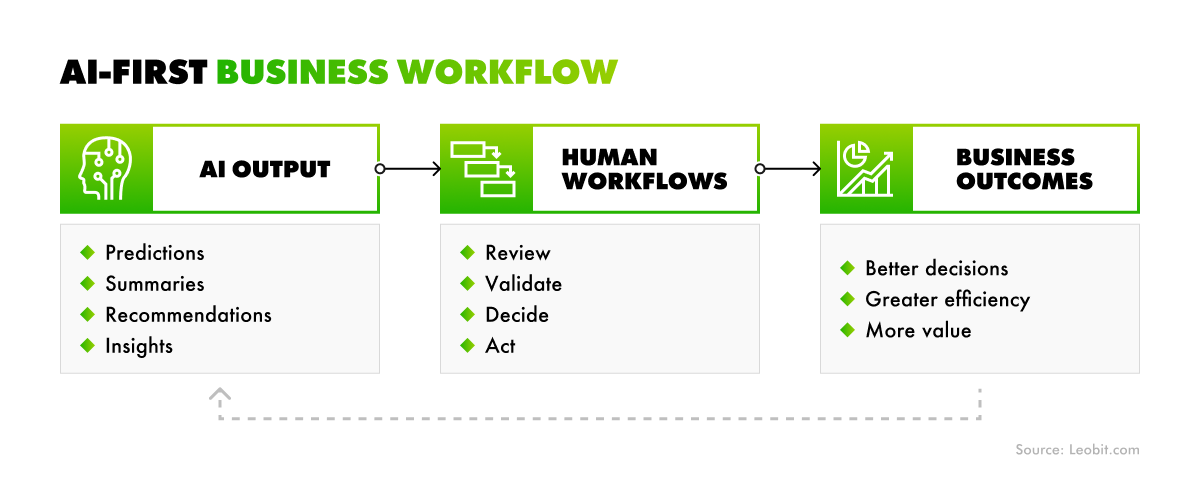
AI-first business workflow

For example, a company building an AI-powered legal software doesn’t treat AI as one feature among many. Artificial intelligence defines the business case from the start and even influences decisions like whether to hire ML engineers or legal domain experts.

Data pipelines are core infrastructure

Around 42% of business executives cite the lack of relevant data as one of the major barriers to AI adoption. Therefore, the AI-first approach starts with a solid data foundation, treating data as a first-class product asset. AI-first teams invest early in clean labeling, structured storage, and reliable pipelines, because the quality of model output is bounded by the quality of the data flowing into it. Many of these teams look for data engineers before they hire AI engineers to develop an AI-powered product.

AI Models are versioned, monitored, and iterated

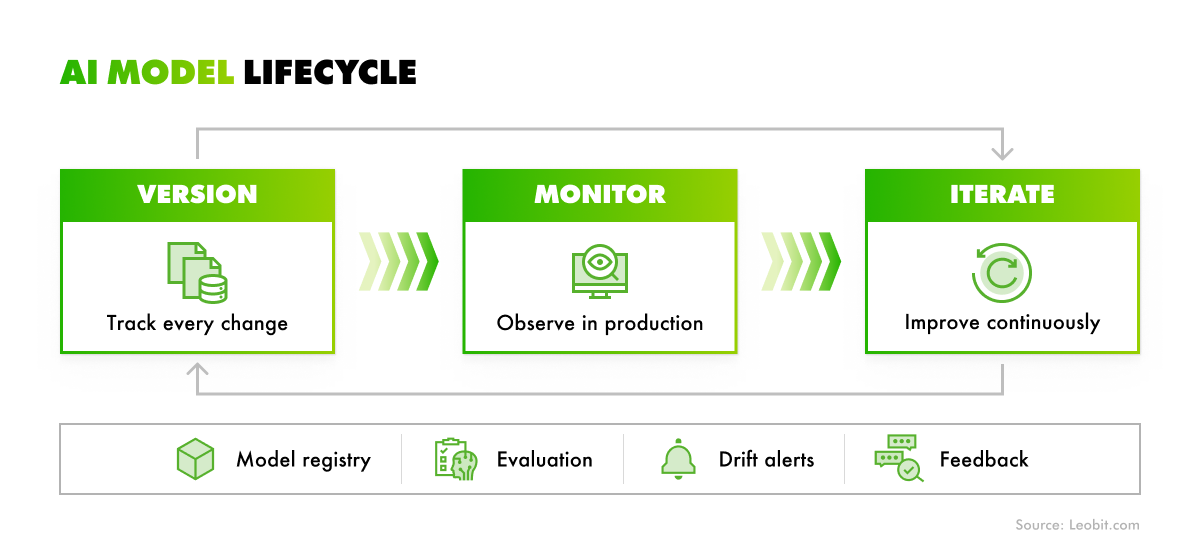
AI models are managed with the same rigor as application code. The team tracks each model version in a model registry alongside its evaluation metrics, training dataset lineage, and deployment configurations. In the AI-first approach, teams follow these principles for managing models:

  • Monitoring production for data drift, latency, and cost per inference
  • Setting automated triggers to flag when model accuracy drops below a defined threshold
  • Integrating model evaluation gates into CI/CD pipelines to ensure that a new version reaches production only if it meets certain performance benchmarks
  • Set up automated rollback workflows for cases when post-deployment metrics degrade
ai strategy development
The lifecycle of an AI model in the AI-first approach

Apart from monitoring, this approach involves continuous iterative improvement of models through diverse techniques, such as fine-tuning and prompt-tuning.

 Book Icon

Business Benefits of AI-First Software Development

Whether you are building a system to support internal operations or a customer-facing product, the AI-first approach delivers solid advantages over systems where AI is added as an isolated feature after the fact. The difference is architectural: in an AI-first system, software engineering specialists design pipelines, data schemas, endpoints, and monitoring infrastructure around the requirements of the model from day one. Below, we outline the key benefits this produces in practice.

Cost structure that scales favorably

Systems built without AI implementation in mind tend to keep humans in the loop by default – not by design choice, but because the underlying business logic and data flows were never structured to hand off decisions to a model.

In AI-first products, things work differently. Software engineers design such solutions from the ground up around model outputs. The structure workflows so that decisions, validation, and routing can be handled autonomously, without a human bottleneck at each step. The result is a cost model that scales with compute, not headcount. This approach supports better control of AI costs as usage grows, aligning with the goal reported by 54% of company executives who are focused on achieving cost savings through artificial intelligence.

A product that improves with use

AI integration into the existing product doesn’t mean that the model won’t improve over time. However, in such products, improvement cycles tend to stay partially manual and engineering-dependent. Capturing and routing model outputs back into training pipelines requires deliberate effort that the original architecture wasn’t built to support.

On the contrary, AI-first systems make this structural from the start. AI models treat every user interaction as a training signal, with feedback loops for capturing, labeling, and routing outputs built into the architecture from day one. The result is a product that automatically compounds its capabilities over time. It can learn autonomously, getting smarter with usage rather than requiring continuous reengineering to absorb new AI capabilities.

Faster iteration on AI capabilities

In a retrofitted system, introducing new AI capabilities often means working around existing architecture. This typically involves:

  • Adapting pipelines that weren’t built for powering AI models
  • Using data schemas that predate the AI layer
  • Testing changes without a proper evaluation infrastructure adapted to AI integration needs

In an AI-first setup, model updates, retraining, and testing are part of the default release cycle. The development team builds the system for constant iteration, so new AI features can be rolled out without major rework, and teams can react faster when business needs or market conditions change. That speed matters even more in today’s AI race, where 92% of companies are planning to increase their AI budgets this year to implement new features.

Reliability and observability by design

Adding AI to an existing product often means treating it as a feature rather than a core system. Without pre-built monitoring workflows, tracking model-specific signals like prediction drift, confidence score degradation, and input distribution shift can be more challenging. These problems tend to require deliberate instrumentation that the original architecture wasn’t designed to support.

An AI-first product treats model performance as production-critical from day one. It involves dedicated monitoring pipelines that track prediction drift, confidence score distributions, input feature statistics, latency percentiles, and cost per inference, alongside standard infrastructure metrics. If model quality drops, alerts and rollback mechanisms work the same way they would for a system outage. Model failure is treated as a product failure – with the same on-call ownership, incident response process, and postmortem expectations applied to any other critical system component.

Better observability matters because AI models don’t stay accurate forever. Across industries, performance can drift over time as real-world data changes. In areas like medical diagnostics, for example, studies have shown that models trained on historical data tend to become less reliable over time, especially when applied to new cases.

Improved user personalization

Feature-level personalization(e.g., a recommendation widget, a smart search bar) works within the data exposed at that specific touchpoint. To help an AI system understand the bigger picture, you often need to adjust how the model is configured or rethink the underlying data architecture.

AI-first systems approach this differently. User modeling and data architecture are built in from the start, giving the model continuous access to the full picture of behavior flowing through the system – across sessions, features, and interaction types. The result is personalization that adapts across the entire product experience, compounding in relevance over time as the model accumulates a richer signal about each user.

For customer-facing apps, such as e-commerce platforms, this can mean delivering more relevant product recommendations to users. For internal apps, like task management systems, it can take the form of an interface that automatically adapts to the needs of specific specialists.

Common Misconceptions about the AI-First Development Approach

With the growing AI investment, only 1% of executives call their companies “mature” on the deployment spectrum. Among the main problems is the lack of a well-defined AI business case, cited by 42% of company executives as one of the top AI adoption challenges.

This points to the fact that many organizations still lack a complete understanding of AI and its business value. The domain is still bounded by many misconceptions that apply to AI-first software development as well. The most common ones are the following:

  • “AI-first means automating everything.” AI-first is a design philosophy where product architecture is built around AI model requirements from the start, not a mandate to automate all workflows. It should not be confused with the automation peculiar to approaches like AI-augmented software development. The latter focuses on how software is built, while AI-first defines what the product fundamentally is.
  • “AI-first is only viable for large enterprises with big budgets.” Cloud-native inference, pre-trained foundation models, and managed AI services, such as those provided by Azure, have lowered the entry barrier. An organization can ship an AI-first product on a serverless inference stack without investing in GPU clusters or large ML research teams.
  • “One successful AI feature makes a product AI-first.” A recommendation widget or smart search layer on top of an existing system doesn’t make your solution AI-first. In AI-first products, models shape the core architecture. If you can remove the AI layer without changing the product itself, it wasn’t AI-first in the first place.
  • “You need massive datasets before you can start.” With foundation models, fine-tuning, RAG, and few-shot prompting, AI-first systems can still produce strong results from relatively small, high-quality datasets. The key point here is to start with narrow and specific use cases. When real data is limited, synthetic data can often help bridge the gap.
 Book Icon

Understanding what makes software AI-first is important. But building it requires a structured approach grounded in that philosophy.

AI-First Approach in Software Engineering: Essential Steps

Here are key steps and best practices in an AI-first development workflow. They go beyond implementation and focus on shaping the right planning and design approach to build a genuinely AI-first product.

ai adoption framework
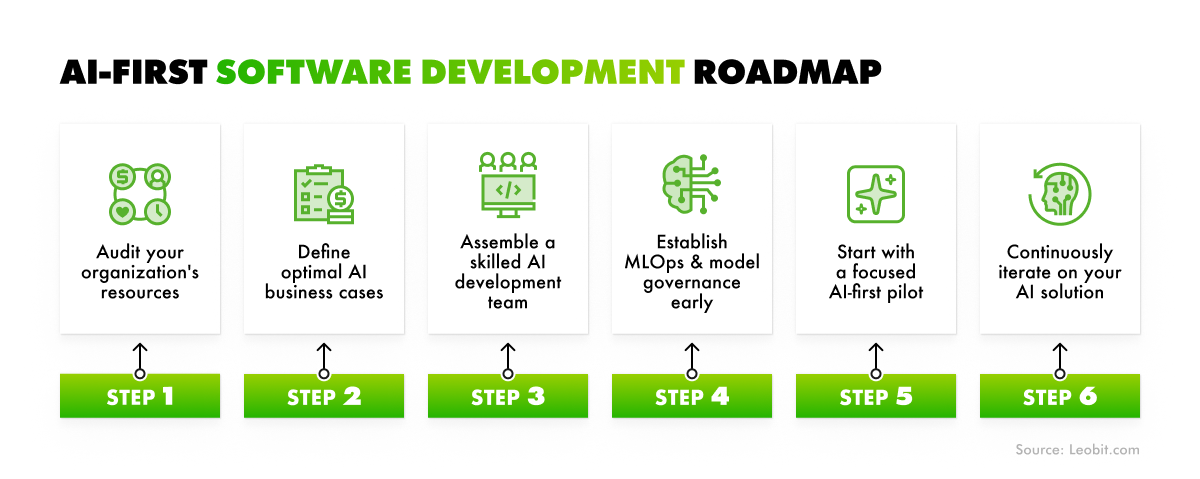
Core steps in AI-first software development

Below, we provide a more detailed explanation of each step and its value for your AI-first initiative.

Audit your organization’s resources

Before committing to an AI-first approach, take stock of what you have. If you are building a product for internal use, run a comprehensive AI readiness assessment to determine whether your organization is ready.

Identify whether your team has the engineering depth to build and maintain AI systems in production. A clear-eyed resource audit prevents you from starting an AI-first initiative with the wrong foundation. For example, if your team skips data pipeline development early due to a lack of experience, you may need to rebuild core infrastructure mid-product just to support basic model retraining.

 Book Icon

Define optimal AI business cases

Not every problem needs an AI-first approach. Focus on use cases where model capability is central to the value. AI-first software works best for prediction, classification, generation, or pattern recognition at scale, where rule-based systems or solutions with limited AI capabilities fall short.

Define each case in terms of business outcomes: faster processing, lower error rates, higher conversion, or reduced cost per transaction. Pick the right type of AI for your needs. For example, complex multi-step workflows may require agentic AI systems. Clear planning upfront helps keep the initiative grounded and gives you a baseline for measuring real impact.

 Book Icon

Assemble an experienced AI development team

AI-first products require a distinct combination of skills:

  • ML engineers who can design and evaluate models
  • Data engineers who can build reliable pipelines
  • Software engineers who understand how to integrate inference into production systems
  • Product leaders who can translate business goals into model requirements

The shortage of AI skills is a notable issue, reported by 15% of highly AI-mature businesses and 27% of less mature ones. A possible option for filling this gap is delegating the entire project to a dedicated team with strong AI development expertise and a deep understanding of the AI-first model.

Upon assembling an AI development team, clearly define ownership, especially for model monitoring and incident response. This will help you avoid accountability gaps that undermine production AI systems.

Establish MLOps, model governance, and evaluation early

MLOps is especially critical in an AI-first approach, where models handle the core product value – their failure means the failure of the entire product. Teams need reliable processes for deploying, monitoring, and governing models at scale. Here are critical practices:

  • Set up a model registry and log every version with its training data reference, hyperparameters, and evaluation metrics.
  • Build evaluation pipelines first. Define benchmarks and validation datasets before the first model ships.
  • Set threshold-based alerts on accuracy, latency, and confidence scores to trigger automatic rollback.
  • Define governance policies and document data lineage, access controls, and bias scores from the start.

Continuous model evaluation is what makes these practices compound. Every new release or feature addition is a potential regression risk for code and for model behavior.

Automated pipelines should validate, on every deployment, that core use cases continue to perform as expected and that confidence scores haven’t degraded. If a critical workflow starts producing lower-confidence outputs or fails benchmark prompts, the pipeline catches it before it reaches production. Teams that automate this process spend significantly less time on production incidents and more time shipping new capabilities.

 Book Icon

Start with a focused AI-first pilot

Rather than attempting to build everything at once, identify a single high-value workflow where AI capability directly determines the outcome. For example, if your team manages large volumes of customer data, a focused first build might be an AI-powered database querying assistant connected to your databases through the Model Context Protocol (MCP).

Build it end-to-end the AI-first way: proper database integration and data pipelines, model versioning, monitoring, and feedback loops from day one. A focused pilot validates your architecture under real conditions, surfaces integration challenges before they compound, and generates the internal evidence needed to justify broader investment.

 Book Icon

Continuously iterate on your AI solution

AI-first products are never finished – and that is a structural advantage, not a liability. Production feedback, shifting input distributions, and new foundation model releases all create continuous opportunities to improve performance without rebuilding the product. Build iteration into your release cadence:

  • Run scheduled model evaluations against a held-out validation set
  • Monitor latency and confidence score distributions on a defined cadence
  • Treat retraining as a standard sprint activity triggered by model drift alerts or accumulating user feedback

Each iteration improves the product further over time, gradually creating a wider gap between your system and products where AI was added later as a separate layer.

How Can Leobit Help You Build an AI-First Software Solution?

Building an AI-first product requires a strong AI adoption and engineering expertise, a deep understanding of AI-first architectural patterns, and an MLOps discipline. Without that foundation, the AI core is at risk – and in an AI-first product, that means the entire product is at risk.

Leobit is ready to help you build this foundation and support the entire AI-first software development cycle. We have significant experience developing custom AI-powered solutions for clients across industries. Our expertise in managing data across multiple environments and building Azure-powered analytics and AI systems has earned us the status of Microsoft Solutions Partner for Data & AI.

We also have a solid portfolio of AI agents built on top of our corporate LLM – our team uses custom AI agents, including an AI-powered voice assistant supporting sales workflows, in our internal operations. Leobit’s corporate LLM with AI agents tailored for sales, marketing, and HR was recognized with a Global Tech Awards win in the Artificial Intelligence category.

Our R&D team is also constantly experimenting with proof of concept projects built around Azure AI services, such as voice recognition, image analysis, document processing, etc. Technical decisions and frameworks developed through these experiments can later serve as core building blocks for AI-first products.

We also have a solid portfolio of custom AI solutions built for our clients, including projects that illustrate an AI-first approach.

An AI-powered trichoscopy application

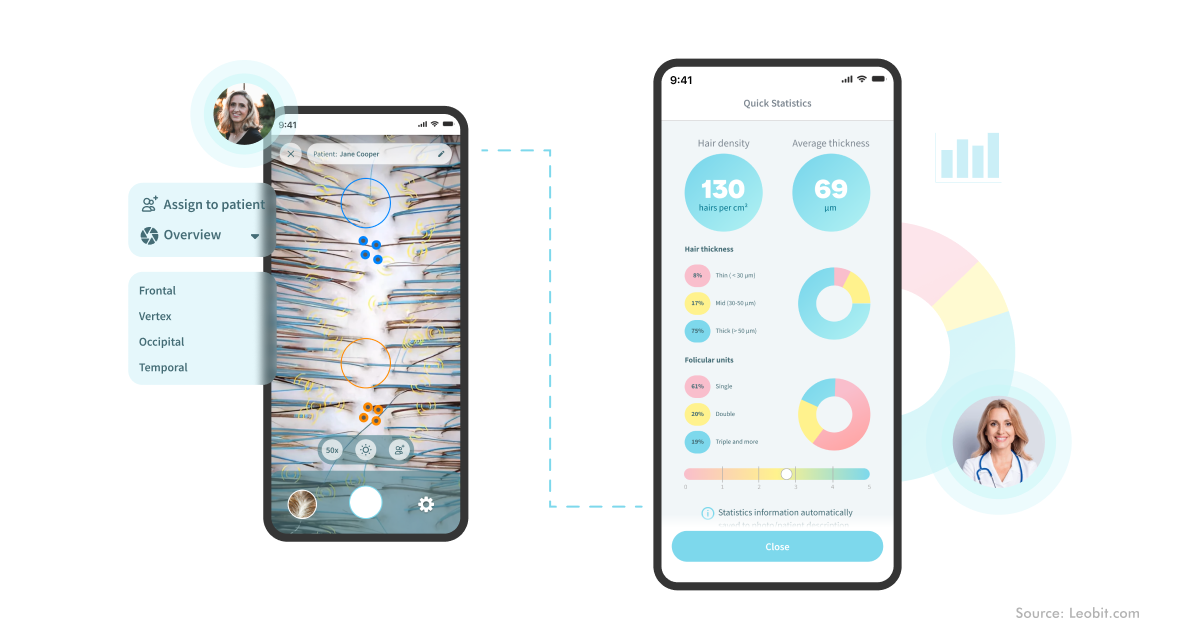
A smart trichoscopy application built for a European healthtech provider illustrates how AI-first architecture can replace an entire diagnostic workflow rather than assist within one. The app turns a standard smartphone into a digital trichoscope. However, the core value is not the camera integration; it is the custom AI-powered Computer Vision model at the center of the product.

ai first approach in software engineering
Screenshot: AI-powered trichoscopy application

Trained on the company’s proprietary clinical data, the model automatically calculates key hair parameters, such as density, hair count, anagen-telogen ratio, vellus and terminal hair distribution, from a photo, without any manual measurement or specialist interpretation.

 Book Icon

Final Thoughts

AI-first software development is more than just an architectural shift; it is a strategic paradigm approach where entire software products are built around AI models. When artificial intelligence is treated as a foundational layer rather than an added feature, the advantages compound:

  • Costs scale with compute rather than headcount
  • Models improve with usage
  • New AI features are released faster
  • The solution becomes more reliable and observable
  • Product personalization capabilities improve

At the same time, building a genuine AI-first product is not straightforward. It requires the right data infrastructure, MLOps discipline, and solid engineering expertise. Without that foundation, AI-first initiatives are likely to miss the structural advantages this approach is designed to deliver.

Whether you need to run a comprehensive discovery phase to plan your AI-first product or build a complex agentic AI system from the ground up, Leobit has the hands-on experience to help. Contact us to discuss your needs and find out how we can support your initiative.

FAQ

Start outlining your AI implementation strategy by asking whether artificial intelligence is central to the product’s value. If the core workflow depends on a model’s ability to learn, generalize, and improve with usage, the use case is likely a strong fit. A simple way to test it: look at the actual business goal. If the result depends on a model learning from data instead of following fixed logic, it’s probably a strong AI-first candidate.

AI-augmented development focuses on how software is built. This approach involves using AI tools to assist engineers during the development process. AI-first development defines what the product fundamentally is. In an AI-first system, the core business logic, data architecture, and workflows are designed around an AI model from the start. If you can remove the AI layer without changing the product itself, it is not AI-first.

Not always. Modern tools, such as foundation models, RAG, fine-tuning, and few-shot prompting, can work well even with smaller datasets, as long as the data is relevant and clean. Where a team sits on the AI adoption curve matters more than raw data volume: organizations earlier in their AI journey tend to benefit most from starting with a narrow, well-defined use case. Sometimes, teams also use synthetic data early on when real examples are hard to collect.

No, it’s not. Cloud AI services and pre-trained models have made the entry point much lower than it used to be. You no longer need your own GPU cluster or a massive ML team just to run an AI transformation initiative. What matters more is building the system around AI from the beginning instead of trying to fit it into a system that has already been developed.