
Contact us

Token Economics for Business: What Your AI Feature Actually Pays For

15 mins read

what is token economics
Blog Calculator Widget Logo

Estimate Your Software Project Cost

Describe your idea — get a budget breakdown in minutes.

Get Your Estimate

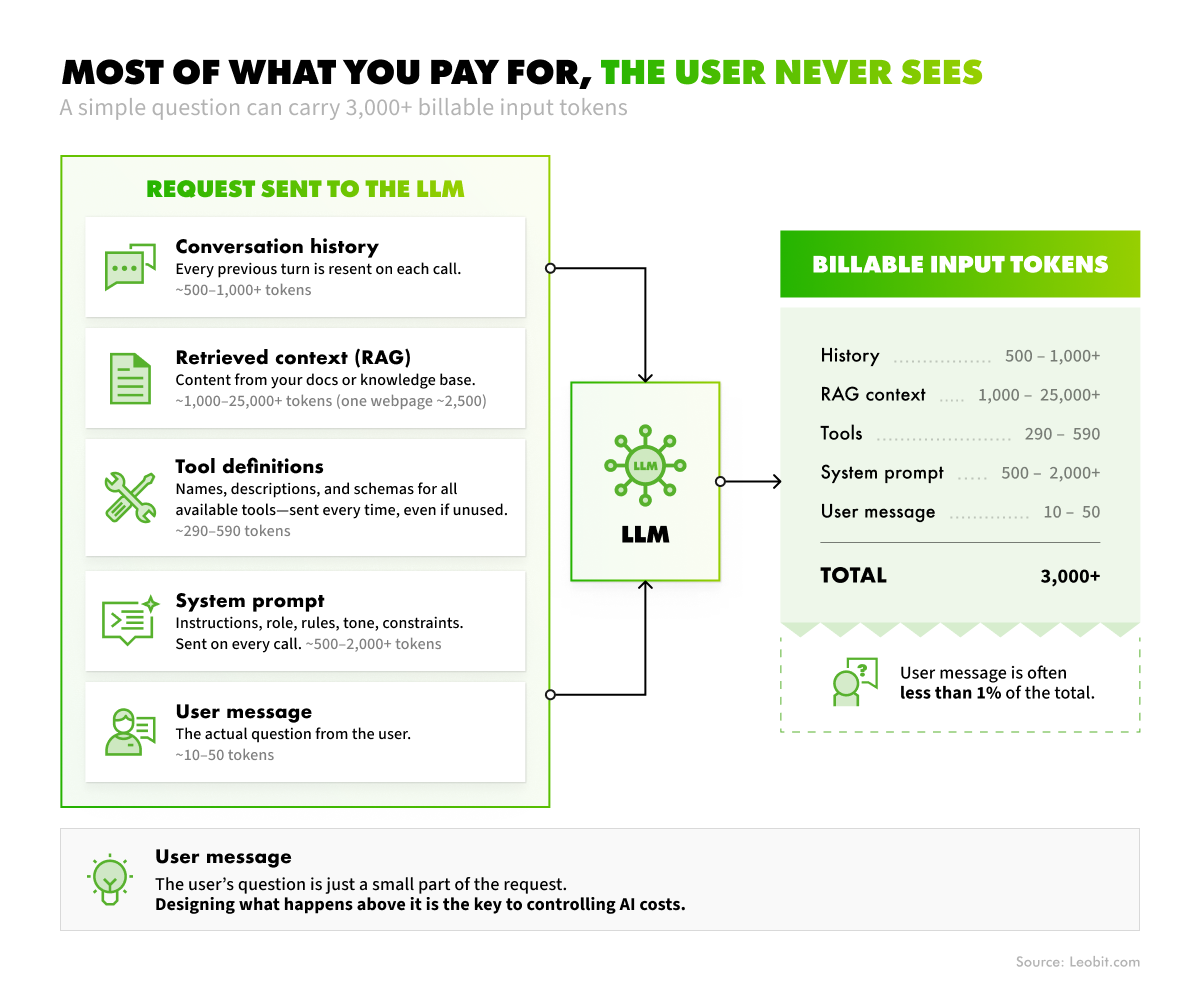
Here is an uncomfortable piece of arithmetic. A user types a ten-word question into your AI feature. Behind the scenes, that request can carry 3,000 or more billable tokens, while the user’s original prompt often accounts for less than 1% of them. Most tokens come from information the user never sees, like system instructions, conversation history, retrieved documents, and tool definitions that help the model generate a response.

Understanding where those tokens come from is vital because AI budgets have stopped being experimental. Worldwide AI spending is forecast to reach $2.59 trillion by the end of 2026, which shows a 47% increase year over year. Yet many organizations still struggle to predict what their AI features will cost. According to a study of 372 enterprises by Benchmarkit and Mavvrik, only 15% forecast AI costs within 10% of actual spending, while nearly one in four miss by 50% or more.

One reason is that AI costs behave differently from traditional infrastructure costs. Server expenses are relatively predictable, but token usage depends on how people use the product. A longer conversation, a larger document, or additional context sent to the model can all increase the bill, even if the feature itself hasn’t changed.

The good news is that token economics is learnable in one sitting. Four mechanics explain most of any AI bill, and none of them requires an engineering background.

In this article, we’ll explain the four concepts that have the biggest impact on AI costs: the difference between input and output tokens, how the context window affects spending, where “invisible” tokens come from, and how to translate token counts into approximate word counts.
What Is Token Economics?

Token economics is the practice of understanding what drives the cost of an AI feature. Every interaction with a language model is measured in tokens, and providers charge based on how many of those tokens your application uses. The more requests you make and the more information each request contains, the higher the cost.

AI token costs
Factors behind AI costs

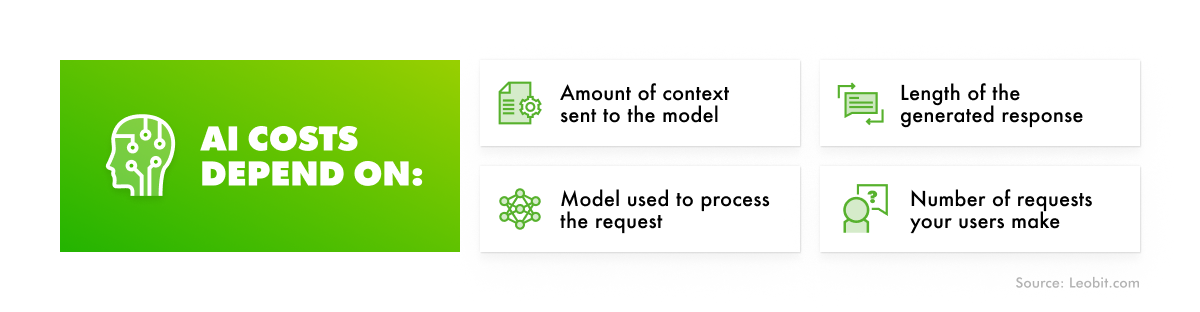
AI costs are not a single flat fee. They come from many small decisions:

  • Amount of context sent to the model
  • Length of the generated response
  • Model used to process the request
  • Number of requests your users make

Together, these factors determine what you ultimately pay.

Those costs are becoming significant. Enterprise spending on model APIs, which is billed almost entirely by token usage, reached ⁠$8.4 billion in the first half of 2025, doubling in just six months. As more businesses put AI into production, token costs are becoming a regular operating expense rather than an experimental budget item.

Before you can predict the cost of an AI feature, you need to know what is being metered. That starts with the split between input and output.

Input tokens vs. output tokens: why they're priced differently

Every API call to an LLM has two distinct parts, and providers meter them separately.

  • Input tokens cover everything you send to the model: the system prompt, the conversation history, the user’s message, any attached documents.
  • Output tokens cover everything the model generates in response.

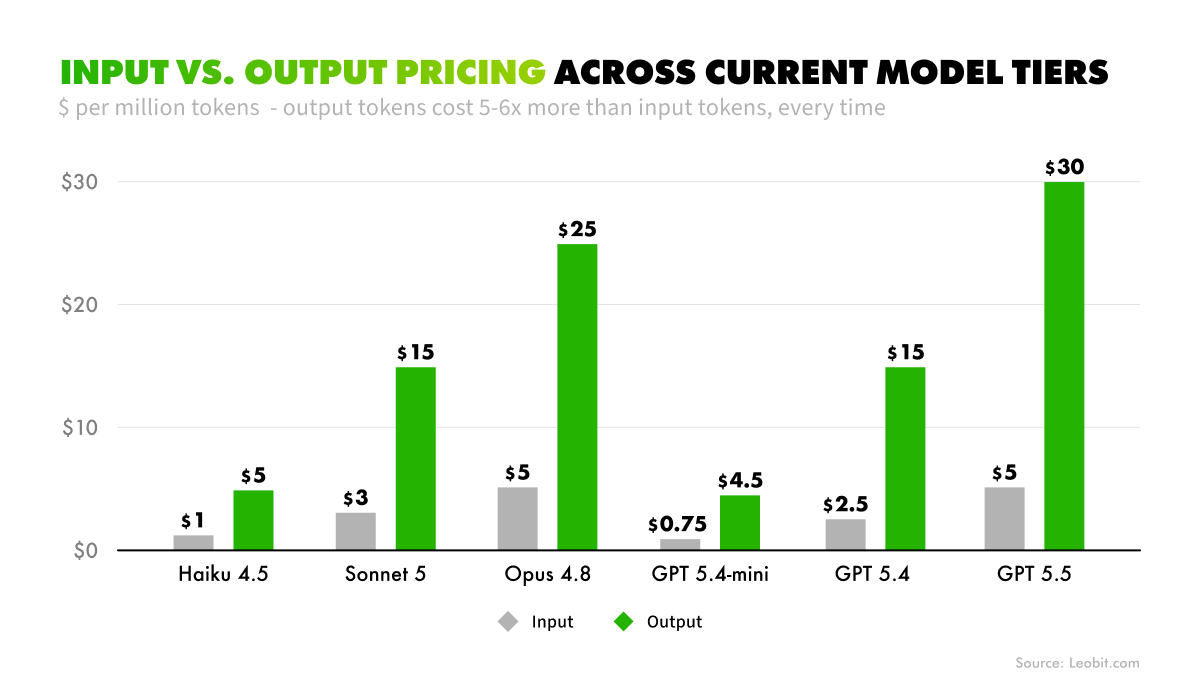
The two are not priced the same, and the gap is consistently 3 to 6 times in the output’s favor across every major provider.

AI model price
Input vs. Output pricing across current model tiers

The reason comes down to how the two directions actually get computed. Processing input is comparatively cheap: the model can read and encode an entire block of input text in parallel, in a single pass, using well-optimized batch computation. Generating output is fundamentally different: the model produces one token at a time, and each new token depends on every token generated before it.

That means generating a 500-word response requires hundreds of sequential computation steps, each one dependent on the last, and is far more expensive in hardware. This is a structural, physics-of-computation reason, which is why the pricing ratio holds across providers rather than being a commercial choice any of them could undo.

Current published rates as of mid-2026 (Sources: Claude pricing, OpenAI pricing):

Input ($/million tokens)
Output ($/million tokens)
Output premium

Claude Haiku 4.5

$1.00

$5.00

Claude Sonnet 5

$3.00

$15.00

Claude Opus 4.8

$5.00

$25.00

GPT-5.4-mini

$0.75

$4.50

GPT-5.4

$2.50

$15.00

GPT-5.5

$5.00

$30.00

Treat these as a snapshot; figures shift as providers release new model versions.

For you as a business stakeholder, the practical consequence is this: the shape of your AI feature, meaning how much it reads versus how much it writes, is one of the biggest cost decisions you will make. And it should be made in a product meeting.

A feature that classifies incoming support tickets reads the entire message and writes a single word or label is cheap by design. A feature that drafts full email responses or generates reports writes a lot. It is expensive by design, even if the model and volume are identical.
Two features that feel equally AI-powered to a user can differ in cost per interaction by an order of magnitude purely because of which side of that ratio they sit on.

Context window as a cost multiplier

The context window is the amount of text a model can consider in a single request, and it acts as a cost multiplier because the model re-reads the entire conversation on every message. This is the mechanic that surprises finance teams the most, because it violates the intuition that each message in a conversation should cost roughly the same.

In fact, it doesn’t, and the reason is that LLMs have no memory of their own. Each API call is entirely self-contained. This means that the model has no idea a conversation is even happening unless your application resends the full transcript, including every prior question and answer, and the original system prompt with every single new message.

AI model cost
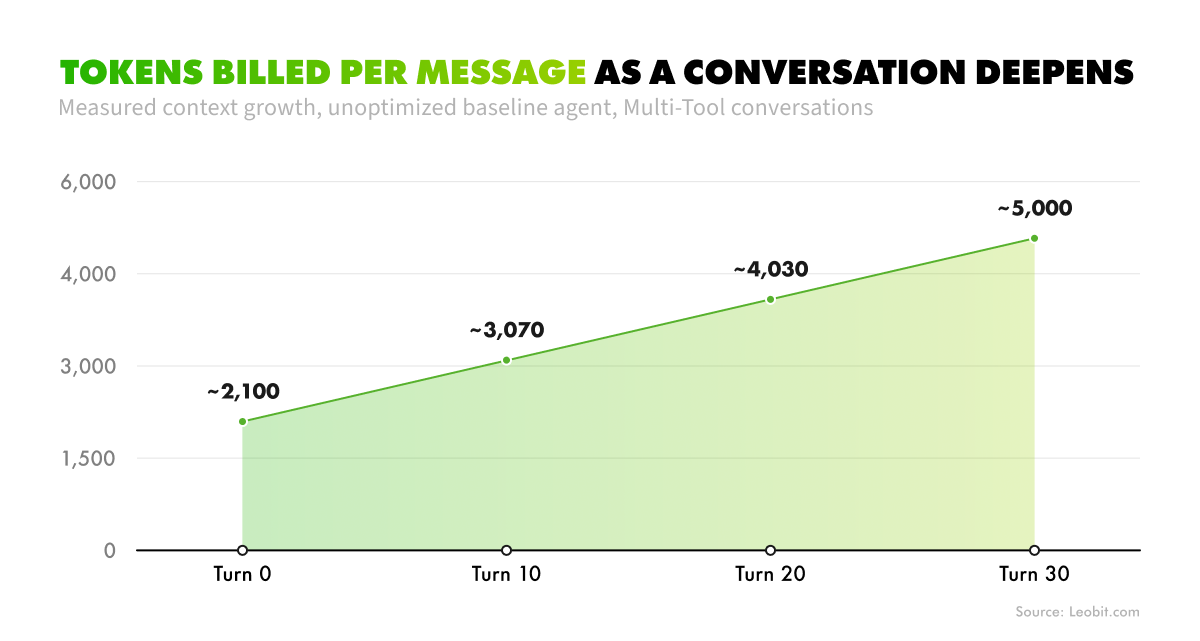
Tokens billed per message as a conversation deepens

That means a 20-turn conversation isn’t 20 independent, equally-priced calls. It’s 20 calls, steadily increasing in size, because call #20 has to carry the weight of everything said in calls #1 through #19 just to maintain continuity. Using a simple illustrative model (a 300-token system prompt, roughly 130-token average responses, no caching or trimming applied):

Total tokens billed as input

Turn 0

~2,100 tokens

Turn 10

~3,070 tokens

Turn 20

~4,030 tokens

Turn 30

~5,000 tokens

By the 30th turn, the model is processing about 2.4 times more input tokens than it did at the start, even though the user’s behavior hasn’t changed. The increase comes entirely from the growing conversation history.

The ceilings are high enough that cost is usually the binding constraint. Current frontier models such as Claude Opus 4.8 and Claude Sonnet 5 accept context windows of up to 1 million tokens, which corresponds to roughly 750,000 words. Nothing stops a chatty user or a document-heavy workflow from filling a meaningful share of that window, and you are billed for every token it carries.

This has direct product design implications. Features built around short, single-turn interactions, like a form-filling assistant, a one-shot summarizer, are naturally insulated from this effect. Features built around sustained dialogue, like a support chatbot or a coding assistant, are not. Their per-conversation cost can vary wildly depending on how “chatty” a given user turns out to be.

A budget built on average message length without accounting for conversation depth will systematically underestimate cost for exactly the power users your business most wants to retain.

The invisible tokens: system prompts, tools, and RAG

Ask a product manager to estimate an AI feature’s cost, and they will almost always start from the user’s question. That instinct misses the majority of what actually gets billed, because most of the tokens in a real production request never came from the user.

Here we list where they come from:

  • The system prompt. The instructions that define the AI’s role, tone, constraints, and behavior are invisible to the user but sent in full on every single call. These commonly run from a few hundred to several thousand tokens, and unlike the user’s message, this cost is entirely fixed regardless of what the user asks.
  • Tool and function definitions. If the feature allows the model to call tools (e.g., a search function or a database lookup), the name, description, and parameter schema for every available tool get attached to every request, whether or not the tool gets used. On Claude models, enabling tool use adds roughly 290 to 590 tokens per call before any actual tool activity happens.
  • Retrieved context. If the feature grounds answers in your company’s documents or knowledge base, the retrieved chunks are injected directly into the input and billed exactly like typed text. As a factual reference point, Anthropic’s documentation notes that fetching a single average web page adds roughly 2,500 tokens to the context, and a full documentation page can add 25,000 or more.Stack these together, and the arithmetic from the opening of this article becomes clear: a user who types a simple ten-word question into a feature with a 1,000-token system prompt, two enabled tools, and a retrieved reference document can easily trigger a call carrying 3,000+ input tokens of which the user’s actual words account for less than 1%.
prompt caching
Token economics behind a simple user request

This is why prompt size, rather than conversation content, tends to dominate total token spend.

Our team sees the same pattern across LLM integration projects. When we review an AI feature’s spend, the user’s own messages are rarely the problem. In most integrations we audit, the system prompt and the retrieved context account for the large majority of billed tokens. Trimming what the application sends silently is usually the fastest way to save, and the user never notices the difference.

Denys Korpan

Denys Korpan

Senior .NET Software Engineer

Tokens as postage: an analogy for budget conversations

Think of every API call as sending a letter through a metered mail system. You pay a per-word rate to send your letter (input tokens), and a separate, higher per-word rate for whatever reply comes back (output tokens).

Postage that favors receiving over sending is a strange picture for physical mail. Still, for API costs, it maps well, because generating a reply costs the “postal service” more computational effort than simply reading an incoming envelope, exactly as explained in the input/output pricing mechanics above. Unlike real mail, you re-pay that surcharge every time you write back into the same conversation, because the model needs the whole envelope re-sent with every reply.

Critically, there’s also an extra fee for a long event. And the fatter the letter, meaning a long system prompt, an attached document, or a chat history folded in with every message, the more each send costs. Unlike real mail, you re-pay that surcharge every time you write back into the same conversation, because the model needs the whole envelope re-sent with every reply.

This analogy does real work in a budget conversation, because it reframes three abstract technical facts into one intuitive picture:

  • Why does a longer conversation cost more per message? The envelope keeps growing; you are re-mailing the whole thread every time.
  • Why does a one-line answer cost less than a full report? The reply postage rate is higher, and the report is a much heavier reply.
  • Why did adding that search feature raise the bill? Every added tool is more paper stuffed into every envelope, used or not.

When a technical team explains a cost overrun using terms like context window bloat or unoptimized system prompt, this analogy is the translation layer that turns it into something a budget owner can actually act on.

How Many Words Is a Token?

Tokens are an abstract unit until you can map them to something familiar – word counts. The commonly cited rule of thumb, and the one used by OpenAI’s own documentation, states the following:

750 words equal 1,000 tokens in standard English text, or one token is about 0.75 words, according to OpenAI Help Center.

However, this ratio isn’t exact. Punctuation-heavy text, code, and non-English languages tokenize differently, and can run noticeably higher (sometimes 2-3 times more tokens per word for entirely non-English content). But it is close enough for the gut-check a business stakeholder needs when an engineering team hands over a token estimate.

To make that ratio precise, here’s what it looks like mapped onto everyday business documents:

Approximate word count
Approximate token count

A short email or chat reply

~100 words

~130 tokens

A one-page brief or memo

~500 words

~670 tokens

A two-page product spec

~1,000 words

~1,300 tokens

A long-form blog article (like this one)

~3,500 words

~4,700 tokens

A 20-page contract

~8,000 words

~10,700 tokens

A 300-page ebook or manual

~90,000 words

~120,000 tokens

Keep this table on hand for sanity-checking technical estimates. If your engineering team says a feature’s average request uses 2,000 input tokens, translate that to roughly a page and a half of text and ask a grounded follow-up: Does that match what the feature should actually be reading?

A number that feels too high usually points to invisible-token bloat, such as an oversized system prompt or redundant conversation history, and that conversation is much easier to have with a word-count comparison in hand.

How Leobit Can Help With Token-Efficient AI Development

Understanding how token costs work is one thing. Building an AI feature that uses tokens efficiently is another. Many of the biggest cost drivers are determined early in development, from how prompts are structured and what information is included in the context to how conversation history is managed. These decisions affect every request the application sends to the model, so getting them right from the start can significantly reduce operating costs over time.

Leobit helps companies design, build, and scale AI solutions with cost efficiency in mind. We scope AI features with realistic token estimates attached to the product spec from the first sprint, and we design prompts and retrieval so the invisible-token share of every call stays under control rather than being discovered on the first invoice.

Whether you are planning your first AI feature or optimizing an existing one, our team can help you build a solution that delivers business value without unnecessary token costs.

Conclusion

An AI bill stops being a mystery once you know what is being metered. Teams get surprised by invoices because nobody has looked at what the application silently sends on every call, and that is a visibility problem you can fix in an afternoon with the tables in this article.

Falling prices will not fix it for you. Epoch AI’s tracking shows the price of reaching a fixed level of model performance has dropped by a median of roughly 50 times per year since 2020, yet bills keep growing, because usage tends to grow faster than prices fall. The mechanics in this article decide your bill regardless of which model generation you buy.

In the next article in this series, we turn these mechanics into a working budget: the five cost drivers to model before you build, and a cost-per-call worksheet your finance team can actually approve.

FAQ

Token economics is the practice of understanding what drives the cost of an AI feature: the tokens that language model providers meter and bill, and the product decisions that determine how many of them each request consumes. It treats AI spend as something you can model in advance rather than discover on an invoice.

Input tokens cover everything your application sends to the model, including the system prompt, the conversation history, and any attached documents. Output tokens cover everything the model generates in response, and they cost 3 to 6 times more per token because the model produces them one at a time through sequential computation.

Language models have no memory of their own, so your application resends the entire conversation transcript with every new message, and the model bills that full transcript as input each time. In the illustrative example above, the tenth message bills roughly 5.5 times more input tokens than the first, even though the user typed the same amount of new text.

Estimate four things: the full prompt size per call (including the system prompt and any retrieved context), the expected response length, the model’s per-token price, and how many calls your users will make per day. When Leobit scopes an AI feature for a client, we attach exactly this kind of token estimate to the product spec in the first sprint, using word-count comparisons like the table in this article to keep the numbers understandable for every stakeholder.

Start with the invisible tokens. In our team’s experience reviewing LLM integrations, oversized system prompts and redundant retrieved context are the most common sources of waste, and trimming them cuts cost without changing anything the user sees. Larger savings come from engineering choices such as prompt caching and routing simple requests to cheaper models, which we cover in the third article of this series.