However, AI use across the software development lifecycle (SDLC) varies widely. Many teams use artificial intelligence just to handle isolated tasks, such as generating a test case or specific code strings. Only a limited number of companies have structurally embedded AI across every stage of development, from requirements to deployment.
In this article, we provide an overview of such vendors: AI-powered software development companies with proven, hands-on expertise running an AI-native SDLC.
What Is AI-Driven SDLC and How Does It Differ from Other Approaches to Software Development?
As of early 2026, Google reports that at least 41% of all new code is AI-generated. However, active use of AI in coding doesn’t automatically make an approach to software development AI-native. AI-driven SDLC means deeper and more consistent integration of AI across different software development workflows, from requirements gathering to maintenance and continuous optimization. Engineers stay in control of every decision, while AI handles execution within boundaries the team defines.
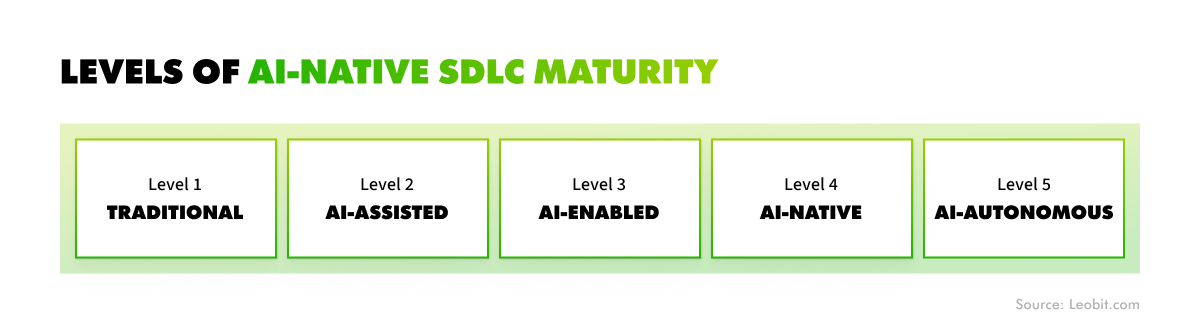
Not every company operates at the same level of maturity here. Currently, we can distinguish five general levels of SDLC maturity.
SDLC maturity levels
Here’s a basic description for each level:
Traditional. Most workflows are manual or use non-AI automation. AI-driven development plays no defined role.
AI-assisted. Developers use AI tools for individual tasks, such as code completion or generating a test case. However, the underlying workflow doesn’t change.
AI-enabled. AI supports multiple delivery stages with human review at each step. Still, governance and standards vary by team and project.
AI-native. AI is embedded into the SDLC through governed workflows and shared context across stages, with engineers retaining full control over every release.
AI-autonomous. Agents handle most execution within defined boundaries, while engineers oversee strategy and handle exceptions. This level remains largely aspirational, as even the most advanced agentic AI systems today haven’t fully reached it.
Still, AI-native SDLC is rare. Most organizations are somewhere between AI-assisted and AI-integrated development. The real question is which vendors have taken AI further and actually built it into the development lifecycle.
How Did We Select AI-Native Software Development Firms?
We researched popular vendor review platforms, such as Clutch and GoodFirms, analyzed leading IT blogs and newsletters, and ran a basic Google search to identify teams with established AI-driven SDLCs. Top AI-powered software development companies featured in this list were then selected based on the following criteria:
Proven experience embedding AI across multiple SDLC stages, with a named, repeatable methodology rather than ad hoc tool usage
Publicly available case studies showing AI-native workflows operating on real client projects
Demonstrated ability to integrate AI into existing delivery pipelines and systems, keeping engineers in control of releases
Experience with major models and platforms used for building AI-native workflows, including GPT, Gemini, Claude, Llama, Mistral, Azure OpenAI, AWS Bedrock, and Google Cloud Vertex AI
Third-party validation through reviews, awards, and recognizable enterprise clients mentioned on platforms like Clutch, GoodFirms, and G2
Research activity, conferences, and knowledge-sharing initiatives, such as webinars
Companies were excluded if they:
Sell AI coding tools or platforms (e.g., Cursor, Replit) and don’t offer software development services
Use AI for a single isolated task, such as QA automation alone, with no broader lifecycle integration
Market “AI-powered development” without public case studies, a named methodology, or verifiable client evidence
Based on these criteria, the final shortlist of the best AI-native software development firms is presented below.
Top 10 Companies with AI-Native Software Development Lifecycle
Each entry covers general company information, how it restructured its SDLC around AI, and the type of project it best suits.
1. Leobit
General information about Leobit
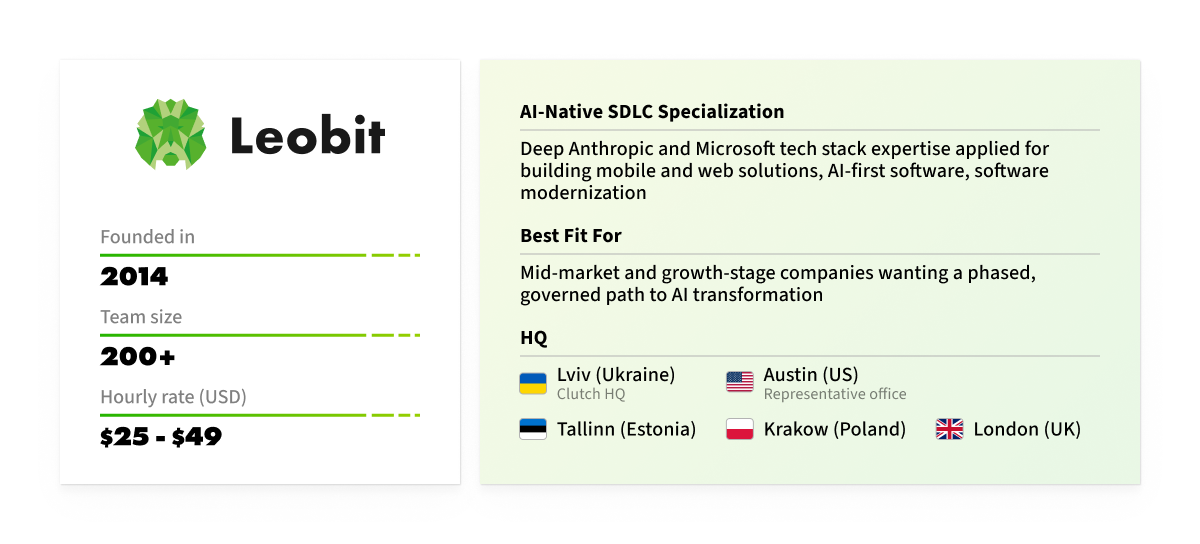
Leobit is a dedicated team and software development provider specializing in AI, .NET, web and mobile development, with a representative office in Austin, TX, and development centers in Lviv (Ukraine), Krakow (Poland), and London (UK), and Tallinn (Estonia).
Leobit has recently introduced an AI-native SDLC: a delivery model that embeds AI across requirements, design, engineering, testing, release, and project management, with engineers staying in control of every release. Across its first AI-native projects, the vendor reports 3 to 10 times faster time to accepted output than ad hoc AI-assisted development.
Leobit’s CEO and founder Oleksa Stelmakh frames the shift as a deliberate move past vibe coding toward agentic engineering, where AI becomes a structured part of workflows. In practice, that means replacing static project templates with AI-generated starting points, running AI-powered code reviews built on Anthropic’s Claude, and organizing client engagements into three tiers:
Exploring AI — readiness assessments and discovery
Implementing AI — development of corporate LLMs, agents, and multi-agent systems
Scaling AI — full AI-native delivery with governed workflows and updated team roles
Leobit backs the model with an expanding list of certifications. In fact, the company has Anthropic Claude Certified Architects and Engineers on the delivery side. Leobit is also a Microsoft Solutions Partner for Data & AI, as well as Digital & App Innovation. The company runs solutions on enterprise infrastructure, such as Azure AI services, or keeps client data in the client’s environment and applies automated masking, role-based access controls, and governance rules for regulated workloads, backed by ISO 9001:2015 and ISO 27001:2022 certification.
Leobit has delivered more than 40 agentic AI projects across fintech, insurtech, proptech, and legaltech. The company also holds ISTQB Premium Partner status and has won a 2025 Global Tech Award for AI Excellence with Corporate LLM Innovation.
On Clutch, Leobit has a 4.9/5 stars rating across 55 verified reviews. The company is a strong fit for mid-market and growth-stage businesses that want a phased, governed path, from AI readiness assessment through full AI-native delivery.
2. LeewayHertz
General information about LeewayHertz
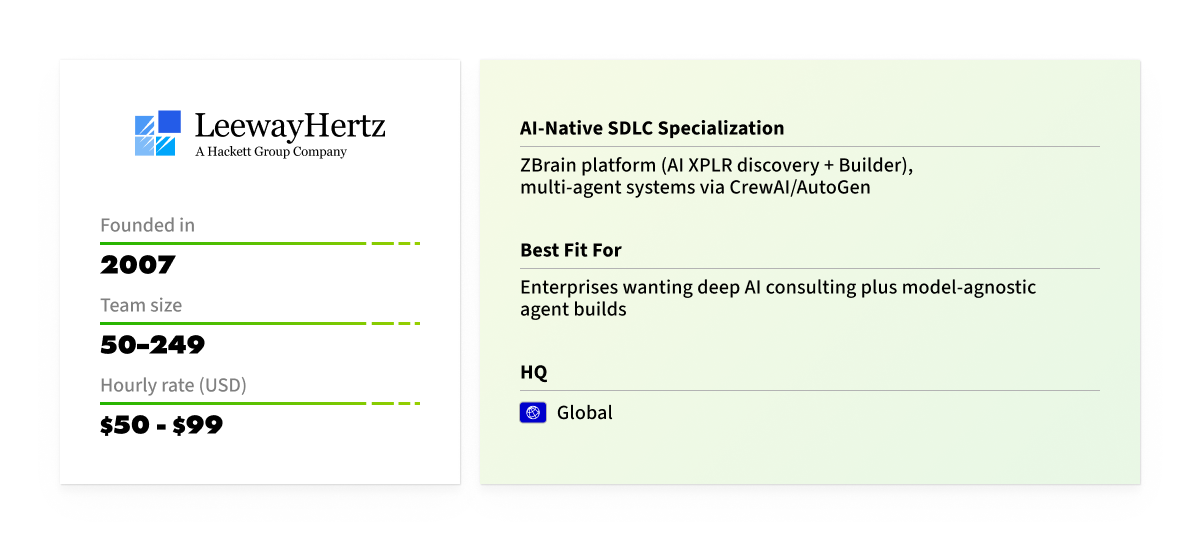
LeewayHertz is a San Francisco-headquartered AI development company that works across multiple industries, with the primary focus on fintech, healthcare, and retail. The Hackett Group acquired the company in September 2024, adding consulting and benchmarking resources to LeewayHertz’s engineering practice.
LeewayHertz has built its AI-native software development approach around ZBrain, the company’s enterprise generative AI platform. LeewayHertz also offers this solution to its end customers as a SaaS to support their own projects. ZBrain consists of two AI-powered modules.
ZBrain AI XPLR. A discovery module that identifies where AI can improve a business’s existing processes and designs agentic solution blueprints.
ZBrain Builder. A module that converts requirements into technical architecture and turns those blueprints into agentic AI solutions.
LeewayHertz applies this approach to build AI applications, intelligent agents, and multi-agent systems using frameworks including CrewAI and AutoGen Studio.
Analytics Insight named LeewayHertz a top U.S. AI agent developer in its 2026 roundup, citing its work in RAG, custom copilots, and multi-agent systems. The company also has a 4.7/5-stars rating based on 9 reviews on Clutch.
LeewayHertz fits enterprises that need deep technical expertise for developing AI-first products, especially when custom model development is central to the project.
3. Xebia
General information about Xebia
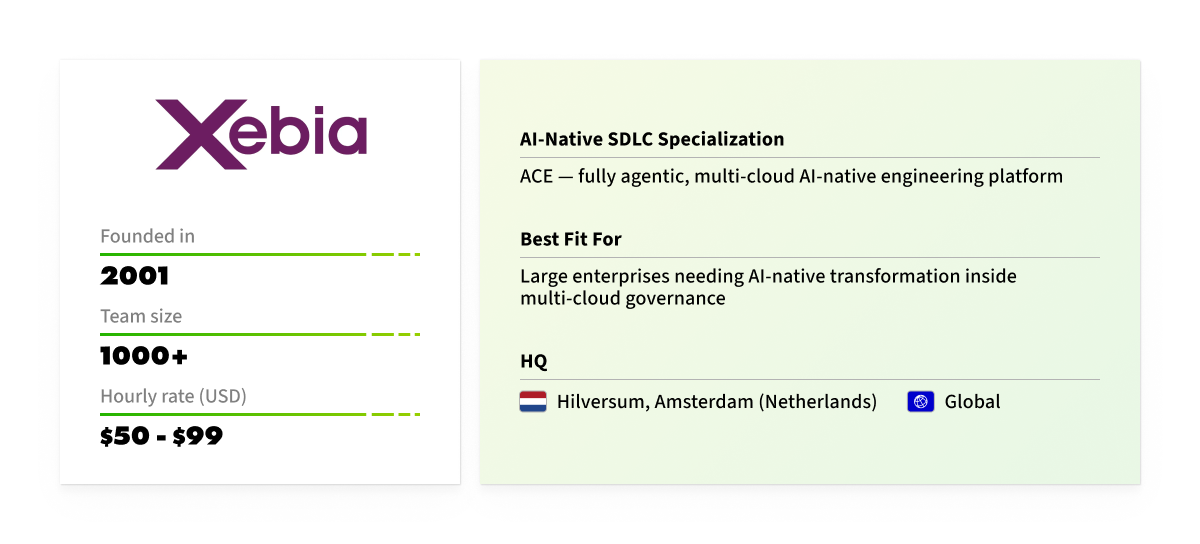
Xebia is a Netherlands-founded, AI-first consulting and software engineering company with 25 years of history, more than 5,500 professionals, and operations across 16 countries.
The vendor has built a strong AI-native approach to software development, helping clients weave AI into their own workflows. Xebia’s developers regularly share insights on using AI across the software development process through blog posts. The company also offers an external tool that helps customers build their own AI-native SDLC: ACE, an agentic AI-native engineering platform that runs across AWS, Azure, and GCP and plugs into GitHub, Jenkins, Azure DevOps, and Harness.
With its AI-driven approach, Xebia is recognized as a GitHub Global Partner of the Year in both 2024 and 2025, Global Security Partner of the Year 2024, and the Microsoft Copilot Studio Enterprise Agent Challenge 2025 (EAC Award) for a supply chain multi-agent solution.
On Clutch, Xebia has a 4.7/5 stars rating based on 7 reviews. These reviews suggest that the company is a good fit for enterprises seeking AI-native transformation within an established, multi-cloud governance framework.
4. Saigon Technology
General information about Saigon Technology
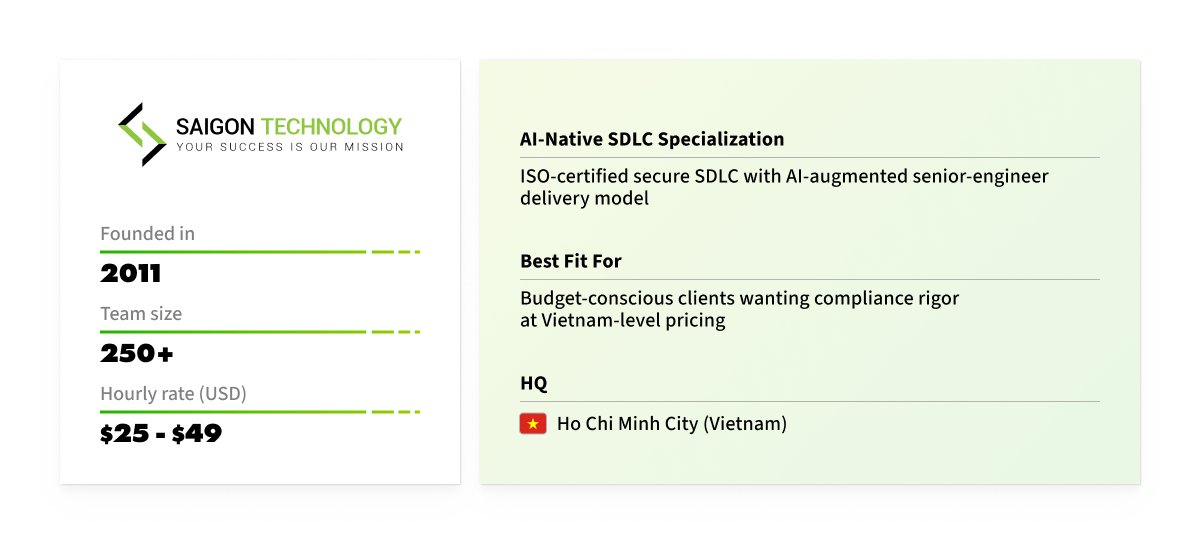
Saigon Technology is an ISO-certified Agile software development company headquartered in Ho Chi Minh City, Vietnam. Operating since 2012, the vendor has over 850 successfully delivered projects in its portfolio.
Saigon Technology describes itself as AI-native. The company’s senior engineers have an established approach to applying AI tools, allowing the same project scope to be delivered with a smaller team. Its software development lifecycle runs on autonomous systems that plan, decide, and act, with human checkpoints at every step, alongside a strong focus on security-first design.
In May 2026, Saigon Technology won a Sao Khue Award in the AI-native Custom Software Development category, a new evaluation track introduced that year by the Vietnam Software and IT Services Association (VINASA). The company also has generally positive client testimonials on Clutch, with a 4.8/5 stars rating based on 9 reviews.
Saigon Technology primarily cooperates with SMBs seeking a cost-effective vendor in the East Asian region. The company has experience across multiple industries, with a particular focus on fintech.
5. Innowise
General information about Innowise
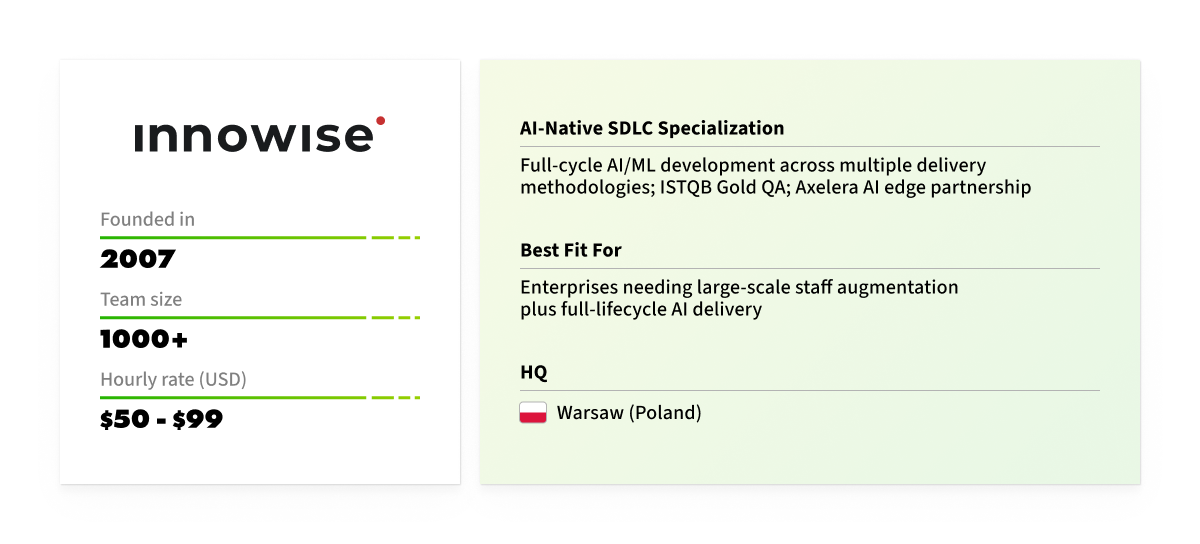
Innowise is an international software development company with over 18 years of experience. Its offering includes AI, machine learning, computer vision, and NLP engineering alongside traditional custom software and cloud development.
In 2026, Innowise was a finalist at the UK’s AI and Software Development Awards in three categories: Most Innovative UK Software Company (Enterprise), Innovation of the Year (Enterprise), and Best Use of AI and Machine Learning in Development. The last category on this list highlights the company’s effective implementation of AI-native practices. Innowise emphasizes its dedication to an AI-native SDLC across multiple phases, from software planning to ongoing maintenance and support. The company also integrates this approach with different project management methodologies, such as Waterfall, Agile, Spiral, V-shaped, etc.
At the end of 2025, Innowise has earned an ISTQB Gold Partner status for its QA department. The company also partnered with Axelera AI to add edge AI hardware to its offering, extending AI-native development into on-device and embedded contexts.
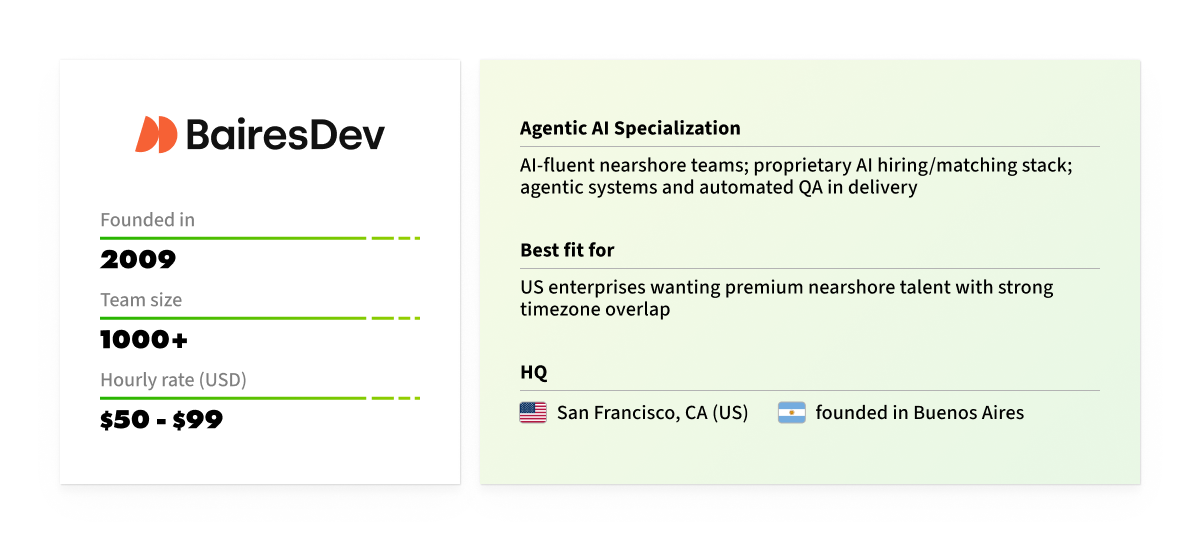
BairesDev is a nearshore software development company headquartered in Mountain View, California, with more than 4,000 engineers, primarily across Latin America.
BairesDev applies AI across all levels of the company’s operations. In particular, the vendor uses agentic systems, automated QA, and engineering intelligence to accelerate delivery while keeping humans responsible for core intent.
Its AI-native approaches show up most clearly in its own hiring and delivery infrastructure. BairesDev screens more engineering applicants through a proprietary AI ecosystem, pairing it with a Team Recommendation Engine that matches engineers to client teams and an in-house English-proficiency model trained specifically on Latin American speakers. In July 2026, this system earned BairesDev two Gold Globee Awards in the 2026 Technology Awards: Best AI for Human Resources, Recruiting & Talent Intelligence, and Achievement in Collaborative Technology Implementation.
BairesDev has a strong track record on Clutch, with a 4.9/5 stars rating based on 63 reviews. The company’s portfolio shows that it is best suited to enterprise clients that need to scale nearshore engineering capacity quickly and want AI to accelerate product releases.
7. Rootstrap
General information about Rootstrap
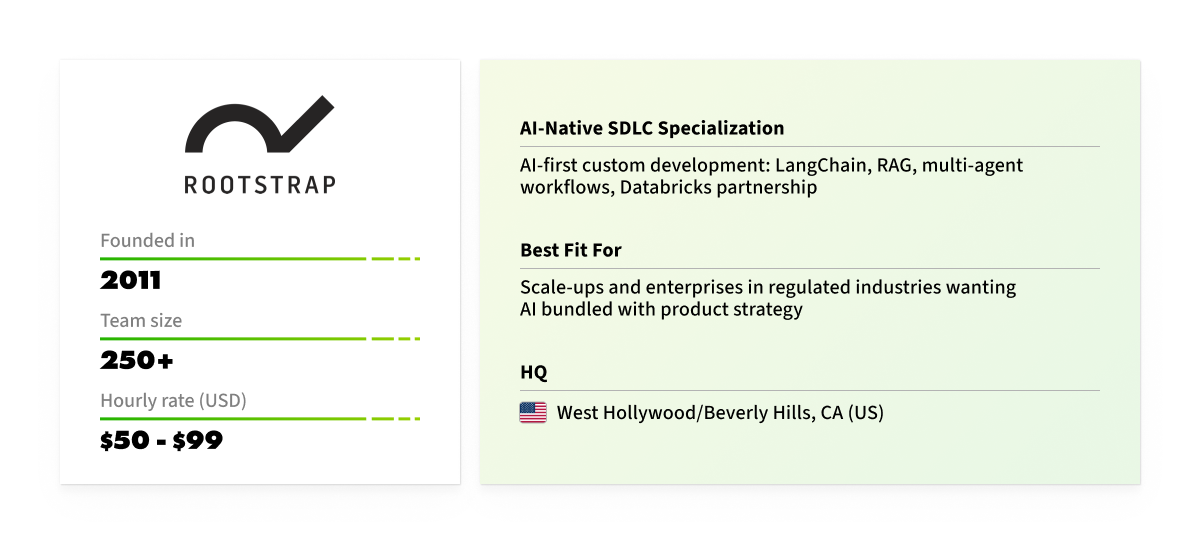
Rootstrap is a Los Angeles-founded software agency that strongly relies on the Latin American pool of software engineers. The company puts a strong focus on mobile development for both Android and iOS.
Rootstrap emphasizes the systematic use of AI across different stages of the software development lifecycle, including coding, testing, and documentation. The company’s AI practice covers LLMs, retrieval-augmented generation pipelines, AI agents, LangChain-based orchestration, and RLHF work, layered onto its existing staff-augmentation and full-product development model. Rootstrap also runs a Databricks partnership to support the data infrastructure that AI-native delivery depends on.
The company has earned recognition across industries and domains. For instance, Inc. named it an AI Power Partner and included it on the Inc. 5000. The company also has a solid Clutch profile with a 4.8/5 stars rating based on 44 reviews.
Rootstrap works well for startups and mid-market product teams that want AI capability bundled with product strategy and design.
8. Notch
General information about Notch
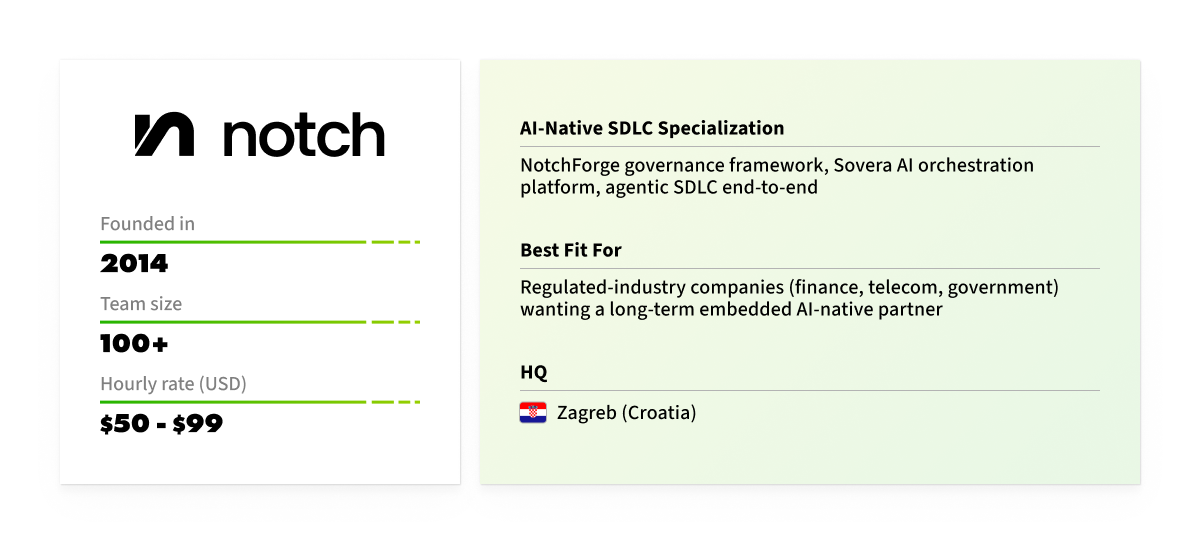
Notch is a Central European AI engineering partner that has been building custom software since 2014. Its primary industries are insurance, telecom, and other regulated sectors.
The company’s AI-native approach centers on NotchForge, an engineering and governance framework that defines the environment in which coding agents operate, including the main agent, subagents, skills, tools, and memory. It also keeps this setup version-controlled, making it easier to manage and update over time. In this approach, agents handle the majority of research, planning, and execution, while engineers retain ownership of architecture decisions, domain logic, and review gates.
The company pairs this with Sovera AI, its agentic orchestration platform, and the Notch 3S Method, which is built to take greenfield MVPs from idea to production in around 12 weeks. On Clutch, Notch holds a 4.9/5 stars rating based on 20 customer reviews.
Notch is a good fit for companies in regulated industries that want a long-term embedded engineering partner rather than a project-based vendor.
9. ThoughtWorks
General information about ThoughtWorks
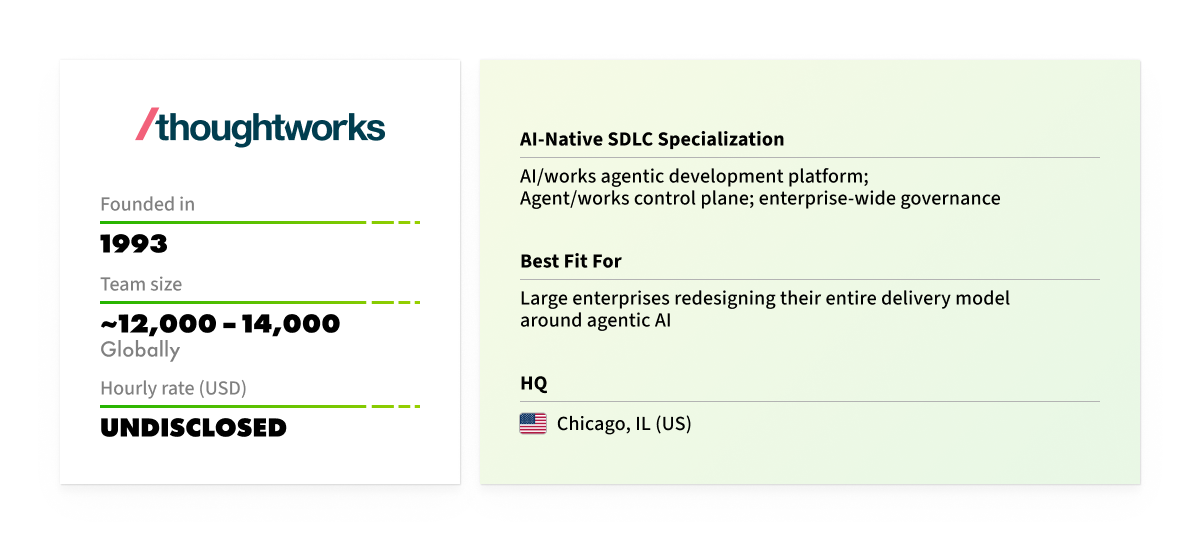
ThoughtWorks is a global technology consultancy, founded in 1993. The company has built its reputation by shaping practices like Agile, microservices, and continuous agentic software delivery.
Its AI-native approach centers on AI/works. It is an agentic development platform launched in January 2026 that unifies legacy system understanding, requirements generation, and agentic code generation and testing inside a single governed environment. ThoughtWorks offers AI/works to its customers as a SaaS solution and uses its core principles in its own custom software development projects.
ThoughtWorks was named a Visionary in the 2025 Gartner Magic Quadrant for Custom Software Development Services and was also recognized as a Leader in Forrester’s Modern Application Development wave in January 2025. The company’s Clutch profile currently lacks reviews, but ThoughtWorks has a 4.8/5 stars rating based on 3 reviews on GoodFirms.
ThoughtWorks fits large enterprises looking to modernize and redesign their entire delivery model around agentic AI and governance.
10. BCG X
General information about BCG X
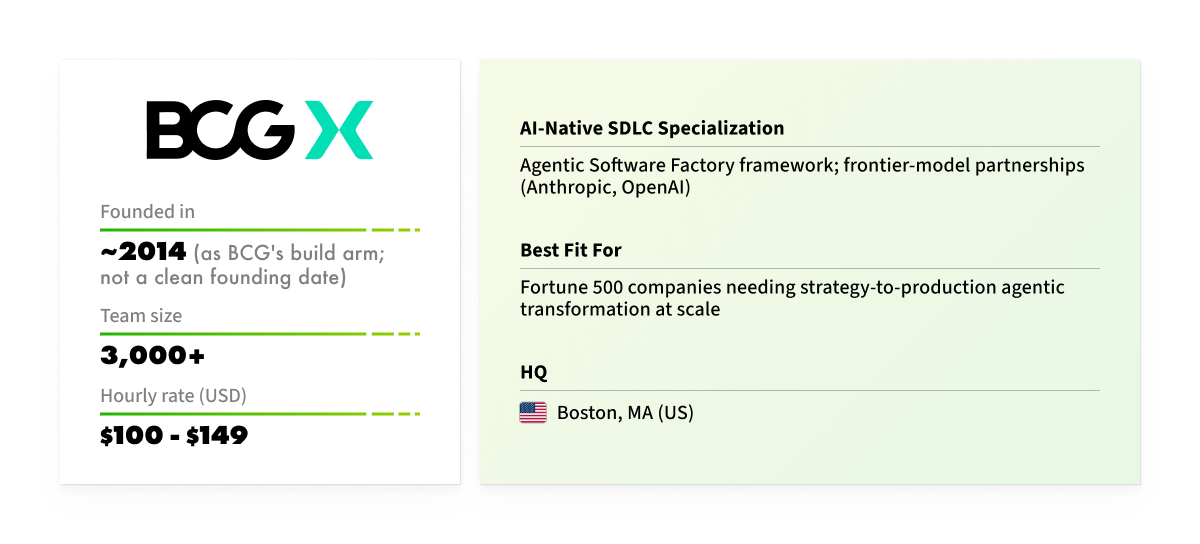
BCG X is Boston Consulting Group’s engineering and product development arm. Its team includes over 3,000 technologists, designers, and data scientists worldwide working on AI programs.
BCG X uses proprietary AI SDLC tools to help customers worldwide deploy AI-first solutions or modernize existing systems. The company has published an Agentic Software Factory framework, which restructures the traditional SDLC into three continuous, AI-embedded phases: inception, construction, and operation. Additionally, BCG’s broader research arm, BCGonTech, tracks Generative AI adoption across the SDLC, giving BCG X useful insights for optimizing its AI-native SDLC.
The company currently doesn’t have a Clutch profile, while positive BCG reviews can be found across other vendor platforms, such as G2.
BCG X is a good fit for Fortune 500 companies looking to accelerate AI transformation. However, its consultancy-heavy approach can add unnecessary layers for companies that need AI solutions built quickly.
Final Thoughts
The ten companies take different approaches to AI-native SDLC. Some have established workflows, while others have developed proprietary tools that they also offer to customers as SaaS solutions. What they all share is a shift from occasional AI use to AI-centered workflows, with AI supporting every stage of the SDLC.
That said, these companies target businesses of different sizes, industries, and budgets. The right choice depends on your project’s scope, your starting level of AI maturity, and the degree of governance you need.
Start by matching the partner to the work you need to do. If you want to speed up software delivery with an AI-powered SDLC or introduce AI-native workflows across your organization, look for a team that has already gone through this transition.
Leobit’s AI-native software development team can help assess your current AI maturity and build a phased path toward AI-native delivery. Contact us to discuss your project.
FAQ
It’s a company that builds AI into its actual delivery workflow, not just its output. That means AI works across requirements, design, coding, testing, release, and other project workflows with governed processes and shared context between stages. In this approach, engineers still make every final call.
Four patterns generally define AI-native development: AI embedded across the full lifecycle (not just isolated tasks), shared context and data flowing between stages, governed workflows with human review built in, and engineers retaining final control over releases.
AI-first usually describes a company’s product or market focus. Such a company builds a solution centered around AI functionality from the start. An AI SDLC company is about how they build things. AI is baked into the delivery process itself, regardless of what the end product is.
Depends on the level. Regarding the SDLC maturity framework, AI-augmented can typically mean anything from AI-assisted up through AI-enabled. Only when AI is embedded across the entire lifecycle, with shared context and governed workflows, can it truly support an AI-native SDLC.
Roman has a deep passion for a wide array of subjects, spanning from market insights to in-depth technical examinations of complex projects. He dives deep into technical aspects of various solutions to extract valuable insights for business purposes, and he enjoys sharing tips and tricks with business owners to help them leverage advanced technologies effectively.
Lenovo’s 2026 CIO Playbook, with research by IDC, found that 46% of AI proofs of concept (PoCs) have progressed into production, so just over half have ...
MIT’s State of AI in Business 2025 report shows that monthly job listings for forward deployed engineers increased by more than 800% this year, part of a ...
This year’s studies suggest that 31% of organizations across Norway, Sweden, Denmark, and Finland plan to increase spending on external IT service providers ...
Leona, Leobit’s AI agent designed to find promising cooperation opportunities and automatically send requests for proposals (RFPs), has helped our sales ...
Gartner estimates that generative AI cost projections can be off by 500% to 1,000% when organizations fail to account for how costs scale. They also predict ...
AI features rarely fail during a demo. They usually fail a few months after launch, when finance asks why the AI assistant is costing far more than anyone ...
Open WebUI has over 376 million downloads since its release in 2023, a scale of adoption that puts it among the most widely deployed open-source AI projects to ...
13 mins read
We use cookies to enhance your browsing experience. By agreeing, you accept our Privacy and Cookies Policy.
By ignoring or closing this banner, we will only collect essential cookies necessary for the website to function properly.
 Leobit