With an estimated annual growth rate of 16.4% through 2035, Europe remains a strong market for custom software development. Countries such as Ukraine, Poland, and the UK have established tech sectors and deep pools of engineering talent, giving businesses access to vendors with diverse technical expertise, industry experience, and delivery models.
However, having so many options can make choosing the right partner challenging. Beyond technical skills, businesses need to consider relevant project experience, communication, scalability, security practices, and the ability to meet long-term goals.
This article lists the top custom software development companies in Europe to help you choose a reliable partner.
Choosing among Top European Software Development Companies: An IT Vendor Evaluation Checklist
Check two things: credentials somebody outside the company has verified, and the contracting side of a European engagement. Self-declared expertise costs nothing to publish, and most vendor websites read identically.
Run the checklist below against every vendor on your shortlist:
Platform partner status, confirmed in the partner directory. Microsoft awards Solutions Partner designations through its AI Cloud Partner Program based on performance, skilling, and customer success. Google lists vetted Flutter consulting partners in its own directory, and AWS runs a comparable program. These credentials show that a third party has verified the company’s expertise in a given technology.
ISO certificates, with the certification body, scope statement, and expiry date. ISO 27001 covers information security management and ISO 9001 covers quality processes. Ask for the certificate itself and read three fields: which accredited body issued it, what scope it covers, and when it expires. Check that information security certificates run against ISO 27001:2022, since certificates issued against the 2013 version are no longer current.
A named practice with work shipped in the last 12 months. Ask which framework versions the team has put into production this year, and on which projects. Vendors that list 15 technologies with equal weight usually have one or two real ones.
A contracting entity inside the EU or the UK. An EU-registered entity means your data processing agreement sits under GDPR Article 28 with no third-country transfer mechanism to build. Contract with a non-EEA entity and you take on Standard Contractual Clauses plus a transfer impact assessment. For British buyers, a UK entity keeps the agreement under UK GDPR instead of requiring an International Data Transfer Agreement or the UK Addendum.
Named data residency and a current subprocessor list. Ask which cloud region your data and backups sit in, and which subprocessors touch them. GDPR Article 28 requires your authorization before a processor adds a new one, so a vendor who cannot produce the list has not thought about it.
Written assignment of economic rights, covering contractors. In several civil law jurisdictions, including Germany, France and Poland, an author’s moral rights cannot be assigned, and economic rights transfer only through an explicit written agreement. Confirm the contract assigns those rights to you and that the assignment covers code written by the vendor’s subcontractors.
The sector rules that reach your suppliers. If you operate in a sector covered by the NIS2 Directive, supply chain security obligations extend to your software vendors. Financial entities contracting under DORA need specific clauses on audit rights, exit plans and the register of ICT providers. If the product includes AI features, agree who carries provider and deployer obligations under the EU AI Act. If it sells to EU consumers, the European Accessibility Act puts accessibility requirements into scope.
Invoicing and VAT mechanics. Confirm which legal entity issues the invoice, in which currency, and whether EU B2B reverse charge applies. This decides what your finance team has to reconcile every month.
How We Selected Top Custom Software Development Companies in Europe
We screened 72 European vendors with a verifiable custom software practice, then checked every data point against third-party sources. Companies on this list met the following criteria:
The vendor runs a verifiable custom software development practice
Third-party reviews on Clutch, G2, or GoodFirms back up the company’s claims
The vendor’s European headquarters, registered office, and founding year are confirmed on its website or Clutch profile
The company publishes verifiable case studies on its website
Companies were excluded if they:
Offer custom software development as one of many services without specifying particular expertise or primary focus areas
Have too few client reviews and lack credible third-party validation.
Operate primarily as a recruitment business placing individual contractors rather than delivering software
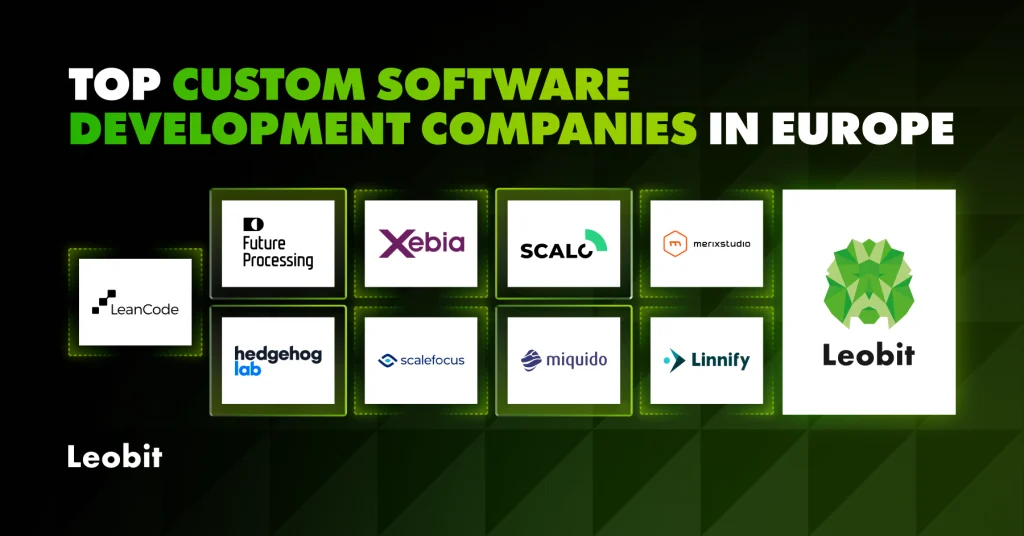
Based on the criteria outlined above, we compiled a list of the top 10 software development companies in Europe that fit different business needs and technology requirements.
1. Leobit
General information about Leobit
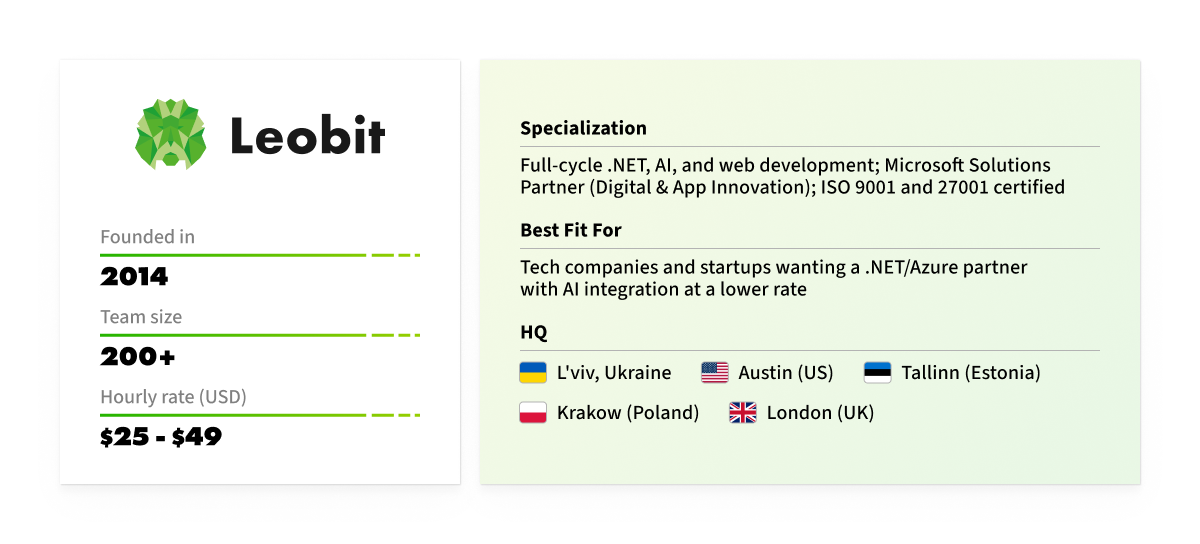
Leobit is a full-cycle AI, web, mobile, and .NET development company founded in 2014, headquartered in Lviv, Ukraine, with offices in Austin (US), Tallinn (Estonia), Kraków (Poland), and London (UK). The company’s portfolio includes a strong list of customers across Europe, including the UK, Switzerland, the Netherlands, Norway, Sweden, Finland, etc.
Leobit’s AI practice starts with its own delivery model. In August 2026 the company introduced an AI-native software development lifecycle that embeds AI across requirements, design, engineering, testing, release, and project management, with full human oversight of every release. In October 2026 Leobit became a Certified Partner of the Claude Partner Network, a tier that recognizes firms whose people have completed Claude training and earned Claude certifications. The team includes 25+ Claude Certified Developers and Architects. Leobit also runs a European R&D office in Lviv, where the company’s R&D team develops AI-powered proof of concept projects. Each PoC validates an innovative technical approach, explores a new technology, and demonstrates solution feasibility before full-scale implementation.
At the 2026 International Business Awards, Leobit won five Gold Stevie® Awards and one Silver Stevie® Award. This is the company’s third consecutive year of Stevie Award wins, following Silver Stevie® Awards for Customer Service in 2024 and 2025. For customers, this recognition means working with a partner whose client service has been assessed by outside judges three years running,
On Clutch, Leobit holds a 5 out of 5 stars rating across 63 verified reviews. Clients praise three things: on-time delivery, a proactive team that suggests improvements and anticipates problems, and technical depth across .NET, Azure, and AI.
Leobit primarily suits companies that drive innovation and AI transformation, building partnerships based on trust, transparency and long-term cooperation.
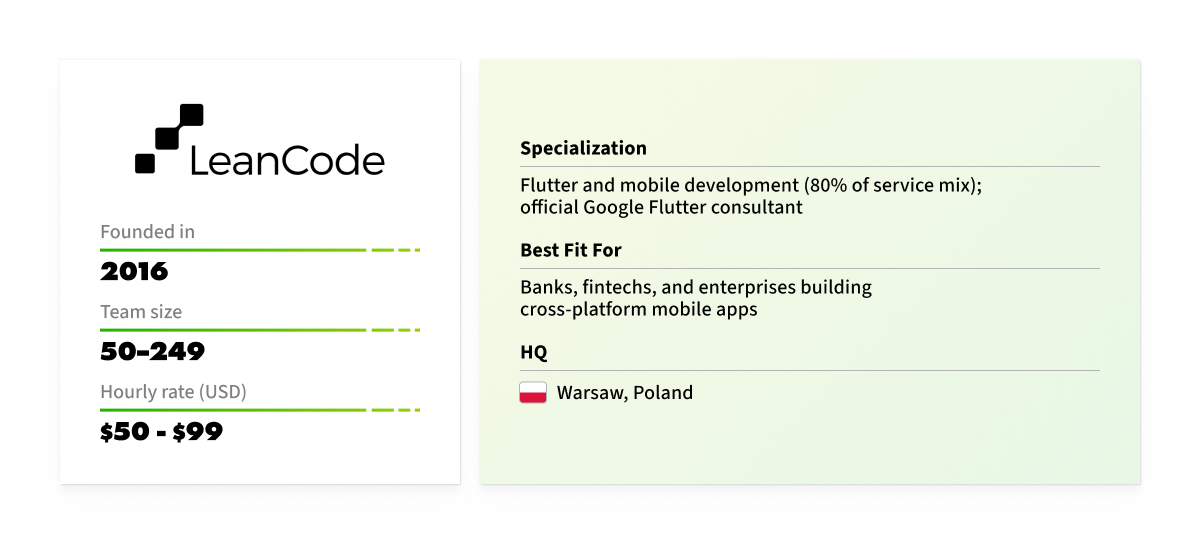
LeanCode is a medium-sized mobile development company founded in 2016 and headquartered in Warsaw, Poland, with a team of 80+ people. In addition to its mobile development services, the vendor can handle custom web development and provides IT strategy consulting services.
LeanCode’s core technology is Flutter. The vendor has strong expertise in building cross-platform solutions, primarily for regulated industries like insurtech, fintech, or the governmental sector. This deep focus has earned LeanCode a place in Google’s directory of Flutter consulting partners.
On Clutch, LeanCode holds a 5/5 stars rating across 40 verified reviews. Reviewers call the team genuine Flutter experts and praise its on-time delivery and open communication. Several say it works like an extension of their own team. The criticisms are minor: few clients noted unclear communication about project start dates and resource allocation.
LeanCode has established itself as a reputable software development partner in Europe that fits banks, fintech businesses, and enterprises that require reliable cross-platform solutions.
3. Future Processing
General information about Future Processing
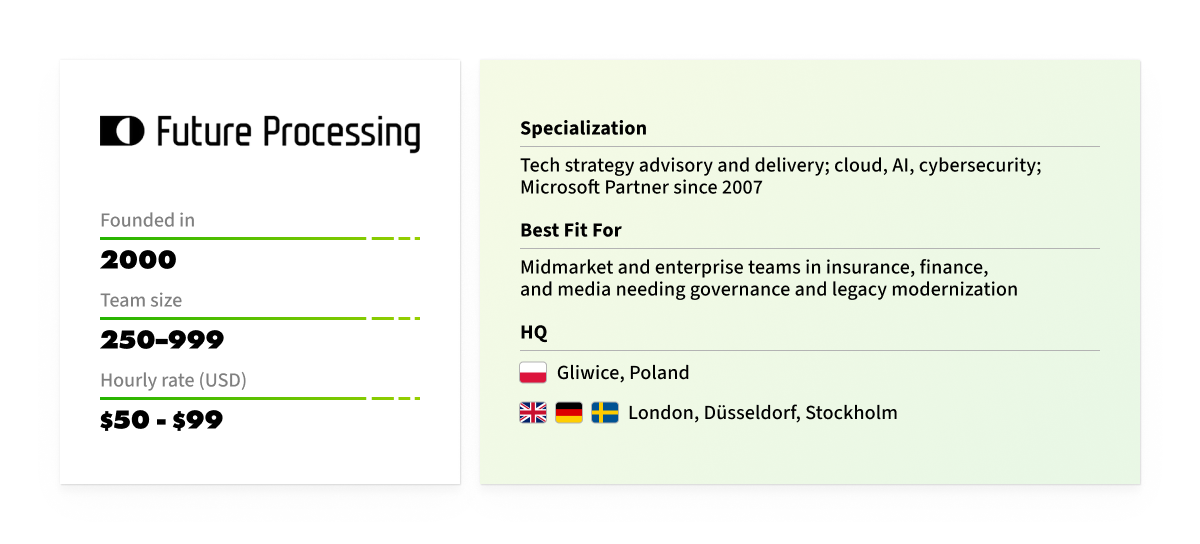
Future Processing is an experienced technology consultancy founded in 2000. The company is headquartered in Gliwice, Poland, and has offices in London, Düsseldorf, and Stockholm.
The vendor sells technology strategy advisory alongside delivery. Its main areas of focus include custom software development with a strong focus on .NET, cloud consulting, and AI consulting and development. Future Processing also specializes in DevOps services and building infrastructure as code using Terraform, Bicep, and ARM templates.
Microsoft services are central to Future Processing’s offering. In fact, the company has been holding Microsoft partner status since 2007, with Solutions Partner designations in Data & AI, Digital & App Innovation, and Infrastructure. Future Processing also has a badge for building scalable, secure Azure environments.
On Clutch, Future Processing holds a 4.7/5 stars rating across 51 verified reviews. Clients praise the vendor’s delivery quality, strong QA, and breadth across Java, .NET, AWS, and Azure, along with disciplined agile project management. Two criticisms recur: final project costs sometimes exceeded the initial estimates, and a few reviewers noted language barriers with individual developers.
Future Processing suits midmarket and enterprise teams in insurance, finance, and media. It fits companies that need documented governance and legacy modernization and plan multi-year engagements, not single projects.
4. Xebia
General information about Xebia
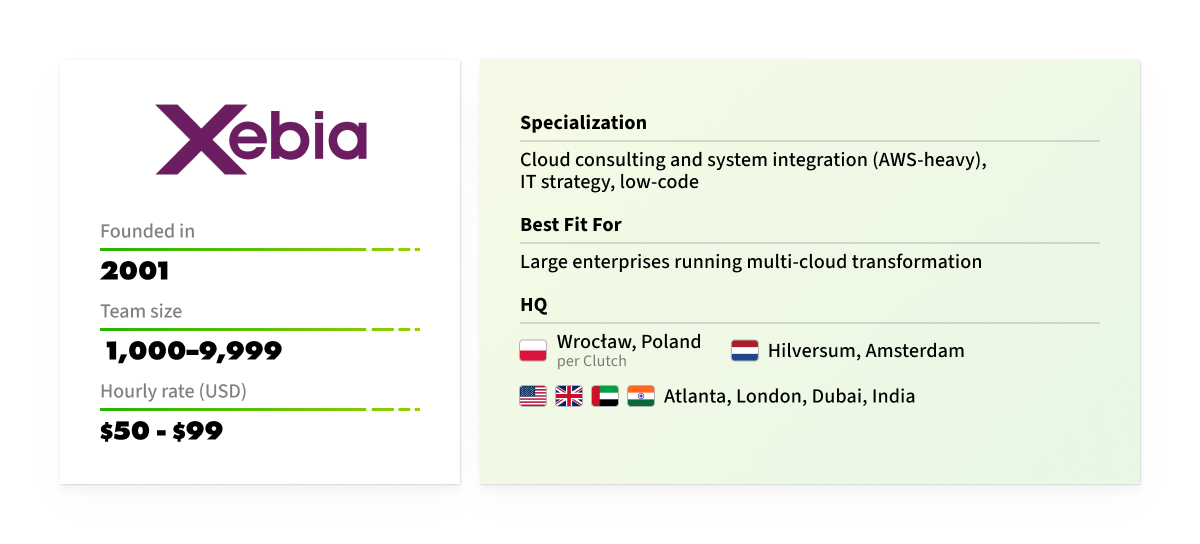
Xebia is an international software development vendor headquartered in Amsterdam, with offices in Atlanta, London, Dubai, and Wrocław, among other locations. With more than 25 years in the field and a team of over 5,000 specialists, Xebia is one of the biggest European IT companies in the outsourcing domain.
Its main services are cloud consulting and system integration, custom software development, and IT strategy consulting. Xebia also offers BI and big data, low-code, mobile, and web development. Public reviews also point to the vendor’s deep AWS expertise.
Xebia also holds Microsoft Solutions Partner status in five areas (Data & AI, Digital & App Innovation, Security, Infrastructure, and Training) and a Microsoft AI Applications on Azure specialization. It has roughly 1,500 Microsoft-certified professionals and more than 27 Microsoft MVPs. Additionally, Xebia was named GitHub Global Partner of the Year for both 2024 and 2025, and Global Security Partner of the Year for 2024.
Xebia holds a 4.7/5 stars rating based on 7 reviews on Clutch. Clients praise the vendor’s cloud and mobile proficiency, on-schedule delivery, and teams that integrated well with in-house staff. The main criticism concerns problem framing and strategic understanding in a project’s early phases.
Xebia fits large enterprises running multi-cloud migration and modernization programs that want consulting, DevOps, security, and team training from one supplier.
5. Scalo
General information about Scalo
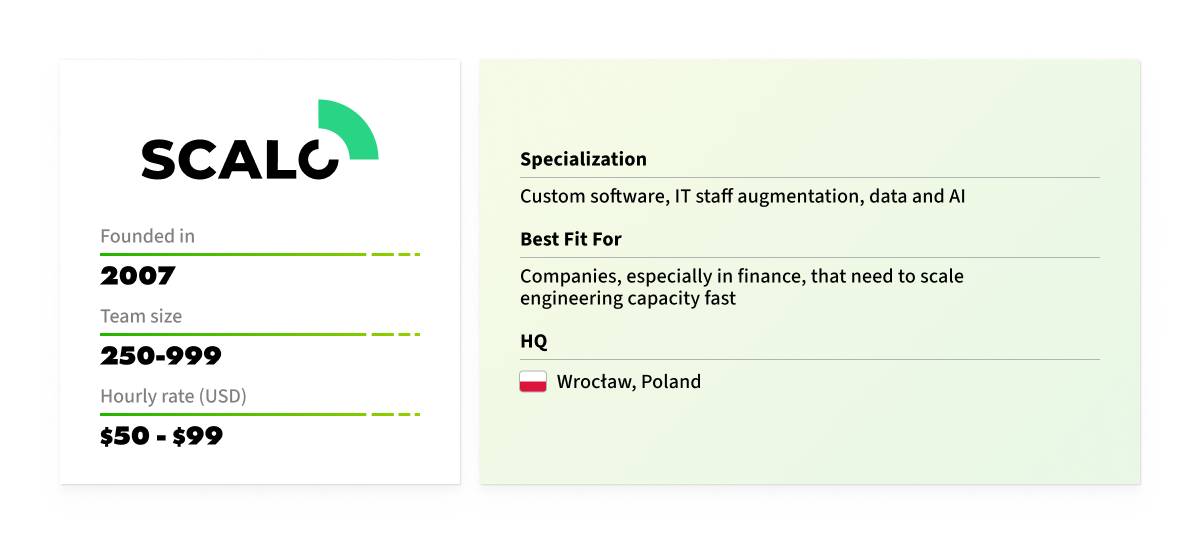
Scalo is a software and engineering services company founded in 2007 and headquartered in Wrocław, Poland. It serves clients across Europe, with a focus on financial services.
Its core services include custom software development, engineering team extension, AI consulting and development, and web development. The company works closely with small businesses and startups, since it can assemble a team and deliver a product quickly. Scalo also reports ISO 27001 certification and AWS, Microsoft Azure, and Databricks partnerships.
On Clutch, Scalo holds a 4.7 out of 5 rating across 33 verified reviews. Clients praise its on-time delivery, transparent communication, and the caliber of its engineers, who reviewers say contributed from early in the engagement. The main criticisms are code quality and software architecture, pricing, and language differences with individual team members.
Scalo suits companies, particularly in financial services, that need to add engineering capacity quickly and have their own architecture oversight in place.
6. Merixstudio
General information about Merixstudio
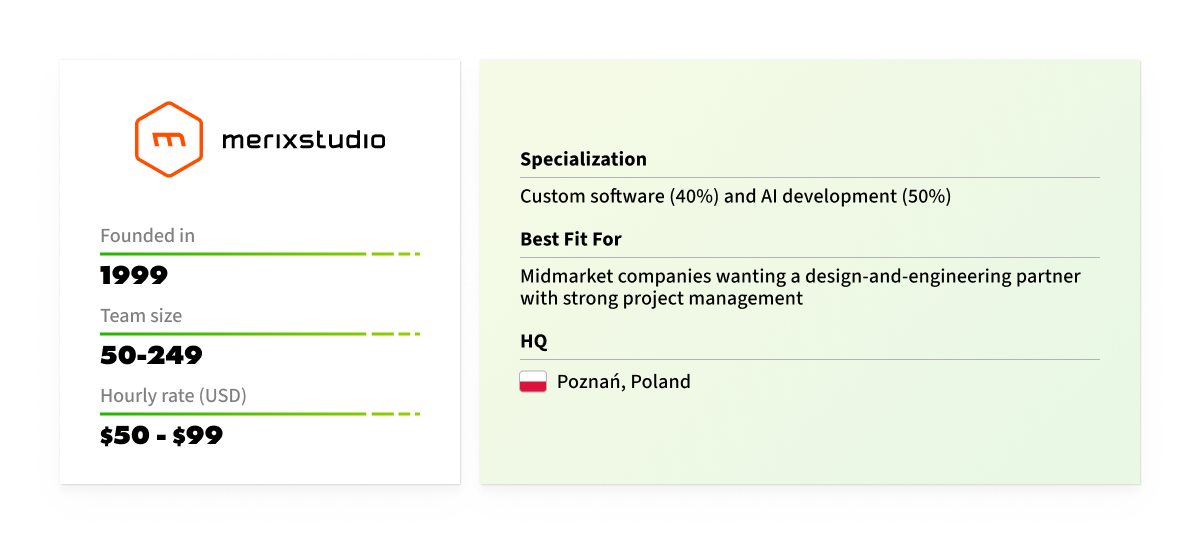
Merixstudio is a software development company founded in 1999 and headquartered in Poznań, Poland, with offices in New York, Bristol, and Berlin.
Merixstudio specializes in AI development, custom software development, and web development, combining engineering expertise with in-house design under one roof. The company also focuses on IoT development, building smart home apps and interactive solutions for amusement parks, construction sites, and museums. Merixstudio is ISO 27001 certified and holds Premier Verified status on Clutch.
On Clutch, Merixstudio holds a 4.8/5 stars rating across 97 verified reviews. Clients praise its communication and responsiveness, polished production-ready work, and structured project management. Main criticisms include limited capacity during high-demand periods and delays reviewers attribute to project complexity and thorough testing.
Merixstudio fits midmarket companies that want design and engineering from the same partner and value structured project management.
7. Hedgehog Lab
General information about Hedgehog Lab
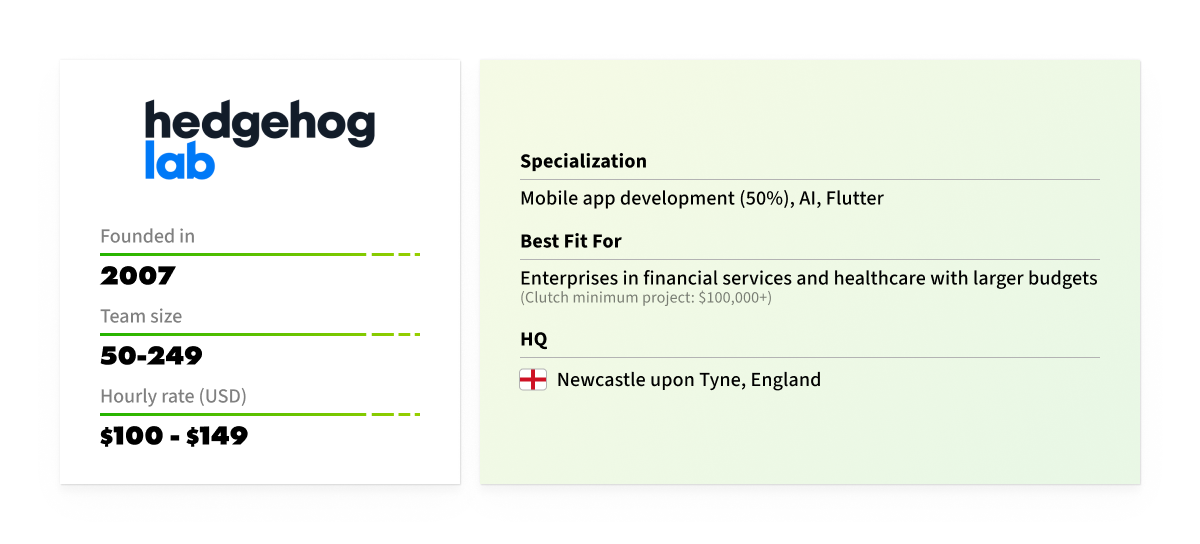
Hedgehog Lab is a medium-sized product consultancy founded in 2007 and headquartered in Newcastle upon Tyne, England.
Its core services include mobile app development, AI development, custom software development, UX/UI design, and web development. The company builds in Flutter alongside native iOS and Android. The vendor’s portfolio also includes projects with AR and VR development. Hedgehog Lab’s primary industries are fintech, tourism and hospitality, and the public sector. The company prioritizes long-term partnerships with customers across industries.
On Clutch, Hedgehog Lab holds a 4.8/5 stars rating across 82 reviews. Clients describe a genuine partnership as one of the vendor’s key strengths. The team invests time in understanding the business and proposes ideas beyond the brief. Reviewers also praise the vendor’s design work, its handling of complex features, and its flexibility when scope changes. The main criticism is unrealistic time estimates in early project phases, though reviewers say quality held and the team brought schedules back on track.
Hedgehog Lab suits enterprises in financial services and the public sector that want a UK-based partner handling product strategy, design, and mobile engineering together.
8. Scalefocus
General information about Scalefocus
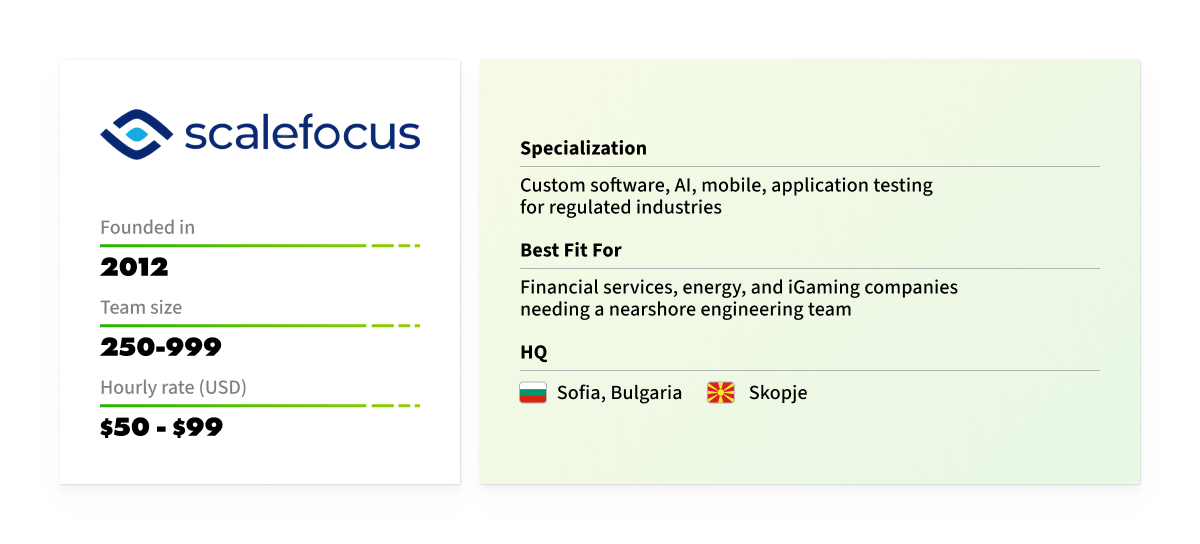
Scalefocus is an experienced software development vendor headquartered in Sofia, Bulgaria, with an additional location in Skopje, North Macedonia. It works with governmental organizations and with clients in aviation, aerospace, and energy.
The company focuses on custom software development for midmarket and enterprise clients and specializes in Salesforce and Databricks. It also builds AI-powered solutions and runs a dedicated testing practice. ScaleFocus holds ISO 9001 and ISO 27001 certifications and is an AWS Advanced Consulting Partner. Its website also lists partnerships with Google Cloud, Oracle, Salesforce, and MuleSoft.
On Clutch, Scalefocus holds a 4.9/5 stars rating across 39 verified reviews. Clients praise the vendor’s technical expertise and open communication. Reviewers say the team took time to understand the business problem, proposed solutions beyond the specification, and integrated naturally with internal staff. The main criticism concerns onboarding, where aligning processes and adjusting to cultural differences took time early on.
Scalefocus fits financial services, energy, and governmental organizations that want an EU-based engineering team.
9. Miquido
General information about Miquido
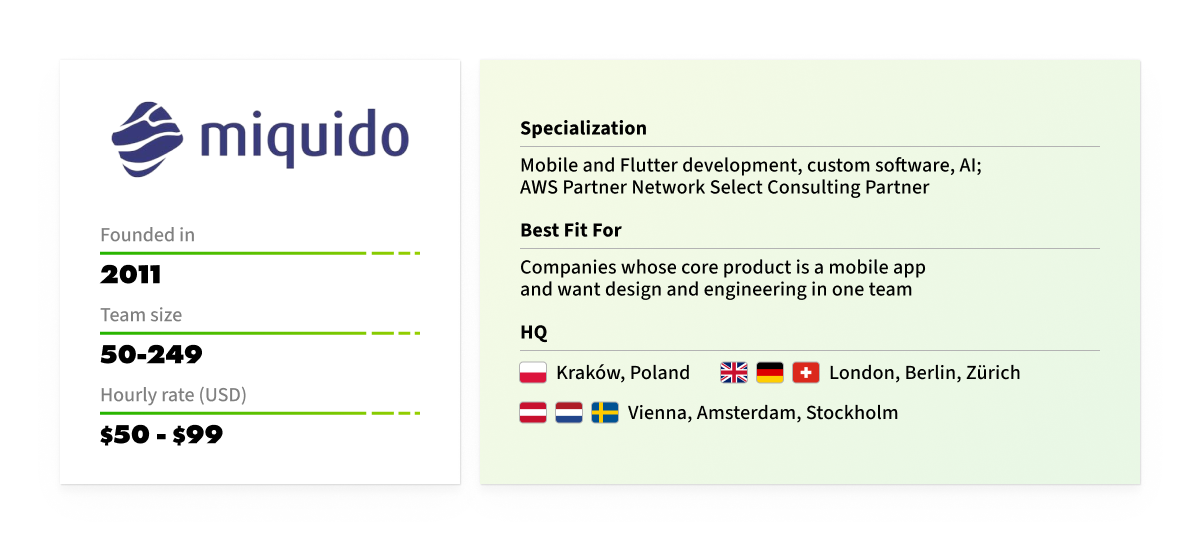
Miquido is a product development company headquartered in Kraków, Poland, with offices in London, Berlin, Zürich, Vienna, Amsterdam, and Stockholm. The vendor has an international team involving over 200 specialists skilled in different areas.
The vendor was among the early Flutter adopters, building one of the first apps on the framework, which Google showcased at its 2018 I/O conference. Miquido’s core services include mobile app development, custom software development, and AI engineering. Mobile software development comes together with product strategy and UX/UI design, and cloud work runs through its AWS practice.
Miquido is an AWS Select Consulting Partner. The company was named among Europe’s fastest-growing businesses by the Financial Times and won a 2023 Webby Award for Best Visual Design, as well as a 2023 UX Design Awards win in the Product category.
On Clutch, Miquido holds a 4.9/5 stars rating across 51 verified reviews. Clients praise the vendor’s communication, quality of work, on-schedule delivery, and project management. Reviewers also mention its flexibility and proactive problem-solving. The main criticism is limited resource availability when a project needs to scale quickly, and one client wanted more advance notice about team member changes.
Miquido fits European IT companies whose core product is a mobile app and that want design and engineering in one team, with a European office network reaching the UK, DACH, and the Nordics.
10. Linnify
General information about Linnify
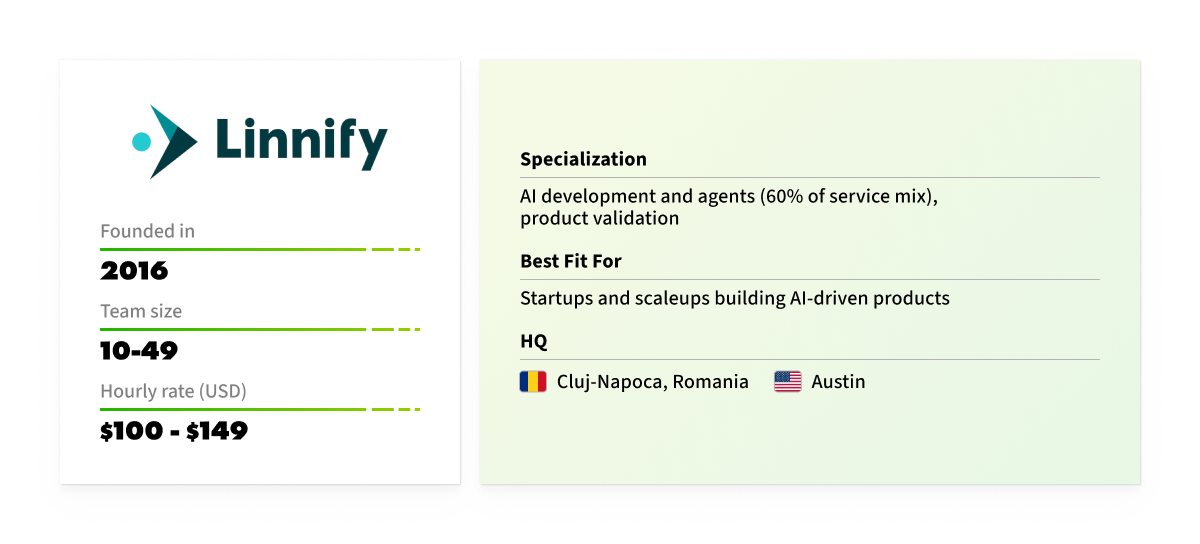
Linnify is a product development company founded in 2016 and headquartered in Cluj-Napoca, Romania, with an additional office in Austin, Texas. The company works with mid-sized and large businesses in industries such as healthcare, education, and automotive.
Linnify focuses on AI development, including AI agents and generative AI. It also offers web and mobile development, along with product validation: structured discovery and testing of an idea before the full build begins. Linnify reports ISO 27001, ISO 9001, and ISO 14001 certifications and Google Cloud Partner status on its Clutch profile. In 2026, it ranked 697th in the FT1000: Europe’s Fastest-Growing Companies.
On Clutch, Linnify holds a 5 out of 5 stars rating across 45 reviews. Clients praise its timely delivery, communication, quality of work, and AI expertise, and they say the team adapts well when priorities shift.
As an experienced AI software development company in Europe, Linnify suits startups, scaleups, and product teams that want to validate an AI product before committing to a full build.
Final Thoughts
The companies on this list differ in size, specialization, and how they work. When choosing a custom software development company in Europe, weigh your business model, in-house capacity, and compliance requirements. Shortlist two or three vendors that fit your goals, verify their credentials in the official partner directories, and ask for recent projects built on your stack. The best results come from asking sharp questions and checking claims at the source.
If you need custom software on the Microsoft stack or AI-powered solutions tailored to your business, Leobit is ready to help. Our engineers bring deep .NET, Azure, and AI expertise, and our structured AI-native software development lifecycle speeds up time to market while keeping delivery consistent. Contact us to find out how we can help you build software that meets your business needs.
FAQ
Verify every claim in a source the vendor doesn’t control. Check partner status in the platform’s own directory, read ISO certificates for issuer, scope, and expiry (security certificates should be ISO 27001:2022), and weigh review ratings against review counts. Ask which framework versions the team shipped to production in the last 12 months. Then check the contract. Prefer an EU or UK contracting entity, ask for the data region and subprocessor list, and confirm in writing that you receive the economic rights to the code, including subcontractors’ work. Make sure the vendor meets the sector rules that apply to you, such as NIS2, DORA, the EU AI Act, and the European Accessibility Act.
Be cautious when a company displays badges that its issuing directory or lacks transparency around who will actually work on the project. Reluctance to discuss a data processing agreement, repository access rules, or code ownership terms is a serious red flag. Additionally, ask how the vendor manages staff turnover during a project. The answer reveals whether project knowledge resides in documentation or with a single individual.
Outsourcing in Europe gives you access to strong engineering talent and a wide range of technical expertise, from .NET and cloud to AI and mobile. Teams scale with the project, and many vendors run mature delivery practices backed by ISO certification and documented QA. Working hours overlap with the UK, the Nordics, Switzerland, and the Middle East across the business day, and with the US East Coast in the afternoon, so working with clients in different markets is practical. A vendor registered in the EU or UK can also ease GDPR compliance, since your data processing agreement stays within a single legal framework. It doesn’t replace due diligence, so still check where your data sits, who the subprocessors are, and what the contract says.
GDPR applies to anyone processing personal data of people in the EU and EEA. In practice, that means a lawful basis for every data flow, consent captured per Art. 7, security appropriate to the risk per Art. 32, and documentation that proves it. Be very cautious while dealing with documentation in GDPR-compliant software. All undocumented measures count as unimplemented during an audit.
If the product includes AI features, classify each one against the EU AI Act risk categories during discovery, and if it serves consumers, build to WCAG level AA for the European Accessibility Act, as our guide to accessible applications explains. Settle data residency before the first deployment, because moving a production database between cloud regions later becomes a project of its own.
Leobit builds custom software on .NET and Azure, along with AI-powered solutions, for clients in the UK, Switzerland, the Netherlands, and the Nordics. The company works from Austin (US), Tallinn (Estonia), Kraków (Poland), London (UK), and Lviv (Ukraine), where its R&D team sits. The European offices keep the team within two hours of those markets, so client and team share a full working day instead of a morning handover. With more than a decade of delivery for EU and UK clients, Leobit’s engineers work inside the same regulatory environment as their customers, validating releases against GDPR and OWASP and testing accessibility against WCAG success criteria.
Roman has a deep passion for a wide array of subjects, spanning from market insights to in-depth technical examinations of complex projects. He dives deep into technical aspects of various solutions to extract valuable insights for business purposes, and he enjoys sharing tips and tricks with business owners to help them leverage advanced technologies effectively.
MIT’s State of AI in Business 2025 report shows that monthly job listings for forward deployed engineers increased by more than 800% this year, part of a ...
According to Deloitte’s Tech Trends 2024, CIOs spend 10% to 20% of their technology budgets on resolving issues caused by outdated systems. On the front ...
This year’s studies suggest that 31% of organizations across Norway, Sweden, Denmark, and Finland plan to increase spending on external IT service providers ...
A 2025 DORA survey found that 90% of software engineers now use AI in their daily work. These numbers show that AI adoption has become a universal standard in ...
The application you ship today is rarely one deployable unit. It is a set of services, each running closer to the user or the data it depends on, so responses ...
Lviv, Ukraine, June 2026 — Leobit, a .NET, AI, and web application development company, is proud to announce its inclusion in Techreviewer’s list of ...
Most companies adopting generative AI have already realized they cannot do it alone. According to RSM’s 2025 AI survey, 70% of middle-market companies using ...
Valued at about $12.3 billion in 2024, the global market for serverless architecture is expected to reach roughly $42.4 billion by 2032. That rise is largely a ...
13 mins read
We use cookies to enhance your browsing experience. By agreeing, you accept our Privacy and Cookies Policy.
By ignoring or closing this banner, we will only collect essential cookies necessary for the website to function properly.
 Leobit