
Contact us

Leobit Introduces an AI-Native SDLC to Accelerate Customer Software Delivery

Inna Fishchuk, Market Data Analyst

6 mins read

AI expertise
Blog Calculator Widget Logo

Estimate Your Software Project Cost

Describe your idea — get a budget breakdown in minutes.

Get Your Estimate

Lviv, Ukraine, August 2026 — Leobit has introduced an AI-native software development lifecycle (AI-native SDLC), a delivery model that embeds AI into the entire delivery process and helps customers bring their products to market faster. In this new delivery model, AI supports work across requirements, design, engineering, testing, release, and project management. It enables development teams to increase productivity, improve software quality, and shorten time-to-market with full human oversight of every release.

The transition reflects Leobit’s broader evolution into an AI-first engineering organization. Over the past year, the company has scaled AI across its internal teams and expanded its AI transformation services, from AI readiness assessments and discovery workshops to corporate LLMs, AI agents, multi-agent systems, and AI-native software delivery, supporting organizations at every stage of AI maturity.
AI adoption
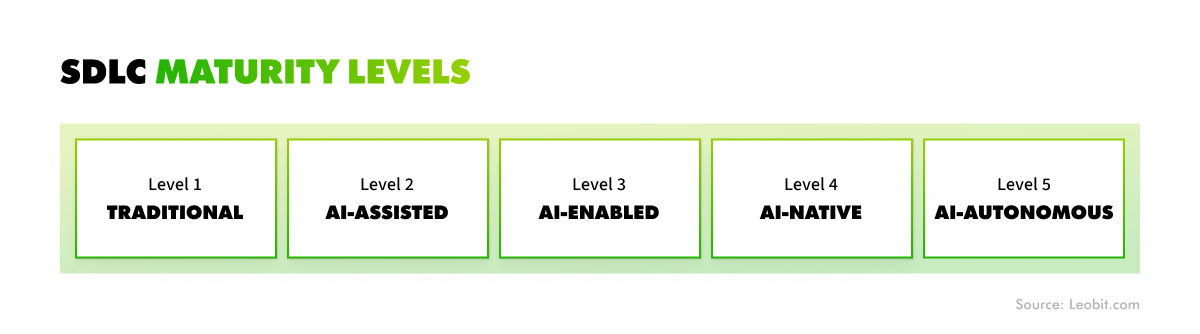
Software development lifecycle maturity levels

Today, AI is embedded across the entire software development lifecycle as a governed engineering system, with experienced engineers staying in control. Across real client projects, this approach delivers 3 to 10 times faster time to accepted output than traditional or ad hoc AI-assisted development.

From AI-Assisted Development to AI-Native Software Delivery

Leobit has fundamentally rethought how software should be delivered in the AI era. By evolving from an AI-assisted software development to an AI-native SDLC, Leobit embedded AI into the entire delivery process through governed workflows, shared engineering context, human review, and measurable quality controls. The result is faster delivery, greater consistency, and higher software quality for clients without compromising engineering oversight.

This evolution reflects the industry’s progression from traditional software development to AI-native engineering. Companies typically move through five levels of AI adoption, from manual development to AI-assisted and AI-enabled workflows, and to AI-native and AI-autonomous software delivery. Over the past year, Leobit has advanced from using AI to support individual engineering tasks to making AI a core part of its software delivery system.

Moving to an AI-native SDLC also requires rethinking how engineering teams operate. AI changes the responsibilities of developers, architects, QA engineers, business analysts,project managers, and product managers, shifting their focus from executing routine tasks to guiding, validating, and orchestrating AI-assisted workflows. To prepare teams for this transition, Leobit continuously invests in internal AI education, role-specific training, and industry certifications, ensuring that specialists across engineering and business functions have the skills needed to deliver AI-native projects with confidence.

The company has already integrated AI into its software delivery process, replaced static project templates with AI-powered templates that give every new project an intelligent starting point, and introduced AI-powered code reviews based on Anthropic’s Claude. Regular internal AI training sessions and knowledge-sharing initiatives help engineering teams continuously adopt and refine these practices.

AI is not simply making software development faster; it is changing the way software organizations operate.Becoming AI-native requires more than adding new tools to an existing SDLC. It means moving beyond individual productivity gains and “vibe coding” toward agentic engineering — where AI becomes a structured part of engineering workflows, while people provide direction, judgment, and accountability.

At Leobit, we chose to make this transformation ourselves before bringing it to our customers. By integrating technologies such as Claude Code into real engineering workflows, we have learned where AI creates genuine leverage, where human judgment remains essential, and how the two can work together at scale. In our first AI-native projects, certain delivery processes are already three to ten times faster, but speed is only part of the value. The bigger advantage is the ability to build better software, make decisions faster, and continuously improve how an engineering organization operates.

We believe AI-native software delivery will become the new standard for the industry. Our role is to help customers make that transition responsibly and turn AI from a collection of tools into a sustainable engineering capability and competitive advantage.

Oleksa_Stelmakh_CEO_and_Founder_of_Leobit

Oleksa Stelmakh

CEO and Founder of Leobit

Helping Customers at Every Stage of AI Adoption

Leobit addresses the full spectrum of customer needs, from a traditional SDLC to fully AI-native delivery, and matches the model to each client’s product maturity, industry requirements, and business goals. Leobit AI transformation services cover:

  • Exploring AI. Technology Assessments, AI Readiness Assessments, and Discovery Phases show business and technology leaders where AI can deliver measurable value before significant investment begins.
  • Implementing AI. Leobit designs and develops corporate LLMs, AI agents, multi-agent systems, and intelligent automation that solve real business challenges and integrate securely with existing systems. The company also helps organizations move beyond ad hoc AI adoption toward a systematic, AI-native approach to software development, embedding AI into engineering workflows, governance, and delivery processes.
  • Scaling AI. For companies already using AI, Leobit helps adopt an AI-native SDLC, with governed workflows, shared engineering context, human oversight, AI-driven project delivery governance, and updated team roles.

Whether a client is evaluating its first AI initiative or scaling AI across the entire software organization, Leobit provides the strategy, engineering expertise, and delivery model needed to turn AI adoption into measurable business outcomes.

Backed by Microsoft Partnerships and Certified Anthropic Expertise

Last year, Leobit strengthened its collaboration with Microsoft by adding the Microsoft Solutions Partner for Data & AI designation to its existing partnership. The designation confirms the company’s ability to design, build, and deploy AI and data-driven solutions on Microsoft technologies while meeting Microsoft’s strict technical and customer success requirements.

Leobit is also expanding its collaboration with Anthropic to strengthen the way AI solutions are designed and delivered. The company includes Anthropic Claude Certified Architects and Engineers, while an increasing number of specialists are completing Anthropic certification. Beyond engineering, Leobit invests in AI certification across business functions, enabling product managers, business analysts, QA engineers, and other specialists to collaborate more effectively on AI projects and help clients move from strategy to production faster.

Leobit builds AI solutions on enterprise-grade infrastructure such as Azure AI services and designs them to run where the client’s data already lives, without exporting sensitive information to external tools. For projects involving confidential or regulated data, the company applies automated masking, role-based access controls, and data governance rules within its AI workflows, and its corporate LLMs keep proprietary knowledge within the client’s environment. The approach is backed by Leobit’s ISO 27001:2022 and ISO 9001:2015 certifications.

Looking Ahead

Leobit remains focused on helping clients adopt AI with greater speed, confidence, and business value. We will continue evolving our AI-native software delivery model to shorten time-to-market, improve software quality, to bring measurable business impact.

Leobit will also deepen its strategic partnerships with Microsoft and Anthropic, expanding its expertise across Azure, AI platforms, and foundation models to give clients earlier access to new technologies, proven implementation practices, and enterprise-grade AI solutions. Together with continued investment in cloud-native engineering and AI expertise, these initiatives will help customers modernize faster, reduce delivery risk, and scale AI with confidence.