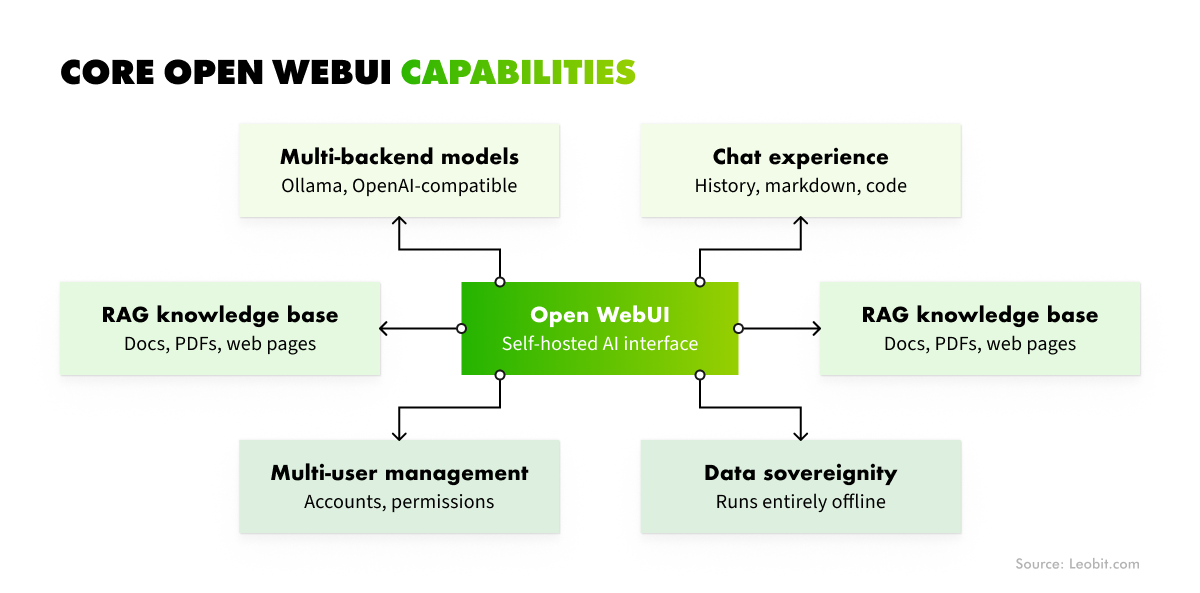
Open WebUI’s biggest benefit is flexibility: it decouples a business from any single AI vendor. However, Open WebUI’s architecture also provides a set of other specific advantages that matter at the organizational level. Below are the most significant ones.
Cost control
Open WebUI removes per-seat licensing from the equation entirely. For instance, a platform like ChatGPT Enterprise charges per user per month regardless of how heavily that user relies on the tool. Open WebUI shifts the cost structure toward infrastructure and engineering time. Instead of paying a recurring fee tied to headcount, the organization can merely pay for servers, maintenance, and setup. In conditions where total generative AI spending has reached $13.8 billion among companies globally, such a possibility to reduce and control costs can mean a great advantage for a business.
That difference becomes especially relevant to bigger organizations. After all, seat-based pricing scales linearly with every new hire, while infrastructure costs scale with actual usage and can often be optimized through MLOps practices.
Data sovereignty
Open WebUI runs on infrastructure the business controls, so that logs, prompt history, and uploaded documents never leave that environment. Nothing routes through a third-party vendor’s servers, and nothing is retained under a policy the business didn’t write itself.
Such a self-hosting approach is especially relevant to regulated industries, such as healthcare or fintech. It is also an optimal choice for AI-powered systems that operate under strict data residency rules or companies handling client contracts and proprietary source code that can’t legally or contractually leave a controlled environment.
Ability to switch between vendors fast
Open WebUI allows organizations to switch between AI models and providers fast. The interface stays constant regardless of which model sits behind it. In fact, your organization can run GPT-5 for one workflow, Claude for another, and a locally hosted open-weight model for a third. The good thing is that all these workflows will be managed from the same familiar chat window.
If a provider raises prices, deprecates a model, or changes its terms of service, the business can redirect its workflows to a different back end without disrupting the tools its employees already know how to use. This brings organizations flexibility and the ability to handle different workflows with AI models that fit them most.
Knowledge management
Through retrieval-augmented generation (RAG), Open WebUI turns a company’s internal documents, such as policy manuals, technical documentation, past project reports, and onboarding materials, into a searchable, AI-accessible knowledge base. Employees can query company data directly through the interface, with the AI drawing answers from the company’s own material rather than generic training data. This turns Open WebUI into an internal knowledge tool as much as a general-purpose assistant, without requiring a separate enterprise search product.
 Leobit