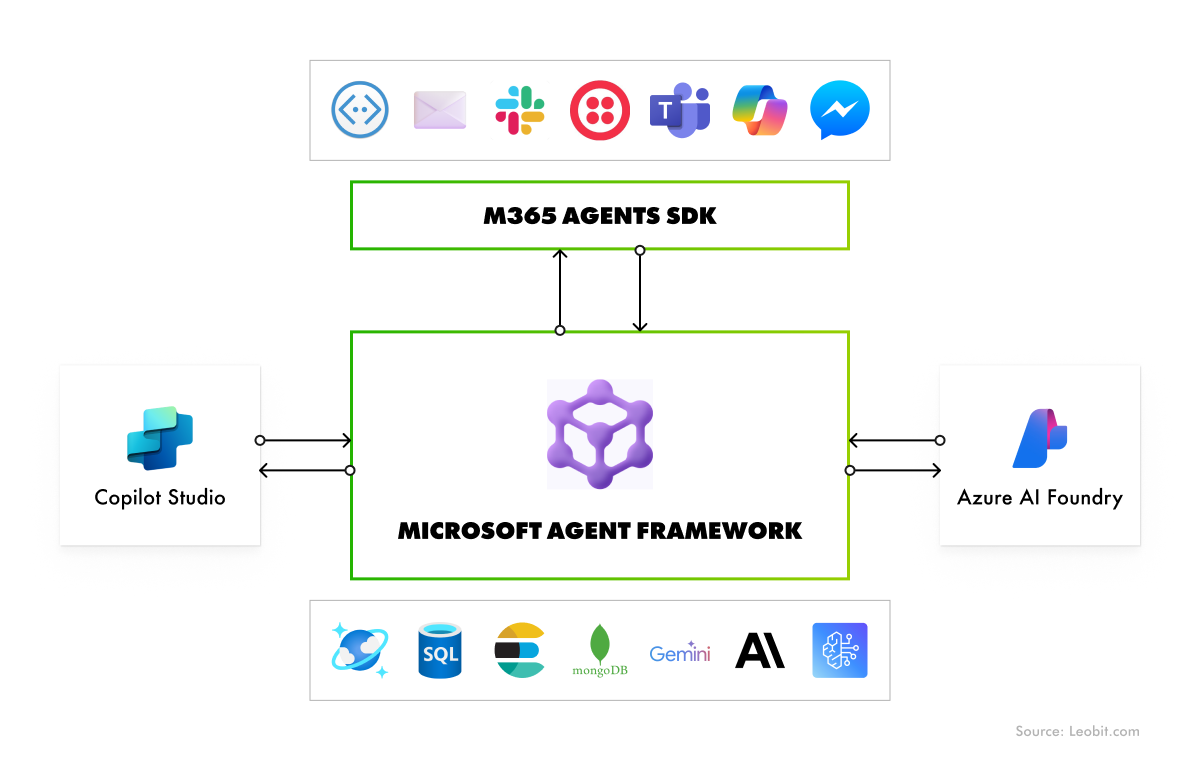
In practice, this means an agent doesn’t need a custom-built connector for every external system it touches. The framework implements MCP support through two patterns: local MCP tools that execute directly in the client application, and hosted MCP tools that are managed and executed by AI services such as Azure AI. Whether it’s a GitHub repository, a filesystem, a database, or a proprietary internal tool, agents can discover and call it through the same standardized interface.
Agent to agent (A2A) protocol connection
Microsoft Agent Framework connects AI agents through the agent to agent protocol. It works as a structured messaging layer that allows agents to communicate across different environments.
For example, a claims-processing agent built on Semantic Kernel in a .NET environment can hand off a task to a fraud-detection agent running on LangGraph in Python. In this scenario, each side exposes an “agent card” describing its capabilities, while A2A handles the task negotiation and result exchange without either agent needing to know the other’s internal architecture.
This is especially valuable for organizations that operate with mixed technology stacks used for developing AI agents. With A2A, these agents are no longer siloed and can be composed into larger systems without a rewrite.
Solid control over multi-agent orchestration
Where Agent Framework goes further than either of its predecessors is in giving developers explicit control over how multiple agents work together. Agents are paired with a workflow, which is designed as an abstraction for expressing business or application logic as computation graphs. These agentic workflows define exactly how tasks move between specialized agents.
Microsoft Agent Framework’s 2026 build has also brought the Agent Harness and stable multi-agent orchestration patterns to general release. The harness gives a language model the infrastructure it needs to function as an agent, including tool use, memory, planning, and safety controls. As a result, teams don’t have to build that runtime themselves. The framework also provides a single interface for orchestration patterns, helping teams to define how agents coordinate without rewriting the underlying logic.
These features ensure faster deployment, lower engineering overhead, and greater flexibility. In fact, AI development teams can start with a simple infrastructure that coordinates two agents and evolve toward more complex orchestration models.
Enterprise-grade observability
Debugging agentic AI systems is typically very challenging because reasoning steps and tool calls happen behind the scenes, which makes some failures non-evident. Microsoft Agent Framework responds to this problem by introducing observability that emits traces, logs, and metrics according to OpenTelemetry GenAI semantic conventions, which are generally applied standards for tracking GenAI application behavior.
In practice, every agent run, tool call, and group chat turn is captured as an OpenTelemetry span. Thanks to that, the teams get full audit trails, latency breakdowns, and quality metrics in the same observability workspace as the rest of their application.
Combined with security features like Microsoft Entra ID authentication and Azure AI Content Safety, this gives compliance and security teams the audit trail they need to run agents in regulated environments.
Consistent path to production
One of Agent Framework’s biggest practical advantages is that the code your software engineers write locally is the same code that runs in production. Typically, this process looks as follows:
- Developers build and test agents, tools, MCP integrations, and multi-step agentic workflows locally in .NET or Python.
- A single Azure Developer CLI command provisions the required Azure resources, including Foundry, model deployment, Application Insights, and Container Registry.
- The agent is packaged into a container, pushed to Azure Container Registry, and deployed to Foundry Agent Service with autoscaling and managed identity.
- Each deployed agent gets its own Microsoft Entra identity, while every deployment is stored as an immutable versioned snapshot.
- The same OpenTelemetry instrumentation works across local and production environments, giving teams a consistent view of agent behavior.
This parity means shorter timelines because it eliminates the need for a separate integration phase. Additionally, per-agent identities, versioned deployments, and shared observability carry the same governance and debugging clarity from prototype through production. As a result, teams can move fast without losing control as the number of deployed agents grows.
 Leobit