For software development teams, challenges such as lengthy developer onboarding, gaps between requirements and implementation, and repeated QA rework can affect delivery speed and consistency. Addressing these issues requires a structured approach that brings together shared engineering context, specification-driven workflows, automated quality checks, human oversight, and measurable performance metrics.
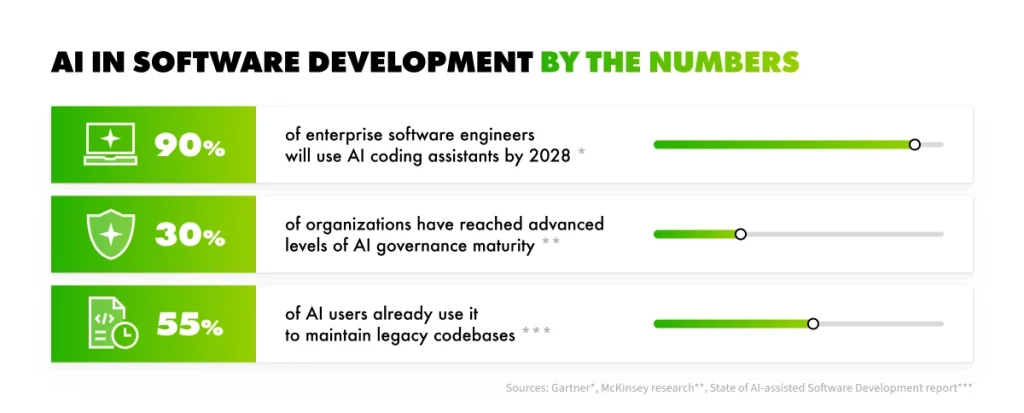
AI usage in software development statistics
In this article, we explore the key practices behind AI-native software development, explain how we implement them with Claude, and share practical examples of their impact on software delivery.
What Is AI-Native Software Development?
AI-native software development is an approach in which AI is integrated throughout the software development lifecycle, from requirements gathering and design to engineering, testing, and project management. It relies on shared project context, structured workflows, human oversight, and measurable delivery outcomes to ensure AI contributes to the overall development process rather than simply improving individual productivity.
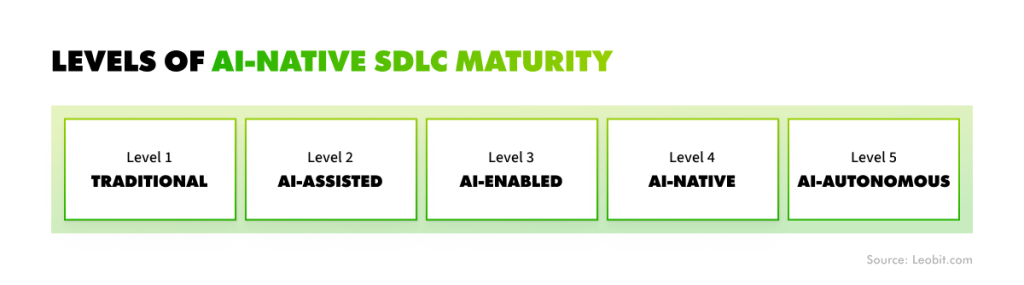
SDLC maturity levels
The distinction matters because adopting AI tools does not automatically translate into faster software delivery. According to the DORA research program, over 80% of AI tool users report improved productivity. However, individual productivity gains do not necessarily improve the efficiency of the entire development lifecycle. When developers use AI tools independently, challenges related to requirements management, code reviews, testing, and coordination may remain.
AI-native development addresses these challenges by integrating AI into established engineering processes. Rather than focusing solely on code generation, it considers the entire delivery workflow, from defining and approving requirements to developing, validating, and delivering the final solution. AI supports specific activities at each stage, while engineers retain responsibility for reviewing and approving the results.
It is also important to distinguish AI-native development from AI-first software development. AI-native refers to how software is developed. AI-first, in contrast, is a product approach in which the entire solution is built around fundamental AI functionality: AI serves as the foundational layer of the product, and the rest of the system, including APIs, data storage, and business logic, is designed around what the AI model needs to deliver its core value.
The two approaches are independent. A conventional web application can be developed using AI-native practices even if it includes no AI-powered functionality, and an AI-first product can, in turn, be built through an AI-native delivery process.
Why We Build Our AI-Native Workflow Around Claude
Claude is a family of AI models developed by Anthropic, designed to support complex reasoning, coding, and agentic workflows. In software development, tools such as Claude Code allow engineers to work across codebases, automate multi-step tasks, and integrate AI into existing development processes while maintaining human oversight.
Leobit is a certified member of the Claude Partner Network, with more than 25 Claude Certified Architects and Engineers. With this expertise, our team brings Claude into engineering workflows while keeping established development standards, quality checks, and accountability intact.
AI already makes individual developers faster. What we work on is making the whole project faster: shared context, specs a person has approved, and checks every change has to pass. Claude runs that flow as an agent; people still make the decisions.
The following sections explore how we apply these practices across different stages of software development and the value they bring to our clients.
AI-Native Development Best Practices and the Problems They Solve
Certain practices distinguish teams that turn AI adoption into reliable software delivery from those that simply accumulate AI-generated code. Across research and engineering publications on AI-driven development, we can distinguish five major practices.
Description
Shared engineering context
Version-controlled project knowledge that every AI interaction draws from
Specification-driven workflows
Requirements as the reviewable source of truth
Automated quality gates with human acceptance
AI output held to the same bar as human work
Measured delivery outcomes
Tracking time from approved requirement to accepted result, instead of AI usage
Governed access and permissions
Defined AI access to code, data, and environments
In AI-native software delivery, these practices target the recurring problems that slow projects down regardless of how skilled the team is. Below is how we apply each of them with Claude, and who approves the result at every step.
New engineers take weeks to become productive
Onboarding new engineers to an existing project takes time, particularly when working with complex or long-established systems. Developers need to understand the codebase, architecture, business logic, and established conventions before they can contribute effectively. AI can help streamline this process.
At Leobit, we use shared, version-controlled engineering context to make project knowledge more accessible. This includes architecture decisions, coding conventions, domain terminology, and other relevant documentation that Claude can reference when assisting developers. New team members can use Claude to explore the codebase, understand how different components interact, and identify where changes should be made. By providing a consistent source of project context, this approach reduces the need for repetitive explanations and helps engineers become productive sooner.
On a project set up this way, the repository holds the architecture decisions, conventions, and domain rules as plain Markdown next to the code. A new engineer starts with one onboarding command: Claude walks them through the modules they will touch, using that written context and the code itself, and points to the file or decision behind each answer.
The same context serves Claude in every later session, because an AI agent starts each session with no memory of the last one. The newcomer’s first task is small and well-specified, with tests, so the tech lead can quickly review something they can judge. For the client, a new team member costs less ramp-up time, and team changes no longer mean lost knowledge.
Mykola Sheredko
AI Solution Architect at Leobit
Still, the tech lead validates the engineer’s understanding and reviews their first production contributions. Claude shortens the path to context; it does not replace the conversation where the lead confirms the newcomer is ready.
Requirements get lost between BA and development
Maintaining alignment between business requirements and technical implementation can be challenging, particularly as projects grow in complexity. Important details discussed during requirements gathering may not always be fully reflected in development tasks, leading to additional clarification and rework. Specification-driven development helps address this by establishing structured, reviewable specifications that serve as a shared reference throughout the development lifecycle.
At Leobit, we use AI-powered project templates to establish a consistent structure from the beginning of each project. Claude uses approved specifications to support implementation, helping developers stay aligned with the original requirements. When we need additional details or clarification, we can identify them early and address them before they affect later development activities.
The business analyst pulls the backlog item from Jira or Azure DevOps through an MCP connector, and Claude drafts a specification with acceptance criteria. Each criterion gets a stable ID, and each ID later gets a test. Developers plan from the approved spec, not from the ticket.
When a criterion has no test yet, or the code covers something the spec doesn’t mention, an automated check flags it; on our strictest projects, that turns the build red, so the gap goes back to the analyst before it reaches QA. This gives everyone involved, including the client, a clear understanding of what needs to be delivered and how its completion will be verified. Instead of relying on subjective assessments, the team can check each requirement against its corresponding test.
Mykola Sheredko
AI Solution Architect at Leobit
At the end of the day, the business analyst and the product owner sign off on the specification, and every change to it goes back through them.
QA keeps rewriting tests
Test automation often lags behind the product, and QA ends up rewriting tests after every change. AI can help speed up this process. According to DORA, 62% of AI users apply AI to writing test cases.
Integrating AI-assisted testing into specification-driven workflows can help teams keep requirements and test coverage consistent. By using approved specifications as a reference, AI can support test case generation, identify areas where existing tests may need updates, and help QA engineers adapt test coverage as requirements change.
QA engineers keep their existing test cases as the input. Claude generates automated tests from those cases and the acceptance criteria, for example, Playwright tests for user flows, working from the project’s documented flows and business rules. Each test carries the ID of the criterion it covers, so when a requirement changes, the affected tests are easy to find. Once a test exists, rerunning it costs no AI usage. For the client, regression coverage keeps up with the product instead of lagging behind a release.
Mykola Sheredko
AI Solution Architect at Leobit
QA engineers remain responsible for reviewing AI-generated tests, validating test coverage, and confirming that the implemented functionality meets the acceptance criteria.
Senior engineers become the review bottleneck
Code reviews are essential for maintaining software quality, but they can also affect delivery timelines, especially when senior engineers review a large volume of changes. AI-assisted reviews can help teams manage this workload while maintaining consistent quality standards. As Stack Overflow’s research on AI coding agents highlights, systematic verification remains important when working with AI-generated code. This includes automated testing, static analysis, and human review.
At Leobit, we use Claude-powered code reviews as an initial quality check before human review. This approach helps identify potential issues, such as coding convention violations, overlooked edge cases, and inconsistencies with project specifications, allowing engineers to address them earlier in the review process.
Claude reviews each pull request against the project’s own written rules and the specification the task came from. It flags convention violations, acceptance criteria without a test, and edge cases the spec names but the code skips. The author fixes those before a person looks.
Review also starts earlier and gets smaller: a person approves the plan and the spec before any code exists, and each pull request carries one tested task, so review no longer lands on one tech lead’s desk. For the client, faster AI-written code does not turn into a review queue.
Mykola Sheredko
AI Solution Architect at Leobit
Still, engineers retain responsibility for final code review and merge approval, focusing on architectural decisions, implementation correctness, and overall code quality.
Architecture mistakes are the most expensive to fix
Architecture decisions have a long-term impact on software scalability, maintainability, and performance. Evaluating different approaches early in the development process helps teams identify potential risks and choose the most suitable technical solutions.
At Leobit, we use adversarial multi-model reviews for complex architecture decisions. Independent AI models evaluate proposed designs from different perspectives, helping architects identify potential weaknesses, assess trade-offs, and validate their approach. For example, in our multi-product enterprise ERP project, this approach supported the design of a unified architecture connecting seven products through a shared identity and data model.
For decisions that are expensive to reverse, one model is not enough. Claude drafts the design, and a model from a different vendor reviews it as an adversary: it looks for failure modes, hidden coupling, and wrong assumptions, and Claude answers each finding.
The architect reads the whole exchange, not only the conclusion. Models trained differently rarely miss the same thing, and where they disagree is exactly where a person needs to look. For the client, the decisions that are most expensive to undo get the most scrutiny before any code is written.
Mykola Sheredko
AI Solution Architect at Leo
The solution architect reviews the AI-generated feedback, evaluates the recommendations, and makes the final architecture decisions.
Knowledge walks out with people
The reasoning behind decisions often lives in one person’s head or in a closed chat. When that person moves on, the next engineer repeats the investigation, or the mistake.
At Leobit, every feature runs in three steps: plan, work, wrap. The wrap asks one question: what did we learn? Claude proposes the lesson, whether a decision, a pitfall or a rule, and it goes into the project wiki as plain Markdown in the repository next to the code. The next feature starts from what the last one learned, because Claude reads it before writing code. For the client, a change of people or of AI models does not reset the project’s memory.
A person approves every lesson before it enters the wiki, and the record shows who approved it.
Project managers lose hours every week to status updates, release notes, and meeting summaries. That’s time they could spend with the client and the team, catching problems early, clearing blockers, and keeping the project on track.
At Leobit, the PM gives Claude a short brief together with the Jira export and the meeting notes. Claude drafts the report and lists every number it could not trace to a source. For the client, reports arrive on time, and every figure in them can be traced back.
The project manager decides what is said to the client and checks every number and date before it leaves the company.
What AI-Native Delivery with Claude Changed for Our Clients
At Leobit, we evaluate the effectiveness of our AI-native software development approach through measurable delivery outcomes. We focus on the time required to move from approved requirements to accepted results, while maintaining established quality standards and human oversight throughout the development process.
Across client projects, our AI-native software development lifecycle has helped accelerate specific development activities by 3–10 times compared to traditional approaches. The improvements vary depending on the project scope, complexity, and stage of development, including business analysis, engineering, testing, and project management.
One example of our approach in practice is the development of a Claude-powered AI sales assistant for Tipco, a US-based industrial distributor. Within several months, the team delivered a release-ready solution for internal users that successfully passed user acceptance testing with the company’s regional directors. The project has since evolved into an ongoing engagement, with plans to expand the solution into a customer-facing product.
The project illustrates how structured requirements, consistent quality controls, and human validation can support AI solution delivery from initial development through subsequent product evolution.
Maintaining Human Oversight in AI-Native Development
Human oversight is a fundamental part of Leobit’s AI-native software development approach. While AI supports activities across the development lifecycle, engineers remain responsible for reviewing outputs, validating quality, and approving results. This helps ensure that AI-driven development follows established engineering standards and supports long-term software maintainability.
Effective governance is particularly important when managing technical debt. According to Accenture, companies allocate approximately 15% of their IT budgets to addressing technical debt. The challenge extends to existing systems as well: according to DORA, 55% of AI users already apply AI to maintain legacy codebases, where consistent quality controls matter most. As AI accelerates code generation, maintaining these controls becomes increasingly important.
At Leobit, we incorporate technical debt management into the development process through structured reviews, testing, and ongoing code quality assessment.
This approach also highlights the distinction between vibe coding and agentic engineering. While rapid AI-assisted code generation can be useful for prototyping and experimentation, production software requires structured specifications, quality gates, and clearly defined responsibilities. The same principles apply to access management, with Claude operating within established permissions for code repositories, data, and development environments.
Traditional delivery
AI-native delivery
Project knowledge
Spread across people, tickets, and chats
Version-controlled shared context
Requirements
Tickets interpreted by each developer
Approved specifications as the source of truth
First draft of code and tests
Written by hand
Proposed by AI within governed workflows
Review
Human review carries the full load
AI first pass, human acceptance
What gets measured
Activity and velocity
Time from approved requirement to accepted result
Final responsibility
Human
Human
By combining AI capabilities with established engineering practices and human expertise, Leobit’s AI-native approach supports more efficient software delivery while maintaining accountability, quality, and control throughout the development lifecycle.
How to Transition to AI-Native Software Development
Adopting AI-native software development is a gradual process that involves integrating AI into engineering workflows, establishing governance practices, and measuring its impact on delivery.
Leobit’s five-level AI maturity model outlines this progression, from traditional software development and individual AI-assisted activities to AI-integrated processes and a fully governed AI-native SDLC. The fifth level, AI-autonomous delivery, represents an emerging stage in which AI agents take on greater responsibility for development activities.
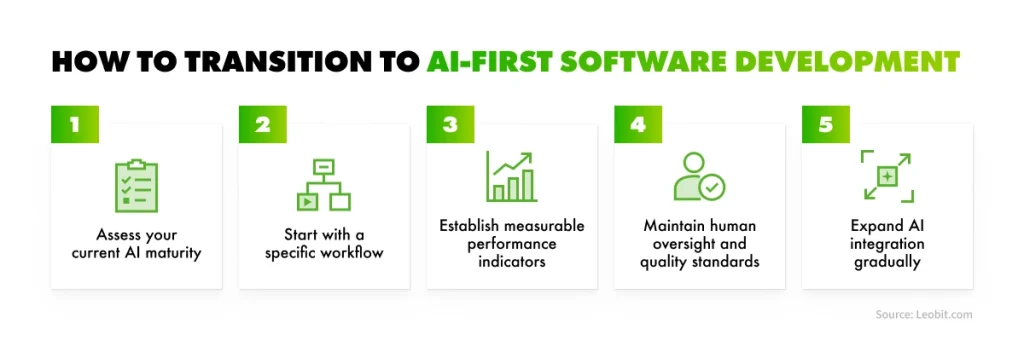
Regardless of an organization’s current level of AI adoption, the transition to AI-native development can follow five practical steps.
How to transition to AI-Native software development
Assess your current AI maturity. Evaluate how AI is currently used across your development lifecycle, which workflows are supported, and whether consistent governance and performance measurement practices are in place. This helps identify opportunities for improvement and establish priorities.
Start with a specific workflow. Select an area where AI can deliver measurable value, such as developer onboarding, requirements management, or code reviews. Define the process, establish the necessary project context, and assign clear responsibilities for reviewing and approving AI-generated outputs.
Establish measurable performance indicators. Define baseline metrics before introducing changes and track improvements in delivery speed, quality, and efficiency. Measuring the time from approved requirements to accepted results, where applicable, provides a clearer picture of AI’s impact than tool adoption metrics alone.
Maintain human oversight and quality standards. Establish clear acceptance criteria, review processes, and approval responsibilities for AI-assisted activities. As AI takes on more development tasks, experienced engineers remain responsible for validating outputs and ensuring they meet technical and business requirements.
Expand AI integration gradually. Once a workflow demonstrates consistent results, extend the approach to other stages of the development lifecycle. Reuse established governance practices, shared project context, and performance metrics to support consistent implementation across teams and projects.
None of these steps requires a large upfront program. The approach is deliberately incremental: each governed workflow makes the next one easier to introduce, because the shared project context, approval practices, and performance metrics already exist and can be reused. Long-term success depends on consistent application of these practices, which depends on engineering discipline rather than tool choice.
How Can Leobit Help with AI-Driven Software Development?
Leobit helps businesses adopt AI-native software development by integrating AI into engineering workflows, establishing governance practices, and improving delivery efficiency. Drawing on our experience implementing an AI-native SDLC across our own projects, we offer several ways to support clients depending on their needs and existing development capabilities.
Our AI-native software development services include delivering software projects using our established AI-native approach or helping organizations integrate governed AI workflows into their existing development processes. For businesses looking to incorporate AI capabilities into their products, we also provide agentic AI development services.
Our team includes 25+ Claude Certified Architects and Engineers. Leobit is also certified in the Claude Partner Network, reflecting our expertise in implementing Claude-powered solutions and engineering workflows.
For organizations exploring AI adoption, an AI readiness assessment can help identify opportunities for AI integration, evaluate existing processes, and prioritize initiatives based on potential business value.
Conclusion
Successful AI-native software development requires more than adopting AI tools. It involves integrating AI into established engineering processes, supported by shared project context, structured specifications, consistent quality controls, and measurable delivery outcomes. Together, these practices help organizations improve development efficiency while maintaining software quality and clear accountability.
Leobit’s experience with Claude demonstrates how a structured, AI-native approach can accelerate software delivery while keeping engineers responsible for critical decisions and final approvals. By combining AI capabilities with established engineering practices, organizations can build a scalable development model that continues to evolve alongside advances in AI technology.
Whether you want to accelerate software delivery or introduce AI-native practices into your engineering organization, Leobit can help you define an approach aligned with your technical requirements and business goals. Contact our team to discuss your project.
FAQ
AI-native software development is an approach in which AI is integrated throughout the software development lifecycle, from requirements and design to engineering, testing, and project management. It relies on shared project context, governed workflows, human oversight, and measurable delivery outcomes, so AI improves the delivery process rather than individual productivity alone.
Individual productivity gains are widely reported, but they translate into faster delivery only when the surrounding process changes. In Leobit’s measured experience, an AI-native approach accelerates specific delivery activities by 3 to 10 times, tracked as the time from approved requirements to accepted results under unchanged acceptance criteria.
It is safe when it goes through the same quality bar as human-written code: automated tests, static analysis, and human review. Risk comes from skipping those gates, not from the origin of the code. In an AI-native process, an engineer reviews and approves every change before it reaches production.
Inna loves making complex tech feel simple. With a strong eye for innovation, she helps businesses turn complicated ideas and data into clear strategies they can actually use. Whether it’s new tools or big trends, she’s all about making technology work for people.
Mykola Sheredko is a solution AI architect leading AI Enablement at Leobit, helping teams and clients bring AI into everyday software development while keeping quality and people at the center. Anthropic-certified, he has worked across healthcare, fintech, and govtech, from modernizing legacy systems to building products from scratch. Mykola is focused on making AI practical and reliable beyond demos.
AI now accounts for 52.7% of all code created by 500+ engineering organizations surveyed by DX. Yet only 33% of developers trust the accuracy of AI output, per ...
Flexera’s 2026 State of the Cloud Report found that 85% of organizations name managing cost as their top cloud challenge. Respondents from the same ...
Google’s 2025 DORA report found that 90% of developers now use AI at work. The data on code quality is less encouraging. GitClear analyzed 623 million ...
62% of business leaders at mid-sized and large companies believe parts of their business-critical applications are already so outdated that they no longer meet ...
In August 2025, TypeScript overtook Python and JavaScript to become the most used language on GitHub: 2.6 million monthly contributors, up 66.6% in a single ...
Nearly 90% of organizations are already piloting or deploying generative AI in their quality engineering practice, according to the World Quality Report 2025. ...
22 mins read
We use cookies to enhance your browsing experience. By agreeing, you accept our Privacy and Cookies Policy.
By ignoring or closing this banner, we will only collect essential cookies necessary for the website to function properly.
 Leobit