Contact us

When and Why to Build an AI PoC?

14 mins read

generative ai poc
Blog Calculator Widget Logo

Estimate Your Software Project Cost

Describe your idea — get a budget breakdown in minutes.

Get Your Estimate

Around 22% of executives from companies with high AI maturity cite technical implementation as a major challenge. The broader picture is bleaker: 72% of businesses fail to achieve and scale value from AI adoption, often because the leap from strategy to full production is too steep.

ai models
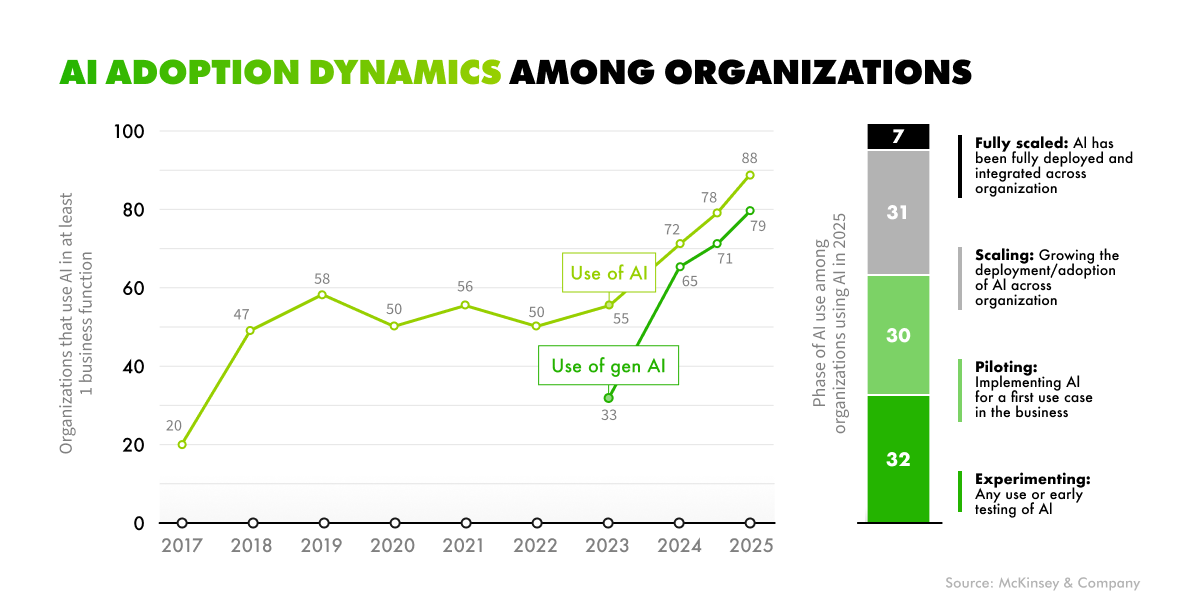
AI adoption statistics

Starting an AI project with a proof of concept (PoC) can make the difference. It is a certain way to validate a technical approach before allocating budget and engineering resources.

In this article, we’ll walk through the key benefits of running an AI PoC, the essential use cases that justify this approach, and the best practices that turn a PoC into a foundation for production success.

What Is an AI PoC?

An AI proof of concept is a small-scale project designed to explore the capabilities of particular AI technologies or to examine whether a specific approach can solve a defined business problem. It is a working test against real data and real constraints, designed to prepare an organization for a full-scale AI implementation.

The complexity of an AI PoC varies widely depending on the use case. On the simpler end, a generative AI PoC can explore how well a pre-trained model extracts structured data from receipts or invoices. A more complex AI PoC project can involve advanced functionality, such as dynamic video tagging and analysis. There are no limits to such complexity because even agentic AI setups may start with multi-model PoCs that explore the capabilities for autonomous reasoning.

 Book Icon

The core aim of an AI PoC is to determine whether the proposed AI approach or solution is feasible by evaluating it against predefined success criteria. This method is relevant to both AI-first development initiatives and cases when you need to integrate AI functionality into an existing system.

Key Benefits of Building an AI PoC Before Full Implementation

The key purpose of building a PoC before committing to full-scale implementation is to understand the relevance of a concept or technology in practice. A proof of concept can be developed within hours or days and is typically oriented toward technical executives and other internal stakeholders.

 Book Icon

By using this iterative approach to validate an AI project concept, organizations gain several benefits outlined below.

Solid technology foundation

When done right, an AI PoC becomes the technical backbone of the production system. Technology choices, data pipelines, and model configurations validated at this stage can carry over into full implementation, reducing the need to rebuild from scratch. The team also gets hands-on experience with deploying and operationalizing AI, an area where 19% of low-maturity AI companies report major challenges.

Even if a validated proof of concept doesn’t move forward immediately, it still leaves behind a usable framework that can be refined and reused later, without heavy upfront investment.

Timely detection of hidden blockers

When only 6% of companies report achieving sufficient AI adoption ROI within a year, early detection of hidden blockers becomes critical to improving the chances of quickly realizing measurable returns from AI adoption.

A PoC helps surface issues early, whether system inconsistencies, data limitations, or compliance constraints, that restrict how data can be used. Finding a critical blocker on day three of an eight-day PoC is inconvenient; finding it during the 8th month of a full implementation is costly.

Fast definition of requirements

Around 37% of low-maturity organizations struggle to identify the right AI use case. Even when the vision is clear, turning it into a working system still requires a much more precise specification of how it should operate.

A PoC forces that precision by helping you define what an acceptable error rate looks like, what data is actually available, and how the end-to-end workflow behaves in practice. Getting this clarity early reduces scope drift and avoids requirement disputes that may create significant obstacles once the project is underway.

 Book Icon

Clear success metrics for the entire project

Over 22% of low-maturity organizations see measuring value from AI adoption as a key challenge. A PoC helps address this by establishing baseline metrics for evaluating success.

It produces real, grounded numbers, such as accuracy, processing speed, cost per transaction, and usage signals, that can serve as reference points. Instead of defining targets in theory, you base them on evidence from your own data and use case. As a result, it becomes much easier to see whether a full-scale implementation is actually delivering value.

When to Start Your AI-Powered Product with a PoC?

Not every AI initiative needs a proof of concept, but there are certain conditions where skipping it may expose your project to significant risks. Below are the scenarios where building an AI PoC is especially relevant.

High implementation cost with uncertain ROI

A MIT report indicates that despite $30–40 billion in enterprise investment in generative AI, only about 5% of organizations achieve sufficient returns from their AI pilots. Building a full-scale solution over 6–12 months, with a sizable engineering team and substantial infrastructure investment, only to see no measurable ROI, can be a significant setback for the business.

When the business case is based on untested assumptions, a PoC helps validate those numbers before they are locked into a larger budget. At a fraction of the cost of full implementation, it can prevent a significant investment mistake if the technology fails to deliver the expected value.

Organizational or user adoption risk

AI products deliver value if people actually use them. Still, cultural resistance remains a significant problem, with 15% of low-maturity companies citing it among major AI adoption challenges.

If your solution requires people to change their workflows, it’s worth testing those assumptions first. In most cases, teams want to see something working before they commit budget or political capital to a full rollout. A PoC lets you test a specific technology or framework with real stakeholders, analyzing its usability and adoption patterns.

Data quality or availability uncertainty

An AI system’s outputs depend heavily on the quality of the data it is trained and fed on. At the same time, data availability and quality remain key barriers to AI adoption, cited by 29% of executives in high-maturity companies and 34% in low-maturity ones.

If you’re unsure whether your data is sufficient, properly labeled, or accessible across systems, building a full pipeline first is backward. A PoC forces your team to work with your actual data early, exposing gaps, inconsistencies, or governance restrictions before they become expensive rework.

Technology uncertainty

Different AI platforms and models perform better in different scenarios. Microsoft highlights that model selection typically depends on factors such as:

  • Task fit
  • Model routing strategy
  • Cost constraints
  • Context window size
  • Security and compliance requirements
  • Region availability
  • Deployment strategy
  • Domain specificity
  • Performance
  • Tunability and configuration options

Running a focused technology test on your specific use case shows which option actually works in practice across factors such as accuracy, latency, integration complexity, and cost. This is especially important when integration with existing systems has not yet been validated.

Starting an AI adoption initiative with a PoC is not mandatory, but it can work as an additional safeguard. The table below compares cases where an iterative approach is advisable with those where it is less critical.

Run a PoC When...
Skip the PoC When...

High cost, uncertain ROI

Full build is 6–12 months, costly, and untested

Solution already validated or low budget risk

Adoption risk

Success depends on unproven user or employee behavior

Adoption barriers are minimal, stakeholders aligned

Data uncertainty

Data quality, labeling, or access is unclear

Data is clean, structured, and readily available

Tech/vendor uncertainty

Choosing between platforms with unvalidated integration

Right model/platform already proven for the use case

 Book Icon

AI PoC Best Practices and Tips

To extract the maximum value from a limited-scope experiment, you should take a well-planned and organized approach. Below are the best practices we at Leobit apply during our AI PoC development projects.

Define a narrow scope for your implementation

Resist the urge to test multiple use cases at once. Pick one specific problem, set a fixed timeline, and document what’s explicitly out of scope. For example, if you intend to build a PoC for an AI-powered CV reformatting solution, narrow the scope to CVs only instead of trying to feed too many document types to your model.

Prioritize development speed

The main goal of building an AI PoC is to validate whether the idea works as fast as possible. Teams can accelerate development workflows using AI coding assistance or vibe coding practices to deliver a working proof of concept without the production project demands.

Skipping extensive architecture planning, testing, code review, and integration work is exactly what makes PoCs so much faster to build than real projects. Once the concept is proven, your team should treat that code as a reference, not a foundation to build on.

Build a time buffer for unknown and unpredictable scenarios

Data issues, API delays, and integration surprises are common even in the simplest, smallest projects. Depending on the solution’s complexity, reserve a portion of your timeline for these unknowns rather than scheduling your PoC conclusion around a board meeting or an external deadline. Rushed PoCs produce rushed conclusions that lead to wrong decisions.

Experiment with different AI models

Don’t commit to the first model that works. Test multiple options against your specific data and use case, comparing accuracy, latency, cost, and integration complexity. Model performance varies significantly across tasks, so what works well for one client’s use case may underperform for another.

To get more practical results from user testing, keep several models available in your product rather than locking in a single choice too early. This approach also gives you flexibility if pricing changes or a better-performing option emerges later.

Set up AI governance, version control, and documentation early

Track code, data pipelines, and model versions even at the PoC stage. Write down key assumptions and why certain choices were made instead of alternatives. It keeps your AI setup from becoming a one-off experiment and makes it easier to hand over to a production team later.

Documenting model configurations also improves transparency and makes system behavior easier to explain. This factor becomes increasingly important under regulations such as the EU AI Act.

Test PoC with real users in real-world scenarios

Sanitized test data and internal demos won’t surface real usability issues. Bring in actual end users and validate against real operational constraints such as latency expectations, uptime requirements, and compliance constraints.

Provide a simple, usable interface that allows users to interact with the solution. For instance, AI-powered UI development tools, such as Claude Design or Lovable, can help your team build an app front end within hours. Collecting user feedback at this stage often reveals gaps, friction points, or issues that should be addressed before moving into production.

Focus on technical metrics, then align them with business needs

Start with measurable technical outcomes, such as:

  • Solution’s accuracy
  • Processing speed
  • Error and bias rate

After measuring such parameters, translate your results into business terms your stakeholders actually care about: cost per transaction, time saved, revenue impact. Technical metrics alone aren’t enough to make decisions. An AI PoC should link its results directly to the original ROI assumptions it was meant to test.

How Leobit Uses PoCs to Validate AI Software Ideas

Getting the talent required remains one of the key AI adoption challenges, as cited by 27% of executives from low AI maturity companies. Hands-on technical experience and a willingness to experiment are especially important in AI PoC projects that lay the groundwork for long-term initiatives.

As a Microsoft Solutions Partner for Digital & App Innovation and Data & AI, Leobit brings together cloud-native engineering, Azure AI capabilities, and practical AI implementation experience to help clients turn emerging technologies into secure, scalable, and business-ready solutions. We’ve also successfully implemented AI in our workflows, as Leobit’s portfolio now spans 25+ internal AI agents, collectively saving an estimated 3,500+ hours of manual work per year. Our company won the Global Tech Award in the Artificial Intelligence category, recognized for our corporate LLM deployment.

We also have an experienced and creative research and development (R&D) team with a strong track record of building AI PoCs focused on specific technical implementations and business functions. Many of these projects use frameworks that can be adapted with some customization to meet the needs of clients across different industries.

Below are some AI PoC examples built by our R&D specialists.

AI voice agent for appointment scheduling

Our specialists used ElevenLabs’ ConvAI to ensure effective text-to-speech and speech-to-text capabilities to build an AI-powered voice agent. The solution handles intelligent appointment scheduling and calendar management.

It receives conversational inputs from the users, processes them, and uses this information to schedule, manage, and organize appointments. The framework used in this project can be reused to help companies across industries make calendar management more intuitive and accessible.

 Book Icon

AI-powered assistant for database querying

During this project, our team has explored the capabilities of Model Context Protocol (MCP), an open standard that defines how AI models securely connect to external tools, data sources, and files.

We used MCP to connect Claude AI models to PostgreSQL to seek and process information corresponding to user requests. The framework created during this project enables users without significant technical knowledge to query a PostgreSQL database using natural language questions in English.

 Book Icon

AI-powered image analysis solution

Leobit’s R&D team used the capabilities of Azure AI Vision Image Analysis and OCR algorithms to build an AI-powered image analysis solution. AI models can automatically extract objects from the uploaded images, generate captions, tag objects, and process large volumes of unstructured visual data.

The framework can be further improved to support more detailed image tagging. It can also be refined and configured for specific industries, ranging from healthcare to financial services.

 Book Icon

Final Thoughts

An AI PoC is a certain way to validate the feasibility of your idea before committing to full-scale development of your AI-powered product. By starting your project with a proof of concept, you build a solid technical foundation that can carry into production, surface hidden blockers early, define requirements more precisely, and establish clear success metrics.

This approach makes the most sense when implementation costs are high, the ROI is uncertain, user adoption is a concern, data quality or availability is unclear, or the technology itself is still unproven. In these situations, the goal is to move quickly with a clear purpose while putting the right governance and evaluation processes in place.

Ultimately, an AI PoC isn’t meant to deliver a finished product. Its purpose is to determine whether a specific idea, model, or approach can realistically scale into real business value.

If you want to test AI technologies in practice or need clarity on whether AI can address your business goals before investing in full-scale development, Leobit is ready to help. Contact us and let’s find out how to start your AI adoption with a targeted PoC.

FAQ

In most cases, PoC’s code should not be treated as a foundation for a full-scale product. Your team should rebuild it with proper architecture, testing, code review, and integration. After that, revisit the PoC’s technical metrics, such as accuracy, latency, and error rate, to confirm they hold up at full data volume and real-world scale.

An AI PoC should prove technical and business feasibility. It provides an effective way to clarify whether the approach meets predefined success criteria using real data, establish baseline metrics like accuracy and cost per transaction, and surface blockers early.

Start with technical metrics, such as accuracy, processing speed, and error or bias rate. These give you specific, measurable evidence of whether the approach works. Then translate those results into business terms your stakeholders actually care about, such as cost per transaction, time saved, and revenue impact. A PoC should tie its findings directly back to the original ROI assumptions it was meant to test.