
5 pm CET/ 10 am CST
Live Webinar "Inside an AI-Native SDLC: How Teams and Agents Build Together"
Contact us

Solving Insurance Industry Challenges With Custom Software: Case Studies From Leobit

Inna Fishchuk, Market Data Analyst

15 mins read

Custom Insurance Software Development
Blog Calculator Widget Logo

Estimate Your Software Project Cost

Describe your idea — get a budget breakdown in minutes.

Get Your Estimate

Insurance companies continue to invest heavily in technology, but the returns don’t always meet expectations. According to Deloitte’s 2026 Global Technology Leadership Study, only 7 of 35 surveyed insurance technology leaders reported high or very high returns on their AI investments.

Meanwhile, customer expectations continue to grow. Nearly half of new property and casualty insurance policies are now purchased digitally. Still, satisfaction with the online shopping experience remains low, according to Deloitte’s 2027 Insurance Outlook.

These challenges highlight the importance of having software that supports how an insurance business actually operates. In our experience, existing platforms often struggle to accommodate company-specific workflows, insurance products, and integrations with carriers and third-party systems. Custom insurance software development gives insurers more flexibility to address these requirements and adapt their platforms as business needs change.

In this article, we explore the common software development challenges insurers and insurtech companies face and how Leobit has addressed them in three real-world projects. These include a US insurtech company that secured $10 million in funding after scaling its platform and a claims management solution that significantly reduced regression testing time.
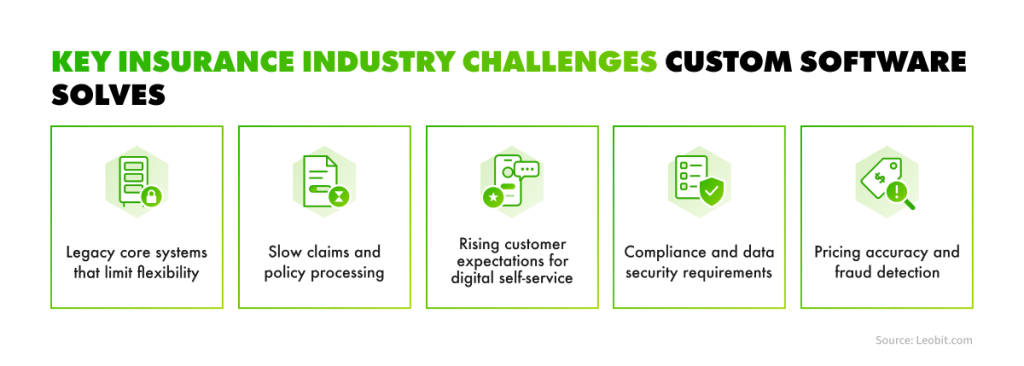
Key Insurance Industry Challenges Custom Software Solves

Insurance companies often operate across multiple systems that were implemented at different times and designed for different purposes. As business requirements evolve, these systems can become increasingly difficult to maintain and adapt. Custom software development helps insurers address these limitations without necessarily replacing their existing infrastructure.

Let’s take a closer look at the challenges and the ways to solve them.

Key insurance industry challenges custom software can solve

1. Legacy core systems that limit flexibility

Maintaining legacy infrastructure takes up a substantial share of insurance IT budgets. According to a 2025 West Monroe survey, 54% of insurers allocated more than half of their IT budgets to maintaining existing systems, while 52% postponed or canceled two to three major technology projects within a year due to budget constraints. Nearly half of respondents reported using core platforms that were six to ten years old, with some relying on systems more than 15 years old.

Beyond maintenance costs, legacy platforms can make it difficult to introduce new insurance products, or integrate with carriers. Changes that should be relatively straightforward may require extensive development and testing because of tightly coupled components and outdated architectures.

Custom software development allows insurers to modernize legacy systems incrementally. Instead of replacing an entire core platform at once, companies can prioritize the components that create the greatest operational constraints and gradually migrate functionality to more flexible architectures.

2. Slow claims and policy processing

Claims processing directly impacts customer satisfaction and retention. A Deloitte analysis of 4,000 data points identifies the claims experience as a key driver of customer loyalty.

However, claims and policy administration often involve multiple systems, manual document processing, and repeated data entry. When information must be transferred between disconnected applications, routine tasks take longer, and employees spend more time coordinating work than resolving customer requests. Errors also become more likely.

Custom claims and policy management solutions can streamline these processes by automating document handling, connecting existing systems, and centralizing relevant information. This reduces repetitive manual work and improves data consistency. As a result, employees have better visibility into the status of each claim or policy.

3. Rising customer expectations for digital self-service

Customers increasingly expect to purchase insurance policies, manage their accounts, and track claims online. However, the digital experience is not always seamless. According to J.D. Power, 21% of auto insurance customers report having to switch between channels to resolve a single inquiry.

These interruptions often occur when customer-facing applications are poorly integrated with policy administration, billing, or claims management systems. As a result, customers may need to contact support or repeat information they have already provided online.

Custom client and agent portals can help insurers create a more consistent digital experience by bringing quoting, policy management, payments, and claims tracking into a single interface. When integrated with existing systems, these portals make routine services more accessible and reduce the need for manual assistance.

4. Compliance and data security requirements

Insurance companies manage sensitive personal and financial information while operating under various regulatory and data protection requirements. The cost of getting security wrong is among the highest of any industry: according to IBM’s Cost of a Data Breach Report 2025, the average breach in the financial sector costs $5.56 million, second only to healthcare and roughly 25% above the global average. For insurers holding both financial and health-related data, the exposure spans the two most expensive categories.

As insurers expand into new markets or introduce new products, maintaining compliance can require additional development, documentation, and ongoing system updates.

Legacy and off-the-shelf platforms may not always accommodate company-specific compliance workflows or reporting requirements without additional configuration or customization. This can make regulatory changes harder to implement, especially when insurers rely on external vendors for system updates.
Custom insurance software lets companies build security and compliance requirements into the system architecture from the outset. Features such as role-based access controls, audit trails, data encryption, and automated regulatory reporting can be designed around specific operational needs. This gives insurers greater flexibility to adapt their systems as requirements grow, although ongoing compliance still depends on appropriate processes and governance.

5. Pricing accuracy and fraud detection

Accurate risk assessment and effective fraud detection are essential to maintaining profitability in insurance. The scale of the problem is substantial: the Coalition Against Insurance Fraud estimates that insurance fraud costs $308.6 billion annually in the US alone, adding around $900 per year to the average policyholder’s premiums. Insurers need to evaluate multiple factors when calculating premiums, while claims teams must identify potentially fraudulent activity without unnecessarily delaying legitimate claims.

Accurate risk assessment and effective fraud detection are essential to maintaining profitability in insurance. Insurers need to evaluate multiple factors when calculating premiums, while claims teams must identify potentially fraudulent activity without unnecessarily delaying legitimate claims.

Standard pricing and fraud detection solutions may not fully accommodate an insurer’s specific products or underwriting rules. This can limit the ability to refine pricing models or identify patterns relevant to a particular portfolio.

Custom pricing engines can combine internal portfolio data with relevant external sources to support more tailored risk assessment and premium calculations. Similarly, AI-supported risk analysis and fraud detection solutions can help identify unusual claims patterns and prioritize cases for investigation. However, their effectiveness depends on data quality and model validation.

How Leobit Addresses Insurance Software Development Challenges

Insurance software projects come with different challenges depending on the company’s goals and technology maturity. Some businesses need to expand an existing platform, while others are building a new product or improving the reliability of their development process.

The following three case studies show how Leobit has helped insurtech companies in the US and Europe address these needs through custom software development, system integrations, and quality assurance.

Scaling an insurance platform beyond its MVP

Online disability insurance solution

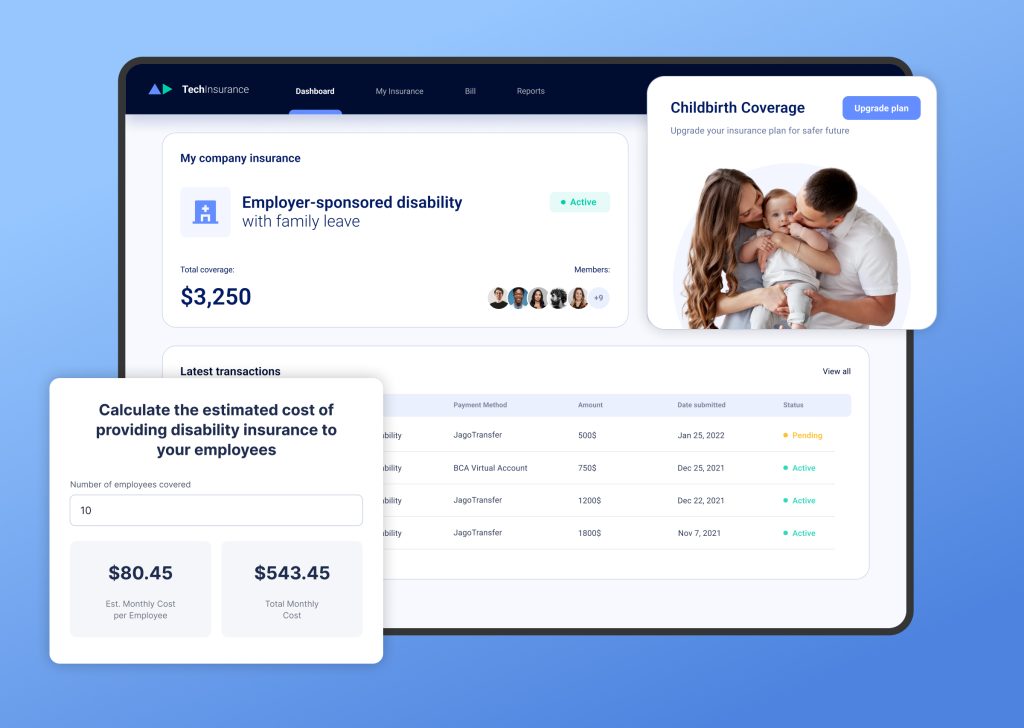
Launching an MVP is an important first step for an insurtech company, but supporting a growing customer base often requires additional functionality, integrations, and development capacity. This was the challenge facing Breeze, a US-based insurtech company offering personalized disability and critical illness insurance plans from leading US carriers.

Following the initial success of its platform, the company needed to expand its functionality and accelerate development beyond what its in-house team could support. The company partnered with Leobit to extend its engineering capacity, implement new features, and establish a comprehensive testing process.

Leobit helped develop the MVP into a cloud-native web application built with .NET, Azure, and Angular. The development work focused on several essential capabilities.

  • Carrier integration. Connected the platform to the Assurity API to exchange policy-related data with the insurance carrier.
  • Agent and customer portals. Delivered a dedicated agent portal for selling income protection products and a customer-facing portal for instant, personalized disability insurance quotes.
  • Payments and document management. Integrated a payment gateway and document management capabilities to support the online insurance purchasing process.
  • Customer communication. Implemented SendGrid, XVerify, and Customer.io integrations for contact data validation and personalized customer communications based on user activity.
  • Application monitoring. Set up Azure Application Insights to track application performance and help the development team identify potential issues.

As Breeze continued to grow, the company secured $10 million in Series A funding led by Link Ventures. Its product also received Real Simple’s 2022 Smart Money Award in the insurance category.

Leobit demonstrated an effective communication and hands-on approach to project management. They consistently kept us informed promptly, willingly engaged in collaborative problem-solving, and significantly contributed to the overall improvement of our team dynamics.

Cody L.

CTO at Breeze

The Breeze project illustrates how custom insurance software development can support an insurtech company’s growth beyond its initial MVP. By expanding the platform’s capabilities, integrating essential insurance services, and strengthening the development process, Leobit helped Breeze build a foundation for continued product development.

 Book Icon

Bringing a new insurance product to market in six months

Сar warranty insurance platform

Our customer is a Germany-based insurtech startup founded in early 2022. The company planned to offer insurance products in cooperation with leading risk carriers, using AI-powered risk analysis to support competitive pricing. Its first product focused on car warranty insurance, with plans to expand into other insurance segments.

The startup partnered with Leobit to turn its initial concept into a market-ready product. The engagement began with a discovery phase, during which Leobit’s business analysts worked with the client to define the product strategy, market positioning, and technical requirements. The team then developed a roadmap for the MVP and outlined the product’s future development.

Based on this roadmap, Leobit delivered the following outcomes.

  • Insurance sales application. Developed an application covering the sales process, with AI/ML-based risk analysis and pricing calculations.
  • Claims management. Built claims management functionality integrated with the client’s existing workflows.
  • Cloud platform. Configured a cloud-based platform built with .NET, React, and Microsoft Azure.
  • Customer-facing website. Created a website with a custom UI/UX design and integration with the insurance platform.

The project went from initial concept to a market-ready MVP in six months, including discovery, design, and development. Leobit provided a cross-functional team covering business analysis, UI/UX design, and software engineering, allowing the startup to develop its first product through a single technology partnership.


From project discovery to the release of the MVP, our team was dedicated to fulfilling all the customer requirements and providing the product that brings them maximum business value. We worked on some complex features, such as integrating several tools into the customer’s established workflows, developing AI/ML scripts for analytics, and configuring a cloud-based architecture composed of different interconnected elements.

Iuliia Berezenko photo

Iuliia Berezenko

BAO Director at Leobit

 Book Icon

Maintaining quality across frequent insurance platform releases

A US-based company headquartered in Austin, Texas, operates a platform that helps individuals navigate the disability benefits claims process. The solution connects applicants with coaches and medical professionals while providing a centralized environment for documentation and personalized action plans.

As the platform evolved, maintaining software quality became increasingly challenging. The team faced tight release schedules, complex third-party integrations, and about 50% test coverage. Manual testing alone could no longer support frequent releases.

Leobit’s QA team introduced a more structured, automation-driven testing approach.

  • Risk-based and end-to-end testing. Prioritized critical user workflows and validated their functionality across interconnected systems.
  • Automated testing with Playwright. Established approximately 1,200 automated tests running daily, supplemented by around 140 specialized tests for filtering logic and database load executed on weekends.
  • CI/CD integration. Incorporated regression and smoke testing into the Azure DevOps pipeline as mandatory checks before production releases.
  • Production monitoring. Extended quality assurance beyond deployment by reviewing application logs and integration data to identify synchronization and performance issues and support faster incident resolution.

As a result, regression testing time decreased from three days to as little as four hours. The improved testing process also supported the platform’s transition from stabilization to continuous, sprint-based development, helping the team manage release and integration risks more effectively.

What’s remarkable is that they’re always on top of deliverables, timelines, and bug-fixes. Their transparency and responsive communication stand out, as does their fast remediation of bugs and committed resources.

Scott M.

Digital Transformation Architect

 Book Icon

Custom Insurance Software vs. Off-the-Shelf Platforms

Custom insurance software development is one of two paths possible when you need to digitize your workflows. The other option is choosing off-the-shelf software. So it is worth being clear about when each option wins. Ready-made solutions often fit businesses with standard products and processes, while custom development offers greater flexibility for companies with specific workflows, products, or integration requirements.

Let’s take a closer look at the main differences between these approaches.

Off-the-Shelf Platform
Custom Insurance Software

Fit to business processes

Provides predefined workflows with varying levels of configuration and customization

Can be designed around specific insurance products, workflows, and business requirements

Implementation time

Typically faster to deploy, although configuration and integration may take additional time

Requires discovery, design, development, and testing before deployment

Cost structure

Usually involves licensing or subscription fees, plus potential implementation and customization costs

Requires a higher upfront investment, with ongoing maintenance, hosting, and support costs

Control over development

Product roadmap is largely controlled by the vendor, although customization may be available

Greater control over feature priorities, architecture, and future development

Compliance and integrations

Depends on supported integrations, configuration options, and the vendor’s compliance capabilities

Can incorporate company-specific regulatory requirements and integrations into the architecture

Off-the-shelf platforms often suit smaller insurance businesses with relatively standard processes or companies looking to validate a new business model without investing in a fully custom solution. Custom development becomes more relevant when software is central to the company’s competitive advantage, particularly when it involves specialized pricing models, complex carrier integrations, or a differentiated customer experience.

The choice also doesn’t have to be between a completely ready-made platform and a system built from scratch. Companies can combine existing solutions with custom-built components, integrations, or workflows. As the Breeze and disability claims projects show, custom development can help businesses expand existing platforms and improve functionality without replacing everything that already works.

 Book Icon

Conclusion

Custom insurance software development gives insurers and insurtech companies greater flexibility to build solutions around their specific products, workflows, and business requirements. Whether the goal is to launch a new insurance product, expand an existing platform, or improve the reliability of critical systems, the right development approach depends on the company’s priorities and existing technology.

As the case studies in this article demonstrate, custom development doesn’t always mean building a platform from scratch. It can involve extending existing functionality, integrating third-party services, automating processes, or improving software quality to support ongoing growth.

At Leobit, we help insurance and insurtech companies address these challenges through end-to-end software development, system modernization, and quality assurance. From initial discovery to long-term product development, our teams deliver solutions that meet current business needs while allowing room for future changes.

FAQ

Custom insurance software development is the design and delivery of applications built specifically for an insurance company’s products, workflows, and integrations, such as policy administration tools, claims management systems, and customer portals. Unlike off-the-shelf platforms, these solutions are shaped by the insurer’s own requirements, including carrier connections and compliance needs.

Legacy technology is among the most persistent challenges. In a 2025 West Monroe survey, 54% of insurers spent more than half of their IT budgets maintaining existing systems, which limits the budget available for new products and digital services. Rising customer expectations and compliance workload compound the pressure.

The cost depends on the project’s scope: the number of workflows covered, required integrations, compliance requirements, and the complexity of features such as pricing engines. A focused MVP costs a fraction of a full platform replacement. The total cost of ownership for custom software also differs from licensed platforms: a higher initial investment, with no recurring per-seat fees.

The timeline depends on scope, but a well-run project can move fast. In one Leobit engagement, a car warranty insurance platform went from initial concept through discovery, design, and development to a market-ready MVP in six months.

Look for verifiable insurance project experience with named outcomes and expertise in your target technology stack. The delivery process matters as much: business analysis and quality assurance should be part of the engagement, alongside development. Client reviews on independent platforms and detailed case studies are more reliable signals than a vendor’s own claims.