The SaaS market is expected to more than triple, growing from $408.21 billion in 2025 to $1,367.68 billion by 2035, according to Precedence Research. As more software is delivered as a service, a product’s tenancy model becomes one of the most important and hardest-to-change architectural decisions.
Cloud adoption has already reached the point where this decision matters to almost every business software provider. Eurostat reports that 52.7% of EU enterprises used paid cloud services in 2025, and 96.44% of them used at least one SaaS application. The tenancy model defines how software scales, what it costs to run, how it meets security and compliance requirements, and how quickly teams can release new features.
That said, however, no universally correct model exists. Single-tenant, multi-tenant, and hybrid architectures each work best under different conditions.
This article compares the three models across the factors that shape real business decisions: isolation, cost, performance, customization, release cadence, and compliance. It also shows when each model is the right fit.
What Is Tenancy in Software Architecture?
A tenant is a separate customer environment within a software product. Depending on the product, a tenant can be a customer, organization, account, workspace, or business unit whose users, data, settings, and permissions must remain isolated from other tenants. Tenancy is the way a system separates and manages those environments.
Tenant isolation means each tenant can access only its own data, users, and settings. Tenants may share the same infrastructure and run the same application, but strict access rules keep them logically separated. This architecture defines not only how data, settings, and security are handled for each tenant, but also how runtime resources and storage are distributed and how much application logic tenants share.
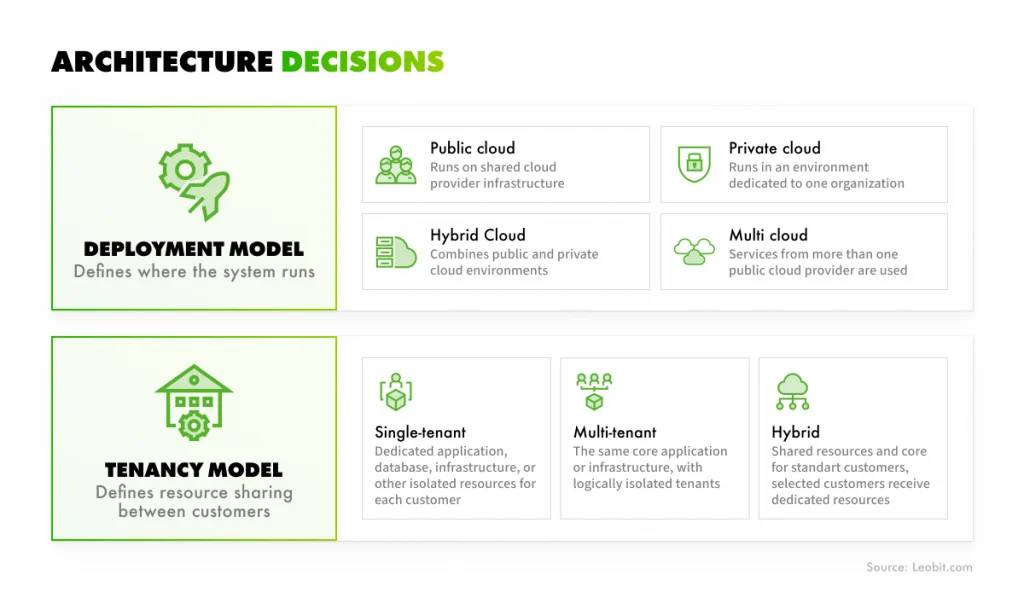
One distinction is important to make early because it often causes confusion: the tenancy model does not define where or how the system is deployed. A system can be single-tenant and still run in a public cloud. A multi-tenant system can also include private or isolated components. Tenancy and deployment are related but still separate architectural decisions:
The tenancy model answers the question: “Who shares what?”
The deployment model answers the question: “Where and how is it hosted?”
This distinction has practical consequences. Clients often ask for a private or dedicated solution when what they actually need is strong data isolation, contractual control, regional data placement, or control over upgrade timing. A fully separate single-tenant system may be the first option that comes to mind, but the same requirements can often be met by an isolated tenant within a broader hybrid architecture, without creating a dedicated product instance for every account.
This is also why the security comparison is rarely simple. Multi-tenancy does not automatically mean weaker security, and single-tenancy does not guarantee a more reliable system. In any model, security, compliance, and performance depend on the quality of isolation, access control, auditability, and lifecycle management. These factors largely depend on the skill and experience of a SaaS development team.
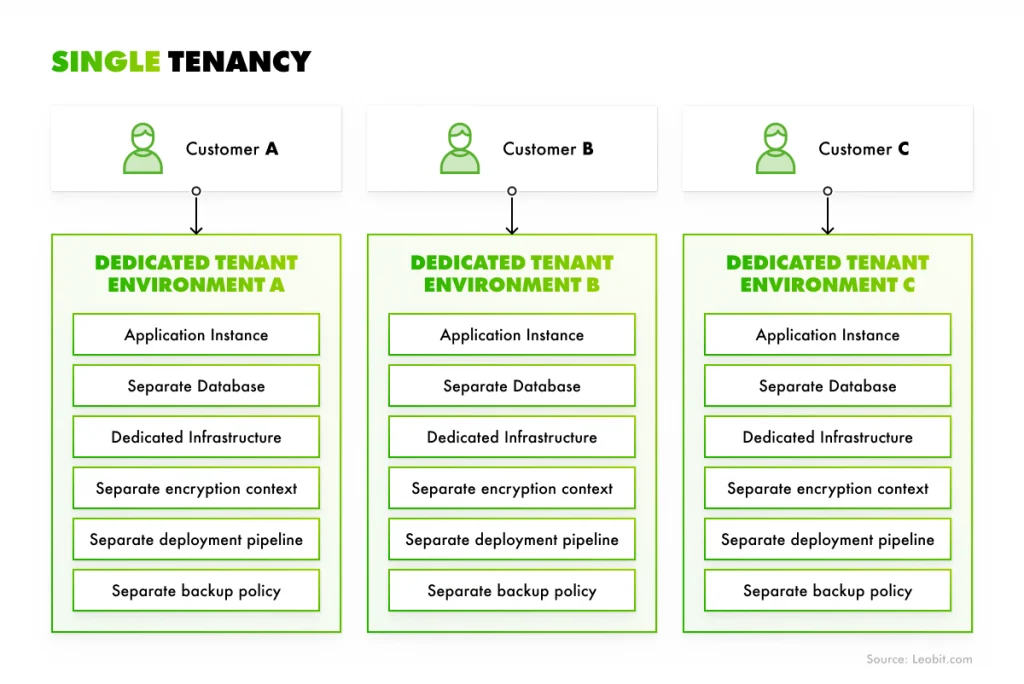
In single-tenant architecture, each customer gets a dedicated environment. Single tenancy can be applied at different levels of the system. At its strongest, this model provides each customer with a separate application instance, database, infrastructure, encryption context, deployment pipeline, and backup policy. The defining characteristic is that every customer has dedicated use of runtime and data resources. In cloud-based SaaS, single-tenancy usually means a dedicated customer environment, not necessarily physically separate hardware.
Single-Tenant Architecture: Scheme
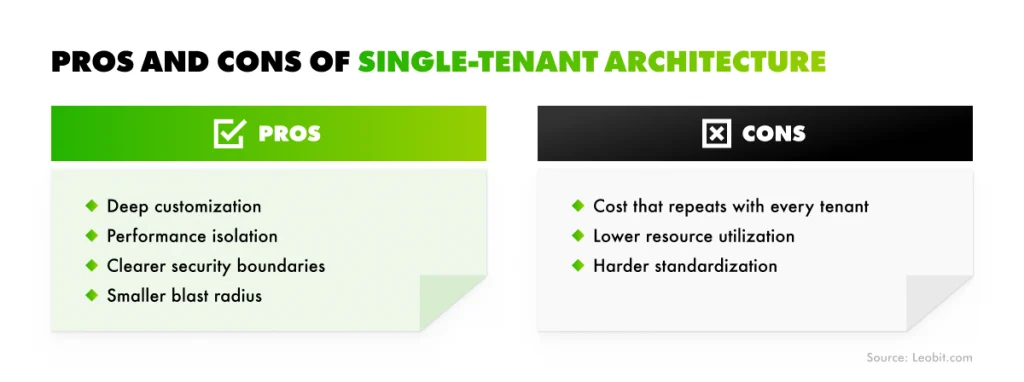
Benefits of single-tenant architecture
The core advantage of single-tenant architecture is operational independence. Because each tenant runs in its own environment, configuration, deployment, performance management, and governance can be set to that tenant’s specific requirements.
Here are additional benefits you can get from a single-tenant architecture.
Deep customization. Separate instances allow a high level of customization, down to software and hardware configurations tailored to one customer’s needs. A dedicated environment can run a specific framework version, a custom integration, or a non-standard data model without those changes affecting anyone else. This makes single tenancy a natural fit for enterprise accounts that need the product to bend around their existing systems rather than the other way around.
Performance isolation. Dedicated resources make performance easier to manage under uneven load. Because tenant workloads do not compete for the same runtime resources, behavior is more predictable, which matters for business-critical systems.
Clearer security boundaries. Isolated data storage and encryption contexts make it easier to define, audit, and explain security boundaries. If a breach is contained to one tenant’s isolated environment, separation can limit the impact on others. That containment has real financial weight: the IBM Cost of a Data Breach 2024 report puts the global average breach at $4.88 million. Containment is not automatic, though. Shared services, administrative access, common code defects, or provider-level incidents can still affect multiple tenants, so strong access control, secure development, monitoring, and incident response remain necessary.
Smaller blast radius. A database issue, configuration error, or workload spike in one tenant’s environment is less likely to affect others. Depending on the design, shared services, common code defects, or cloud-region outages can still reach multiple tenants.
Despite so many pros, single-tenant architecture still has its cons.
Drawbacks of single-tenant architecture
Single tenancy can look simple, but maintenance becomes more complex over time, and resource use becomes less efficient with each new tenant, which can sharply increase costs.
Here are some of the most common drawbacks of such a setup.
Cost that repeats with every tenant. Each new tenant adds infrastructure, CI/CD targets, backup jobs, release coordination, and support touchpoints. Setup gets more complex, management gets harder, and costs climb.
Lower resource utilization. Dedicated environments are easy to underutilize. Idle capacity is a known drain across the industry: Flexera’s 2025 State of the Cloud report found organizations waste about 27% of their cloud spend, and running a separate stack per customer makes that waste easier to accumulate.
Harder standardization. The more tenant-specific implementations a system carries, the harder it is to keep coherent. Custom work can speed up short-term delivery while increasing test complexity and slowing long-term delivery.
Benefits and drawbacks of single-tenant architecture
In a nutshell, single-tenant architecture works best when isolation, customization, compliance, and predictable performance matter more than cost efficiency. It gives each customer a controlled environment that can be adapted to specific business and security needs. However, that control comes with higher operational overhead, duplicated infrastructure, and more complex maintenance. For this reason, single tenancy is usually the right choice for enterprise, regulated, or high-value customers rather than products that depend on fast scaling and low cost per tenant.
What Is Multi-Tenant Architecture?
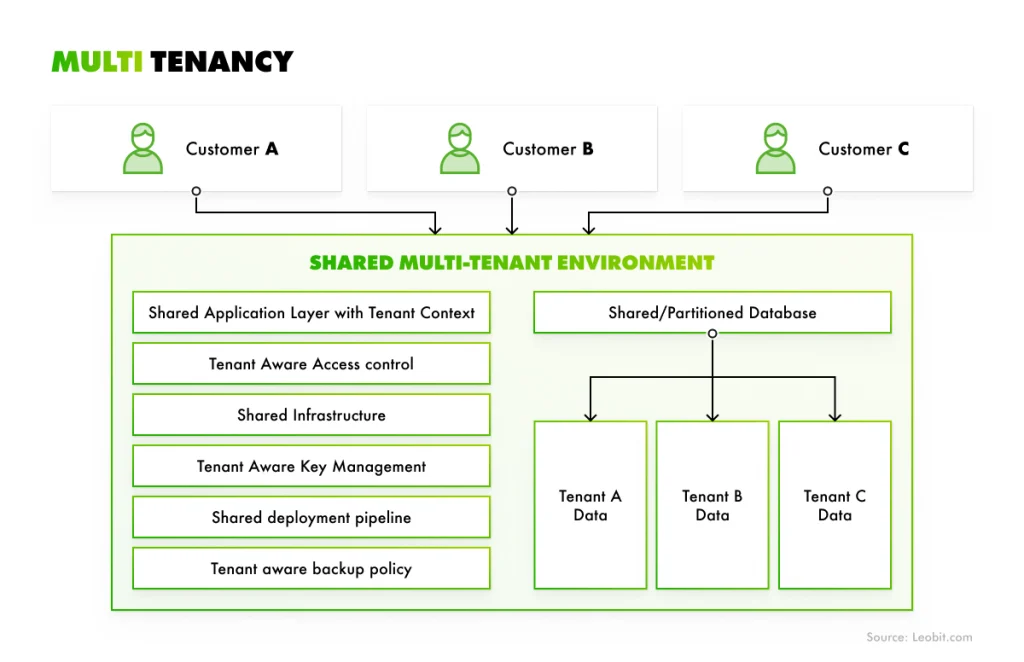
In a multi-tenant architecture, a single platform serves multiple customers simultaneously while keeping each tenant’s users, data, settings, and permissions logically isolated. This can be built in several ways. Many products run all tenants on a shared application layer while logically isolating their data and permissions. Others use stronger patterns, such as a separate database or schema per tenant, while keeping the same core product and operational model. If each customer receives a fully separate application environment, the design moves closer to a single-tenant or hybrid model.
The database can be arranged along the same spectrum. A system can use a single shared database with tenant IDs and filtering to keep tenants apart, separate schemas, or a database per tenant. The right choice depends on isolation, scalability, reporting, backup, and compliance requirements.
Multi-Tenant Architecture Scheme
The key difference from single tenancy is that separation is built around logical tenant isolation rather than dedicated customer environments. There is no need to build new infrastructure for every customer. Instead, the platform carries tenant context through identity, authorization, routing, data access, usage metering, observability, and support tooling. In practice, the system must always know which tenant each user, request, database query, log entry, invoice, and support case belongs to.
Benefits of multi-tenant architecture
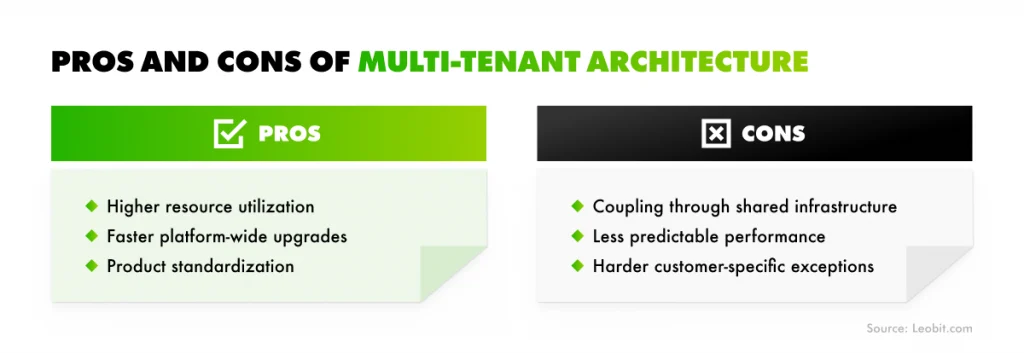
The core advantage of multi-tenancy is efficiency. Sharing infrastructure and operational processes across tenants lets the platform reach higher resource utilization at a lower cost to run.
Higher resource utilization. Shared infrastructure absorbs uneven demand. When one customer’s usage is low, and another’s is high, pooled resources are used more efficiently than many isolated environments would be. This is the direct counterpart to the idle-capacity waste that single tenancy tends to accumulate.
Faster platform-wide upgrades. A single shared service plane is updated once for every customer, so improvements and fixes reach the whole base at the same time.
Product standardization. Multi-tenancy encourages a standard, continuously improving product. A shared platform is usually the simplest way to keep features consistent, ship frequent updates, and enforce common controls across all customers.
As with the benefits, the drawbacks of multi-tenancy stem from shared infrastructure.
Drawbacks of multi-tenant architecture
If the system is not well-designed, a problem can affect many tenants at once, making issues harder to isolate and resolve, and the shared base can limit flexibility for specific tenant requirements.
Coupling through shared infrastructure. Shared components create coupling. With poorly designed isolation, a defect in authorization, data filtering, container policy, or network policy can expose multiple tenants or create a cross-tenant vulnerability.
Less predictable performance. Co-located workloads can degrade one another, the noisy-neighbor effect. If one tenant suddenly imports a very large dataset, runs heavy analytics, or sends a flood of API requests, it can consume more shared resources than expected. Simple fair-sharing is often not enough, so multi-tenant platforms typically add quotas, rate limits, and workload isolation.
Harder customer-specific exceptions. It is more difficult to change platform behavior for a single customer. When those exceptions pile up, the model tends to drift toward a hybrid or segmented design.
Benefits and drawbacks of single-tenant architecture
That said, multi-tenant architecture works best when a product needs to efficiently scale, quickly onboard customers, and deliver frequent updates from one shared platform. It keeps infrastructure and operations lean while supporting a consistent product experience across tenants. However, that efficiency depends on strong logical isolation, access control, performance management, and tenant-aware monitoring. Without those safeguards, shared infrastructure can turn small issues into platform-wide risks.
When Should You Choose a Hybrid Tenancy Model?
In many real-world SaaS products, committing to pure single tenancy or multi tenancy for the life of the product may not be the most practical choice. Given that different customers arrive with different requirements and expectations, a single model rarely serves all of them well. This is where the hybrid model can work as a middle path that combines the strengths of both.
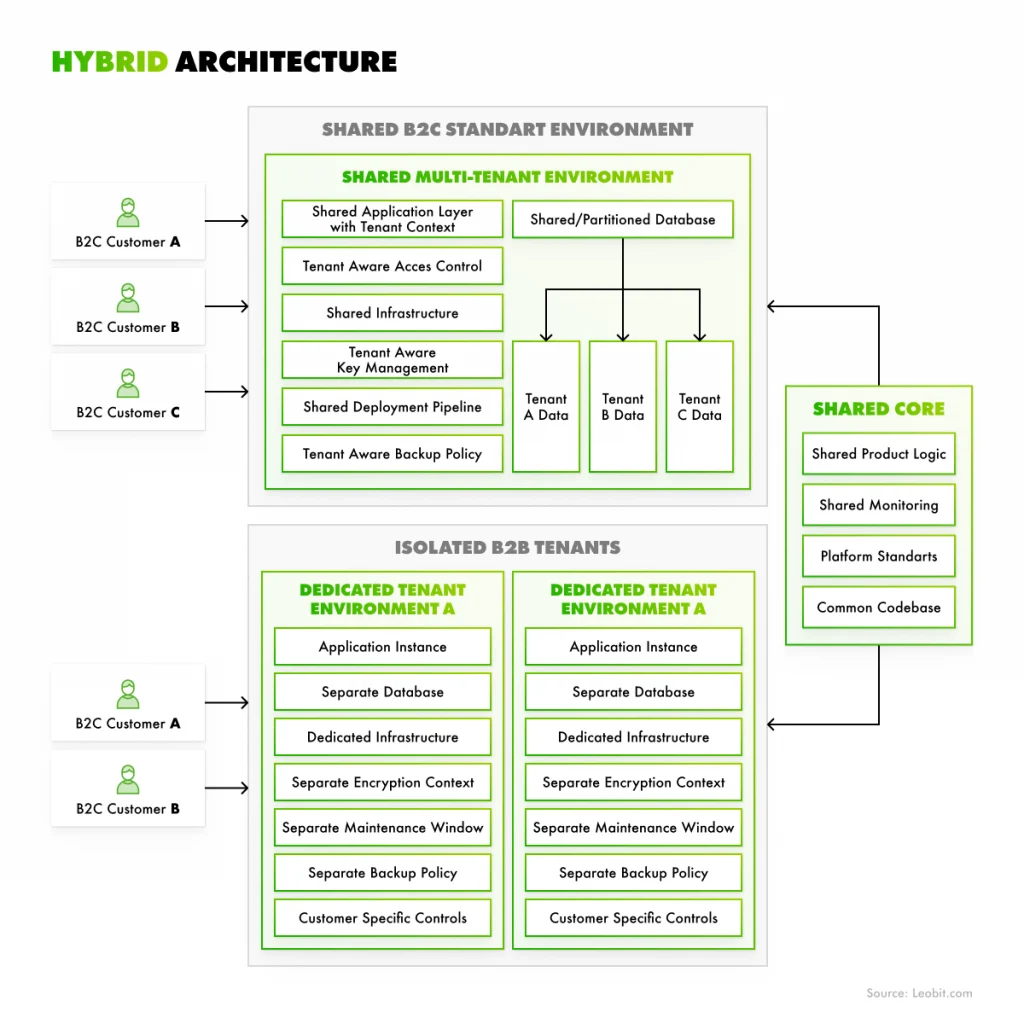
A hybrid architecture keeps one shared core with a common codebase and operational model, while allowing certain tenants to run with additional separation, closer to a single-tenant setup. That separation can be applied at different levels: application, database, infrastructure, security, or deployment. The product stays standardized for most customers, and the isolation is added only where a specific account needs it.
Hybrid architecture scheme
This model is especially useful when a product serves both B2C and B2B customers, because the two segments tend to pull in opposite directions.
In B2C software, the product usually serves many individual users or small accounts with similar needs that can be standardized. These customers expect fast onboarding, stable performance, and lower pricing, while dedicated infrastructure or custom compliance is rarely a priority for them. A shared multi-tenant environment efficiently meets those needs.
In B2B software, customers are often enterprise accounts with distinct requirements. A single B2B customer can be an entire organization with many users, roles, integrations, and data policies. Some are satisfied with a standard environment, while others require isolated data storage, dedicated resources, specific encryption settings, regional data placement, or separate maintenance windows.
A hybrid architecture supports both types without building a separate product for each. Regular customers use the shared environment, while high-value enterprise customers are served through isolated tenants. Those enterprise customers still run the same core product on the same codebase, just with stronger isolation and more customer-specific controls. Offering isolation this way is usually more commercially sound and less risky than providing dedicated infrastructure to every new customer from the start.
How to Choose Between Single-Tenant, Multi-Tenant, and Hybrid
Each tenancy model has its own strengths, so the right choice usually comes down to trade-offs. Business owners need to weigh isolation, customization, performance predictability, release cadence, cost, and compliance requirements against business priorities such as growth, productivity, risk, and liability.
The table below summarizes how single-tenant, multi-tenant, and hybrid models compare across the factors that matter most.
Single-tenant
Multi-tenant
Hybrid
Isolation model
Dedicated environment per customer
Shared environment with logical isolation
Shared core, selective isolation where needed
Cost baseline
Higher per customer
Lower per customer
Mid-range
Cost efficiency at scale
Scales linearly with tenant count
Best at scale
Better than single-tenant, less efficient than pure multi-tenant
Performance predictability
More predictable
Depends on quotas, scheduling, and noisy-neighbor controls
Tunable by tier
Customization
Most flexible
Usually limited to safe configuration boundaries
High for premium tiers, standard for others
Update schedule
Can be set per customer
Usually shared across all customers
Shared core with optional staged rollout
Operational complexity
Highest
Lowest
Medium
Compliance fit
Strong where custom controls are required
Strong when standard controls suffice
Strong for mixed portfolios
Once the product requirements are clear and the trade-offs are weighed, the decision becomes easier to map. The table below connects common business situations to the model that usually fits best.
Recommended model
Why
Many small customers, standard workflows, fast onboarding
Multi-tenant
A shared cost base and one release train matter most
High-value enterprise accounts with strict legal or regulatory obligations
Single-tenant or hybrid
Segregation, custom controls, and custom change windows matter most
Mixed B2C and B2B product portfolio
Hybrid
Shared platform for scale, isolated paths for premium or regulated accounts
Deep customer-specific integrations or customization
Single-tenant or hybrid
Reduces exception pressure on the shared core
Strong need for rapid feature rollout to all customers
Multi-tenant
One code path and one platform plane simplify release cadence
Customer-specific maintenance windows, keys, data residency, or audit evidence
Single-tenant or hybrid
Easier to prove and operate with isolated boundaries
When Is a Single-Tenant the Right Choice for Your Business?
Single tenancy fits when business, regulatory, or contractual requirements outweigh the cost benefits of sharing resources. It is often the better model when a customer needs a level of customization or control that a standard, shared feature set cannot provide. Regulation keeps pushing more products in this direction, and data-residency rules are a frequent trigger for dedicated environments.
Typical scenarios include:
Strict regulatory or data-sovereignty rules. Some compliance regimes and national data-residency laws require customer data to stay within a defined jurisdiction or under specific controls. A dedicated environment makes it easier to enforce and prove those boundaries during an audit. When the penalty for getting it wrong is a fine or a lost contract, the extra cost of isolation is usually justified.
Mandated network segmentation. Some customers contractually require an isolated network or a dedicated environment rather than shared infrastructure. This is common in sectors where the customer’s own security policy extends to every vendor it works with. A single-tenant setup satisfies the requirement without exception to a shared platform.
Customer-specific security and audit requirements. Enterprise accounts often bring their own encryption policies, security controls, or audit evidence that must be applied and demonstrated for their data alone. Isolated storage and encryption contexts make those controls easier to define and verify. It also keeps one customer’s audit scope from spilling into another’s.
Complex enterprise integrations. The product may need to connect deeply with a customer’s existing enterprise systems in ways that are hard to standardize. A dedicated environment can run those custom integrations and data models without affecting other customers. This avoids loading the shared core with logic that only one account will ever use.
Custom data retention and recovery policies. Some customers need their own backup schedules, retention rules, or disaster-recovery arrangements. A dedicated backup policy and recovery target are simpler to guarantee when the environment is not shared. This matters most where recovery time and data-retention terms are written into the contract.
Controlled maintenance and release timing. Certain customers need to set their own maintenance windows and decide when updates are applied. Single-tenancy lets each environment follow its own release schedule rather than a platform-wide one. That control is valuable when the customer runs its own change management process for the product.
Predictable performance for critical workloads. Business-critical operations sometimes need guaranteed resources with no competition from other tenants. Dedicated runtime removes the noisy-neighbor risk and maintains stable performance under load. For workloads where slowdowns carry real cost, that predictability is worth the higher baseline.
Premium enterprise offerings. Dedicated infrastructure can be part of the service agreement and a selling point for the high-end tier. Customers paying for isolation expect it to be real and demonstrable. Single tenancy delivers that guarantee cleanly.
In short, single tenancy is the right choice when dedicated control, compliance assurance, and predictable operations create more business value than the savings of a shared model.
When Is Multi-Tenancy the Right Choice for Your Business?
Multi-tenancy is a good fit when standardized, best-practice controls and fast delivery matter more than customer-specific infrastructure. It lets a platform serve a large number of customers on shared infrastructure while keeping tenants logically isolated, which makes the economics work as the customer base grows.
Typical scenarios include:
Broad customer base with similar needs. A SaaS product serving many customers with overlapping requirements can run them all on a single shared platform. Standardization keeps the product coherent and the cost per customer low. This is the classic setting where multi-tenancy pays off most.
Fast onboarding. New customers can be provisioned without standing up infrastructure, so time-to-first-value stays short. Onboarding becomes a configuration step rather than a deployment project. That speed is a competitive advantage when customers expect to start using the product the same day they sign up.
Standardized workflows. When the feature set needs little per-customer customization, a shared platform stays clean and maintainable. Every customer runs the same code path, which keeps testing and support manageable. The product can then evolve as a single, consistent offering.
Frequent updates. Continuous delivery pushes new functionality to the entire customer base on a single release train, ensuring that an improvement ships once and reaches everyone. This is hard to match when every customer runs a separate instance on its own schedule.
Lower running costs. Shared infrastructure and pooled resources reduce the cost of serving each additional customer. Capacity is used across tenants instead of sitting idle in separate environments. Those savings can fund a more competitive price or a higher pace of development.
Consistent experience over custom control. For many products, a uniform user experience and unified platform behavior matter more than per-customer exceptions. A shared platform enforces the same controls and behavior for everyone. This keeps the product predictable for both users and the team maintaining it.
Efficient scaling. The product is expected to grow its customer count without a matching rise in infrastructure per account. Multi-tenancy adds customers as tenant records and configuration rather than new stacks. That is what lets a platform scale to thousands of customers without a proportional operations burden.
Choosing a tenancy model is an expensive decision to revisit, so it is worth considering all the ins and outs before committing to any approach. That is where an experienced SaaS development company can be helpful.
How Leobit Helps You Choose the Right Tenancy Model
Leobit helps companies design SaaS architectures that match their business, technical, and compliance needs. Our team has delivered 40+ SaaS products, including shared multi-tenant platforms, isolated single-tenant deployments, and hybrid architectures that combine both approaches.
We treat tenancy and deployment as two separate architecture decisions, not one default choice. Our engineers start by analyzing your business requirements, customer isolation needs, compliance obligations, expected scale, and pricing strategy. Based on that context, we recommend the model that fits best: a shared platform, dedicated customer environments, or a hybrid core with isolated tenants for high-value or regulated accounts.
A practical starting point is a software architecture design and consulting engagement or a discovery phase for a new product. Both result in a documented architecture where trade-offs are clearly explained, so the tenancy decision is grounded in your requirements before production development begins.
Here are several examples of our latest SaaS development projects.
From single-tenant to multi-tenant: cutting infrastructure cost for stakeholder management SaaS
A UK-based stakeholder management SaaS provider ran on a legacy ASP.NET Web Forms monolith with a single-tenant architecture. To serve more than 130 clients, the company had to maintain over 260 separate environments, which created significant infrastructure overhead and made scaling slow and expensive.
Our team rearchitected the platform into a multi-tenant, cloud-native system on Microsoft Azure, migrating incrementally using the Strangler Facade pattern so daily operations could continue throughout.
The move from single-tenant environments to multi-tenancy is projected to lower monthly infrastructure costs by up to 80%. Alongside the cost reduction, the new platform delivers 6x faster response times, cutting a representative query from 8 seconds to 1.34 seconds. It also reaches up to 99.99% availability through multi-zone redundancy on Azure.
Running a multi-tenant platform with role-separated access: a fire inspection portal
A US fire protection company needed to move decades of paperwork into a single digital platform used by both its inspectors and its clients. The Leobit team built a multi-tenant fire inspection portal on .NET Core, Angular, and Azure, with separate admin and service portals that expose different roles and functionality to internal users and customers. The build shows how a shared multi-tenant platform can still enforce clear access boundaries between user types.
On one shared platform, our team delivered role-separated admin and service portals, integrated a PCI-compliant payment flow with Collect.js while preserving the customer’s branding, and added anomaly detection and data synchronization through Azure Functions, Service Bus, and Application Insights.
Getting tenant isolation right at the identity layer: a multi-tenant asset management platform
Multi-tenant security depends on the quality of authentication and access control, which is exactly where a UK proptech company needed help. Its multi-tenant asset management platform, used by tenants, service providers, and property owners, had identity data fragmented across two systems, which increased maintenance overhead and slowed and risked changes to authentication flows.
Our team consolidated that data into a single governed source of truth and replaced the legacy IdentityServer setup with OpenIddict, supporting both multi-tenant and single-tenant scenarios. We added multi-factor authentication through Google Authenticator and Microsoft Authenticator for local accounts and delivered the modernization in around one month with a team of five specialists.
The right tenancy model should follow from your customers’ needs, not from a preference for one architecture over another. Single tenancy justifies its higher cost when customers require strong isolation, custom controls, dedicated release schedules, data residency, or premium enterprise support. It also makes it easier to prove compliance and customer-specific operations.
Multi-tenancy is a better fit when a product needs fast onboarding, efficient scaling, frequent releases, and a low marginal cost per customer, as long as isolation, access control, and performance are carefully engineered. For products that serve several customer segments, a hybrid model often provides the best balance: a shared core keeps standard customers efficient, while isolated environments meet the stricter needs of enterprise or regulated accounts.
Because reversing this decision can be expensive, the best time to make it is before the product is built. The safest approach is to document the trade-offs and tie them to real business, compliance, and customer requirements.
If you are choosing between single-tenant, multi-tenant, or hybrid architecture for a new or existing product, Leobit can help you match the model to your customers, compliance obligations, and growth plans. Contact us and let’s choose the architecture that supports your business.
FAQ
In single-tenant architecture, each customer runs in a dedicated environment with its own application instance, data, and often its own infrastructure. In multi-tenant architecture, many customers share one platform while their data, users, and permissions stay logically isolated. The main trade-off is isolation and customization on the single-tenant side against efficiency and lower cost per customer on the multi-tenant side.
Not automatically. Multi-tenancy relies on logical isolation, so its security depends on the quality of access control, data filtering, and tenant separation. Single-tenancy provides stronger environment-level separation, but shared services, common code defects, or provider-level incidents can still affect multiple environments. In every model, security comes down to how well isolation, access control, and monitoring are engineered.
Multi-tenant architecture is usually more cost-effective at scale because shared infrastructure raises resource utilization and lowers the cost of serving each additional customer. Single-tenant architecture repeats a baseline cost for every customer and is easier to underutilize. Flexera’s 2025 State of the Cloud report found that organizations waste about 27% of their cloud spend, and running a separate stack per customer makes that waste easier to accumulate.
A hybrid model keeps one shared core with a common codebase and operational model, while allowing selected tenants to run with additional isolation at the application, database, infrastructure, or deployment level. It lets standard customers use a shared multi-tenant environment while high-value or regulated accounts get isolated environments. This is a common choice for products that serve both B2C and B2B customers.
No, tenancy and deployment are separate decisions. A single-tenant system can run in a public cloud, and a multi-tenant system can include private or isolated components. The tenancy model answers who shares what, while the deployment model answers where and how the system is hosted.
Yes. A phased migration can move a single-tenant system to multi-tenancy without stopping daily operations, often using patterns like the Strangler Facade to replace parts of the system incrementally. Leobit did this for a UK stakeholder management SaaS, a migration projected to lower its monthly infrastructure costs by up to 80%.
Inna loves making complex tech feel simple. With a strong eye for innovation, she helps businesses turn complicated ideas and data into clear strategies they can actually use. Whether it’s new tools or big trends, she’s all about making technology work for people.
Vitalii is a full-stack engineer primarily working with .NET, Angular, MS SQL Server, Azure, and various third-party integrations. He believes that major software decisions should be supported by careful research, problem analysis, and comparison of possible solutions. He is open to working with new technologies, tools and approaches and is quick to learn and adapt.
In April 2026, Microsoft released a production-ready Version 1.0 of its Microsoft Agent Framework, a solution that brings several AI agent development ...
The application you ship today is rarely one deployable unit. It is a set of services, each running closer to the user or the data it depends on, so responses ...
Lviv, Ukraine, July 2026 — Leobit, a full-cycle .NET, AI, and web application development company, is proud to announce that it has been shortlisted at the ...
Around 70% of Fortune 500 software is more than 20 years old, according to McKinsey. Systems of that age are often costly to maintain, difficult to scale, ...
Gartner now names computer vision the top edge AI use case, driving production deployments across manufacturing, retail, healthcare, and smart cities. No ...
The McKinsey US CSO survey found that more than 90% of companies are using generative AI, yet only 1% say the technology is fundamentally changing the way they ...
Despite nearly every organization using some form of AI or machine learning, managing AI initiatives, particularly their financial aspects, is becoming ...
Microsoft Azure stands at the forefront of the growing AI adoption and analytics market. In particular, nearly 60% of CIOs across industries plan to increase ...
The growing AI adoption helps businesses automate and enhance many workflows, but it also has a downside. By accelerating software development lifecycles, AI ...
12 mins read
We use cookies to enhance your browsing experience. By agreeing, you accept our Privacy and Cookies Policy.
By ignoring or closing this banner, we will only collect essential cookies necessary for the website to function properly.
 Leobit