
Contact us

What Is ASP.NET and When to Choose It: Use Cases and Examples

Inna Fishchuk, Market Data Analyst

Updated

22 mins read

ASP.NET
Blog Calculator Widget Logo

Estimate Your Software Project Cost

Describe your idea — get a budget breakdown in minutes.

Get Your Estimate

ASP.NET is an open-source web framework created by Microsoft for building dynamic websites, web applications, and APIs on the .NET platform. Nearly 4.5 million live websites run on ASP.NET, and it accounts for 4.3% of all sites with a known server-side programming language. Behind those numbers stands a mature, Microsoft-backed technology with more than two decades of enterprise adoption and a deep talent pool.

The framework exists in two lines. The classic version still supports a large base of enterprise systems, while ASP.NET Core, its cross-platform successor, has become the framework of choice for new development. ASP.NET Core ships with .NET, whose current release is .NET 10, and runs on Windows, Linux, and macOS.

This article explains what ASP.NET is, how its versions differ, where its strengths and limitations lie, and which use cases it fits, backed by real examples from Leobit projects.

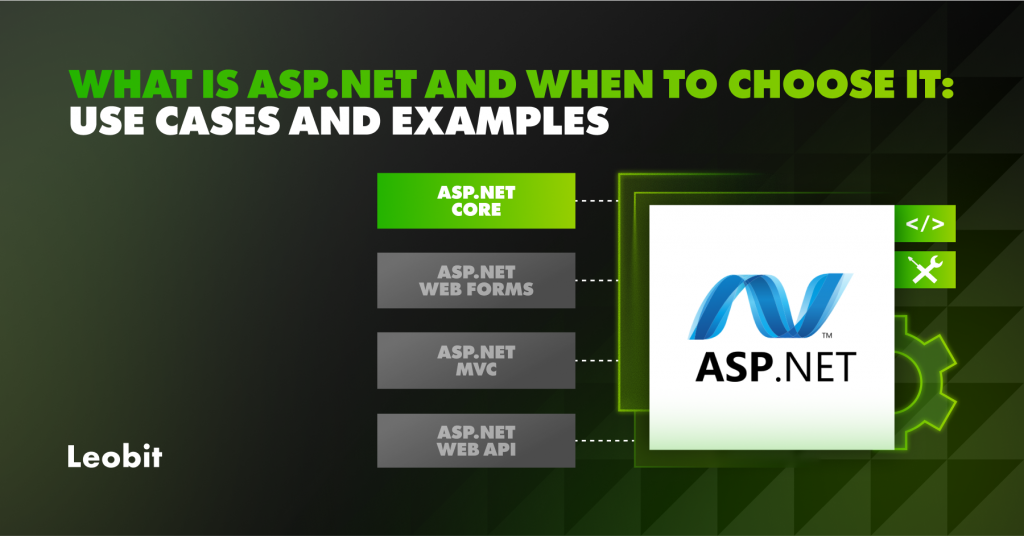
What Does ASP.NET Stand For?

The ASP.NET full form is Active Server Pages .NET, a reference to Microsoft’s original web technology from the 1990s, though the modern framework shares little with it beyond the name. Back-end logic is written in C#, F#, or Visual Basic, and the Razor syntax combines C# with HTML to render pages dynamically.

Because ASP.NET is part of the broader .NET ecosystem, development teams get access to a large range of shared libraries, packages, and development tools. The current version, ASP.NET Core, is developed in the open on Microsoft’s dotnet/aspnetcore GitHub repository, which serves as a central hub for source code, community discussions, and contributions, with over 38,000 stars and an active global community behind it.

ASP.NET in numbers
ASP.NET in numbers

Beyond its core functionality, the ASP.NET ecosystem offers extensions for real-time communication (SignalR), performance monitoring, containerization with Docker and Kubernetes, and integration with modern front-end frameworks.

What Is the Difference Between .NET, ASP.NET, and ASP.NET Core?

For a business, the distinction matters because it determines what you hire for, what you budget to maintain, and what you plan to migrate. .NET is the platform, ASP.NET is the web framework that runs on it, and ASP.NET Core is the modern, cross-platform version of that framework.

Let’s take a look at the major versions of ASP.NET and what they introduced.

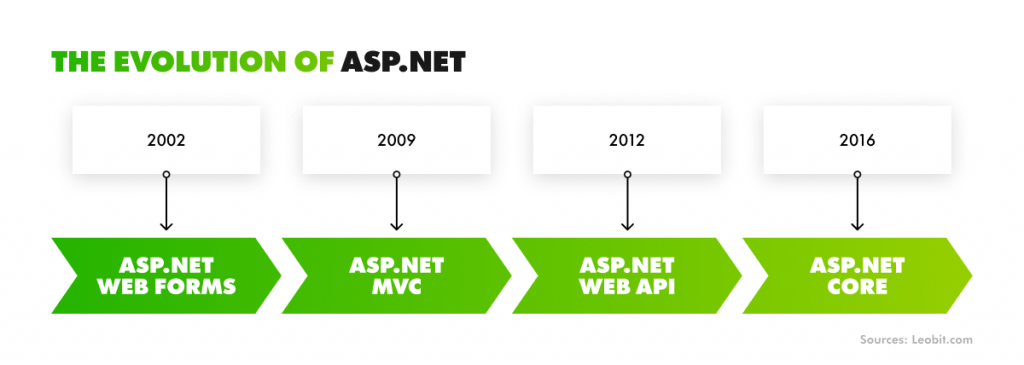
The evolution of ASP.NET
What it is
Platform
Status in 2026
When it applies

.NET

The runtime and base libraries many app types build on

Cross-platform

Current (.NET 10 LTS)

The foundation under everything below

ASP.NET

The web framework for sites, apps, and APIs on .NET

Originally Windows

Umbrella term

Web development on .NET in general

ASP.NET Core

The rebuilt, cross-platform web framework

Windows, Linux, macOS

Current, recommended for new builds

New web apps, APIs, cloud-native systems

ASP.NET Framework

The classic, Windows-only version (Web Forms, classic MVC)

Windows only

Maintenance (security fixes)

Existing legacy systems

ASP.NET Versions: Web Forms, MVC, Web API, and ASP.NET Core

Originally built as part of the .NET Framework for Windows-based applications in the early 2000s, ASP.NET has changed significantly to meet the demands of modern web software development. Over more than two decades, it has grown to support multiple programming models, including Web Forms, MVC, Web API, and its modern cross-platform successor, ASP.NET Core.

ASP.NET Web Forms

Microsoft developed ASP.NET Web Forms in 2002 for rapid application development. Its event-driven model and drag-and-drop design approach made it exceptionally popular for building enterprise applications and internal business solutions.

With the growth of the .NET ecosystem, Microsoft has placed ASP.NET Web Forms in maintenance mode. It continues to receive essential security updates as part of .NET Framework 4.8, but no new features are being developed. Companies relying on Web Forms can continue to operate their legacy systems without interruption, though the framework does not focus on future capabilities. As the industry shifts toward modern frameworks such as ASP.NET Core and Blazor, the pool of developers with deep Web Forms expertise is gradually shrinking. The Web Forms model relies on concepts like ViewState and postbacks, which fit poorly with modern practices such as containerization, microservices, and cloud-native architectures.

ASP.NET MVC

Released in 2009, ASP.NET MVC was introduced as an alternative to Web Forms. It promoted the Model-View-Controller design pattern, which separates an application into components with distinct responsibilities. This separation of concerns makes an application easier to maintain and test, especially in large or complex projects.

ASP.NET MVC moved away from the event-driven, stateful architecture of Web Forms toward a stateless request and response model, which encourages more manageable, scalable codebases. Although ASP.NET Core has shifted the focus of new projects, ASP.NET MVC keeps a large installed base: BuiltWith has reported over 420,000 live sites using it. Many enterprise applications continue to run on it because of established codebases and in-house expertise.

ASP.NET Web API

ASP.NET Web API, introduced as part of ASP.NET MVC 4 in 2012, made it easier for developers to create HTTP-based endpoints that could be accessed by a wide range of clients, including browsers, mobile apps, and IoT devices. It was specifically designed for building RESTful services that follow standard HTTP methods (GET, POST, PUT, DELETE), making the APIs more consistent, scalable, and easier to consume across platforms.

ASP.NET Web API follows a REST (Representational State Transfer) architectural style, giving developers more control over HTTP features (such as status codes, headers, and the request/response pipeline). This makes it highly suitable for building scalable and standardized APIs.

While still widely used in legacy systems running on the full .NET Framework, ASP.NET Web API is in a maintenance state. Microsoft continues to offer security and compatibility updates but has shifted major innovation efforts to ASP.NET Core.

 Book Icon

ASP.NET Core

Originally introduced as ASP.NET vNext, the framework was rebranded as ASP.NET Core and officially released in June 2016. ASP.NET Core unified the previously separate MVC and Web API models into a single programming model, and it was designed to run on Windows, macOS, and Linux. This cross-platform capability, paired with its open-source nature, opened the way for broader adoption and community contributions.

ASP.NET Core ships as part of .NET, and the current release is .NET 10, a Long Term Support version that became generally available on November 11, 2025. According to the 2025 Stack Overflow Developer Survey, 19.7% of developers report using ASP.NET Core, which keeps it among the most used web frameworks, and in the 2024 survey 72% of developers expressed admiration for it. The framework employs a modular design that lets developers add only the components an application needs, which results in leaner applications with faster startup times. Its architecture emphasizes asynchronous processing and dependency injection, both of which improve scalability and make testing easier.

ASP.NET Core also includes Blazor for building interactive web UI, and it integrates with JavaScript frameworks like Angular, React, and Vue.js. For new projects today, ASP.NET Core is the recommended choice. Classic ASP.NET still runs and is supported for maintenance, but new capabilities land in ASP.NET Core, so the rest of this guide concentrates there.

 Book Icon

If you’re starting a new project today, ASP.NET Core is the recommended choice, since ASP.NET no longer receives updates. So we’ll further concentrate on what ASP.NET Core can bring to the table.

Key Features of ASP.NET Core for Modern Web Development

The key features of ASP.NET Core combine cross-platform reach, performance, security, and cloud-native tooling. The table below summarizes them, followed by a closer look at each and the business advantage it brings.

Key features of ASP.NET Core

Cross-platform support

ASP.NET Core is fully cross-platform, so developers can build and run applications on Windows, Linux, and macOS. This flexibility is one of the key differentiators from the classic ASP.NET Framework, which was traditionally tied to Windows. With ASP.NET Core, teams can use their preferred development environments and target a broader range of deployment options without being locked into a single operating system.

In terms of hosting, applications can run on Kestrel, be reverse-proxied through web servers like Nginx or Apache, or be hosted within Docker containers for more scalable, portable deployments. This makes ASP.NET Core an ideal fit for modern cloud-native architectures as well as hybrid or on-premises infrastructures. For businesses, this means lower infrastructure costs, easier CI/CD integration, and more flexibility as technical requirements change.

High performance and scalability

ASP.NET Core is engineered for speed. It uses a modular middleware pipeline and supports asynchronous programming out of the box. In the independent TechEmpower Round 23 benchmarks (2025), ASP.NET Core ranked among the fastest web frameworks, placing first in the Fortunes database test among widely used backend frameworks. The framework also uses memory and processing power efficiently, which makes it well-suited for high-traffic applications.

ASP.NET Core speed test

The ability to handle thousands of concurrent requests makes ASP.NET Core well suited to growing businesses and customer-facing platforms that demand scalability. This means serving more users with fewer resources, which helps reduce infrastructure costs.

Built-in dependency injection

ASP.NET Core has built-in support for dependency injection, a design pattern that promotes loosely coupled, testable, and maintainable code. This feature is deeply integrated into the framework, which makes it easier to implement a clean software architecture from the start.

Dependency injection makes a codebase easier to modify and scale. It encourages good software design and reduces bugs. With a skilled ASP.NET web development company involved, this feature helps build a codebase that can grow with business needs and reduce long-term maintenance costs.

Unified development model

ASP.NET Core introduces a unified development model that merges previously separate frameworks into one coherent framework:

  • MVC for structured web applications
  • Web API for RESTful services
  • Razor Pages for page-focused scenarios

This consolidation removes the need to choose between separate frameworks or combine several in one application. Developers use one consistent set of tools, conventions, and middleware to build all layers of a modern web application. For development teams, this unified model means simpler project architecture, less boilerplate code, and a shorter learning curve for new members. From a business perspective, it translates into faster time-to-market and lower long-term maintenance costs.

 Book Icon

Strong security features

Security is built into ASP.NET Core from the ground up. The framework includes features for authentication (including Identity, OAuth, OpenID Connect), authorization, HTTPS enforcement, and protection against threats like Cross-Site Scripting (XSS), Cross-Site Request Forgery (CSRF), and SQL Injection.

ASP.NET Core provides the tools to build secure applications by default, which helps businesses meet industry compliance standards such as GDPR, HIPAA, or PCI DSS and protect user data. This matters in particular for finance, healthcare, and e-commerce.

Cloud-ready and container-friendly

Out-of-the-box support for environment-based configuration, dependency injection, logging, and telemetry makes ASP.NET Core a natural fit for platforms like Microsoft Azure, AWS, and Google Cloud. The framework simplifies integration with cloud services such as Azure App Services, Azure Key Vault, Application Insights, and AWS Lambda. It also supports health checks, metrics, and structured logging, which are essential for monitoring application performance and maintaining reliability in production.

ASP.NET Core is fully container-friendly. It works with Docker and orchestration tools like Kubernetes, which makes it easy to package and scale applications across environments. For businesses building SaaS products or enterprise systems, these cloud and container capabilities support elastic scalability, high availability, and simpler CI/CD pipelines.

Open source with a strong community

ASP.NET Core is fully open-source and backed by Microsoft, with development conducted openly on GitHub. It benefits from a large and active global .NET community with over 100,000 contributions and 3,700 companies. This participation keeps the framework modern, secure, and aligned with real-world development needs, and it gives businesses access to a broad talent pool and community-built tools.

Razor Pages and Blazor for modern UIs

ASP.NET Core supports Razor Pages, which simplifies page-focused web app development, and Blazor, which allows developers to build interactive client-side apps using C# instead of JavaScript. Blazor supports both server-side and WebAssembly-based models.

This is useful for teams with deep .NET expertise, since it lets them deliver front-end experiences without expanding the tech stack, and it makes it easier to share code between client and server.

 Book Icon

While ASP.NET Core offers many advantages, it’s not without its challenges.

ASP.NET Core Limitations And How To Overcome Them

Like any other web development framework, ASP.NET has its weak sides that can affect adoption, development speed, or compatibility in certain scenarios. Understanding these early allows a business and its ASP.NET developers to plan ahead and minimize bottlenecks.

Migration complexity from legacy ASP.NET

Moving from classic ASP.NET, such as Web Forms, to ASP.NET Core is not a direct upgrade. It often requires significant code rewriting due to differences in architecture and APIs. To reduce risk and disruption, many companies opt for a phased migration: high-priority modules are modernized first, and the rest of the system transitions gradually. Microsoft’s .NET Upgrade Assistant automates parts of this process. This is the kind of work the Leobit software re-engineering and modernization team handles regularly.

Performance optimization issues

Performance is a core strength of ASP.NET Core, but reaching its full potential can require expertise in asynchronous programming, memory management, and optimization techniques. For high-traffic APIs or real-time systems, it helps to assess performance early in development. Tools like Application Insights and JetBrains dotTrace identify bottlenecks, and Microsoft’s guidelines offer best practices for tuning.

Dependency on the Microsoft ecosystem

A common assumption is that ASP.NET Core is heavily tied to the Microsoft ecosystem. While it was originally rooted in Windows development, ASP.NET Core has become a fully open-source, cross-platform framework that runs on Linux, macOS, and in containerized environments like Docker. Teams that prefer open tooling or non-Windows environments can adopt it without committing to a single vendor stack.

When to Choose ASP.NET: Common Use Cases And Real-Life Examples

ASP.NET Core is a versatile, high-performance framework well suited for building modern web applications across various industries. Below are key scenarios where choosing ASP.NET makes strategic sense, each supported by a real example from Leobit’s experience.

Building scalable SaaS platforms

ASP.NET Core is ideal for creating SaaS applications that need to serve multiple tenants, handle complex user permissions, and scale with growing demand. Its modular architecture, built-in support for dependency injection, and integration with cloud platforms like Azure make it a go-to choice for SaaS products.

The franchise operations SaaS platform created by Leobit leverages ASP.NET Core for back-end services. It includes dynamic modules for franchisee management, reporting, and performance tracking, and supports a growing number of tenants across different regions.

Franchise operations SaaS platform developed by Leobit

We also used ASP.NET Core to support multiple user roles, recurring billing, and a comprehensive API when developing a full-cycle gym management subscription-based platform.

Developing cross-platform and multi-device applications

When you need a single codebase that supports multiple platforms (e.g., web, mobile, and desktop), ASP.NET Core, particularly when used with .NET MAUI or Blazor, enables efficient code sharing and consistent user experiences.

A great example of this in practice is Leobit’s work on a cross-platform concert ticketing platform. The team used ASP.NET Core together with .NET MAUI and Blazor to create native-like experiences for web, iOS, and Android. Thanks to the shared codebase, our developers achieved an impressive 90% code reuse, which significantly reduced development time and costs.

Despite supporting high user volumes and frequent real-time updates, the platform maintains excellent performance and stability. Today, it successfully manages thousands of ticket sales, check-ins, and live updates during peak event times.

Application for selling tickets

Supporting complex internal systems with role-based access

Thanks to ASP.NET Core’s robust Identity system, the framework allows developers to define detailed user roles and permissions. Middleware support enables custom logic at every stage of request handling, which makes it easy to enforce security policies, logging, and data validation. Additionally, seamless integration with Azure services, such as Active Directory, Key Vault, and Azure Blob Storage, enables you to build secure, scalable, and cloud-native applications that support sensitive data and complex operations.

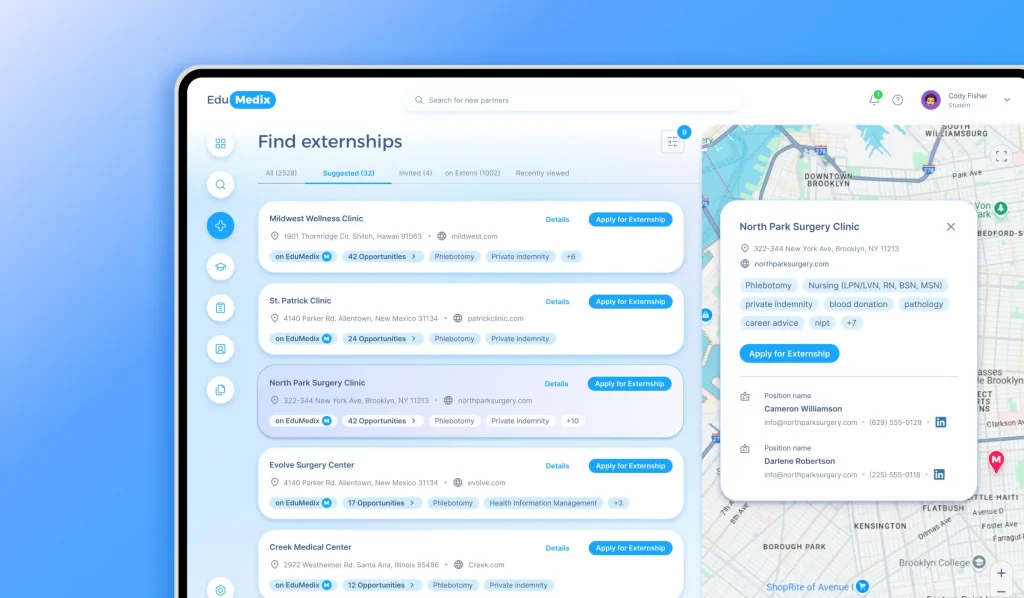
A prime example of this capability is Leobit’s HealthTech externship coordination platform, built with ASP.NET Core and Azure. Designed for a highly regulated healthcare environment, the platform supports multi-role access for administrators, healthcare providers, and students. It includes AI-based student-hospital matching, document upload and sharing, e-signatures, real-time status tracking, and detailed audit trails.

HealthTech externship coordination platform

Handling data-intensive and analytics-driven applications

ASP.NET Core supports high-throughput APIs and scalable microservices, which make it ideal for serving real-time dashboards, processing event streams, or powering reporting engines. Its compatibility with platforms like Google BigQuery, Azure Synapse, or Apache Kafka allows for flexible, cloud-native data architectures. You can use these capabilities to generate actionable insights at scale while maintaining fast load times and responsive user experiences.

One example is Leobit’s work on modernizing a real estate platform’s data architecture. Using ASP.NET Web API in combination with Google BigQuery, the team overhauled the system to support near real-time analytics across multiple property categories and user roles. The solution enabled users to query large datasets quickly, visualize trends, and make timely decisions, which significantly improved the platform’s value proposition.

Real estate platform developed by Leobit

In another case, Leobit developed a re-commerce reporting portal with a back end powered by ASP.NET Core. This solution processes extensive datasets related to secondhand product transactions and presents the information in clear, interactive dashboards. The platform handles complex reporting logic, supports custom filters, and offers data visualizations tailored to business stakeholders.

Re-commerce Reporting Portal
Re-commerce reporting portal

Developing secure, consumer-facing web applications

ASP.NET Core can be a great choice for building responsive, high-performing web applications that involve secure transactions, user authentication, and integration with payment services. The framework offers out-of-the-box support for authentication and authorization, including integration with OAuth, OpenID Connect, and external identity providers like Google, Facebook, or Microsoft.

With ASP.NET Core Identity, developers can securely implement features like two-factor authentication, password recovery, and user role management. Additionally, its middleware architecture allows for customization of request handling pipelines, which helps to optimize security and performance.

A great example of these capabilities is Leobit’s printed photo ordering application, built using ASP.NET Core. The application allows users to customize their photo prints, place orders, and complete payments through a seamless and secure interface. It supports dynamic product handling, secure payment processing, and order tracking.

Printed Photo Gifting Mobile App
Printed photo gifting mobile app developed by Leobit

Another case is Leobit’s work on an enterprise B2B jewelry network — a secure, e-commerce-like platform tailored for jewelry wholesalers. It enables wholesalers to manage large inventories, connect with partners, and complete orders through an intuitive and robust digital interface. Built with ASP.NET Core, the platform maintains high security standards suitable for enterprise-level financial transactions.

B2B purchasing and assortment management platform for jewelry enterprise retailers
Jewelry supply chain software developed by Leobit

Simplifying integration with payment systems and fintech services

With built-in support for encryption, authentication protocols, and data protection, ASP.NET Core helps development teams meet fintech compliance requirements such as PCI-DSS and GDPR. Its middleware pipeline allows fine-grained control over request processing and authentication workflows, so that financial data is transmitted securely. Moreover, ASP.NET Core supports asynchronous programming and parallel processing, which are essential for handling large volumes of real-time payment transactions.

Leobit used these ASP.NET Core’s capabilities when developing an alternative electronic payment SaaS solution. The application handles high-frequency transactions with ease, supports secure user authentication, and processes financial data in real time.

Electronic Payment SaaS Solution for Startup
Electronic payment SaaS solution for a startup

Another example is Leobit’s project for a global payment processing provider, where ASP.NET Core was used to create a secure back end. The platform integrates with multiple external payment gateways to enable seamless and automated financial workflows across different currencies and regions. With ASP.NET Core, the development team ensured smooth API interactions, high availability, and robust error handling. It helped our customer minimize transaction failures and deliver a seamless user experience for merchants and customers alike.

Leobit’s project for a global payment processing provider

Powering real estate and proptech applications

Real estate and proptech platforms often need to manage large datasets, integrate with third-party financial and legal systems, and support high-stakes transactions. ASP.NET Core is well-suited for these complex requirements due to its high performance, modular design, and robust integration capabilities. Its support for scalable back-end architectures, secure data handling, and cloud-native features makes it a good choice for building sophisticated real estate platforms.

A great example is Leobit’s work on a blockchain-based real estate platform, which combined ASP.NET Core with decentralized technologies to enable secure property transactions and enhanced transparency in real estate investments. The integration of blockchain added trust and auditability to the buying process, while ASP.NET Core handled key back-end services, business logic, and user management. This hybrid architecture helped reduce fraud risk and improved investor confidence by making property data and transactions more verifiable and tamper-proof.

Real estate and proptech platforms

In another project, Leobit developed a real estate solution that uses ASP.NET Core to automate complex financial calculations and help users better understand the financial impact of property investments. The platform streamlines compliance processes and improves the overall user experience by providing instant tax forecasts, personalized investment insights, and automated documentation.

Tax-optimized solution for Realized Technologies LLC
Tax-optimized solution development

Is ASP.NET Still Relevant in 2026?

Yes. ASP.NET is still used and actively developed, and the current .NET 10 release keeps ASP.NET Core competitive for new builds. The question usually comes from confusing the legacy Web Forms model, which is in maintenance, with ASP.NET Core, which is not. Classic ASP.NET still runs millions of existing sites and remains supported, while ASP.NET Core is a standard choice for cloud-native applications.

For a business, relevance is really a question of risk. A framework backed by Microsoft, shipped on a three-year Long Term Support cycle, and supported by a large certified talent pool is a low-risk foundation for a product that has to run for years. The W3Techs market-share data and the 2025 Stack Overflow Developer Survey both show continued, broad adoption. For most enterprise back ends and new web products on the Microsoft stack, ASP.NET Core remains a current, reliable choice rather than a legacy bet.

How Leobit Can Help With ASP.NET Development

Leobit brings over a decade of experience in building scalable, secure, and high-performing applications with ASP.NET. With more than 70 successful ASP.NET projects delivered across industries like fintech, real estate, and healthcare, we know how to tailor solutions to meet both technical and business needs.

As a Microsoft Solutions Partner for Digital & App Innovation, Leobit is trusted for delivering modern web solutions using the latest Microsoft technologies. Our team includes 78 Microsoft-certified engineers with hands-on expertise in ASP.NET Core, Blazor, MVC, and cloud-native development. We have also been recognized as a Top ASP.NET Development Company by Clutch on a global level and in Ukraine.

We support the full application development lifecycle, from architecture design and UI/UX to testing, deployment, and post-launch maintenance. Whether you’re building a new product or modernizing an existing one, we can ensure quality, scalability, and on-time delivery.

Conclusion

ASP.NET, and ASP.NET Core in particular, has proven to be a flexible framework for building scalable, secure web applications. Over the past two decades, it has changed from a Windows-only solution into a fully cross-platform framework that runs on Linux, macOS, and Windows. Older versions like Web Forms and classic MVC are still supported, but they are now legacy technologies, with new work centered on ASP.NET Core.

Despite common misconceptions, ASP.NET Core works in non-Microsoft environments. It supports deployment on Linux servers and integrates easily with open DevOps tools like GitHub Actions, Jenkins, and Docker, which make it a strong fit for modern development stacks. Still choosing ASP.NET should depend on your project’s specific needs, such as cross-platform support, maintainability, or enterprise-grade security. With the right development partner, you can fully use ASP.NET’s strengths while effectively addressing its challenges.

Contact us to find out how we can help bring your vision to life with ASP.NET.