
Contact us

ASP.NET vs. PHP: Which Technology Wins for Modern Web Development?

21 mins read

ASP.NET vs. PHP ASP.NET vs. PHP: Which Technology Wins for Modern Web Development?

Want a quick tech consultation?

Yurii Shunkin|R&D Director at Leobit

Yurii Shunkin

R&D Director at Leobit

Contact Us

The choice between PHP and ASP.NET would seem to be relatively straightforward on the surface and complicated the moment you look at real data. PHP powers around 73% of all websites with a known server-side language. Yet, from a developer perspective, the ASP.NET ecosystem is among the most widely used back-end technologies today. According to Statista and Stack Overflow, ASP.NET Core is used by nearly 19,7% of professional developers, with classic ASP.NET adding another 14,2%.

PHP dominates by deployment numbers, largely due to its deep roots in CMS-driven and legacy systems. On the other hand, ASP.NET gains ground in modern custom web development, especially in enterprise software, SaaS platforms, and native cloud applications. This contrast is at the heart of the PHP vs. ASP.NET debate.

In this article, we’ll compare PHP and ASP.NET through a business lens to understand why both technologies still matter, where each one performs better, and how their differences affect real business decisions.

But before that, let’s take a closer look at what each of these technologies offers.
What is PHP?

PHP is a server-side scripting language that was created in 1995 for the purpose of building simple dynamic web applications. However, over the years, the language has developed into a full-fledged web development tool that is capable of managing larger-scale web applications.

PHP runs on the server, handles requests, processes data, and sends HTML back to the browser. If you’ve ever logged into a site, submitted a form, or loaded a dynamic page, there’s a good chance PHP was involved.

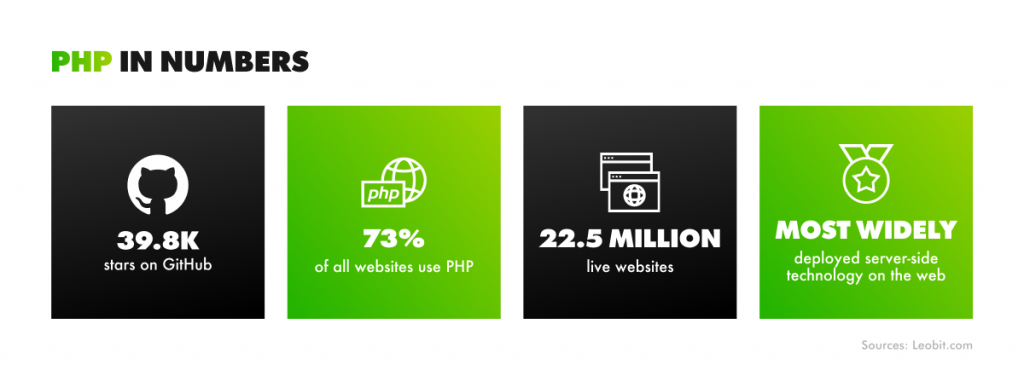
As of today, PHP can boast of having 39,8K stars on GitHub and remains the most widely deployed server-side technology on the web. However, from a popularity standpoint, PHP no longer sits at the top of developer trend charts, but it hasn’t vanished either. The TIOBE Index, aimed at assessing and tracking the quality of software, placed PHP in 15th place among programming languages. That’s a significant drop from its peak in the mid-2000s, when PHP was named Programming Language of the Year in 2004 and drove much of the early dynamic web.

PHP in numbers
PHP in numbers

Interest declined sharply around 2014 and has largely stagnated since. However, PHP didn’t disappear. Continuous performance improvements, better typing, and major upgrades in PHP 7 and PHP 8 kept the language relevant enough to survive and take a significant part of the market share.

Despite frequent claims that PHP is “dying,” the numbers tell a different story. BuiltWith reports 22.5 million live websites currently using PHP, with more than 91 million sites having used it historically. That’s the key reason behind its survival. Besides, most professional PHP developers already use mature PHP frameworks, like Laravel, Symfony, CakePHP and many others that have rich and mature ecosystems and strong, built-in security mechanisms.

What Is ASP.NET?

ASP.NET is a server-side web framework developed by Microsoft in the early 2000s. Over these two decades, ASP.NET has evolved from a Windows-only, tightly coupled web framework into a broad platform. It currently supports a variety of programming models such as Web Forms, MVC, Web API, to its current version, ASP.NET Core.

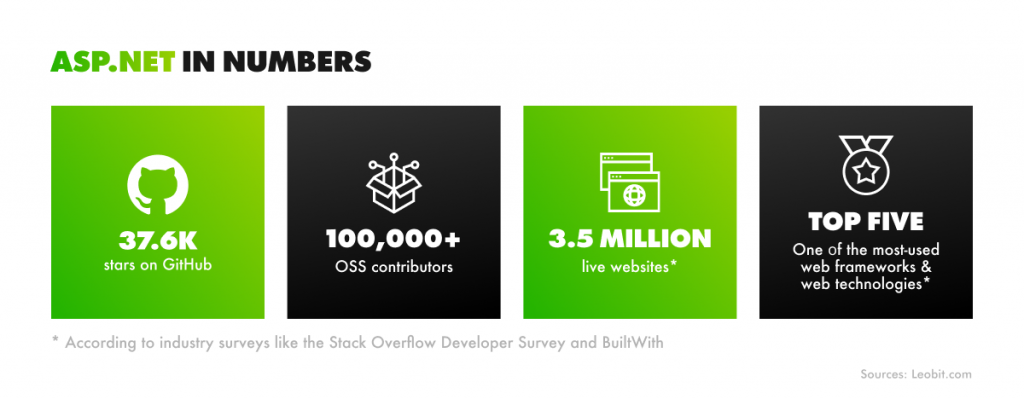
As of today, ASP.NET’s base usage is lower compared to PHP. ASP.NET is used by about 7.5% of all websites that have a known server-side language. Though this gap might seem significant, it doesn’t tell the whole story. The framework boasts 37,6k stars, thousands of forks, and a vibrant community on GitHub. According to Stack Overflow, ASP.NET is among the top 5 most-used web frameworks and web technologies.
ASP.NET in numbers
Worth mentioning that, unlike its previous versions, ASP.NET Core is well-suited for modern development stacks and smoothly operates in non-Microsoft environments. It can be deployed on Linux servers and directly integrated with popular open DevOps tools such as Docker, Jenkins, and GitHub Actions.

PHP vs. ASP.NET: A Detailed Business-Level Comparison

When comparing PHP and ASP.NET for business, it’s important to look beyond the syntax and the preferences of the individual. What’s more important is the cost, the scalability, and the long-term implications of each technology. ASP.NET and PHP are both tried and tested technologies, but they each fulfill different business needs.

Let’s compare PHP vs. ASP.NET from a business perspective.

Performance and scalability

According to the latest set of benchmarks across 331 frameworks, ASP.NET Core outperforms PHP in most cases, with higher performance in low-level and DB-intensive scenarios.

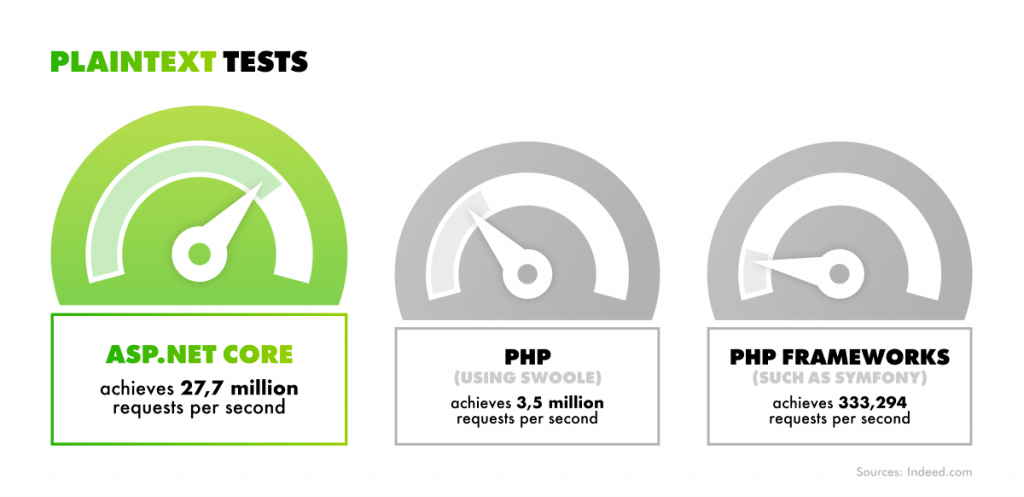
In plaintext tests, for instance, ASP.NET Core achieves ~27.7 million requests per second (RPS), compared with around 3.5 million RPS with PHP using Swoole and 333,294 RPS with traditional PHP frameworks such as Symfony.

ASP.NET vs. PHP benchmarks: Plaintext tests results

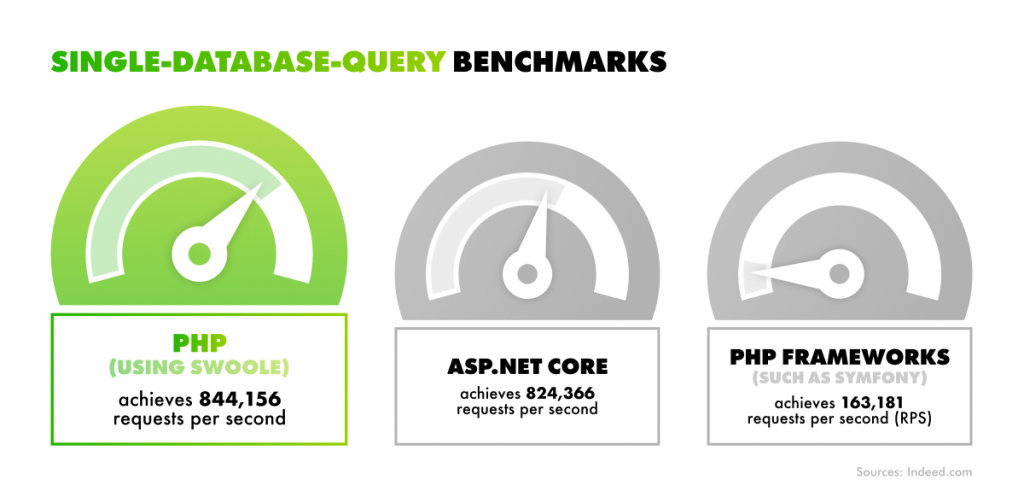
In single-database-query benchmarks, ASP.NET Core achieves approximately 824,366 RPS, and stands in the middle between PHP with 844,156 RPS and Symfony with 163,181 RPS.

ASP.NET vs. PHP benchmarks: Single database query tests results

These results indicate that highly optimized PHP configurations can bridge this gap. Nevertheless, ASP.NET Core performs better with regard to out-of-the-box performance and scalability.

However, these differences in performance may not be important on their own. Nevertheless, they still have a certain impact on the costs. For example, the greater out-of-the-box performance implies that ASP.NET Core applications are able to process a larger number of requests with a smaller number of servers.

PHP, in turn, especially when combined with modern optimizations like Swoole, can achieve strong performance. Yet, it may require additional configuration. For business, that means higher operational complexity and need to hire experienced PHP developers to maintain performance as the system scales.

Licensing and platform costs

PHP runs on an open-source stack, meaning there are no licensing fees for the language itself, the operating system, or the core web server. It’s usually deployed on Linux-based servers using Apache or Nginx. All these components together are often called LAMP stack (Linux + Apache/Nginx + MySQL/PostgreSQL + PHP). For many businesses, especially startups and small teams, this significantly lowers the entry barrier.

ASP.NET, by contrast, is closely associated with the Microsoft ecosystem. Although it can be deployed on Linux with Nginx, Windows Server with IIS remains a common production choice, especially for enterprises with existing Microsoft infrastructure. Windows hosting typically costs more than Linux hosting, and enterprise features such as Entra ID integration or certain management tools can add to the bill.

Development and hiring costs

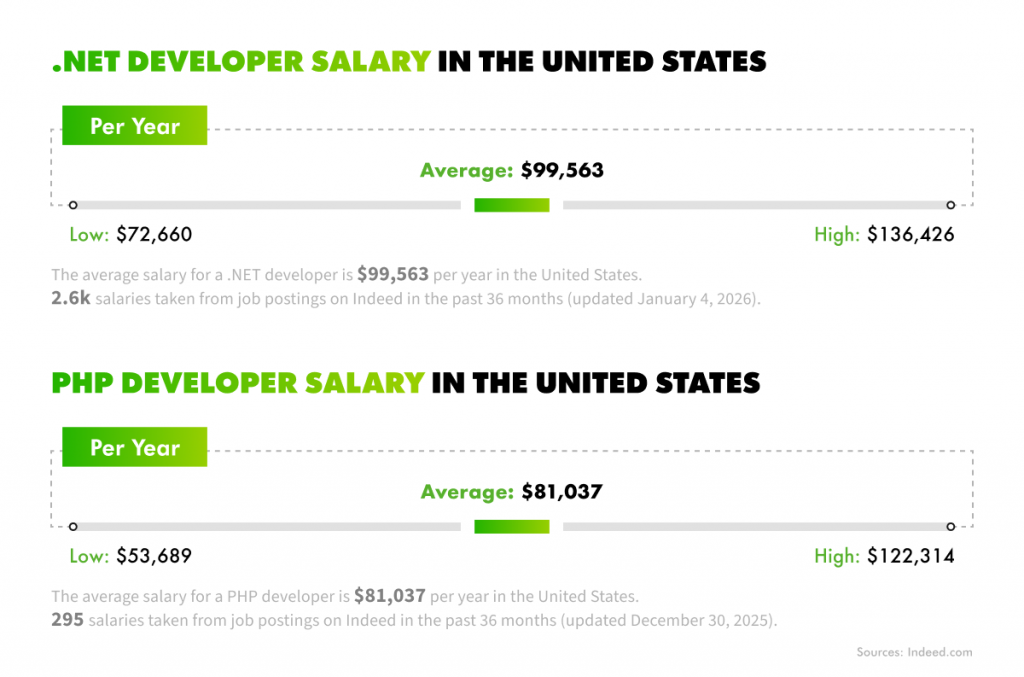
According to Indeed, the average base salary for a PHP developer can range from $53,555 to $122,209 per year. As of January 2026, Indeed lists around 1,000 open positions for PHP developers. The demand isn’t particularly high and comes mostly from businesses and companies that already run PHP-based systems.

For ASP.NET and the broader .NET ecosystem, the numbers are noticeably higher. Indeed reports an average base salary ranging between $72,660 – $136,426 per year for .NET developers, with more than 4,000 open positions listed. In this case, the higher salary reflects greater demand.

.NET vs. PHP developer salary

From a business perspective, it may be easier to hire PHP developers with practical experience at competitive rates, particularly outside major tech hubs or by outsourcing. Senior PHP developers are also widely available, which helps keep salary inflation in check.

ASP.NET developers, on the other hand, are in higher demand and tend to command higher compensation. Hiring can often be faster due to the volume of candidates, especially if you consider a BOT or outsourcing.

Hosting and cloud considerations

For PHP applications to work effectively, it is not always necessary to have customized infrastructure. A common platform like LAMP can be quite adequate to deal with heavy loads in the production environment. ASP.NET Core also works well in Linux, Docker, and Kubernetes environments. However, ASP.NET applications are still more commonly associated with structured cloud environments, particularly Microsoft’s cloud ecosystem.

ASP.NET has tight integration with monitoring, identity, and deployment pipes on platforms such as Microsoft Azure. While this tight integration may reduce friction for enterprise developers, it also comes with additional expenses compared to how PHP applications might be hosted.

Security

ASP.NET is built with security in mind. Many protections are enabled by default, which reduces the chance of mistakes during development. Features like built-in request validation, protection against cross-site scripting (XSS), and automatic defenses against cross-site request forgery (CSRF) are tightly integrated into the framework.

With regard to authentication and authorization, ASP.NET provides a structured identity system, role-based access control, and strong support for modern standards like OAuth and OpenID Connect. When combined with the wider .NET ecosystem, this allows teams to enforce consistent security policies across applications with relatively little custom code. This, in turn, lowers the risk of human error and makes it easier to meet internal security standards, especially in fintech development or other regulated industries and environments.

PHP’s security reputation is more complicated. In its early years, PHP made it easy to write insecure code. Weak defaults, inconsistent APIs, and widespread copy-paste practices led to multiple security vulnerabilities in PHP-based apps. Much of PHP’s “insecure” label comes from this era. No wonder that in 2019, developers from all over the world put PHP in the top 5 most dreaded languages. However, modern PHP development looks very different.

Current PHP versions include strong cryptographic libraries, improved type handling, and safer defaults. Additionally, the majority of PHP projects today are built on mature frameworks like Laravel and Symfony. These frameworks provide built-in protection against common attacks like SQL injection, XSS, and CSRF, along with standardized authentication and validation layers.

With best practices in place, PHP applications can be just as secure as applications developed using ASP.NET. The difference, however, is that PHP applications require discipline in using frameworks, whereas ASP.NET has more security at the platform level. That’s why you need to hire experienced PHP developers to secure your project and data.

Development speed and flexibility

PHP can boast of a low entry barrier and simple deployment. Frameworks like Laravel enable developers to quickly build the foundation for full applications. They provide out-of-the-box support for routing, authentication, database access, and templating with minimal configuration. This shortens the path from concept to MVP, which can be especially beneficial in software development for startups.

PHP also powers popular content management systems, like WordPress and Drupal, which is why it dominates blogs, company sites, landing pages, and e-commerce stores. Thanks to integrated content editors, plugins, and third-party services, changes can be deployed without heavy process overhead. For teams that need to move fast and adapt often, PHP offers a clear advantage.

ASP.NET adopts a highly structured methodology. ASP.NET Core promotes a distinct separation of concerns, strong type checking, and well-defined architectural patterns. The framework also supports deep integration with contemporary IDEs, automated testing tools, and deployment workflows. While all these integrations increase the initial setup duration, they significantly reduce long-term friction, particularly for large, parallel-working teams. All these features make ASP.NET well-suited for enterprise systems and SaaS development.

The right choice depends on how quickly you need to move today and how complex your system is expected to become tomorrow.

Framework diversity and ecosystem structure

According to Wikipedia, PHP powers around 40 frameworks, with Laravel, Symfony, CodeIgniter, and CakePHP being among the most widely used. These development frameworks support different development methodologies and can cater to different scenarios (e.g., building highly modular, long-term system architectures).

In contrast, ASP.NET is more centralized. The existing environment is centered on .NET Core and its associated libraries. This focused approach lowers fragmentation and enhances consistency across projects. The trade-off is less flexibility in tooling choices, but stronger alignment across frameworks, libraries, and deployment practices.

Long-term viability and roadmaps

PHP serves as a foundation for a large share of web resources, including content platforms, e-commerce systems, and internal business tools. So, even as developer interest fluctuates, PHP continues to receive updates because too much of the web depends on it.

The PHP roadmap focuses on incremental improvements rather than radical change. The recent PHP 8.5 version delivered better type safety, and more modern language features like URI extension, pipe operator and persistent cURL share handles without breaking existing applications. This conservative evolution reduces upgrade risk for businesses running long-lived systems. That said, PHP is unlikely to become trendy again, but it also isn’t likely to disappear in the near future.

ASP.NET’s long-term viability is closely tied to Microsoft’s broader platform strategy. Built around .NET 10 and ASP.NET Core, the modern stack continues to rapidly evolve and is heavily promoted for cloud-native and enterprise workloads. The framework’s long-term support is also proven by the fact that ASP.NET is currently used by market giants like Samsung, Intel, Dell, and JPMorgan Chase.

Unlike PHP, ASP.NET’s future is less dependent on legacy usage and more on continued platform investment. As long as Microsoft maintains its focus on .NET as a core development platform, ASP.NET will continue to evolve alongside it.

In a nutshell, both technologies are safe bets, but for different reasons.

Best PHP Use Cases

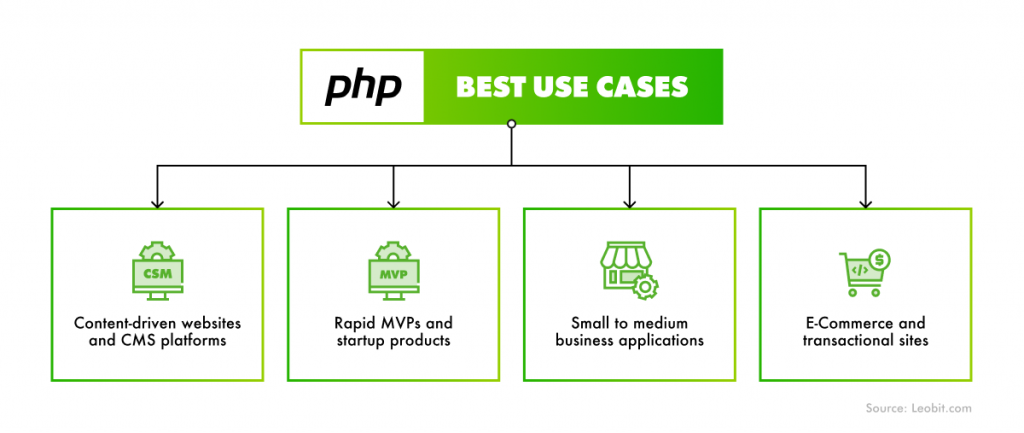
PHP works best for content-heavy platforms that require complex publishing workflows, or for e-commerce solutions built on platforms like Magento, WooCommerce, or OpenCart. PHP is also a solid fit for custom CMS development, as it offers flexibility, modularity, and a broad ecosystem of third-party integrations.

Here are some of the most popular use cases of PHP adoption illustrated with real-life examples .

PHP use cases
PHP use cases

Content-driven websites and CMS platforms

PHP has always been a dominant choice for content-focused websites like blogs, marketing sites, news platforms, and company homepages. This dominance is largely driven by PHP’s connection with WordPress, which is used by 43.0% of all websites worldwide.

Because PHP integrates naturally with templating and server-rendered HTML, it’s well-suited for pages that change frequently and need to be maintained by editors rather than developers. Even Leobit’s blog is built on PHP. It allows non-technical teams to manage content without or with minimal involvement of developers.

For instance, in the real estate search platform project, Leobit used PHP to build a flexible, content-driven web platform tailored to the needs of the real estate market. PHP handled server-side rendering, dynamic property listings, search and filtering logic, and CMS-style content management.

Rapid MVPs and startup products

PHP can be a great option for building MVPs and early-stage products. Frameworks like Laravel make it possible to quickly assemble a working product. Core features such as authentication, user management, database access, and basic APIs can be implemented using established conventions. This reduces both development time and the risk of building systems that turn out to be unnecessary.

Small to medium business applications

Many internal tools and customer-facing apps do not require the complexity of microservices or advanced infrastructure. PHP performs well in this space by supporting core business functionality such as authentication, dashboards, reporting, and third-party integrations within a straightforward architecture.

That said, this simplicity can become a double-edged sword if architectural decisions are made poorly. Because PHP makes it easy to move fast, inexperienced teams may cut corners and choose shortcuts that later limit your platform’s scalability and performance. In these cases, the problem isn’t the language, but how it’s used.

A good example of why experienced PHP developers matter can be seen in complex products like the AR/VR SaaS application modernized and rearchitected by Leobit. Projects of this nature involve heavy client-side processing, real-time interactions, and performance-critical back ends. If a back-end stack were chosen without considering these constraints, it could lead to bottlenecks, constant rewrites, or costly migrations later on.

E-commerce and transactional sites

One of the reasons PHP works well for e-commerce website development is its ecosystem maturity. Many of the problems e-commerce businesses can face have already been solved dozens of times (e.g., handling carts, discounts, subscriptions, invoices, or refunds). For such cases, PHP-based platforms and libraries already exist and are battle-tested.

Transactional systems tend to grow gradually. A store might start with a few hundred orders a month, then scale to thousands. PHP supports this growth pattern well and allows scaling horizontally without forcing teams to redesign the entire architecture. Many successful online businesses ran PHP back ends for years before they ever needed more complex infrastructure.

A good real-world example is the marketplace modernization for a Swiss Internet service provider. In this project, Leobit experts used PHP to modernize an e-commerce platform for selling home Internet services. Instead of a risky full rewrite, the platform was evolved incrementally, allowing the business to improve performance and maintainability without disrupting active customers.

Best ASP.NET Use Cases

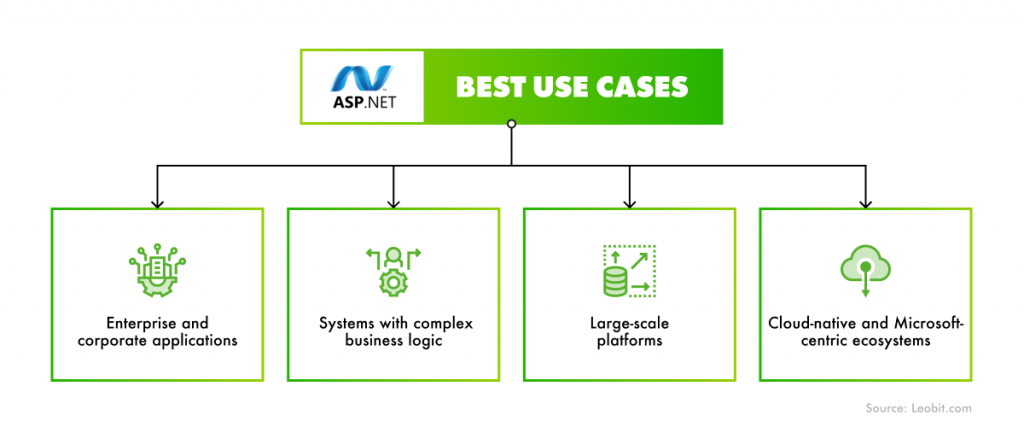
ASP.NET Core is a powerful framework suitable for developing modern web apps for a large variety of industries. In the following section, we outline several use cases where ASP.NET offers the greatest advantage.

ASP.NET use cases
ASP.NET use cases

Enterprise and corporate applications

ASP.NET is a strong fit for enterprise environments because it offers out-of-the-box support of layered architectures, strict access control, and complex workflows. This makes it well-suited for internal business systems, ERP platforms, CRM solutions, and large customer-facing portals. A good example from our portfolio of ASP.NET development projects is a customizable web CRM we developed for our Australian customer. In this project, ASP.NET was used to build a flexible yet highly structured system with role-based access, configurable business logic, and long-term maintainability in mind.

For the same reasons, ASP.NET was used in the franchise operations SaaS platform, which had to support multiple business units, standardized processes, and centralized control across a distributed organization. ASP.NET provided the structure needed to manage complex permissions, workflows, and integrations while keeping the platform scalable and secure.

Organizations that already rely on Microsoft technologies often choose ASP.NET for exactly these reasons, as it integrates naturally with identity management, security policies, and existing enterprise infrastructure.

Systems with complex business logic

ASP.NET’s strong typing and structured design become a real advantage for apps that involve detailed rules, validations, and multi-step processes.

A good example is our work on AI-powered SaaS quoting assistant for CNC manufacturers for a Swiss customer. ASP.NET (Web API / ASP.NET Core) is used as the backbone of the platform’s server-side application. It exposes the APIs that power the web app’s dashboard, manages quoting workflows (from requests to calculations and to quote generation), and enforces business rules around parts, materials, and historical pricing data.

Another example of ASP.NET usage is our work on the booking system for the medical sphere. We used MVC + Razor for this role-based web portal as it allowed us to structure the application around clear modules (e.g., controllers for booking and patient-management workflows, models for appointments/clinics/clinicians, and Razor views for dashboards and interactive calendars).

Large-scale platforms

ASP.NET is a good option for systems that are expected to grow and remain in production for many years. Its emphasis on clean architecture and maintainability helps large teams work in parallel without creating fragile codebases. As projects scale, ASP.NET’s tooling, testing frameworks, and deployment pipelines reduce technical debt and make long-term maintenance more predictable.

A clear example of this is the global payment processing provider platform delivered by Leobit. Payment systems operate under constant load, process high transaction volumes, and must meet strict security and compliance requirements. ASP.NET provided the structure needed to manage complex workflows, integrations, and validations while ensuring stability as the platform evolved.

A similar pattern appears in the alternative electronic payment SaaS solution, where the system had to support continuous feature growth, multiple integrations, and long-term operation without service disruption. In both cases, ASP.NET enabled Leobit to build platforms that could scale safely over time and easily embrace new regulatory and business changes.

Cloud-native and Microsoft-centric ecosystems

Businesses building on Microsoft Azure often choose ASP.NET because of its tight integration with Microsoft-powered cloud services, monitoring tools, and deployment workflows.

A good example is the SaaS Stakeholder Management Software that Leobit rearchitected and modernized for a UK client. The product originally ran on a legacy, single-tenant ASP.NET Web Forms application that had become difficult to scale and maintain. Instead of attempting a risky full rewrite, we modernized the system step by step. Leobit introduced a new ASP.NET Web API back end built around a vertical-slice, modular monolith architecture, alongside a Blazor-based front end.

Our work on this project was recognized with the 2025 Cloud Computing Award in the Business Cloud Transformation category. We won this award for driving measurable business impact by helping our UK-based customer achieve operational excellence through the strategic adoption of Azure cloud and AI technologies. Later on, we were also named a finalist in The Cloud Awards 2025/26 for leading this large-scale cloud migration and modernization project.

How Can Leobit Help Decide Between PHP and ASP.NET?

Leobit works extensively with both PHP and ASP.NET, helping clients select the technology that best fits their product goals rather than forcing a one-size-fits-all solution. Our tech team understands not only how each stack works in isolation, but also how they behave in real production environments over time.

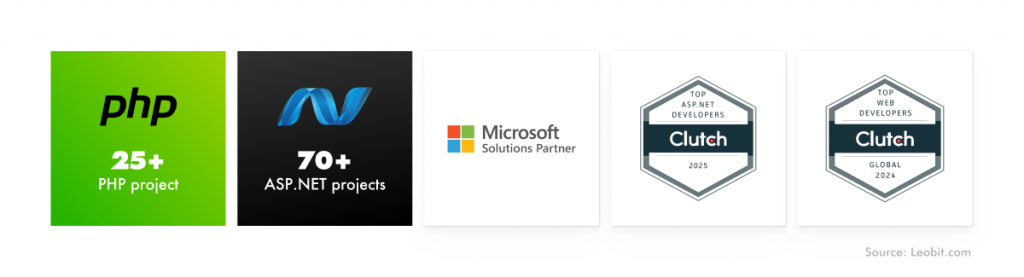
We also have significant experience with ASP.NET and other Microsoft technologies and services. Leobit has been a Microsoft Solution Partner since 2019, which reflects our long-term experience with the .NET ecosystem. We’ve delivered 70+ ASP.NET projects, ranging from enterprise platforms to high-load, API-driven systems. This expertise has also been recognized by Clutch, which named Leobit among the Top ASP.NET Developers 2025 and Top Web Developers Global 2024.

At the same time, PHP is a core part of Leobit’s delivery portfolio. We completed 25+ PHP projects using frameworks like Laravel, Symfony, WordPress, and other custom PHP stacks. Our hands-on experience with PHP allows us to develop and support everything from content-driven platforms and MVPs to mature, long-lived business applications.

In some projects, we often go beyond “either-or” decisions. A strong example is our work on Enterprise B2B Jewelry Network, where we used ASP.NET Core for complex enterprise logic and structured workflows, and PHP to build flexible, content-oriented and supporting components. This hybrid approach allowed each technology play to its strengths.

Conclusion

Choosing between PHP and ASP.NET is more than just a technology decision. The choice can affect costs, scalability, and long-term maintenance of your existing or future web project.

PHP’s modern frameworks like Laravel or Symfony can offer faster time to market and lower upfront investment, especially for content-driven projects. ASP.NET, particularly its latest version, ASP.NET Core, provides stronger structure, predictable scalability, and long-term stability for complex web systems.

Yet, instead of pushing PHP or ASP.NET by default, we can help you understand the trade-offs and, when needed, design architectures that combine both technologies effectively. The outcome is a technology strategy based on practical experience, proven delivery, and long-term value, not trends or assumptions. Contact us and we’ll help you modernize or build your software solution from the ground up.

FAQ

Yes. PHP remains widely used in production, especially for content-driven websites, e-commerce platforms, and cost-sensitive business applications.

Indeed. Many platforms successfully use PHP for content or CMS layers and ASP.NET for complex business logic or APIs.

Yes, when designed properly. However, achieving predictable performance at scale often requires more optimization compared to ASP.NET Core.

While raw PHP can be used securely, modern frameworks like Laravel and Symfony significantly reduce risk by providing built-in protections and standardized patterns.