 Leobit
Warehouse Management System with Multiple Integrations
Custom software development and software modernization helping a US-based apparel e-commerce company optimize its inventory management
ABOUT the project
- Client:
- US-based e-commerce retailer
- Location:
-

USA
- Company Size:
- 50+ Employees
- Industry:
-
E-commerce
- Solution:
- Custom Software
Leobit helped a US-based e-commerce company extend their Laravel-based warehouse management system with guided putaway (directing received goods to the right storage location), single-pass receiving, automated purchasing, and integration of the EDI (Electronic Data Interchange) standard for sending business documents machine-to-machine between trading partners. These improvements allowed the client to ensure greater inventory traceability and reduce manual work.
The client came to us with a system that already worked and a very precise picture of what was missing. Our job was not to rebuild anything — it was to fit new capabilities into a live Laravel application so cleanly that the warehouse floor never noticed a deployment, only that the next task was faster.
Customer
Our customer is a US-based e-commerce company that sells premium blank apparel and custom Direct-to-Film transfers to crafters, creators, entrepreneurs, and small businesses. With over a decade in the market, the company competes on price, shipping speed, and customer service. All three depend on how much the warehouse can move in a day, so throughput is under constant pressure.
Business Challenge
The client’s system was running in production but had significant gaps across warehouse operations. Putaway lacked pallet history, rack dimensions, and placement recommendations, while inventory counts failed to update occasionally. Receiving required duplicate data entry and did not flag discrepancies. Purchasing lacked seasonal adjustments, low-stock alerts, and automated purchase orders. Staff could not track incoming stock or manage restocking tasks efficiently. The largest apparel supplier, responsible for roughly half of purchasing volume, also had unintegrated EDI feeds.
With its internal team fully occupied running the warehouses, the customer needed an external team to take over the codebase and deliver seven defined workstreams without disrupting live operations.
Why Leobit
Leobit’s proposal included practical ideas for optimizing the workstreams. Each requirement mapped to a technical design deliverable, a staged deployment, test coverage, and a documented rollback plan. The team also listed the integration dependencies upfront as assumptions: sandbox access, printer models and label templates, supplier file formats and delivery methods, and carrier credentials. That matched how the client’s technical lead had structured the statement of work (SOW). Combined with Leobit’s prior work on logistics and retail back-office systems, it settled the decision.

Project
in detail
Leobit started working in accordance with the SOW written by the customer’s Technical Lead for Automation, with acceptance criteria per workstream and a companion EDI integration plan. There was no greenfield discovery phase, so the engagement opened with a rapid onboarding instead.

For Leobit’s team, the first stage of the project went into absorbing the existing codebase, database schema, and AWS environments, standing up a staging environment with production-mirrored data, and producing a technical design document per workstream. Each document covered data model changes, API specifications, and integration architecture.
Putaway, receiving, purchasing, and inbound visibility formed the critical path and ran in two-week sprints, each closing with a demo on staging. Receiving and putaway were built together because they share a handoff: confirming a receipt now generates putaway tasks automatically. Purchasing and the delivery schedule were paired for the same reason, as one purchase order lifecycle feeds both.
Task assignment and key performance indicator tracking for stockers (warehouse staff who store and replenish inventory), the shared alerting infrastructure, and the microsite UX overhaul started in parallel once the core data model stabilized. The team built alerting as a shared service first, so receiving discrepancies, low-stock events, and schedule changes all route through the same configurable layer.
The supplier EDI work ran as its own three-phase track. Inbound feeds came first, followed by outbound 850 purchase orders, and then 870 order status and 810 invoice matching. Each phase was tested against supplier sample files before automation was enabled.
The customer’s technical lead acted as product owner and ran user acceptance testing for every workstream. The process looked as follows: Leobit deployed to staging and notified the project lead; the customer tested against the acceptance criteria, defects were classified as blockers, issues, or enhancements, and a workstream went to production once all blockers were closed. The customer’s operations team supplied rack-slot cubic dimensions, purchasing surveyed supplier EDI and email capabilities, and leadership approved each third-party integration.


Guided Putaway Workstream
The putaway workstream turned basic stock tracking into a system that records each pallet’s history. Every license plate number (LPN), a unique identifier for a pallet or container, now has a record of its contents, storage location, picking history, and current status. The system also logs every stock movement with the employee responsible and the time, which makes it easier to trace misplaced goods.
Leobit also configured the system to add measurements for each storage slot, including height, width, and depth. A guided putaway system recommends suitable locations based on pallet size, available space, product type, demand, and weight limits. Backup rules ensure the system can suggest a valid location for standard pallets, even in unusual cases
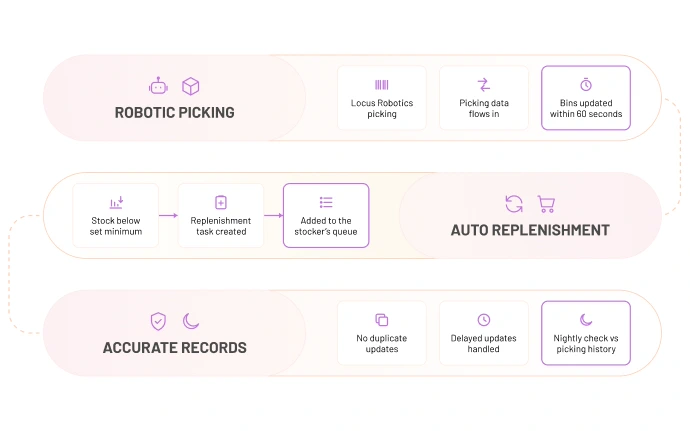
Keeping Inventory in Sync With Robotic Picking
The team connected the system to the warehouse’s Locus Robotics picking system so inventory quantities update automatically as items are picked. Picking data flows into the system, updating bin quantities within 60 seconds. When stock falls below a set minimum, the system automatically creates a replenishment task and adds it to the stocker’s task queue.
To keep inventory records accurate, the team also built safeguards against duplicate or delayed updates and a nightly check that compares recorded stock levels with picking history.

An EDI Translation Layer Inside the Existing Stack
Leobit built a service to exchange data directly with suppliers. It retrieves supplier files, checks their format and contents, and imports product, inventory, purchase order, and shipment information into the client’s system. It also matches supplier product codes with internal stock records, reducing the need for manual data entry.
When an advance shipment notice (ASN) arrives, the system automatically fills in expected products, quantities, carrier details, and tracking numbers before the delivery reaches the warehouse. The system flags differences between expected and received goods for review. For outgoing orders, it generates supplier-ready files from approved purchase orders in under five minutes and tracks each order from creation through acknowledgment, shipment, and receipt.

Role-Based Routing and Zero Downtime
Around a hundred people use the system daily, each group with a different daily task set. Leobit implemented role-based routing so that receivers, stockers, buyers, and warehouse supervisors each land on a view tailored to their work at login. The stocker view is the same microsite made responsive for the small screens of handheld Android scanners, with barcode-driven entry points into each task.
We also ensured that the microsite would stay available to warehouse staff through every release. Leobit shipped each workstream into the existing application behind feature flags and sequenced deployments by workstream, with a rollback plan for each.
The Journey
Behind Our Success
Technology Solutions
- The EDI translation service inside the existing Laravel application, ensuring that every message validates against the supplier’s published specifications, failed transmissions retry automatically, and errors route to the shared alerting layer
- Dedicated integration tables added for vendor products, vendor inventory, purchase order and ASN headers and lines, and SKU (stock-keeping unit) mapping with a confidence score for each supplier-to-internal match
- A queue that filters out duplicate and out-of-order messages, supported by a nightly job that checks processed warehouse robot picking events and corrects bin quantities when needed
- Putaway recommendations based on pallet fit, bin capacity, product turnover, product type, and rack weight limits, with fallback rules to ensure every standard pallet gets a recommendation
- A print agent on the warehouse network that lets the microsite print labels directly to Zebra printers without transferring files
- A configurable alert system that routes notifications to email, Slack, or the app based on user roles, while suppressing low-stock alerts when a replenishment order is already in transit
- Role-based access and mobile-friendly views for handheld devices within the existing microsite, without requiring a separate mobile app
- Feature-flagged releases for each workstream, with a documented rollback plan and user acceptance testing in a staging environment that mirrors production data
Value Delivered
- Full inventory traceability, with every case movement linked to a person, a timestamp, and a License Plate Number
- Faster dock operations through single-pass receiving and receiving tasks prefilled with data from ASNs, targeting a match rate of over 95% between expected and received goods
- An estimated 80% reduction in manual Purchase Order entry time and a purchase order processing cycle of under five minutes for the largest supplier
- Over 98% inventory accuracy compared with supplier inventory feeds, with a target of reducing stockouts of the supplier’s products by 50%
- Purchasing plans tailored to seasonal demand and specific business scenarios
- Dock labor scheduling based on a shared calendar of incoming deliveries
- Measurable data on stocker productivity to help supervisors monitor performance
- A complete foundation for warehouse information management that the client’s own team can maintain and extend without rebuilding the system
