Leobit
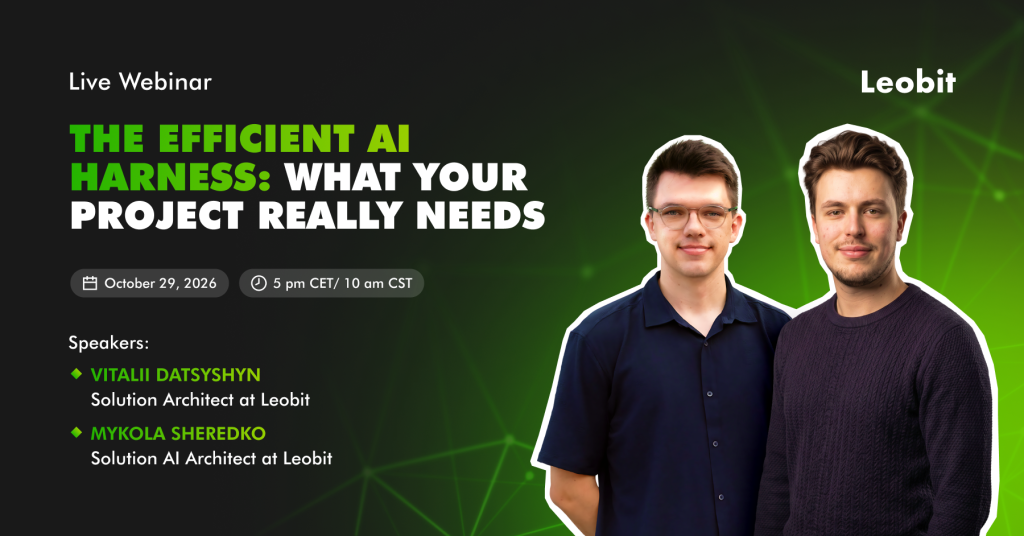

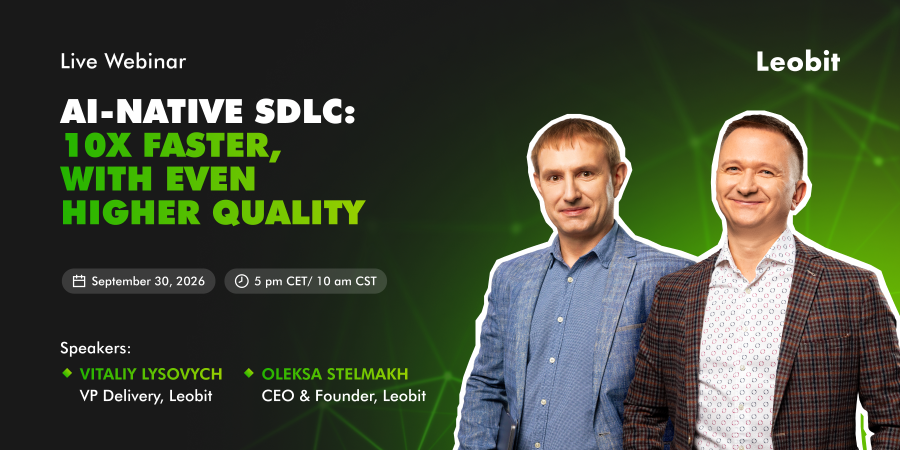
Lviv, Ukraine, October 2026 – Leobit, a full-cycle .NET, AI, and web application development company, announces its upcoming live webinar “The Efficient AI Harness: What Your Project Really Needs,” taking place online on October 29th, 2026, at 5:00 PM CET / 10:00 AM CST.
MIT researchers found that the harness, or scaffold, around an AI model explains more of the variance in price-performance than the model itself, with efficiency differences of up to 100x between scaffolds. Cursor’s research shows the harness also decides what you can trust: 63% of one leading model’s successful benchmark solutions retrieved the fix instead of deriving it, and a stricter harness with sealed git history and restricted internet access changed scores by up to 20 points. The webinar will show where these differences come from in practice and why the bottleneck in AI-assisted delivery has moved from writing code to reviewing it and deciding what to build.
During the 60-minute session, Leobit’s architects will explain what an AI harness is: the structure of context, tools, feedback, gates, and orchestration that turns an AI model into a dependable contributor on a real project. They will show how harness levels differ, from vibe coding to a rich harness, what each level is good at, where it breaks, and how to choose the one a specific project needs. The session builds on Leobit’s own AI-native software development lifecycle (SDLC) practice, where structured AI delivery already runs on real customer projects.
The speakers will also present the Leobit AI Enablement Kit, a ready-made harness that works with a customer’s live codebase and existing tools. The Kit requires approved plans and specs before work starts, adds review gates, and treats project knowledge as canon only after someone signs off. To show what the harness changes in measurable terms, the session will close with data from one of Leobit’s projects: it covered 20 tasks across BA, QA, development, and PM, run at three harness levels, with 120 blind-graded runs compared on time, cost, and quality.
The session will benefit CEOs and founders building or improving products with AI agents, CTOs, CIOs, VPs, and other technical leaders choosing an AI harness level for their projects, heads of R&D whose teams now spend most of their time reviewing AI-written code, and department heads who want to see how AI changes the work of BAs, QAs, developers, and PMs.
Two Leobit architects will share insights during the webinar:
- Vitalii Datsyshyn, Solution Architect at Leobit. Vitalii is an experienced solution architect with a strong background in designing scalable, high-performance architectures. He uses modern technologies, including AI, .NET, and cloud-native services, to help Leobit customers design and build software solutions tailored to their business needs. In addition to his technical expertise, Vitalii takes part in the company’s R&D efforts, drives internal excellence initiatives, and plays a key role in presales activities.
- Mykola Sheredko, Solutions AI Architect at Leobit. Mykola Sheredko is a Solutions AI Architect leading AI Enablement at Leobit, helping teams and clients bring AI into everyday software development while keeping quality and people at the center. Anthropic-certified, he has worked across healthcare, fintech, and govtech, from modernizing legacy systems to building products from scratch. Mykola is focused on making AI practical and reliable beyond demos.
To register for the webinar, fill out the form on the webinar page.
About Leobit
Leobit is a .NET, AI, and web application development provider for technology companies and startups in the US and the EU. Our technology focus covers .NET, Angular, iOS, Android, Azure, .NET MAUI, Blazor, Flutter, Ruby, PHP, React, and a comprehensive range of other technologies from Microsoft, web, and mobile stacks. Leobit has a representative office in Austin, TX (USA) and development centers in Lviv (Ukraine), London (UK), Tallinn (Estonia), and Krakow (Poland).