When to Consider Opening an ODC?
One of the main reasons why companies open ODC is the need to reduce their operating costs due to the difference in high-level specialists’ rates, as well as savings on office rent, technical equipment, etc. But there are other cases when this approach can be beneficial.
- The need to scale the development team or strengthen it with specialists of a narrow profile with particular tech expertise. According to Forbes, 36% of HR leaders note a shortage of resources for attracting top talent, and retaining newcomers within the company proves even more challenging. Statistics reveal that 30% of new hires depart within 90 days.
- The need to enter a certain market, which is much easier, having at your disposal specialists who are familiar with local business processes and pitfalls.
- The need to transfer development routines into capable hands and focus on core business goals.
- Stagnation in the scaling and development of the project, the need for a new vision.
In some cases, opening such a center can be a measure to increase the security of the development because the ODCs work within the framework of a non-disclosure agreement and complex technical security measures.
Key ODC Models
Let’s take a look at the main ODC models
- Managed ODC. In this case, the provider from a remote location hires a team of specialists under project specifics and the client’s needs. The provider takes over the administrative and managerial functions.
- BOT, i.e., Build-Operate-Transfer. In this case, the company hires a development services provider to perform all the tasks of opening an offshore center, including creating a business process management infrastructure.
Each model may have individual limitations and requirements within a specific cooperation or employment agreement.
Benefits of Setting Up Offshore Development Office
Among the main advantages of ODC, the following are worth special attention:
- Wide opportunities for rapid scaling and staff expansion.
- Access to extensive domain expertise.
- Reduction of operating and hiring costs. As reported by Forbes, the cost of replacing an employee for a company amounts to 33% of the employee’s salary. For instance, if the salary were $50,000, the company would incur $16,500 to replace the employee. The expenses related to turnover encompass diminished productivity, along with the costs linked to recruiting, hiring, and onboarding.
- The ability to create a solid infrastructure at low costs.
It is also worth noting that this approach allows you to optimize the development process and find new solutions in cases where the in-house team is stuck and needs a fresh view.
Risks Connected With Opening ODC
Opening an offshore development center has its own risks that should not be ignored.
- Wrong location and cultural differences. Many locations offer a cheap developer rate, but employees may not speak English and may not share your corporate culture, which is critical for remote collaboration.
- Legal difficulties. They may be related to registration and tax issues. Therefore, it is worth paying attention to countries like Ukraine, where the system is loyal to foreign investors.
- Security risks. This is always a painful question because it concerns sensitive corporate data. Everything is resolved by a strong agreement on cooperation and the use of complex security measures.
How to Open an Offshore Software Development Center? 5 Essential Steps
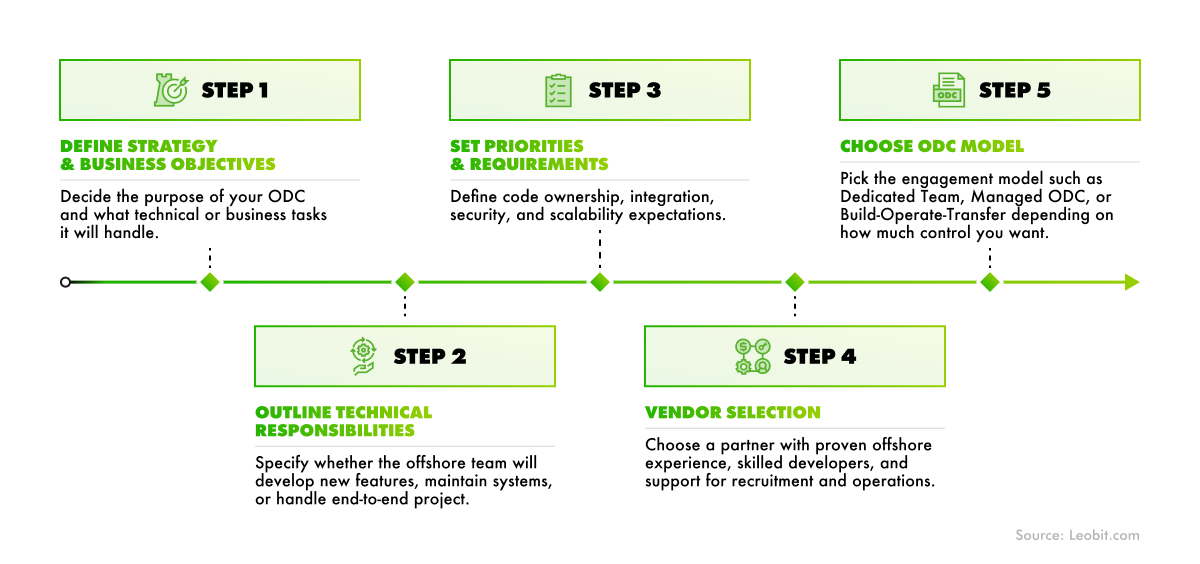
While the opening process involves several steps, following this structured approach makes it smooth and manageable.
1. Define strategy and business objectives
Clarify the purpose of your ODC and the business or technical challenges it should address. This may include extending your tech expertise, optimizing development costs, accessing expert skills in AI, cloud, DevOps, or QA automation to support the company’s product roadmap and operational priorities.
It is also essential to outline the specific technical responsibilities that the offshore team will handle. Decide whether the ODC will take on end-to-end product development, maintain legacy systems, or implement new features.
Establish priorities like code ownership, integration with in-house architecture, security requirements, and scalability expectations. Defining these parameters early simplifies talent selection, process design, and location choice to ensure offshore collaboration strengthens your technical capabilities and delivers measurable project outcomes.
2. Vendor selection
Choosing the right vendor is critical to the efficiency and reliability of your offshore development operations. Look for partners with proven experience in offshore cooperation and an extensive portfolio of projects across relevant technologies. Demo calls, technical interviews, or workshops can help assess the team’s skills, communication style, and ability to adapt to your operational standards. In addition to providing skilled developers, a reliable vendor also supports recruitment, administrative tasks, and operational guidance to streamline the process.
3. Choose ODC model
Selecting the right engagement model determines how much control you retain over your offshore development center and how much responsibility the service provider assumes. Here are some of the most popular options:
- Dedicated Team model. It gives your company direct ownership and management of the offshore developers, while the vendor supports recruitment and administration. This model is suitable when you want maximum control over team structure, processes, and project priorities.
- Managed ODC. This option presupposes that the provider recruits and manages a team of specialists aligned with the project requirements. The vendor handles administrative tasks, HR, payroll, and daily management, allowing your company to focus primarily on strategic decisions.
- Build-Operate-Transfer (BOT) model. This option is ideal for companies that want to own and operate their offshore center. In this model, the service provider sets up the office, hires staff, and implements operational processes. Once the center is stable and productive, the company gradually assumes full control and management of the team toensure smooth knowledge transfer and long-term scalability.
4. Location
Choosing the right country is critical for the ODC’s success. Look for a location with a strong technical talent pool, favorable tax and economic conditions, and sufficient English proficiency. Time zone alignment is also important to facilitate smooth collaboration with the in-house team. Reliable infrastructure, a supportive business environment, and clear legal frameworks are essential for operational efficiency. The right location ensures access to qualified specialists and minimizes operational friction.
5. Hiring the team
Focus on building a team that combines proven expertise, recognized certifications, and cultural alignment. Select specialists who have the technical skills required for the ODC’s responsibilities, whether it’s development, QA, DevOps, or R&D. You also need to validate their proficiency with industry-standard certifications such as ISO standards, ISTQB for quality assurance, or Microsoft partnership, which demonstrate competence and reliability.
Choose professionals who share your company’s values and approach to work. This will help the team integrate smoothly with your in-house team, and deliver long-term results.
The next steps depend on the ODC model. Office rental, onboarding, and other aspects can be handled by the vendor or yourself.
Useful Tips to Set Up and Manage Offshore Development Center
Here are some helpful tips to make managing an offshore center easier.
First, find a reliable vendor interested in your business success. Stay in touch with the team and establish a comfortable communication system. Regular reports and timelines will help you stay on top of progress and improve interaction with developers.
Second, define the center’s success metrics for yourself. These should be not only financial parameters but also staff performance evaluation, achievements, and customer feedback.
In addition, an intermediary as a project manager plays a major role in establishing work processes. So find someone to control workflow and maintain regular reporting for you.
By following these guidelines, you can successfully establish a productive working relationship with offshore software development companies, making your offshore development center a valuable asset.
Top Countries for Opening ODC in 2026
The choice of location depends on the level of technical education, competence, and rate of developers. In recent years, the best option for opening an ODC was Eastern Europe, namely Poland, Ukraine, and Romania. They are suitable for all parameters, including a loyal taxation system, the closeness of time zones, and a high English knowledge level.
Poland offers 250,000 experienced developers and a relatively cheap cost of living. The number of developers in Romania is slightly less, namely about 140,000, but this country is known for the rapid pace of development of the industry.
As of 2025, Ukraine has approximately 302,000 experienced tech professionals and one of the most dynamic technology markets in the region. Major international corporations such as Oracle, Ring, Siemens, Cisco, and Samsung have established research and development centers in Ukraine and continue to invest in their growth.
Why Customers Choose Ukraine
Ukraine has a vast talent pool, including specialists of a narrow profile, so you should consider choosing a Ukrainian company for offshore software development. The tech industry here is developing fast, and educational institutions conclude agreements with IT companies and train new specialists specifically for them.
At the same time, the country’s tax system is open and loyal to foreign investors. The cost of renting offices and accommodation is relatively small. That is why opening the ОDС here is quite a profitable solution.
How does Leobit set up your offshore development unit?
Leobit sets up a dedicated development team that works alongside your in-house team. The goal is not just to provide additional capacity, but to bring in development expertise that may be missing on your side and ensure smooth, long-term collaboration. We build a dedicated development team tailored to your specific business goals, technical requirements and technology stack. Engineers are selected based on the exact skills your project needs and work closely with your internal team on a daily basis, participating in planning, discussions, and code reviews. For the convenience of cooperation, a dedicated development unit will also be using the same tools as your team,such as Slack, Jira, Confluence, GitHub, or GitLab.
The offshore team works from Leobit’s office, which provides reliable infrastructure and well-organized working conditions. Leobit fully manages recruitment, onboarding, and ongoing team support, allowing your developers to focus exclusively on product delivery. . The team composition is agreed with you up front and remains stable throughout the collaboration.
Transparency is a core principle of Leobit’s offshore model. You have full visibility into what the team is working on,task priorities, and overall progress. All technical tasks adhere to agreed-upon quality standards and undergo mandatory code reviews. Importantly, all source code, data, and system access fully belong to you.
Beyond development, Leobit handles all operational aspects typically associated with running an in-house team. This includes office space, recruitment and HR, payroll and taxes, equipment, insurance, staff education, and team motivation. By handling these responsibilities, we remove the operational burden and risks that often come with building and managing internal teams.
As a result, your offshore development unit operates as a stable, motivated, and well-supported team, fully focused on delivering value to your product while Leobit handles the complexity behind the scenes.
Conclusion
Offshore development center is one of the development trend and a great option for companies that need fast and inexpensive scaling with lower operating costs. It allows you to open a full-fledged company branch and hire highly qualified specialists at a much lower price.
Leobit is a Ukrainian company with extensive experience servicing ODC and providing full-cycle development services. We’ll be happy to advise you on this topic and discuss cooperation options, so feel free to contact us.
 Leobit