However, managing distributed systems is often more challenging than running workloads on a single cloud platform. Inconsistent environments and the need for custom integrations add complexity. Overall, the more diversified the infrastructure becomes, the harder it is to manage.
That’s when Azure Arc can help. In this article, we will discuss this service, its capabilities for managing distributed infrastructures, and its core benefits for business.
What is Azure Arc?
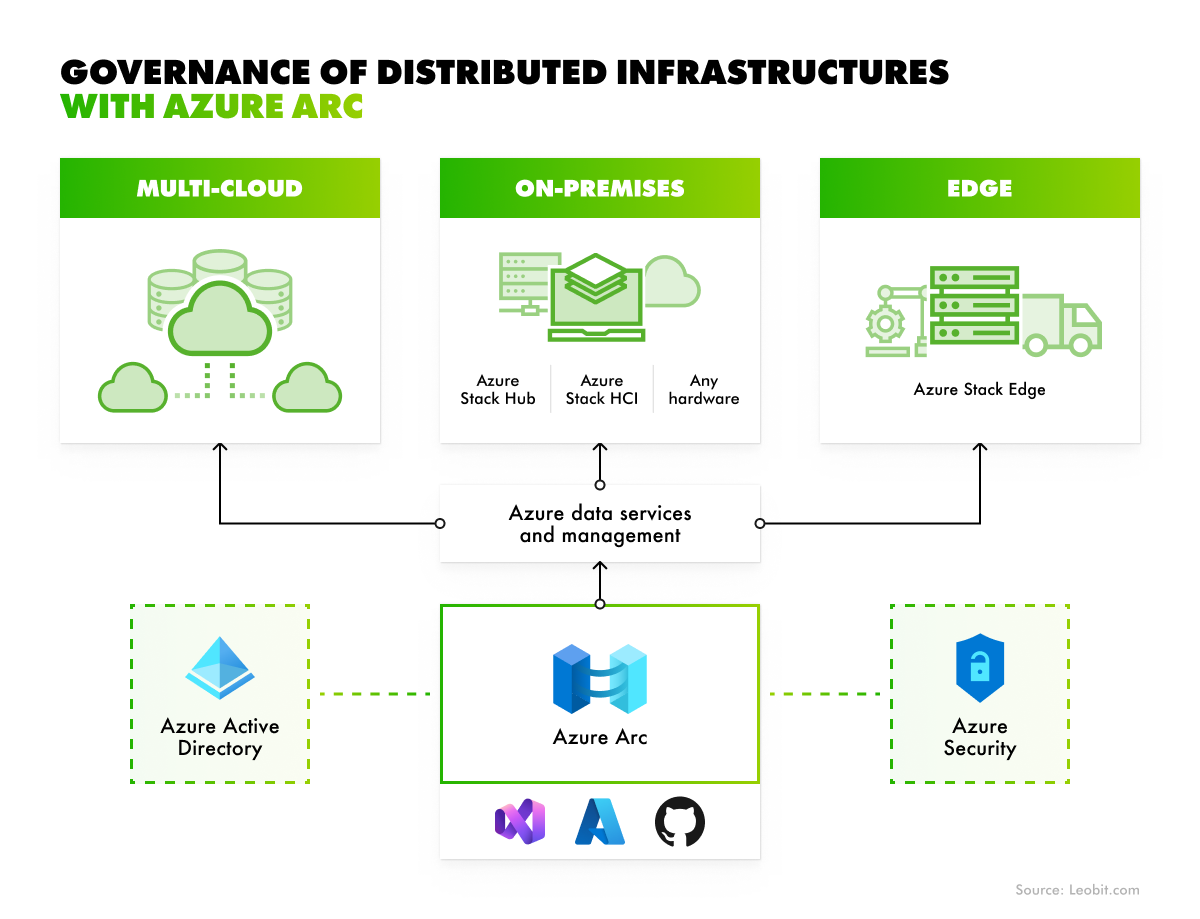
Azure Arc is a service designed for managing resources beyond Azure. It extends Azure’s control plane (Azure Resource Manager) to almost any infrastructure.
Designed for multicloud management, hybrid cloud governance, and edge computing, Azure Arc covers:
At the core of Azure Arc’s capabilities is the Azure Connected Machine Agent. It is a lightweight agent installed on non-Azure servers that connects them to Azure. Once installed, these machines appear in Azure as first-class resources. As a result, a business gets centralized visibility, governance, and lifecycle management over these resources without migrating workloads.
Through the Connected Machine Agent, Azure Arc allows businesses to establish consistent policies, security controls, and observability across all environments. It does so using familiar Azure governance and monitoring services like Azure Policy, Microsoft Defender for Cloud, and Azure Monitor.
For platforms that cannot be managed with agents, businesses can use Azure Arc Resource Bridge, which connects whole virtualization or container platforms to Azure. The Resource Bridge works as a management cluster that connects Azure Resource Manager to environments like VMware vSphere, System Center VMM, and Azure Stack HCI. By establishing native connectivity, Azure Arc Resource Bridge allows organizations to manage virtual machines, networks, and storage from Azure without modifying individual workloads.
In sum, the list of the main Azure Arc capabilities looks as follows:
Managing the entire environment together by projecting existing non-Azure and/or on-premises resources into Azure Resource Manager.
Managing virtual machines, Kubernetes clusters, and databases as if they are running in Azure.
Onboarding physical and virtual servers via the Azure Connected Machine Agent, which ensures monitoring, security, and policy enforcement.
Connecting virtualization platforms through Azure Arc Resource Bridge to ensure their centralized management.
Using consistent DevOps practices to support cloud-native patterns across different environments.
Configuring custom locations as an abstraction layer on top of Azure Arc-enabled Kubernetes clusters and cluster extensions.
How Azure Arc manages distributed infrastructures
Overall, Azure Arc is a strong option for companies that rely on Azure to manage diversified infrastructures and environments with familiar policies, controls, and tools. With tools like Azure Connected Machine Agent and Azure Arc Resource Bridge, this service provides organizations with complete visibility of distributed infrastructures, from individual servers to entire infrastructure stacks.
Unified management across on-prem, cloud, and edge
Managing distributed infrastructures spanning across different clouds and on-premises environments can be challenging. Organizations struggle with duplicated processes, inconsistent policies, and diversified manual workloads. No wonder that 52% of companies cite the complexities of multicloud or hybrid cloud management among the biggest cloud challenges.
Azure Arc provides a single control plane for managing distributed resources. Instead of using separate tools for each environment, businesses can manage servers, Kubernetes clusters, and databases with a unified interface. This allows teams to save time, cost, and effort, managing an Azure hybrid cloud architecture or other distributed infrastructures as one coherent system rather than a collection of disconnected parts.
Improved security and compliance visibility
According to Accenture’s State of Cybersecurity Resilience 2025 report, 77% of organizations lack the foundational data and AI security practices required for safeguarding their resources and infrastructures. In highly diversified hybrid infrastructures, building a unified and secure framework across all resources is even more challenging.
With Azure Arc, teams can enforce uniform security and compliance for diverse infrastructures. Its interface also allows businesses to track compliance status and detect misconfigurations across all connected resources. This is especially relevant to regulated industries, such as fintech, which is bound by regulations like the Payment Card Industry Data Security Standard, California Consumer Privacy Act, the NIST Cybersecurity Framework, etc.
Faster modernization and scaling
According to Gartner, over 40% of enterprise systems are beyond end‑of‑life or unsupported. Software modernization is often challenging because the companies need to preserve all the features and connections while ensuring the compatibility of infrastructure components. The problem becomes even more relevant when it comes to modernizing distributed systems with different infrastructure components located across diverse environments.
Azure Arc allows organizations to modernize existing systems and extend cloud-native capabilities to on-premises environments, and scale when needed without costly cloud migrations. This gives companies greater operational control and reduces downtime, as they can embrace gradual modernization instead of changing the entire infrastructure at once.
Azure Arc helps organizations effectively manage DevOps practices in distributed environments. The service provides a unified interface allowing engineers to ensure the consistency of CI/CD pipelines and DevOps practices. This approach is based on GitOps workflows to Kubernetes clusters across different connected environments.
GitOps is a way to manage deployments where the Git distributed version control system works as a single source of truth. With GitOps, the desired state of your apps and infrastructure lives in a Git repository and is reconciled automatically in every environment. This reduces differences between environments and helps keep deployments consistent, ensuring greater software stability.
Keep in mind that DevOps teams still need to thoughtfully design CI/CD workflows and Git repositories because Azure Arc provides only the tools to enforce consistency. In addition, Azure Arc’s GitOps approach focuses primarily on Kubernetes clusters. Your DevOps teams may need to implement other tooling or pipeline logic for non-Kubernetes workloads.
Azure Arc helps businesses that run hybrid environments achieve greater cost-effectiveness. Companies gain a unified vision of how resources are used across hybrid and multicloud setups. In addition, Azure Arc’s control plane allows teams to apply consistent policies, such as resource limits, tagging rules, security baselines, and cost controls. This helps businesses prevent overprovisioning and standardize resource usage.
This translates into more informed cost decisions and helps companies to adhere to the most cost-effective approach to resource management.
Why Leverage Leobit's Expertise for Managing Your Distributed Infrastructures with Azure Arc?
All diversified infrastructures are unique, shaped by different performance needs, compliance rules, data sources, and workflows. To manage everything effectively with Azure Arc, it’s often necessary to set up advanced configurations, create custom GitOps pipelines, and seamlessly connect multiple environments. This requires specialists with deep experience in hybrid and multicloud management, as well as expertise in Microsoft technologies like Azure Arc, Azure Data Factory, Microsoft Fabric, Azure AI services, etc.
If this expertise is not available in-house, you can outsource distributed infrastructure management to a dedicated team with strong experience in cloud development and cloud data management services.
Leobit is a company with Azure technologies at the heart of our services and is always ready to assist. We are a Microsoft Solutions Partner for Digital and App Innovation and Data & AI, with extensive Azure development experience gained from over 150+ successful projects. Leobit’s team also has strong expertise in building hybrid cloud infrastructures that span
For example, we helped a Norwegian customer build a cloud-based mobile application that seamlessly connects with IoT sensors of a smart home. This solution helps users increase house security and ensure efficient resource consumption.
We know how distributed infrastructures work and will help you configure the most efficient and tailored policies and workflows for their management.
Final Thoughts
Azure Arc is a powerful solution for businesses looking to simplify hybrid cloud data management and implement a multicloud governance platform. Powered by tools like the Azure Connected Machine Agent and Azure Arc Resource Bridge, Azure Arc enables companies to achieve unified visibility and resource management, stronger security, faster modernization, consistent DevOps workflows, and more effective cost control across distributed infrastructures.
To take full advantage of Azure Arc and ensure proper management of your infrastructure, a team with strong cloud governance and development skills is essential. Leobit possesses such skills, as we have strong Azure cloud expertise. Contact us to discuss your needs and find out how we can help you build and manage complex distributed infrastructures.
FAQ
Azure Arc is a service that extends Azure management and governance capabilities to resources outside of Azure. It allows businesses to manage their distributed resources from the Azure control plane.
Azure Arc extends Azure management to a variety of non-Azure resources, such as:
On-premises Windows and Linux servers
Virtual machines
Kubernetes clusters
Cloud resources hosted in AWS or GCP
Azure Arc offers businesses that manage distributed infrastructure a variety of benefits. The most significant ones are:
Unified management across multicloud setups, hybrid cloud infrastructures, and edge environments
Improved security and compliance
Faster modernization and scaling
Consistent DevOps workflows
Enhanced cost control
With our strong Azure expertise, we can help you configure efficient governance over hybrid, and multicloud infrastructures. Our teams will help you leverage Azure Arc to achieve seamless connectivity and unified management across distributed infrastructures, as well as establish consistent DevOps practices with GitOps workflows.
Roman has a deep passion for a wide array of subjects, spanning from market insights to in-depth technical examinations of complex projects. He dives deep into technical aspects of various solutions to extract valuable insights for business purposes, and he enjoys sharing tips and tricks with business owners to help them leverage advanced technologies effectively.
Vitalii is an experienced solution architect with a strong background in designing scalable, high-performance architectures. He uses modern technologies, including AI, .NET, and cloud-native services to help Leobit customers design and build software solutions tailored to their business needs. In addition to his technical expertise, Vitalii takes part in the company’s R&D efforts, drives internal excellence initiatives, and plays a key role in presales activities.
Microsoft Azure stands at the forefront of the growing AI adoption and analytics market. In particular, nearly 60% of CIOs across industries plan to increase ...
The pace of change in software development has never been higher, and 2026 will raise the bar again. We are quickly approaching a world where AI feels as ...
During the past year, 63% of organizations accelerated their cloud migration efforts, up from 57% in 2023. At the same time, 70% now default to cloud-based ...
Leobit, a .NET, AI, and web application development company, is pleased to share that it has reaffirmed its status as a Microsoft Solutions Partner for Digital ...
Last weekend, from October 13 to 16, the Leobit team joined thousands of developers in Lisbon, Portugal, for the Azure Dev Summit, Microsoft’s premier ...
Lviv, Ukraine, October 2025 — Leobit, a full-cycle .NET, AI, and web application development company, is proud to share that it has been named a winner of ...
Used by 5,526 companies globally, Azure Data Factory (ADF) is a critical service in the Azure ecosystem. It is widely applied in domains like data engineering, ...
When companies consider moving workloads to the cloud, the choice typically comes down to two clear market leaders: AWS and Microsoft Azure. According to the ...
Released in 2023, Microsoft Fabric has quickly established itself as a strong contender in the market of data platforms. Specifically, as of mid-2025, it is ...
16 mins read
We use cookies to enhance your browsing experience. By agreeing, you accept our Privacy and Cookies Policy.
By ignoring or closing this banner, we will only collect essential cookies necessary for the website to function properly.
 Leobit