The pace of change in software development has never been higher, and 2026 will raise the bar again. We are quickly approaching a world where AI feels as foundational as HTTP or electricity. It will be everywhere, shaping workflows, architectures, security models, and the experience users expect the moment they open a product. And those expectations are rising fast.
This article breaks down the top 10 technology trends that will define software development in 2026. Some are accelerations of ideas already in motion. Others reflect major shifts in how we design, build, and deliver software. All of them point to the same message. The future belongs to companies that evolve early, stay curious, and build with purpose.
So let’s take a closer look at the future of software development.
1. AI as a Development Partner
AI has already become a daily collaborator for most development teams. Recent findings from DORA’s State of AI-assisted Software Development report show just how quickly this shift has taken hold. Nine out of ten respondents already use AI in their workflows, and more than 80% say it has boosted their productivity. This means the era of just experimenting with AI is over, and in 2026, developers will continue to rely on it actively.
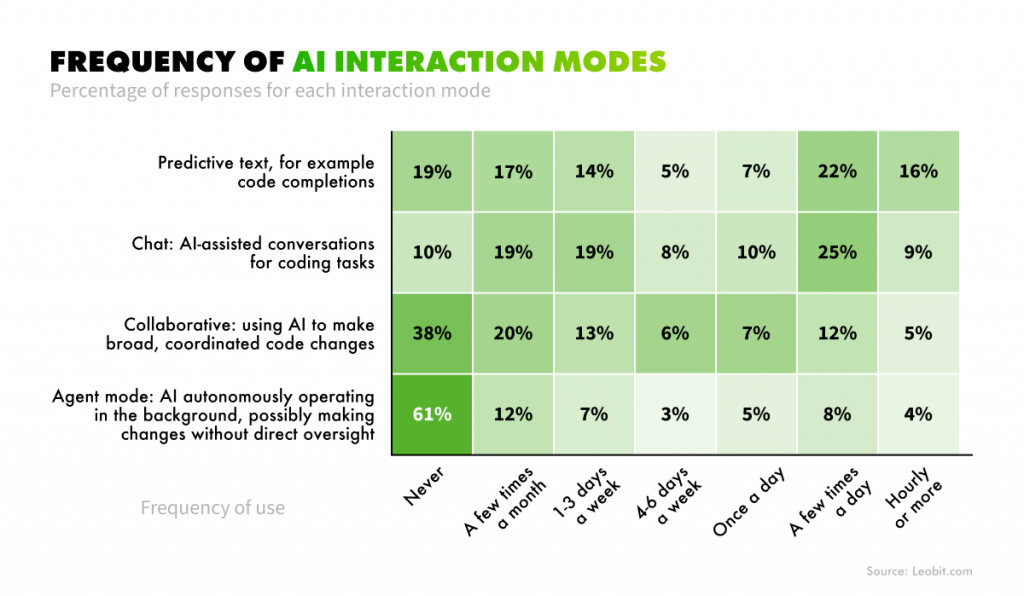
The frequency of use also continues to rise. 74% of developers report using AI about half the time or more when tackling tasks or solving problems. That said, chat-based and in-IDE predictive text features dominate daily use because they are simple, mature, and easy to integrate into familiar workflows. Agentic AI, on the other hand, remains rare.
The same survey states that 61% of respondents never use agent-based tools, suggesting this mode is still in its early stages rather than reflecting a lack of interest. As agentic systems mature, their role in the development stack will likely to expand, but for now, AI’s strength sits in direct, text-driven collaboration.
Frequency of AI interaction modes, scheme
There is also a real risk of overreliance on agentic AI: teams can gradually lose a deep understanding of their own code. When agents handle most decisions and changes, developers may know that something works, but not why. Over time, this can make debugging, onboarding, and maintaining complex systems much harder.
Yurii Chubey
Lead Software Engineer
However, despite widespread adoption, trust will still remain a point of tension. As of the end of 2025, 30% of developers report little to no confidence in AI-generated code. That gap indicates that developers still need to review and validate machine output with the same level of severity as in peer reviews. Despite this, in the coming year, generative AI for software engineering will strengthen its position and become a dependable collaborator.
From my personal experience, while AI certainly brings a significant boost for routine tasks, its ability to “connect the dots” and track a complex context is the biggest limiting factor for the Autonomous Agent Mode adoption. I’m sure leading AI assistants vendors are actively working on self-corrections, context-aware answers (e.g. for a specific version of the library installed), and prioritizing the most recent documentation instead of the most popular (usually older). And I expect a major breakthrough on at least one of those directions in 2026.
Oleksandr Pshenychnyy
Solution Architect at Leobit
2. The Rise of Multi-Agent Systems
As AI matures, the future of software development is shifting from single models doing everything to networks of specialized agents working together. The major reason for that is that multi-agent systems (MAS) can break down complex problems into coordinated roles. For instance, one agent ingests data, another analyzes it, another manages user interaction, and another makes decisions. Instead of one all-purpose AI, you get a team.
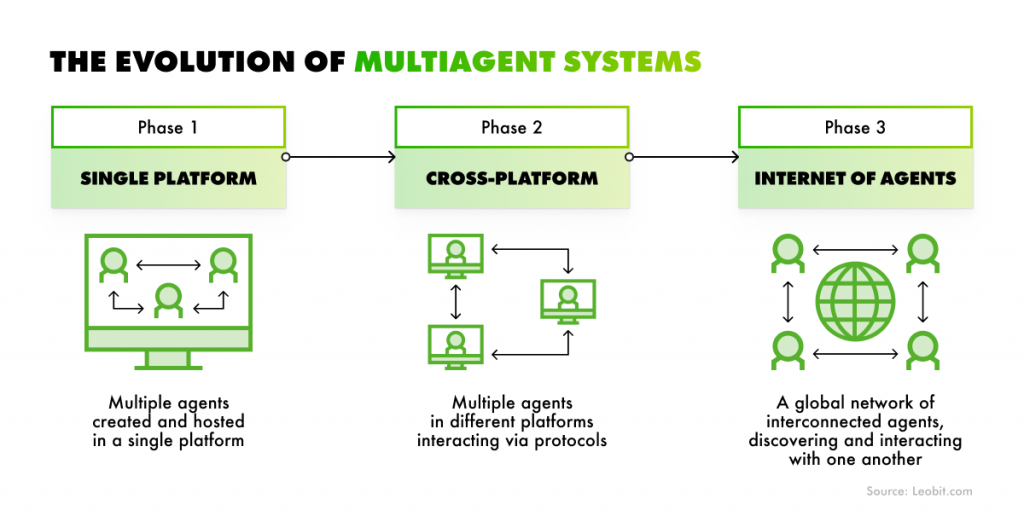
Analysts expect this model to grow fast. Gartner predicts that by 2027, 70% of MAS deployments will rely on narrowly specialized agents. Accuracy improves when each agent focuses on a single skill. However, in this case, coordination becomes more difficult, which in turn prompts teams to reconsider orchestration, testing, and monitoring. By 2028, 60% of these systems are expected to support multivendor interoperability. That shift will open the door to mixing and matching best-in-class agents rather than being locked into a single ecosystem.
The evolution of multi-agent systems
In 2026, MAS will become a practical path to high-level automation for custom software. Entire workflows can be decomposed into agent responsibilities and then executed with minimal human intervention. In the upcoming year, multi-agent systems will have all the prerequisites to automate manual and routine tasks and make development more focused on designing the right set of cooperating agents than on writing every line of logic by hand.
With multi‑agent systems, we have to design AI solutions as an ecosystem rather than a set of isolated assistants. In 2026, the real challenge is defining contracts, observability, orchestration, and safety rules between agents—not just picking a model.
Confidential computing protects sensitive data not only at rest and in transit, but also during computation. It is now shifting from an advanced security option to a baseline requirement. The pressure comes from the growing amount of sensitive data processed in cloud and shared infrastructures. Gartner expects that 75% of this processing in untrusted environments will be protected by confidential computing, which signals a major architectural transition. Getting there is less about buying a new feature and more about changing how teams design, deploy, and monitor their systems.
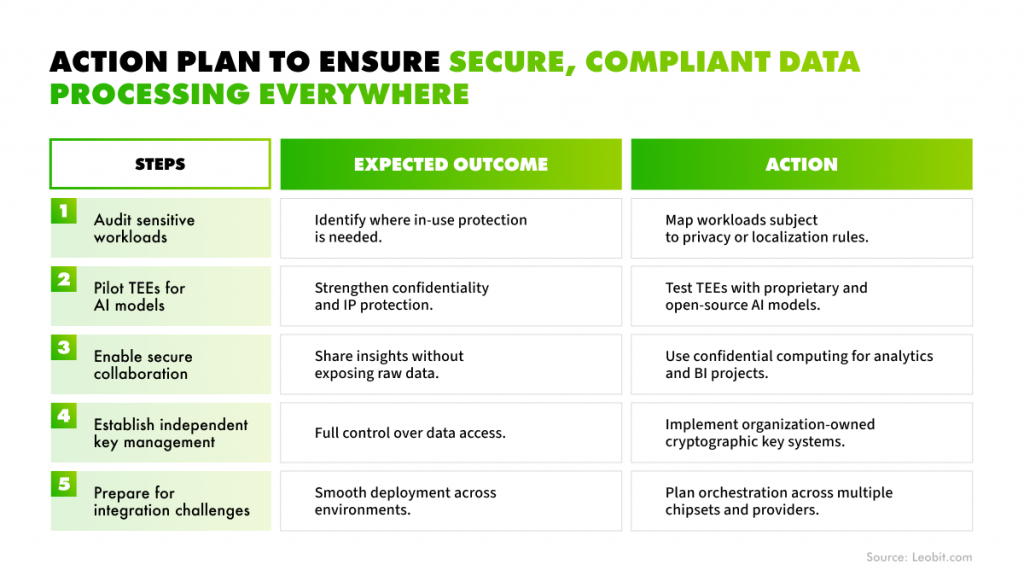
The first practical step is adopting secure enclaves and trusted execution environments offered by major cloud providers. These tools allow data to remain encrypted during computation. Teams that pilot enclaves early generally discover that the biggest challenge is not performance overhead but workflow adjustments. Developers must verify that sensitive logic actually runs inside the enclave and that secrets never leak back into unprotected layers. That requires tighter boundaries, clearer threat models, and automated checks in the pipeline.
This is where security-first coding becomes essential. Frameworks and CI/CD systems will embed secure defaults, but teams still need to enforce them. Expect stronger linting rules, policy-as-code, and automated attestation integrated into the build process. These checks verify that an artifact was produced inside a trusted environment and has not been tampered with. In practical terms, developers will spend less time hunting down insecure patterns and more time responding to precise, automated feedback.
Action plan to ensure secure, compliant data processing
Achieving widespread adoption also means rethinking data handling. Teams that succeed with confidential computing tend to classify data early, separate high-risk paths, and route those paths directly through enclave-backed services. Over time, this reduces the volume of sensitive processing outside of protected environments, which is key to meeting the projected 75% threshold.
4. Cloud-Native Architectures
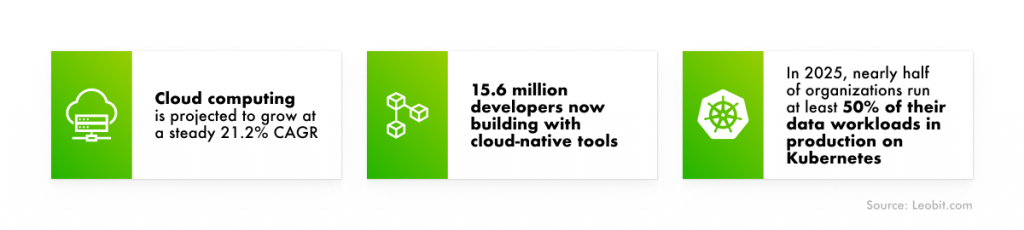
Cloud computing is valued at $912.77 billion in 2025 and is projected to exceed $5 trillion by 2034, growing at a steady 21.2% CAGR. That wave is driven by AI, IoT, and big data workloads that require elastic infrastructure and rapid delivery cycles. Although cloud will remain a strategic trend, in 2026, most companies are not going all-in on the cloud. Hybrid models will still be the norm in 2026 as teams blend on-premises control with cloud flexibility, but the balance will tilt further toward cloud-first thinking.
Developer adoption is a key driver of this trend. The latest CNCF data shows 15.6 million developers now building with cloud-native tools, about one-third of the global developer community. That is not casual interest. It is a sign that Kubernetes, containerization, and service-oriented design are becoming a shared language across teams, regions, and industries.
According to the Data on Kubernetes 2025 report, nearly half of organizations now run at least 50% of their data workloads in production on Kubernetes. In 2026, this share will climb as teams move mission-critical analytics and ML pipelines into clusters built for consistency and elastic scaling. Revenue pressure will make this development trend hard to ignore. The same study suggests that 62% of companies already tie 11% or more of their revenue to data workloads on Kubernetes. In other words, Kubernetes can help companies grow ROI and turn infrastructure into a direct driver of business value rather than a pure cost center.
Cloud computing in numbers
Yet, reaching this level of maturity requires more than adopting Kubernetes or any other cloud-native tools. If you want to meet these 2026 expectations, you will need a clear path forward. Companies that will thrive next year are already standardizing their delivery pipelines and containerizing high-value components first.
They are also preparing for the gradual migration of stateful workloads to Kubernetes by adopting operators and storage layers designed for resilience. Hybrid environments will only work at scale when the same automation and governance covers both sides.
5. Hyperautomation
Hyperautomation is one of the latest market trends in software development that will become a defining characteristic of high-performing engineering teams in 2026. The push is already visible. The State of Quality 2025 research indicates that mature QA groups increase automation, with 45% running automated regression tests and 37% prioritizing API testing. These teams are automating to keep pace with release cycles that accelerate each year.
AI-powered DevOps will widen the gap. Companies already using AI driven pipelines see failure rates drop to 0-15% range. Low performers sit at 46% to 60%. That is a three- to fourfold difference in stability, which means that by 2026, companies will be under significant pressure to adopt automation, not just to save time but to remain competitive.
The practical path to hyperautomation begins with eliminating manual handoffs. Builds, tests, configuration updates, and environment provisioning are all automated by triggers. Whether a commit lands, a policy changes, or a release branch is cut, the pipeline reacts immediately without waiting for a human operator. Modern tools like GitHub Actions, Jenkins, GitLab CI/CD, and CircleCI already support this model. But 2026 will push teams to use these tools more actively and more intelligently through AI-assisted orchestration.
To my mind, a critical change enabled by AI is the decoupling of automation strategy from vendor-specific expertise. Hyperautomation no longer requires teams to be locked into a single cloud provider or tooling ecosystem simply because “that’s what we know best.” With AI-assisted setup, configuration, and troubleshooting, experienced tech leads and solution architects can objectively evaluate AWS, Azure, GCP, or hybrid approaches and select the most suitable option for the problem – not the one the team happens to have the longest history with.
Yurii Chubey
Lead Software Engineer
Agentic AI will further drive hyper-automation. Early data shows that agentic systems improve task accuracy by 7.7% as they distribute work across specialized agents. One agent monitors systems, another generates test cases, and one more reviews code. This division of labor reduces blind spots and improves consistency, which is why more than 59% of software engineers using AI tools report measurable improvements in code quality. In 2026, these multi-agent setups will become a key force multiplier in the automation pipeline.
I believe incorporating AI agents into the development lifecycle has huge potential, especially for the code review process. An AI agent is never tired or unfocused – it would strictly follow the review checklist and ensure best practices are followed, raising any issues discovered. The beauty of such an integration is that it has virtually no downsides/trade-offs: code is still fully in control by a developer, while they also receive an extensive training, like they could have received from an experienced TechLead. And the only investment required is to set up the agentic AI as an automated code reviewer for a pull request.
As of 2025, data centers already consume 1-1.5% of global electricity, and demand is rising fast. Power consumption is projected to reach 84 GW by 2027, with AI workloads accounting for 27%, cloud workloads 50%, and traditional compute accounting for the remaining 23%. This mix signals where pressure will land: teams building AI-heavy systems will face scrutiny first.
Regulation will accelerate this shift. The EU’s Corporate Sustainability Reporting Directive now requires more than 50,000 companies to disclose detailed sustainability data. The SEC’s climate transparency rules are forcing U.S. companies toward the same level of accountability. By 2026, engineering teams will need a clearer view of their energy use and emissions, as sustainability reporting will no longer sit solely with finance or compliance. It will affect investor confidence, procurement, and software architecture choices.
The challenge is that most organizations are not ready. The Uptime Institute’s 2024 survey shows that fewer than half of data center owners track the metrics needed to meet upcoming regulations. Rack densities remain below 8 kW on average, and only a small number of facilities support extremely high-density racks above 30 kW. This will change as AI workloads demand more power per rack and as operators push toward more energy-efficient hardware and cooling. Companies planning for 2026 should expect data center constraints to shape deployment decisions more than before.
At the same time, leading cloud providers are already adjusting:
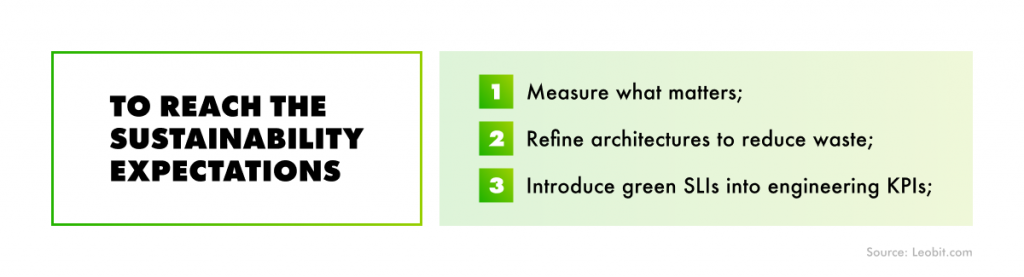
As providers shift to cleaner infrastructure, customers will automatically gain some sustainability benefits. But 2026 will reward organizations that act beyond simple cloud adoption. To reach the sustainability expectations forming around 2026, companies can take several practical steps.
Measuring what matters. Without workload-level energy and carbon metrics, optimization is guesswork.
Refining architectures to reduce waste. Cloud cost optimization practices like right-sizing compute resources, adopting autoscaling, and consolidating idle workloads can help reduce waste and cut the cloud bill
Introducing green SLIs into engineering KPIs. This will help you make sustainability a part of the definition of done rather than an afterthought
Practical steps to meet sustainability expectations forming around 2026
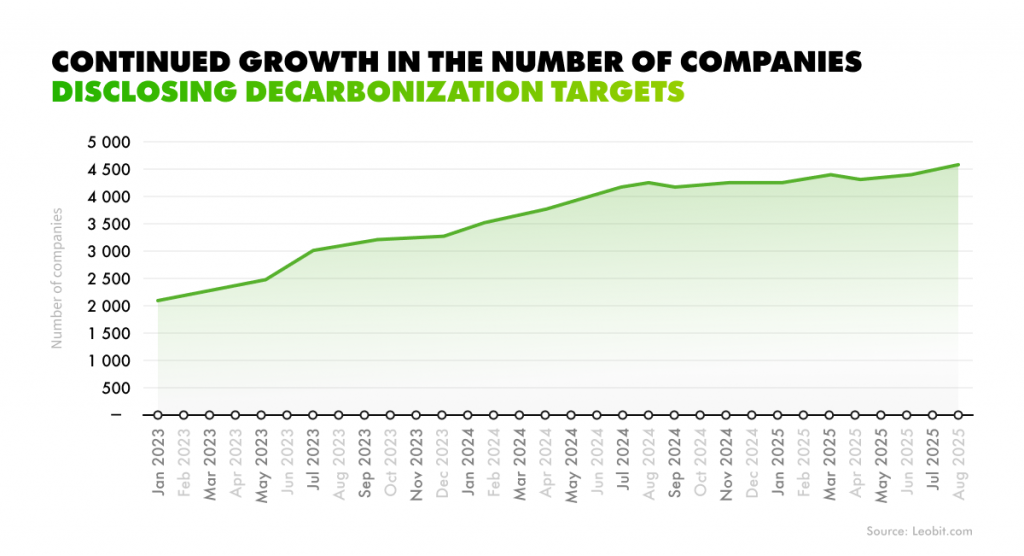
The broader trend line is unmistakable. Thousands of companies are already reporting climate targets that meet MSCI’s Implied Temperature Rise criteria, and this number will keep climbing. As reporting becomes mandatory and as AI pushes energy use higher, 2026 will be the year software companies take direct responsibility for environmental impact.
Number of companies disclosing decarbonization targets
Sustainability will no longer sit on the edge of technology conversations. It will shape how systems are architected, deployed, and measured. The organizations that prepare now will face lower compliance risk and gain a quieter but meaningful competitive advantage, as sustainable systems cost less and earn more trust.
7. Preemptive cybersecurity
Cybersecurity is shifting from reactive to preventive approaches, and 2026 will become the inflection point. Preemptive cybersecurity is one of the software industry trends that replaces the traditional pattern of detecting an attack and then scrambling to respond. Instead, AI models will anticipate malicious behavior, disrupt attack paths, and neutralize threats before they reach critical systems.
The market signals back this up. Preemptive solutions made up only 5% of IT security spending in 2024. And by 2028, one in four traditional detection and response approaches will be displaced by preemptive cybersecurity. Gartner also warns that by 2029, technology products without preemptive defenses will lose market relevance, because buyers will assume that proactive protection is the baseline. That means the transition begins long before 2029. In 2026, software companies will already face mounting pressure to demonstrate that their systems can stop attacks before they happen.
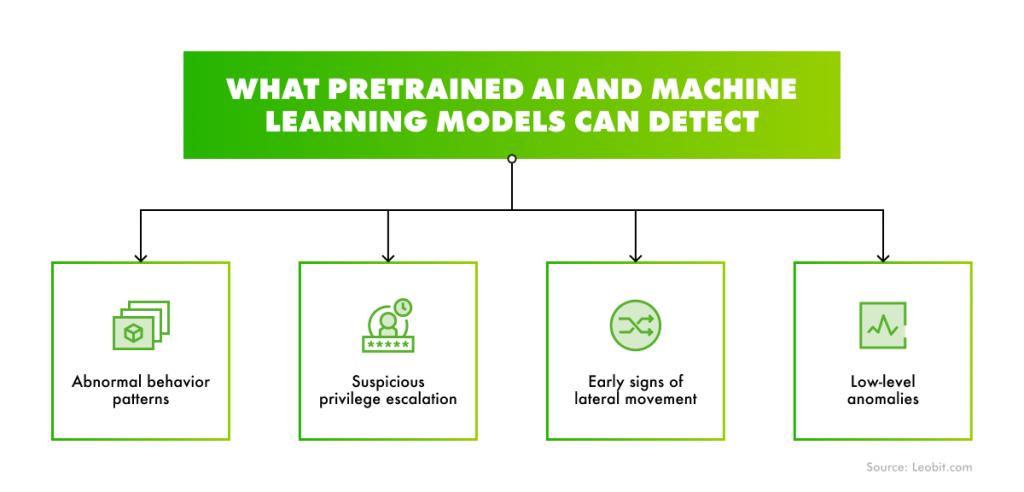
The technology behind this shift relies on AI and machine learning models trained to detect subtle indicators of malicious intent. When models spot these signals, preemptive platforms can block access, isolate processes, or re-route traffic in real time. The goal is to deny attackers the setup steps they need long before any damage occurs.
What pretrained AI and machine learning models can detect
First, integrating behavioral analytics into existing security stacks so predictive models have enough telemetry to learn from.
Second, shifting incident response planning toward automation enables neutralization steps to be executed immediately rather than waiting for analysts.
Third, start evaluating vendors through a preemptive lens: how well do their tools forecast threats rather than just alert on them?
By the end of 2026, preemptive cybersecurity will likely become the preferred defense model. Threats are moving too fast for after-the-fact responses to keep up. Organizations that adopt proactive, AI-driven protection will experience fewer breaches, recover more quickly, and maintain trust in an environment where attackers use AI for malicious purposes.
8. Re-Evaluating Microservices Architecture
In 2026, engineering teams will adopt a more balanced, experience-driven approach to system architecture. Microservices have been part of mainstream software development for nearly two decades, which means the industry now has enough real-world data to understand both where they shine and where they fall short.
What this experience has revealed is not a failure of microservices, but rather a failure of misuse. In many cases, limited domain understanding and rushed upfront design led to overly fragmented systems. Instead of gaining independence and scalability, teams inherited tight coupling through APIs, complex dependency chains, extended testing cycles, and longer issue investigation timelines. The promised benefits never fully materialized, while operational costs steadily increased.
As a result, in 2026, the microservices boom will settle and take its place as one architectural style among many, with clearly understood trade-offs, risks, and operational requirements. Architects will be less likely to default to highly distributed systems and more willing to justify simpler designs when they better serve delivery speed, maintainability, and business goals.
Architects will increasingly have the courage to get back to the roots and justify simplicity over highly distributed architectures. Modular monoliths, SOA, and Microkernel styles may get their “second birthday” for new development in 2026, and see a significant increase in popularity. These approaches offer clearer boundaries, faster feedback loops, and simpler operational models for high-uncertainty projects, especially for teams that value rapid iteration and predictable delivery.
Oleksandr Pshenychnyy
Solution Architect at Leobit
Existing microservices-based systems will evolve as well. Rather than full rewrites, teams will consolidate services that failed to deliver isolation or scale benefits, merging them into larger, more cohesive functional units. This pragmatic refinement improves system clarity while preserving the parts of the architecture that genuinely work.
The trend for 2026 is not about abandoning microservices. It is about architectural maturity. Teams will prioritize delivery speed and simplicity, choosing distribution only when it clearly delivers value.
9. Personalized User Experiences
Personalization will move from a nice-to-have to a baseline expectation in 2026. AI-powered interfaces are already shifting toward real-time adaptation, and industries such as fintech, healthcare, and retail will lead the way. Instead of static screens, users will see interfaces that adjust layout, recommendations, and workflows based on context, intent, and behavior. This goes hand in hand with a growing focus on accessibility and inclusive design, in which experiences adapt to users’ preferences, abilities, and environment.
The strongest push comes from demographic reality. Gen Z now represents more than one-third of the global population, according to the UN’s World Population Prospects 2024. They are digital natives, expectation-driven, and quick to judge the quality of an experience. 70% report believing in personalization as a core part of any digital interaction, and 45% expect a site or app to anticipate their needs. If it does not, they leave. This behavior will influence product strategy across every consumer-facing industry in 2026.
10. Return to on-premises
Cloud repatriation is already taking shape, and 2026 will mark a noticeable shift back toward on-premises infrastructure. A CIO report citing a 2024 IDC study found that nearly 80% of organizations expect to bring some compute or storage workloads back on-premises within a year. However, this should not be seen as a rejection of the cloud. It is a correction.
Teams are learning that some high-volume or high-sensitivity workloads are cheaper, more predictable, or easier to govern when they stay closer to home. In 2026, this trend will mature into a more intentional hybrid strategy. Enterprises will no longer push everything into the cloud by default. Instead, they will choose deployment models based on three questions:
Does this workload handle sensitive or regulated data?
Do we gain or lose cost efficiency by running it on premises?
Does cloud elasticity offer meaningful value for this use case?
Workloads that fail those tests will move back to controlled environments with stronger audit trails and more stable cost structures. Meanwhile, workloads that benefit from scale and global access will remain in the cloud.
To support this shift, teams will invest in automation, container orchestration, and cloud-native tooling that work across both environments. The goal is consistency. Whether an application runs in a managed cloud region or an enterprise data center, the deployment pipeline, security posture, and operational playbook should be consistent.
The return to on-premises is not nostalgia. It is a practical response to regulatory complexity, financial pressures, and the maturation of cloud strategies. In 2026, the winning architectures will be those that integrate both worlds and use each for what it does best.
Are You Ready for 2026?
The year ahead won’t reward teams that simply keep up. It will reward teams that adapt with intention. AI will sit deeper in every workflow. Automation will push development cycles faster. Architectures will simplify where it matters and grow more intelligent where it counts. Security will move from reaction to prediction. Sustainability and compliance will shape decisions as much as performance and cost. And users, especially a rising Gen Z majority, will expect products that feel personal, immediate, and effortless.
The organizations that thrive in 2026 will share one trait: they will build with clarity. They will choose the tools, architectures, and strategies that solve real problems, cut waste, and deliver value quickly. They will embrace AI as a partner, not a novelty. They will design systems that scale without overcomplication. And they will invest in skills and processes that keep them ahead of the curve rather than chasing it.
If you want a development partner who can help you navigate these shifts, guide your strategy, and build solutions ready for what’s next, Leobit is here to support you. Whether you need AI adoption, cloud modernization, architecture guidance, or full product development, our team is ready to help you step confidently into 2026.
Contact Leobit today and start building the future on your terms.
FAQ
The decisions you make today shape how competitive you will be tomorrow. Trends like AI-assisted development, hyper-automation, cloud-native platforms, and preemptive cybersecurity take time to adopt. Teams that wait until these become “mandatory” often struggle with rushed implementations, higher costs, and technical debt.
No. The goal is not to adopt everything, but to adopt what fits your business context. To succeed you need to focus on trends that directly improve delivery speed, reliability, security, or user experience. Thoughtful selection matters more than trend chasing or budget size.
Leobit helps companies translate trends into practical execution. This includes AI adoption strategy, cloud and hybrid architecture design, automation and DevOps modernization, security-first development, and custom software delivery. The focus is always on business outcomes, not just technology choices.
Yes. Many of Leobit’s projects focus on modernization rather than replacement. This can include simplifying over-engineered architectures, migrating selected workloads to the cloud or Kubernetes, gradually introducing automation and AI, or improving performance, security, and scalability without disrupting the business.
Leobit treats AI as a development partner, not a shortcut. This means combining AI-assisted tools with strong validation practices, security controls, and human oversight. The goal is to improve productivity, code quality, and delivery speed while maintaining trust, reliability, and compliance.
It starts with a conversation. Leobit works with clients to understand their goals, constraints, and technical landscape before recommending solutions. Whether you need strategic guidance, a dedicated development team, or end-to-end product delivery, the next step is to align on what success looks like for your business.
Inna loves making complex tech feel simple. With a strong eye for innovation, she helps businesses turn complicated ideas and data into clear strategies they can actually use. Whether it’s new tools or big trends, she’s all about making technology work for people.
Choosing the right front-end framework is no longer just a technical decision. It directly affects development speed, hiring, scalability, and long-term costs. ...
Microsoft Azure stands at the forefront of the growing AI adoption and analytics market. In particular, nearly 60% of CIOs across industries plan to increase ...
In the race to innovate and deliver software faster, quality is often pushed to the back burner. But this strategy carries real financial consequences. ...
The growing AI adoption helps businesses automate and enhance many workflows, but it also has a downside. By accelerating software development lifecycles, AI ...
The insurance industry could unlock $50 billion to $70 billion in revenue through AI, according to McKinsey.
However, not every insurtech business that adopts ...
Research from Bain & Company shows that 44.9% of executives see a clear correlation between flexible, modular architecture and improved productivity. ...
Lviv, Ukraine, February 2026 — Leobit, a full-cycle .NET, AI, and web application development provider, is excited to announce its upcoming webinar ...
Leobit, a .NET, AI, and web application development company, is excited to announce the expansion of its partnership with Microsoft by earning the Microsoft ...
The global cross-platform application development market is expected to reach $546.7 billion by the end of 2033, thriving at around 16.7% CAGR. With its mature ...
52.1% of developers admire React, while 51.9% say the same about Blazor. That near-parity is telling that both React and Blazor are now highly regarded by the ...
21 mins read
We use cookies to enhance your browsing experience. By agreeing, you accept our Privacy and Cookies Policy.
By ignoring or closing this banner, we will only collect essential cookies necessary for the website to function properly.
 Leobit