The growing AI adoption helps businesses automate and enhance many workflows, but it also has a downside. By accelerating software development lifecycles, AI can increase technical debt.
But how does this tech debt appear, and what is the role of AI adoption in it? And how can you reduce it?
In this article, we will explain the most common causes of tech debt in the age of AI and provide tips and best remediation practices for it.
What is a Technical Debt?
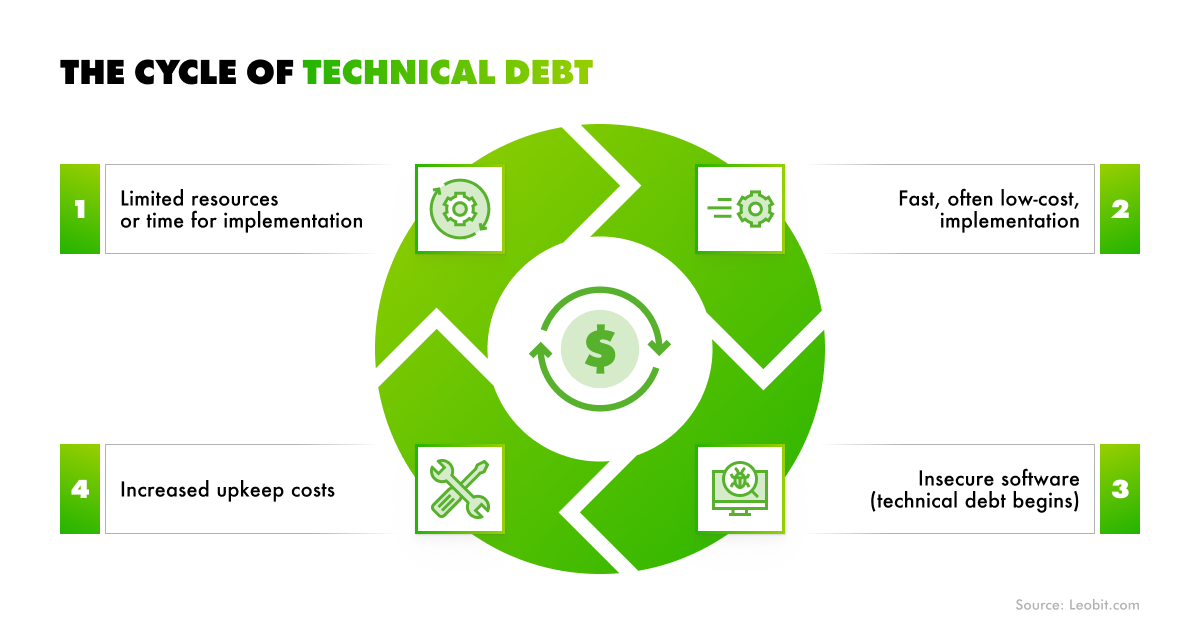
Technical debt is a long-term cost incurred when organizations choose shortcuts over more sustainable software development approaches. It typically occurs when time or budget constraints make teams sacrifice code quality, architecture, documentation, or testing.
Just like financial debt, over time, technical debt generates “interest” in the form of higher maintenance costs, slower innovation, and challenges with system management and maintenance.
The technical debt cycle
Without a proper response, all such factors limit an organization’s flexibility and affect its revenue directly. In particular, companies that actively manage and reduce tech debt report projected revenue growth of 5.3% for 2024–2026, compared to 4.4% among companies with higher debt levels. The problem of technical debt in the global IT industry applies to businesses of different sizes. For instance, the total cost of technical debt among Global 2000 companies is almost reaching $2 trillion.
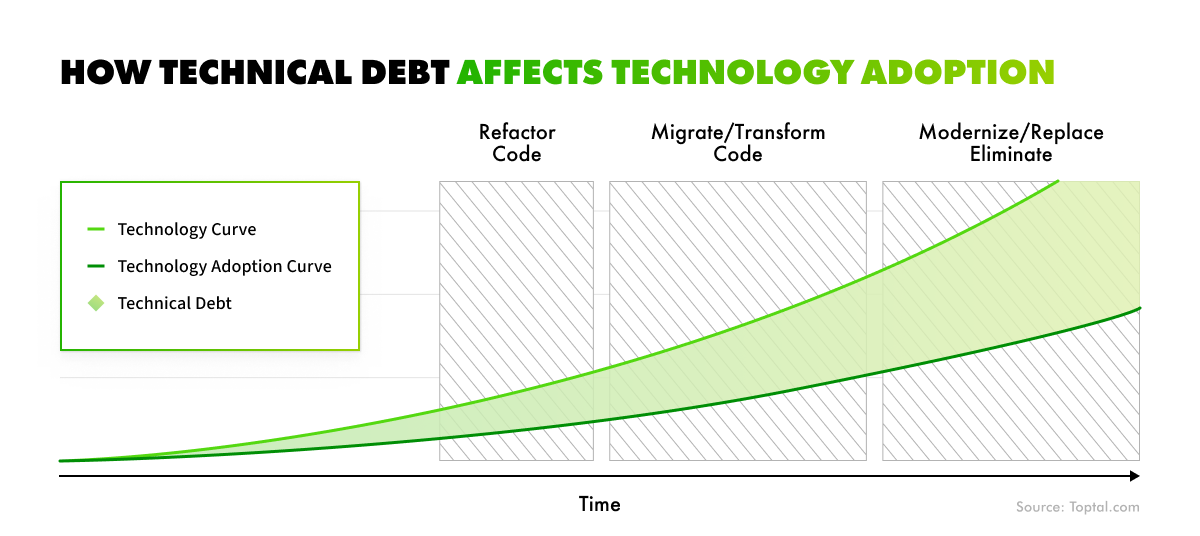
Another significant problem with technical debt is that it hinders technology adoption over time. The greater the technical debt, the more your organization falls behind in adopting new technology trends.
How tech debt impacts technology adoption
All these figures highlight the value of disciplined engineering practices and sustainable technology strategies for long-term business growth and cost-effectiveness.
However, in the conditions of the AI race, the problem of tech debt is more relevant than ever. Many businesses are eager to adopt AI as quickly as possible and sometimes simply label their products as “AI-powered,” regardless of the actual value or cost. With such an approach, problems like technical debt accumulate over time.
How Can the Growing Adoption of AI Impact Tech Debt?
So, how does AI impact technical debt in practice? Below, we provide an overview of common cases where fast adoption of artificial intelligence contributes to organizational tech debt.
Growing AI adoption accelerates development cycles
AI-generated code may appear functional but still contain hidden inefficiencies, security vulnerabilities, or architectural inconsistencies. Over time, such problems can grow, and the system becomes opaque, harder to debug, extend, and maintain. This lack of clarity can compound the AI code tech debt that reduces overall system resilience and productivity.
Organizations face complexities while integrating new AI components
New AI models appear and update at a solid pace. Businesses may be tempted by the possibility of integrating such models and features they offer into their products as soon as possible. However, the introduction of new AI models, data pipelines, and external APIs adds new layers to system architecture. If multiple integrations are performed fast, this may lead to a disorganized infrastructure, causing significant challenges with monitoring, versioning, and lifecycle management.
Moreover, by integrating AI into legacy systems, businesses can expose structural weaknesses and create additional dependencies that can contribute to the growing technical debt.
Data infrastructures become increasingly complex
Properly organized data of good quality is fundamental to any AI system. In particular, 42% of businesses cite the lack of proprietary data for training the models as one of the major AI adoption challenges. In an attempt to compensate for the lack of proprietary data, some companies turn to synthetic datasets or quickly assemble unreliable data pipelines. While this may help them launch AI features faster, it often results in disorganized and excessively complex data infrastructures.
Poor data management, fragmented storage, inconsistent schemas, and weak compliance controls can quickly turn into structural liabilities. Model drifts can also create additional regulatory compliance challenges. Attempts to build data infrastructure to power AI models as quickly as possible often leave underlying issues unresolved. Over time, as technical debt accumulates, companies are forced to address these problems anyway.
While AI has great potential for enhancing productivity and innovation, its rapid and unstructured adoption can significantly increase technical debt. To avoid such a problem, the companies should adhere to clear standards, apply disciplined engineering practices, and establish strong AI oversight.
Best Practices for Remediating Tech Debt in the Age of AI
If you are just planning to build an AI-powered product, always start with a strong business case. Not all software systems need AI components, especially complex ones. Very basic AI model integrations without heavy customization will fit when you need to enhance simple and predictable workflows, such as email classification or text extraction.
Hiring an AI development team to integrate complex models because competitors are doing it is a poor strategic choice. Embrace a full-fledged AI transformation only if this brings you tangible and specific business value.
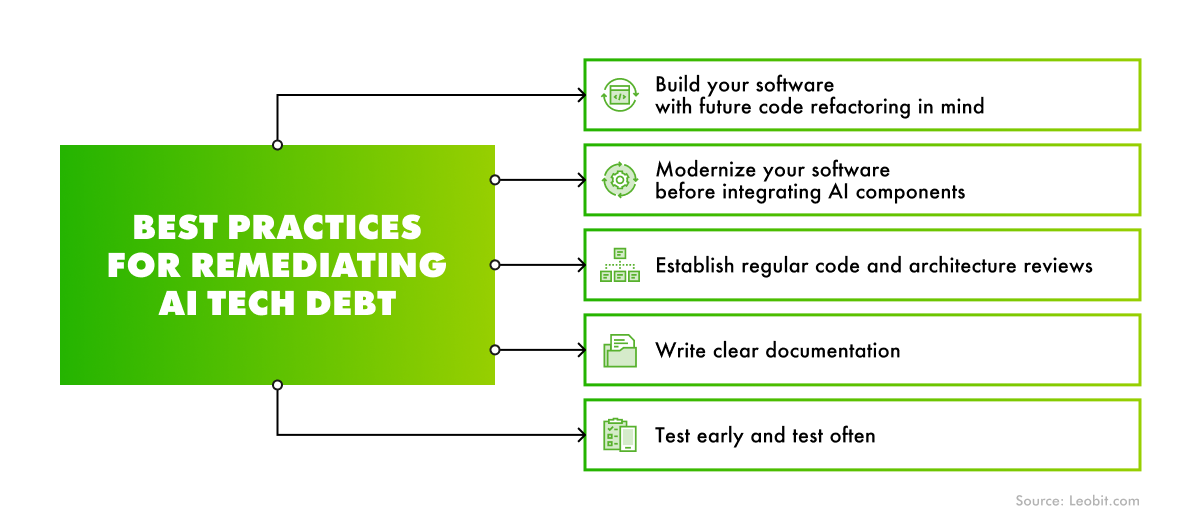
And if you want AI to accelerate your product rather than destabilize it, technical debt remediation is crucial. Here are five crucial practices that we at Leobit suggest you follow while developing your AI solution in order to minimize the tech debt.
Essential tech debt remediation practices
Let’s explore these approaches and workflows in more detail.
1. Build your software with future code refactoring in mind
Assume refactoring is inevitable right when you are building a solution. Today’s “working” can become tomorrow’s opaque dependency chain. Design modules so they can be updated or replaced without ruining your entire operations. The most efficient approaches include:
Defining clear boundaries between business logic and AI components
Featuring toggles for experimental AI features
Using customizable APIs to keep all infrastructure components working together properly
Remember that AI models change and APIs evolve, which means that you should build your solution with replacements in mind.
2. Modernize your software before integrating AI components
Legacy systems and AI integrations do not mix well. If your core platform depends on an obsolete architectural approach, outdated frameworks, or fragile data pipelines, AI integration may be inefficient. You can try to fix the problem by modernizing AI touchpoints — for example, by customizing the APIs. However, without full-fledged system modernization, such practices can work as mere shortcuts that escalate your technical debt.
Therefore, focus on modernizing your architecture before integrating artificial intelligence into your solution. Move towards a more flexible architecture, such as a modular monolith or microservices. Clean up data models, eliminate redundant integrations, and ensure continuous monitoring of your infrastructure’s performance.
AI relies heavily on your system’s elasticity. Without it, artificial intelligence can quickly add to your technical debt and ultimately undermine your profitability.
3. Write clear documentation
While developing an AI-powered solution or integrating AI into the existing app, make sure to document each step. Well-organized documentation adds clarity and simplifies further enhancement, optimization, and other workflows that are vital for tech debt reduction.
For instance, document the following:
Reasons a particular model or integration technique was chosen
All data flows feed the model
Data tuning techniques applied and the logic behind them
Output validation techniques
Model limitations and bias risks
Cost implications per request
Without documentation, your AI features become “black boxes” that are hard to refactor and secure. Write documentation with future major upgrades, architectural shifts, and model changes in mind.
Artificial intelligence can be very helpful while writing and managing documentation. In particular, it automates text summarization, document formatting, and generation workflows. As a result, AI is capable of reducing the time workers spend on documentation tasks by 40% across industries.
4. Test early and test often
AI introduces probabilistic behavior into deterministic systems. That’s why traditional system and code quality assurance practices may not work. In addition to traditional unit and integration tests, consider:
Prompt regression testing
Output consistency thresholds
Bias and fairness evaluation
Performance and latency stress testing
Cost monitoring under scale
This will help you validate both the efficiency of your AI models and the performance of your infrastructure. Regular testing also allows you to identify system weaknesses that may accumulate over time and increase technical debt.
5. Establish regular code and architecture reviews
This practice applies to the cases when you have already developed a software solution and have a (possibly growing) technical debt.
Whether your software includes AI-generated code or short-term architectural decisions and AI touchpoints built with shortcuts, code and architecture reviews are essential. Focus on the following issues that are really common:
Security vulnerabilities
Redundant abstractions
Inefficient queries
Hallucinated methods or dependencies
AI component isolation
Model versioning strategy
Fallback logic when AI services fail
Vendor lock-in risks
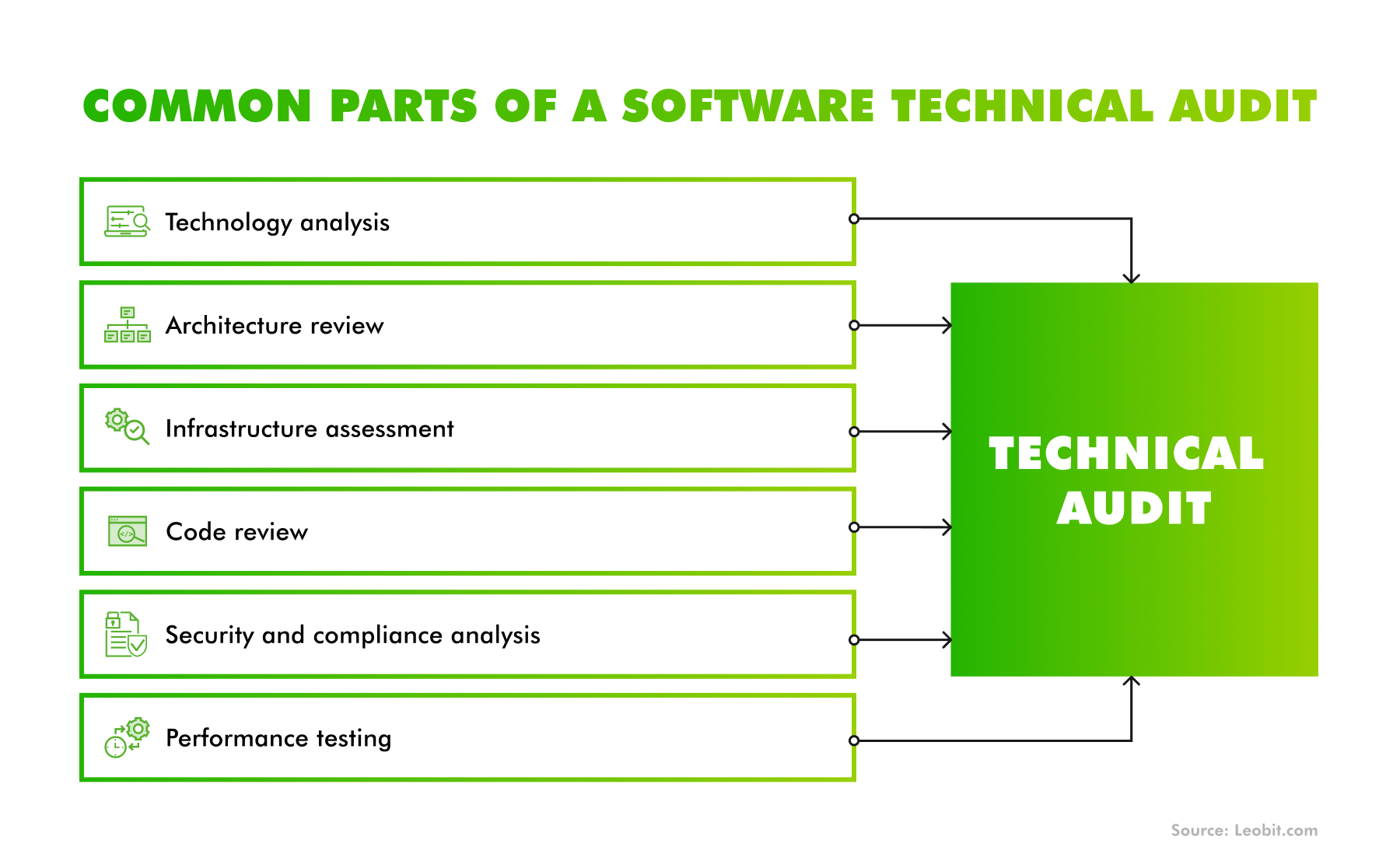
In addition to regular code and software architecture reviews, run a comprehensive technical audit from time to time. It helps you identify the key vulnerabilities of the existing codebase or architecture.
Key aspects of a technical audit
As a result, you will understand the main causes of the problem and come up with efficient approaches to technical debt management.
How Leobit Can Help You Manage Technical Debt
Remediating an AI technical debt without the necessary expertise and hands-on understanding of common causes might be a very challenging task. Most of the practices aimed at remediating the technical debt that we have mentioned above should be applied throughout the software development or AI integration lifecycle. We at Leobit have significant experience in building AI-powered solutions for different industries, which has granted us the status of Microsoft Solutions Partner for Data & AI. While building AI-powered software, we apply best practices to make sure that you won’t be struggling with a growing technical debt after the release.
Our skilled specialists can also help you deal with the existing technical debt by running a technical audit and helping you identify the problems with AI integrations that keep your technical debt growing.
We can also help you modernize your software to prepare it for AI integrations and eliminate obsolete, resource-consuming parts of the infrastructure.
So, whether you want to build a custom AI software from scratch, integrate artificial intelligence into your existing solution, or deal with a technical debt in an existing AI-powered system that is already running, we are ready to help.
Final Thoughts
Technical debt is a problem that causes businesses many issues when it comes to software maintenance costs, technology adoption, or operational overhead. As more and more companies accelerate development cycles, run fast and complex integrations, and build excessively complex data infrastructures in pursuit of AI adoption, this issue becomes even more relevant.
Some of the best ways for remediating technical debt in the AI age include:
Building AI software with future refactoring in mind
Modernizing systems before AI integration
Writing clear documentation
Applying regular testing practices
Reviewing the system on a regular basis and running comprehensive technical audits from time to time
Leobit is ready to help you follow these practices and build AI-powered software that won’t become your long-term burden. We can also help you modernize an existing solution to remediate an AI technical debt that already exists. Contact us to find out how we can help you maximize your AI adoption value without hidden challenges.
FAQ
In simple terms, technical debt is the cost of choosing a quick and easy solution in software development. Over time, you will need to invest cost and effort into fixing, refactoring, or maintaining this shortcut.
The problem of technical debt often becomes even more significant with growing AI adoption. Many companies accelerate development lifecycles with AI tools or take shortcuts to deliver their AI-powered solutions to the market as quickly as possible. The AI race also makes some organizations implement complex and unreliable AI integrations or build excessively complex and disorganized data architectures that contribute to the growing tech debt.
While working on AI-powered software, you must:
Develop software with possible refactoring in the future
Modernize your software before integrating AI components
Write clear documentation
Run regular tests
Establish regular code and architecture reviews
We can leverage our significant AI development expertise to build efficient software solutions from the start. Our legacy system modernization specialists will also help you modernize your system to avoid AI integration challenges. Finally, if you are already running AI-powered software with growing technical debt, we can handle a comprehensive technical audit to help you identify its precise causes and find ways to fix these issues.
Roman has a deep passion for a wide array of subjects, spanning from market insights to in-depth technical examinations of complex projects. He dives deep into technical aspects of various solutions to extract valuable insights for business purposes, and he enjoys sharing tips and tricks with business owners to help them leverage advanced technologies effectively.
Choosing the right front-end framework is no longer just a technical decision. It directly affects development speed, hiring, scalability, and long-term costs. ...
Microsoft Azure stands at the forefront of the growing AI adoption and analytics market. In particular, nearly 60% of CIOs across industries plan to increase ...
In the race to innovate and deliver software faster, quality is often pushed to the back burner. But this strategy carries real financial consequences. ...
The insurance industry could unlock $50 billion to $70 billion in revenue through AI, according to McKinsey.
However, not every insurtech business that adopts ...
Research from Bain & Company shows that 44.9% of executives see a clear correlation between flexible, modular architecture and improved productivity. ...
Lviv, Ukraine, February 2026 — Leobit, a full-cycle .NET, AI, and web application development provider, is excited to announce its upcoming webinar ...
Leobit, a .NET, AI, and web application development company, is excited to announce the expansion of its partnership with Microsoft by earning the Microsoft ...
The global cross-platform application development market is expected to reach $546.7 billion by the end of 2033, thriving at around 16.7% CAGR. With its mature ...
52.1% of developers admire React, while 51.9% say the same about Blazor. That near-parity is telling that both React and Blazor are now highly regarded by the ...
21 mins read
We use cookies to enhance your browsing experience. By agreeing, you accept our Privacy and Cookies Policy.
By ignoring or closing this banner, we will only collect essential cookies necessary for the website to function properly.
 Leobit