Despite this, many companies still treat software architecture as a purely technical concern and delegate it to engineering teams. When tech specialists lack an understanding of domain logic and business specifics, they may choose an architectural approach that technically “works” but limits the business’s ability to adapt.
In this article, we break down three of the most common architectural approaches, monoliths, modular monoliths, and microservices, and examine their trade-offs from a business perspective. The goal is not to declare a universal winner, but to help you understand which approach makes sense, when, and why.
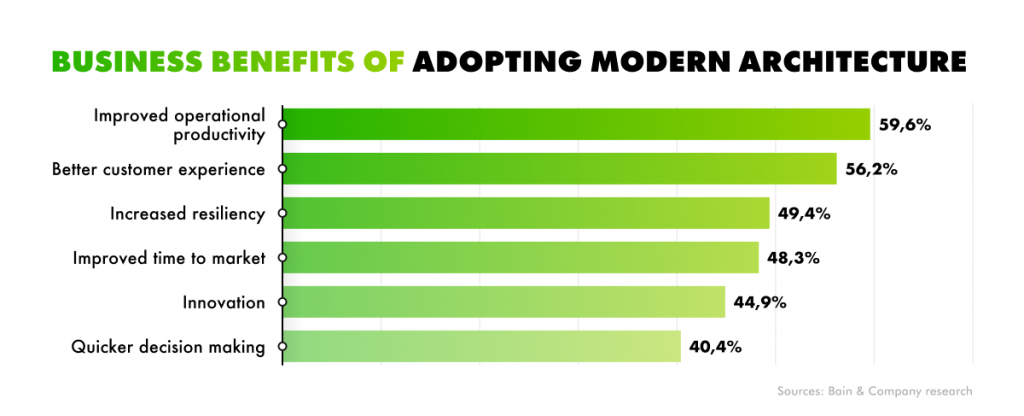
Business benefits of adopting modern architecture, survey by Bain & Company
But what exactly is a modern software architecture? In practice, it is not a specific technology or pattern, but an approach to system design that prioritizes clear boundaries, modularity, and the ability to change without excessive risk. Modern architecture enables teams to deliver features independently, scale as needed, and evolve the system as business priorities shift.
At the same time, there is a clear gap between expectations and reality. Many companies have invested heavily in cloud platforms, agile practices, and DevOps tooling, yet still struggle to deliver faster or scale efficiently. In fact, only 10% of companies are satisfied with their enterprise architecture capabilities.
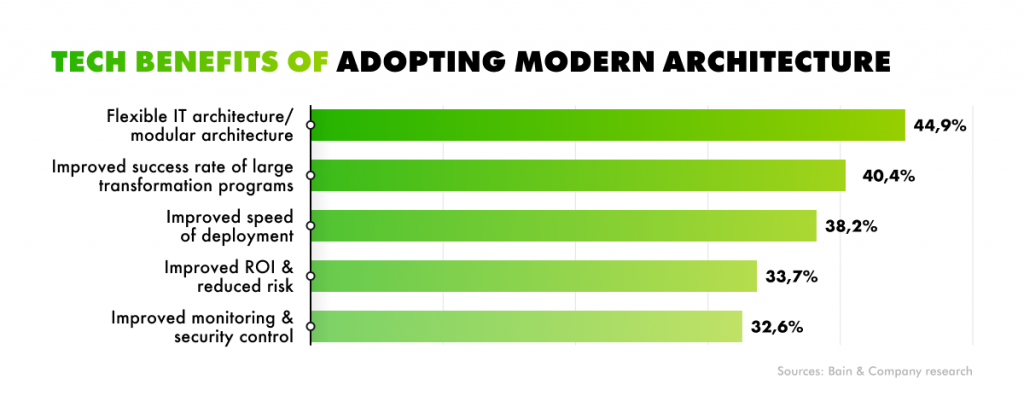
Tech benefits of adopting modern architecture, survey from Bain & Company
To understand where things often go wrong, let’s look closely at the most common architectural choices teams make today: monoliths, modular monoliths, and microservices.
What is Monolithic Architecture?
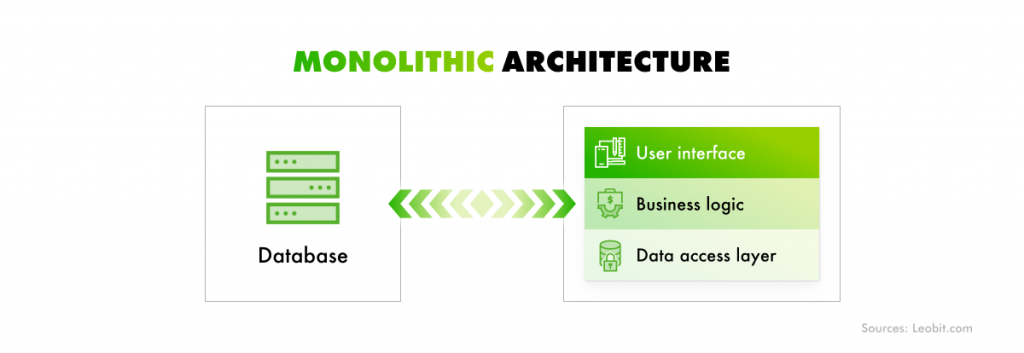
A monolithic architecture is the traditional way most software has been built for decades. In a monolith, the entire application lives in a single codebase and is deployed as one unit. Most monoliths follow a familiar three-layer structure:
User interface layer
Central business layer
Data access layer
While this structure looks clean on paper, it often means that all features share the same business logic layer. Over time, features become aware of each other’s internal rules and assumptions. This creates tight coupling that is hard to untangle later. If you want to change one part, you must rebuild and redeploy the whole application.
Monolithic architecture scheme
From a business perspective, this approach is popular because monoliths are easy to reason about. There is one system, one deployment pipeline, and usually one database. Teams do not have to manage service discovery, network calls between components, or complex infrastructure just to deliver value to customers. This is why many companies start with a monolith. Early on, speed matters more than architectural purity.
Over time, however, growth changes the equation. As the codebase expands, even small changes can require full redeployments. Scaling becomes complicated and expensive because the entire application must grow, even if only one part is under pressure. That said, monolithic architecture is not inherently bad. In many cases, it may be the right choice. The challenge, however, is to determine when it still serves the business and when it starts to hold it back.
Microservices Architecture: Why Companies are Attracted to It?
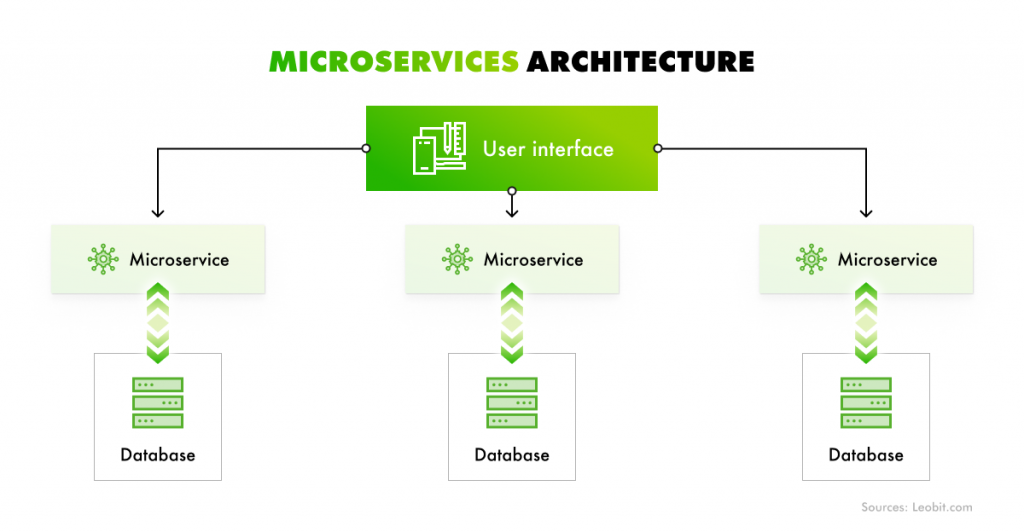
Microservices architecture represents a more radical break from the traditional monolith. Instead of one application, the system is composed of many small, independent services. Each service is responsible for a specific business capability, runs in its own process, and communicates with others over the network, typically through APIs.
Microservices architecture scheme
For many companies, as products grow and user demand becomes unpredictable, the idea of scaling only what is needed is compelling. If one part of the system experiences heavy load, it can be scaled independently without touching the rest. This aligns well with cloud platforms, where infrastructure can scale up or down on demand.
Market data reflects this growing interest. The microservices architecture market has expanded rapidly in recent years, reaching an estimated $7.4 billion in 2025 and expected to grow to $8.94 billion in 2026, with a compound annual growth rate of nearly 21%. This growth has been driven by:
Pain points in large monolithic systems
Widespread adoption of cloud computing
Increasing demand for highly scalable applications
Pressure on engineering teams to deliver faster while using agile development practices
Despite the growing popularity of modular monoliths, the microservices adoption shows no signs of slowing. The market is projected to reach $18.72 billion by 2030, continuing to grow at 20% annually. Much of this growth is fueled by trends such as container-based deployments, API-first design, DevOps-driven development models, adoption of service meshes, and broader cloud-native modernization efforts.
However, what attracts companies to microservices is also what makes them challenging. The number of services in a system grows with the size and complexity of the product and can range from just a few to hundreds. As that number increases, inter-service communication becomes more difficult, especially when implementing complex business workflows that span multiple services. To build an optimal architecture, you should have an experienced development team that can strike a balance between the size and quantity of services.
What Is a Modular Monolith, and Why Is It Gaining Popularity?
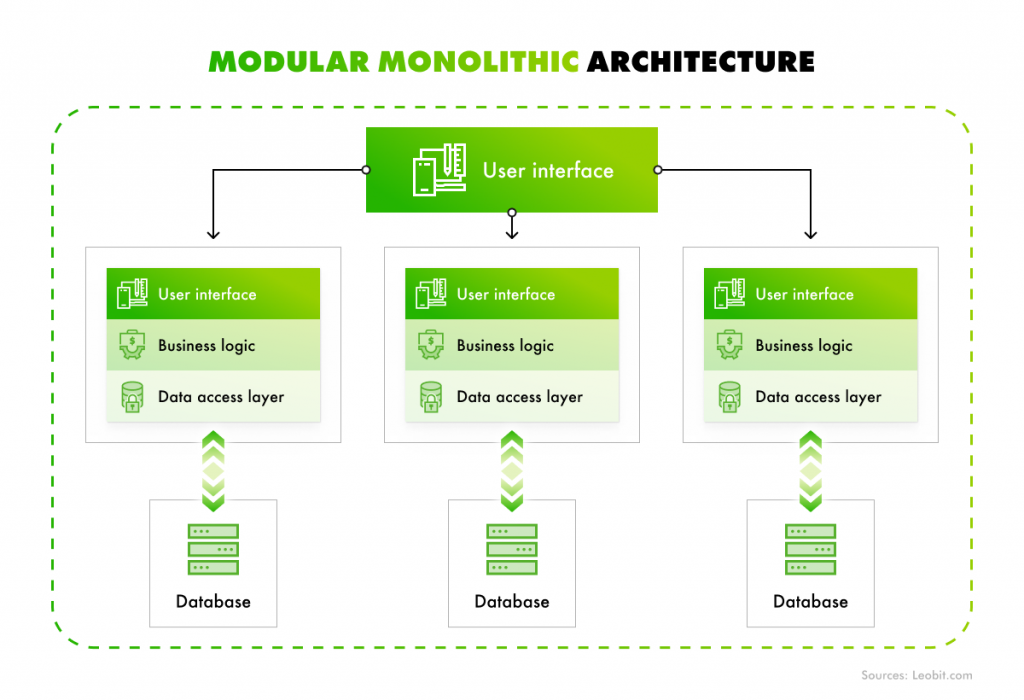
A modular monolith is an attempt to fix the biggest weaknesses of a traditional monolith without jumping straight into microservices. At a high level, it is still one application, but internally it is broken into clearly defined, well-isolated modules that behave more like independent systems.
Unlike a classic monolith, each module in a modular monolith owns its own domain logic and internal structure. It typically has its own domain layer, infrastructure layer, and API. Teams can work on modules independently, test them in isolation, and evolve them without constantly touching unrelated parts of the system. From a leadership standpoint, this results in fewer coordination costs and less risk during change.
What makes a modular monolith different from microservices is how it runs. Despite the internal separation, the application still executes as a single process or within a tightly controlled runtime environment. In many cases, it uses a single database, but structured with separate schemas per module. This approach creates logical data boundaries while keeping operational simplicity.
At the same time, it leaves the door open for future evolution. If the system grows and scaling or organizational needs demand it, those schemas can later be separated into independent databases.
This is precisely why modular monoliths are often considered the best starting point for new products. They provide clear domain boundaries from day one, without introducing distributed system complexity too early. As the system grows, it can gradually evolve toward a more distributed model if required.
Modular monolithic architecture scheme
Still, modular monoliths borrow important ideas from microservices. Modules are loosely coupled and highly cohesive. While the system usually shares a unified database schema, the modular structure enforces discipline around how data is accessed and modified, even without strict ownership boundaries.
Interest in this approach has grown rapidly in recent years. One notable signal came from Google, which introduced the Service Weaver framework in 2023 to encourage developers to build applications as modular monoliths and later to deploy them as microservices (when it makes sense).
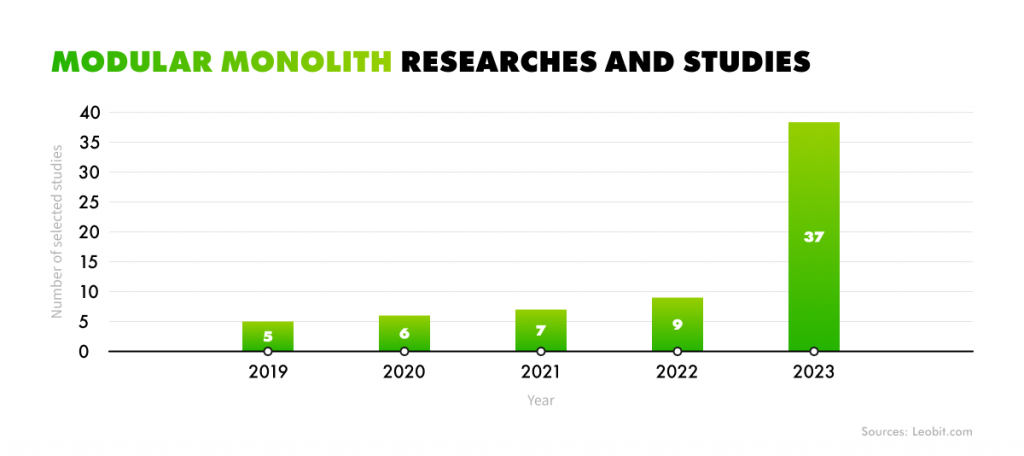
This shift is also visible in industry discussions and research. Conversations around modular monoliths began gaining traction around 2019 and remained steady for several years. In 2023, interest spiked sharply, suggesting that practitioners are actively looking for alternatives to both large, tangled monoliths and overly complex microservice ecosystems.
Number of researches and studies on modular monolith
In short, the modular monolith is gaining popularity because it reflects how many companies actually grow: fast at first, carefully later, and always under pressure to balance speed, cost, and long-term sustainability.
Side-by-Side Comparison of Microservices vs. Monolith vs. Modular Monolith from a Business Perspective
Each architectural approach comes with distinct trade-offs that affect development speed, cost, risk, scalability, and team structure. To make these differences easier to evaluate, in the next chapters, we’ll compare each type of architecture from a business perspective.
Development speed
From a development speed perspective, monoliths, modular monoliths, and microservices behave very differently over time. A traditional monolith is usually the fastest option at the beginning. Everything lives in one codebase, so developers can build, test, and deploy features quickly without coordinating across teams or services.
This makes monoliths especially attractive for startups and early-stage products. However, as the system grows, the shared business logic becomes crowded, dependencies increase, and even small changes can take much time due to full redeployments.
Modular monoliths try to smooth this curve. They allow the team to move quickly within a module without constantly worrying about side effects elsewhere. Thanks to it, your tech team can maintain development speed as the codebase grows.
Microservices take the opposite trade-off. They tend to slow teams down early because of the overhead of distributed systems, API contracts, and deployment pipelines. At scale, however, they can enable faster overall delivery by allowing many teams to work and release in parallel.
From a business perspective, the choice is less about which architecture is “fastest” and more about when that speed is needed and what level of complexity the organization is ready to manage.
Performance
From a performance standpoint, the differences between monoliths and microservices become most visible under heavy load. Experimental studies comparing monolithic architecture vs. microservices architecture show that, in high-load scenarios, microservices can outperform monolithic systems quite clearly. Microservices demonstrated 36% faster response times and 71% fewer errors. This advantage largely comes from their ability to scale specific services independently, allowing resources to be focused where demand is highest.
That advantage, however, is not unconditional. The same experiments show that when systems are pushed into overload, particularly when CPU utilization exceeds 90%, microservices can experience sharp performance degradation. This does not mean microservices are unsuitable for large user volumes. Rather, it highlights that microservices demand more sophisticated resource management, monitoring, and capacity planning.
Without proper controls, the overhead of inter-service communication and orchestration can become a bottleneck. Monoliths, while less flexible at scale, often behave more predictably under extreme resource pressure. In real-life projects, performance will largely depend on whether your company has the operational maturity to manage performance effectively at scale.
Cost of ownership
Monoliths usually have a lower upfront cost when starting from scratch with a small team and simple initial requirements. Modular monoliths remain close to this cost profile. While they require greater discipline in design and boundary enforcement, they still benefit from shared infrastructure, a single runtime, and lower operational overhead than distributed systems.
Microservices shift the cost curve upward, especially early on. Independent services require separate deployments, monitoring, logging, networking, and often container orchestration platforms. Tooling, cloud resources, and DevOps staffing costs increase quickly.
However, over time, microservices can become cost-effective for medium and large companies by enabling precise scaling and reducing inefficiencies caused by scaling entire systems. However, this benefit only materializes at a sufficient scale. From a business perspective, microservices are not a cost-saving strategy by default. They are an investment in flexibility and long-term scalability that makes financial sense only when you have cloud cost management in place and are applying cost-optimization strategies.
Scalability
Scalability is often the main reason companies consider moving away from a traditional monolith. In a monolithic system, if even one feature is under heavy load, the entire application must be replicated or allocated more resources. This approach works well up to a point, but it can become inefficient and expensive as usage grows unevenly across the product.
Modular monoliths improve this situation slightly by making internal boundaries clearer, which helps teams understand where bottlenecks originate. However, from a runtime perspective, they are still usually scaled as a single unit.
The real change comes with microservices. Each service can be scaled independently based on actual demand, allowing resources to be allocated more precisely. This makes microservices highly attractive if you are operating at a large scale or experiencing unpredictable traffic patterns. Still, these scalability gains only pay off when you’re ready to manage them effectively.
Team size and skills required
Monolithic systems work well for small, generalist teams when the domain is not inherently distributed and the expected growth is manageable. Modular monoliths raise the bar slightly. Teams need stronger design discipline and a shared understanding of boundaries, but they can still effectively operate with relatively small groups and a modest DevOps footprint.
Microservices demand a different organizational profile. In addition to strong application development skills, teams need experience in cloud platforms, distributed systems, observability, automation, and incident response. DevOps is no longer optional but a core capability. That said, without hiring experienced developers and architects, the architecture can overwhelm teams and slow delivery rather than accelerate it.
With regard to monoliths, a small change can have unexpected side effects, and every release becomes a high-stakes event because everything is tightly connected. Outages can also be broad because the failure of one part can impact the whole application.
Modular monoliths reduce this risk by enforcing clearer boundaries inside the same application. The system still benefits from simpler operations than microservices, while the modular structure limits how far changes can ripple.
Microservices, on the other hand, lower the risk of large, all-or-nothing releases by allowing services to be deployed independently. In such architecture, failures can sometimes be isolated to a single capability. The trade-off is a different kind of risk: distributed systems introduce more failure modes, more infrastructure dependencies, and a higher chance of partial outages that are harder to detect and diagnose.
From a business perspective, microservices can reduce “big bang” release risk, but they increase operational and coordination risk unless your company has strong engineering maturity, observability, and incident processes.
Monolith
Modular monolith
Microservices
Development speed
Very fast early, slows as complexity grows
Fast and more stable over time
Slower initially, faster at scale
Performance
Efficient and predictable at moderate load
Similar runtime performance to monolith
Strong under high load with proper scaling
Cost of ownership
Lowest upfront and operational cost, but can become high over time
Low to moderate cost
Infrastructure costs vary depending on the project complexity
Scalability
Coarse-grained, entire system scales
Mostly whole-system scaling
Fine-grained, service-level scaling
Team size and skills
Small, generalist teams
Small to mid-sized teams with discipline
Teams with DevOps and cloud expertise
Risk level
Low early risk, high release risk later
Reduced change risk, simple operations
Lower release risk, higher operational risk
Time to market
Excellent for early-stage products
Strong and consistent over time
Slower early, faster deployments for large projects
Common Mistakes Business Leaders Make When Choosing Architecture
Choosing a software architecture is a business decision with long-term consequences. The wrong choice can slow delivery and consume a large portion of your budget, even if the technology itself is good. Many of the most painful architecture failures do not come from poor engineering, but from well-intentioned decisions made without a clear understanding of trade-offs.
What makes this especially challenging for business leaders is that architectural mistakes rarely show immediate symptoms. Systems may appear to work fine at first, only to become expensive, fragile, or slow to change as the company grows.
Based on Leobit’s experience in custom software development and architectural design, the following mistakes recur across companies of different sizes and industries and are often the real reason architecture becomes a bottleneck.
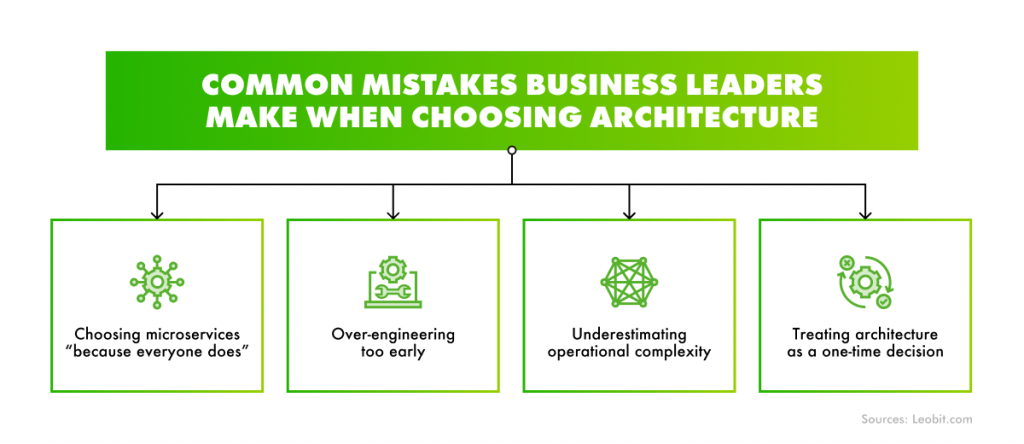
Common mistakes when choosing software architecture
Choosing microservices because they appear to be the industry standard. Many leaders see well-known tech companies using microservices and assume that adopting the same architecture is a sign of maturity. In reality, those companies usually arrived at microservices after years of growth, not at the beginning. Copying the end state without understanding the journey can, conversely, lead to slower delivery and higher costs.
Over-engineering too early. In the early stages of a product, the biggest risks are market fit and speed, not scale. Designing for millions of users before you even have hundreds adds complexity without any real business benefit. What often gets overlooked is how this complexity affects day-to-day execution. In distributed systems, even minor changes can take significantly longer. Updating service contracts, coordinating changes across bounded contexts, or modifying APIs requires alignment between teams and careful rollout planning. So, instead of accelerating growth, premature architectural complexity can slow it down.
Underestimating operational complexity. Microservices require strong capabilities in monitoring, logging, incident response, security, and automation. Without these, small failures can cascade into hard-to-diagnose outages. Leaders often focus on the theoretical benefits of scalability and service independence while overlooking the real cost of running a distributed system day after day.
Treating architecture as a one-time decision. Business needs change, teams grow, and products mature. An architecture that is right today may be wrong in two years. The most successful companies treat architecture as something that adapts over time, starting simple and adding complexity only when the business clearly demands it.
Architecture choices are not about trends or ideology. They are about alignment with current scale, team maturity, and business priorities. The move back toward modular monoliths in 2026 is not a step backward. It is a sign that the industry is becoming more pragmatic, favoring architectures that optimize for cost efficiency and clarity rather than theoretical maximum scalability.
Why Teams Are Moving Back From Microservices to Modular Monoliths in 2026
Over the past few years, a noticeable shift has emerged in how experienced teams think about microservices. While microservices remain a powerful model at a very large scale, many organizations are reassessing whether the operational costs are worth it for their business needs. In 2026, this reassessment is no longer theoretical. Teams are actively consolidating systems and moving back toward modular monoliths.
One of the most cited examples comes from Amazon Prime Video, which publicly shared that it reduced infrastructure costs by roughly 90% after rearchitecting parts of its platform away from a highly distributed microservices setup. The key takeaway was not that microservices “failed,” but that the operational overhead had grown far beyond what the workload justified.
This pattern appears consistently across industry reports and practitioner talks. As systems evolve, many microservice-based platforms accumulate hundreds of services, each with its own deployment, monitoring, scaling rules, and failure modes. Over time, development teams spend more effort managing the system than improving the product.
In contrast, modular monoliths offer a way to regain control without reverting to tightly coupled legacy systems. Modern modular monoliths emphasize strict module boundaries, clear APIs, and internal isolation, while preserving a simpler deployment and runtime model. Teams can still scale development by domain, but without paying the full price of a distributed system. For many companies, this approach delivers most of the benefits they originally sought from microservices while reducing operational complexity by a fraction.
Modernizing Legacy Software: Which Path Makes Sense?
Software modernization is a natural process that ideally should go hand in hand with project evolution and growth. In reality, however, the pressure to modernize often comes from real pain points. The smartest path is not to replace software (though in some cases it is required), but to reduce risk while steadily improving the system’s ability to support the business.
When it comes to a project’s architecture, modernization usually follows a small set of recurring paths. Each path reflects a different balance between risk, cost, and long-term flexibility.
Let’s take a look at the most common approaches your business can consider.
Keeping the monolith and improving it. If the system is stable, well understood, and meets current performance and scaling needs, incremental improvements may be sufficient to deliver significant value. Cleaning up dependencies, improving test coverage, and refactoring the most problematic areas can extend the life of a monolith for years. For many businesses, this approach delivers faster returns than a large architectural shift, especially when teams and processes are already optimized around the existing system.
Move towards modularization. When the monolith has become difficult to change but still contains valuable business logic, modularization is often the smartest first step. Introducing clear module boundaries, enforcing ownership, and isolating domains can significantly improve maintainability without changing the deployment model. This approach lowers risk, preserves institutional knowledge, and creates a foundation for future evolution. Yet, you should keep in mind that modularization alone is enough to restore development speed and reduce operational pain.
Adopt microservices. Microservices become justified when organizational structure demands them. This usually means uneven traffic patterns that require fine-grained scaling, or regulatory and reliability requirements that exceed what a single deployment can reasonably support. Even then, microservices work best when introduced selectively, starting with the areas that benefit most from independent scaling or deployment.
Across all of these paths, one principle consistently holds: gradual evolution usually beats full rewrites. Large, all-at-once rewrites are expensive, risky, and often fail to deliver on their promises. Incremental change allows teams to learn, course-correct, and deliver business value along the way.
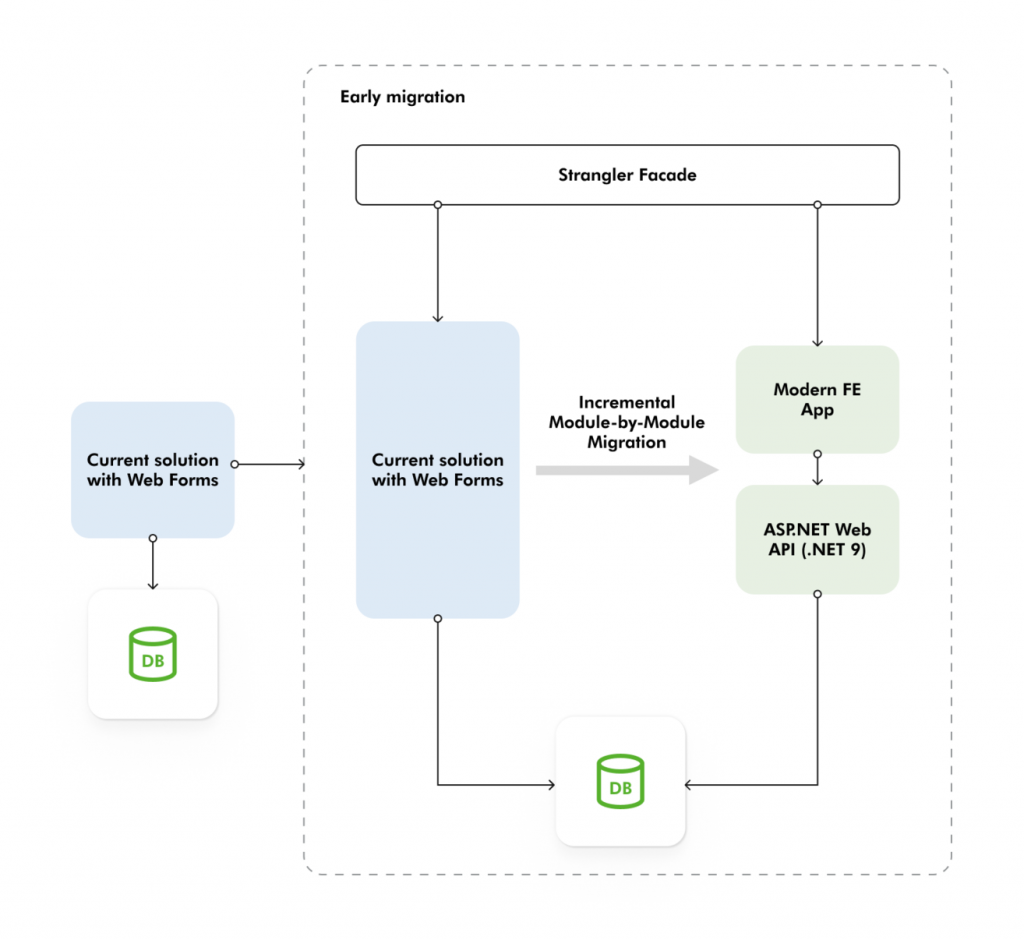
Based on Leobit’s experience, one of the proven ways to modernize a legacy system without disrupting the business is using a strangler facade approach. Instead of replacing the entire system at once, new functionality is built around the existing application and gradually takes over responsibilities piece by piece. The legacy system continues to run while its most problematic or high-change areas are incrementally replaced.
We applied a move to a modular monolith using vertical slices in a SaaS stakeholder management platform project, where the goal was to evolve the architecture without interrupting active users or core business workflows. By introducing a facade layer, the team was able to route new features and refactor components through a cleaner, more modular structure while keeping the legacy parts stable. This allowed modernization to happen in parallel with ongoing product development.
At Leobit, architecture decisions are treated as business decisions first and technical decisions second. The goal is not to apply fashionable architecture, but to choose an approach that fits your current scale and long-term business goals.
The process usually starts with understanding the problem. Before recommending any architecture, Leobit performs a detailed technical and architectural audit to understand:
How the product creates value
Where the current bottlenecks are
What is actually limiting growth
In many cases, the pain point is not the architecture itself, but unclear boundaries, weak processes, or a lack of operational discipline. Addressing those issues often delivers more value than a radical redesign.
When a project starts from scratch, the focus is on keeping the architecture intentionally simple. The goal is to create an architecture that supports rapid learning today while leaving room to scale tomorrow. Rather than pushing clients toward microservices by default, Leobit evaluates multiple architectural paths side by side.
For existing software, this includes improving a monolith (if the software is built that way) by introducing modular boundaries, or selectively adopting microservices where there is a clear business justification. Each option is assessed based on development speed, operational complexity, cost of ownership, scalability needs, and organizational readiness.
A key principle in Leobit’s approach is incremental evolution. In the case of legacy software modernization, large rewrites are treated as a last resort. Instead, the team favors gradual modernization strategies that reduce risk and allow the business to continue delivering value. Techniques such as modularization, facade layers, and phased component extraction are used to ensure that the architecture evolves alongside the product, not ahead of it.
No universally “best” software architecture exists. Monoliths, modular monoliths, and microservices each solve different problems and fail in different ways. The real mistake is not choosing the wrong architecture, but choosing one without understanding the trade-offs it brings to development speed, cost, risk, and long-term flexibility.
For most businesses, success comes from starting simpler than instinct suggests. Monoliths and modular monoliths often deliver the fastest time-to-market and the lowest risk early on. As products grow and organizations mature, architecture can evolve to address real constraints. Microservices make sense when scale, team structure, and operational maturity clearly demand them, not because they are popular or widely adopted.
If you’re evaluating an architectural decision or planning to modernize an existing system, Leobit can help. Our team works with SMBs and enterprises to help them assess options, reduce risk, and design architectures that align with real business goals. Contact us to discuss your product, challenges, and we will help you choose the path that makes the most sense for your organization.
FAQ
The main difference lies in how the system is structured and scaled. A monolith is a single, tightly integrated application. A modular monolith is still one application, but internally split into well-defined, independent modules. Microservices consist of many small, independently deployed services that communicate over a network.
No, it’s not. Microservices offer fine-grained scalability, but they also introduce significant operational complexity. For many companies, especially small ones, a well-designed monolith or modular monolith can scale efficiently without the overhead of distributed systems. Microservices make the most sense when your software has uneven traffic.
Starting a project as a modular monolith makes sense when you want speed today and flexibility tomorrow. For most new products, jumping directly into microservices adds unnecessary operational complexity. A modular monolith allows you to move fast while still enforcing clear domain boundaries from day one.
Leobit approaches architecture decisions as business decisions, not just technical ones. The team evaluates the company’s growth plans, scalability needs, and project peculiarities before recommending an approach.
Yes, we can. Leobit specializes in gradual modernization strategies that minimize risk and disruption. This includes techniques such as modularization, the strangler facade pattern, and phased component extraction. The goal is to evolve the architecture while keeping the system stable, supporting active users, and allowing product development to continue in parallel.
Inna loves making complex tech feel simple. With a strong eye for innovation, she helps businesses turn complicated ideas and data into clear strategies they can actually use. Whether it’s new tools or big trends, she’s all about making technology work for people.
Microsoft Azure stands at the forefront of the growing AI adoption and analytics market. In particular, nearly 60% of CIOs across industries plan to increase ...
In the race to innovate and deliver software faster, quality is often pushed to the back burner. But this strategy carries real financial consequences. ...
The growing AI adoption helps businesses automate and enhance many workflows, but it also has a downside. By accelerating software development lifecycles, AI ...
The global cross-platform application development market is expected to reach $546.7 billion by the end of 2033, thriving at around 16.7% CAGR. With its mature ...
52.1% of developers admire React, while 51.9% say the same about Blazor. That near-parity is telling that both React and Blazor are now highly regarded by the ...
The choice between PHP and ASP.NET would seem to be relatively straightforward on the surface and complicated the moment you look at real data. PHP powers ...
The pace of change in software development has never been higher, and 2026 will raise the bar again. We are quickly approaching a world where AI feels as ...
During the past year, 63% of organizations accelerated their cloud migration efforts, up from 57% in 2023. At the same time, 70% now default to cloud-based ...
 Leobit