However, businesses are now moving beyond the capabilities of traditional generative AI. With its ability to reduce employee time and effort by 50%, agentic AI is rapidly establishing itself as a major trend that many organizations aim to embrace. It attracts companies across industries with its autonomy, task orchestration features, and independent and proactive decision-making.
In this article, we provide tips on finding the right business case for agentic AI to help you decide whether to adopt this technology, how to align it with your needs, and what value to expect from such an implementation.
What Is Agentic AI and How Does it Differ from Generative AI?
Agentic AI solutions are systems that can autonomously work toward achieving goals. They can be applied across a wide range of complex workflows, from market analysis to assistance at different stages of the software development lifecycle. Notable examples of agentic AI solutions are AutoGPT and BabyAGI.
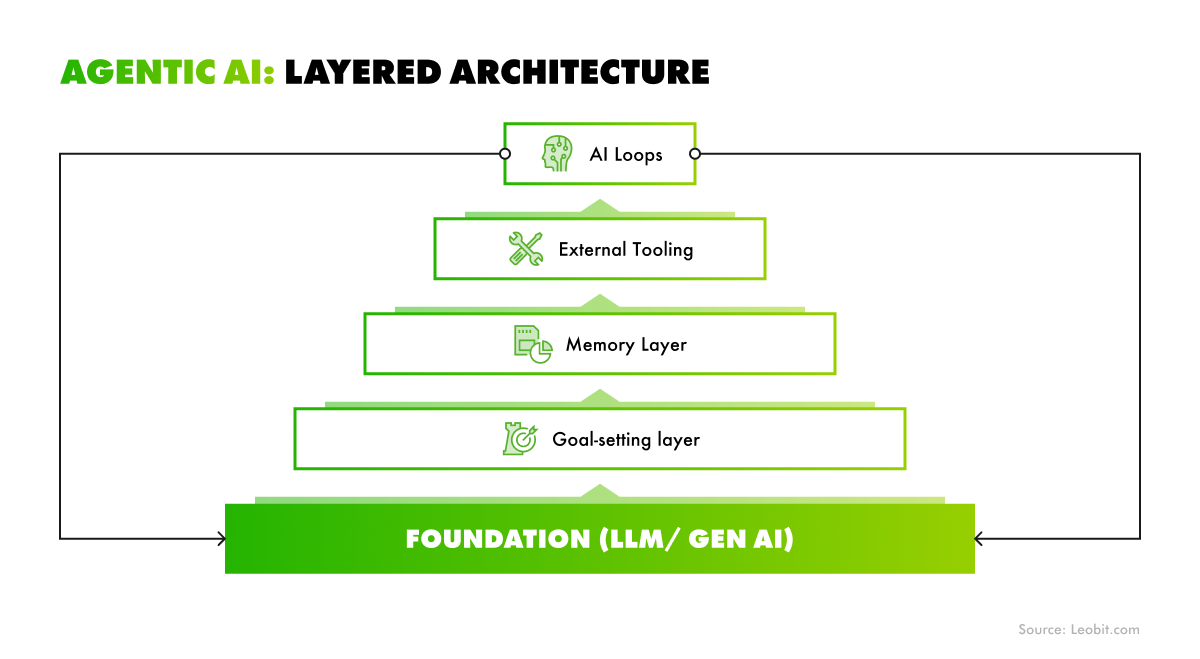
Such systems are typically composed of multiple specialized agents that collaborate, each with its own role. Typically, agentic AI solutions follow a layered architectural approach illustrated in the image below.
Agentic AI architecture
While specific properties of such systems may drastically differ, they share common characteristics:
Ability to perceive and interpret inputs or environmental context
Autonomous reasoning and decision-making (to a defined extent)
Goal-directed planning and execution across multiple steps
Adaptation to changing conditions during task execution
Ability to use external tools, APIs, and systems to achieve objectives
Maintenance of context or memory across interactions
Capability to evaluate outcomes and adjust behavior (feedback loop)
Agentic AI takes the capabilities of generative AI to the next level. The key differences between these two approaches to AI adoption are summarized in the table below.
Generative AI (LLMs, etc.)
Agentic AI
Core Function
Produces outputs (text, images, code) in response to prompts
Achieves goals by planning, acting, and iterating
Input/Output
One-shot: prompt → output
Continuous: goal/task → plan → actions → results
Autonomy
No autonomy, always reactive
Autonomous, can decide next steps without human prompts
Memory
Typically stateless (no persistent memory)
Has short-term and long-term memory for context and continuity
Can call APIs, search web, query databases, and control software
Feedback Loops
No self-correction (unless fine-tuned externally)
Self-reflects, retries, and improves through AI loops
Feedback Loops
No self-correction (unless fine-tuned externally)
Self-reflects, retries, and improves through AI loops
Workflow Role
Acts like a content generator
Acts like an autonomous digital employee
Examples
ChatGPT, DALL·E
AutoGPT, BabyAGI, Microsoft Copilot with agent mode, enterprise AI agents
Keep in mind that building an agentic AI solution is generally more complex and costly than developing a system based solely on generative AI. Not all software solutions need agentic AI integration.
Where Agentic AI Actually Creates Value
If you need to handle simple, straightforward workflows with clear rules, processes with low variability, and tasks that require minimal decision-making, there is no need to adopt agentic AI. Moreover, attempts to handle such workflows with agentic AI may be a waste of time, effort, and budget.
Agentic AI proves to be a relevant solution in more specific and complex business cases. Here are some of them.
Complex decision chains
If a workflow involves a sequence of interdependent choices, where each step reshapes the next, agentic AI is a relevant solution. Such systems can:
Break tasks into sub-goals
Reason across multiple steps
Revise decisions mid-process
For example, agentic AI is well-suited for multi-step customer support scenarios, where simple responses are insufficient, and businesses need a proactive system capable of driving issue resolution. Another example of a complex multi-step workflow that can require agentic AI is advanced investment research that combines data collection, analysis, and detection of promising investment possibilities.
In stable systems, you can optimize an AI model once and reuse it continuously. In dynamic environments, this approach fails quickly. The point is that conditions change constantly:
Use behavior shifts
Data updates in real time
External systems behave unpredictably
If your AI solution doesn’t support proactive reasoning and lacks a well-established feedback loop, it can fail to adapt to these conditions. That’s when the use of agentic AI capable of reacting to new inputs in real time and replanning based on changing context will become an optimal solution.
For instance, an agentic AI system may facilitate strategic planning in the dynamic retail industry. In particular, agentic AI used for analytics and operational planning can provide quick suggestions considering constant changes in supply chains, customer demand shifts, and emerging market trends. Instead of following a fixed approach, the system continuously re-evaluates what it should do to deliver maximum value.
Cross-system orchestration
Modern workflows rarely live in one system. They typically span multiple tools, APIs, databases, SaaS solutions, and internal platforms. Quite often, the responsibility for orchestrating and coordinating such tools is delegated to AI agents. In fact, enterprises that use multi-agent deployments report up to 40% productivity gains.
Agentic AI systems can act as a coordination layer, bringing together multiple agents that handle different workflows and tools, while additional agents manage planning, orchestration, and evaluation. Such a solution can:
Decide which system to call and when
Transform outputs between systems
Handle failures and retries intelligently
For instance, agentic AI can help a software engineering team support DevOps workflows. Such solutions can coordinate CI/CD pipelines, monitoring tools, and incident alerts to keep the operations running and reliable.
If you want to use AI to enhance simple, straightforward workflows with clear rules, a traditional generative AI solution may be enough. It also works well for processes with low variability and tasks that require minimal decision-making. There is no need to make things excessively complex by implementing agentic AI systems. Overengineering with agents often introduces unnecessary overhead without delivering additional value.
How to Identify a Strong Business Case
If you decide that an agentic AI solution is exactly what you need, you still should spend some time planning this implementation. Here we will describe essential steps you need to take before starting your agentic AI project.
Answer the most critical questions
When planning an agentic AI initiative, you need to consider how the system will perceive context, make decisions, and act autonomously. Define clear goals and plan for aligning your solution with your workflows.
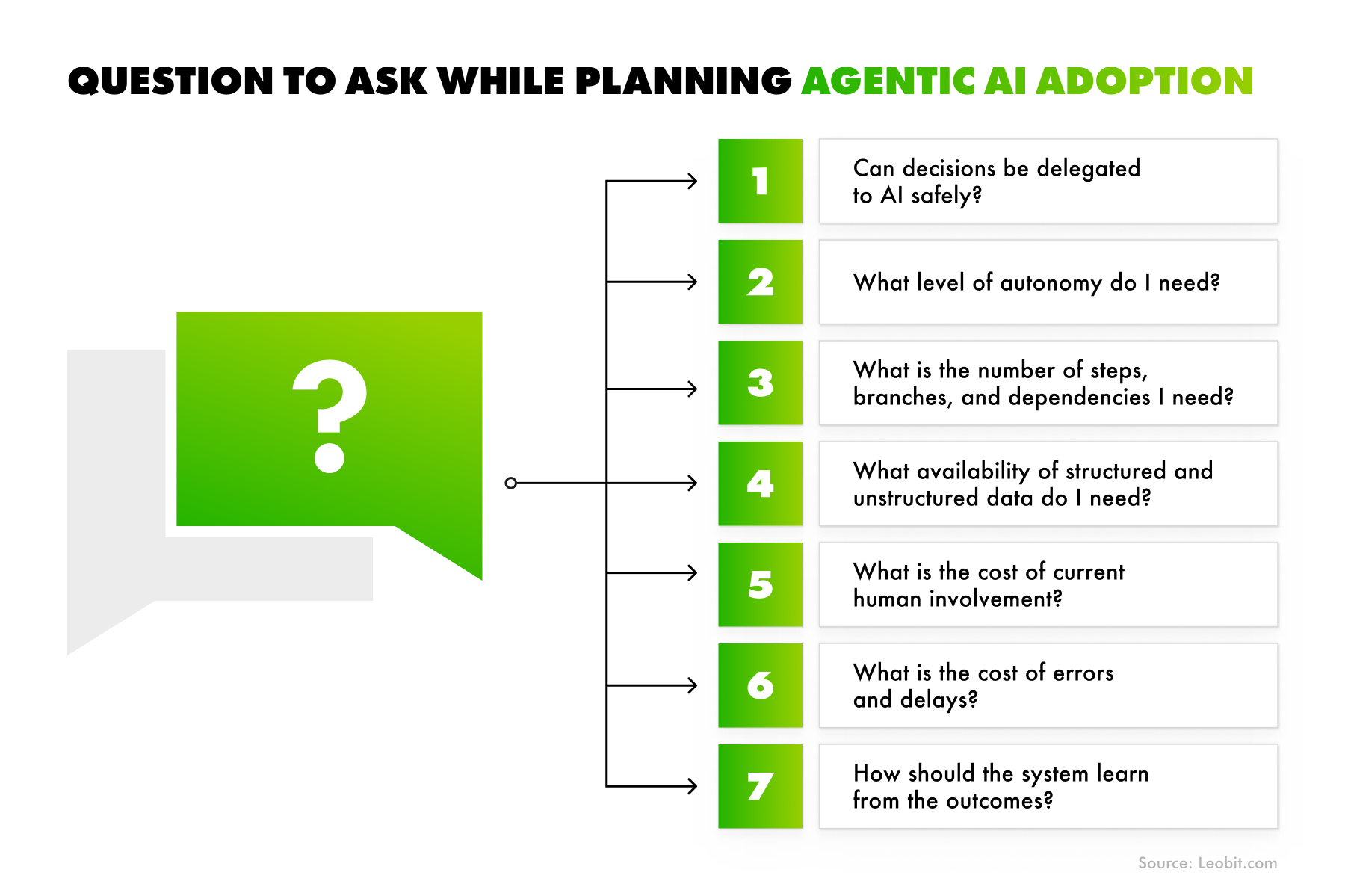
Planning an agentic AI strategy: Key questions
Let’s start with the list of questions you should be able to answer while planning an agentic AI adoption initiative. These questions will help you evaluate feasibility, anticipate risks, and define the business value of your agentic system.
1. Can decisions be delegated safely to AI?
Start by defining your risk boundary. If incorrect decisions made by your AI solution can lead to financial, legal, or reputational damage, you may reconsider its autonomy. At least, you will need to establish strict guardrails and human-in-the-loop control for greater safety.
2. What level of autonomy do I need?
Not every system needs to be fully autonomous. For example, systems that handle critical decisions with low tolerance for error require stricter autonomy limits. Meanwhile, less risky workflows supported by high-quality data are better suited for higher levels of autonomy.
These considerations help you choose between assistive AI, semi-autonomous agents, or fully independent systems. Such a choice directly impacts the complexity, cost, and governance of your agentic AI solution.
3. What is the number of steps, branches, and dependencies I need?
4. What availability of structured and unstructured data do I need?
AI agents’ performance depends heavily on data inputs. Analyze your data infrastructure and types in advance to decide whether you need integrations, preprocessing layers, or retrieval systems. Also, consider potential bottlenecks, such as siloed or outdated data, in advance and adjust your solution accordingly. Consider using advanced data platforms, such as Azure Databricks, to support your AI models.
5. What is the cost of current human involvement?
This question helps you establish a baseline for ROI. If human effort is expensive, slow, or difficult to scale, it creates a clear financial case for adopting agentic AI. You can then evaluate the initiative by comparing how the system performs against human specialists in terms of output quality, speed, and cost efficiency.
6. What is the cost of errors and delays?
Prioritize the reliability of your solution. Try to anticipate potential mistakes and their impact on your business operations. Reconsider your agentic AI adoption initiative if challenges with improving response time and reducing errors outweigh the automation gains. Plan risk management practices that will help you mitigate potential issues and minimize their impact on your business efficiency.
7. How should the system learn from the outcomes?
The long-term value of agentic AI solutions comes from continuous improvement. Thoroughly plan feedback loops and adjust them to your business workflows. For instance, if you intend to use agentic AI for customer support, ensure that, after resolving each query, the system evaluates customer feedback and uses this data to refine future decision paths. This will help you make the system more accurate and efficient over time, increasing ROI beyond the initial deployment.
Consider running a comprehensive discovery phase
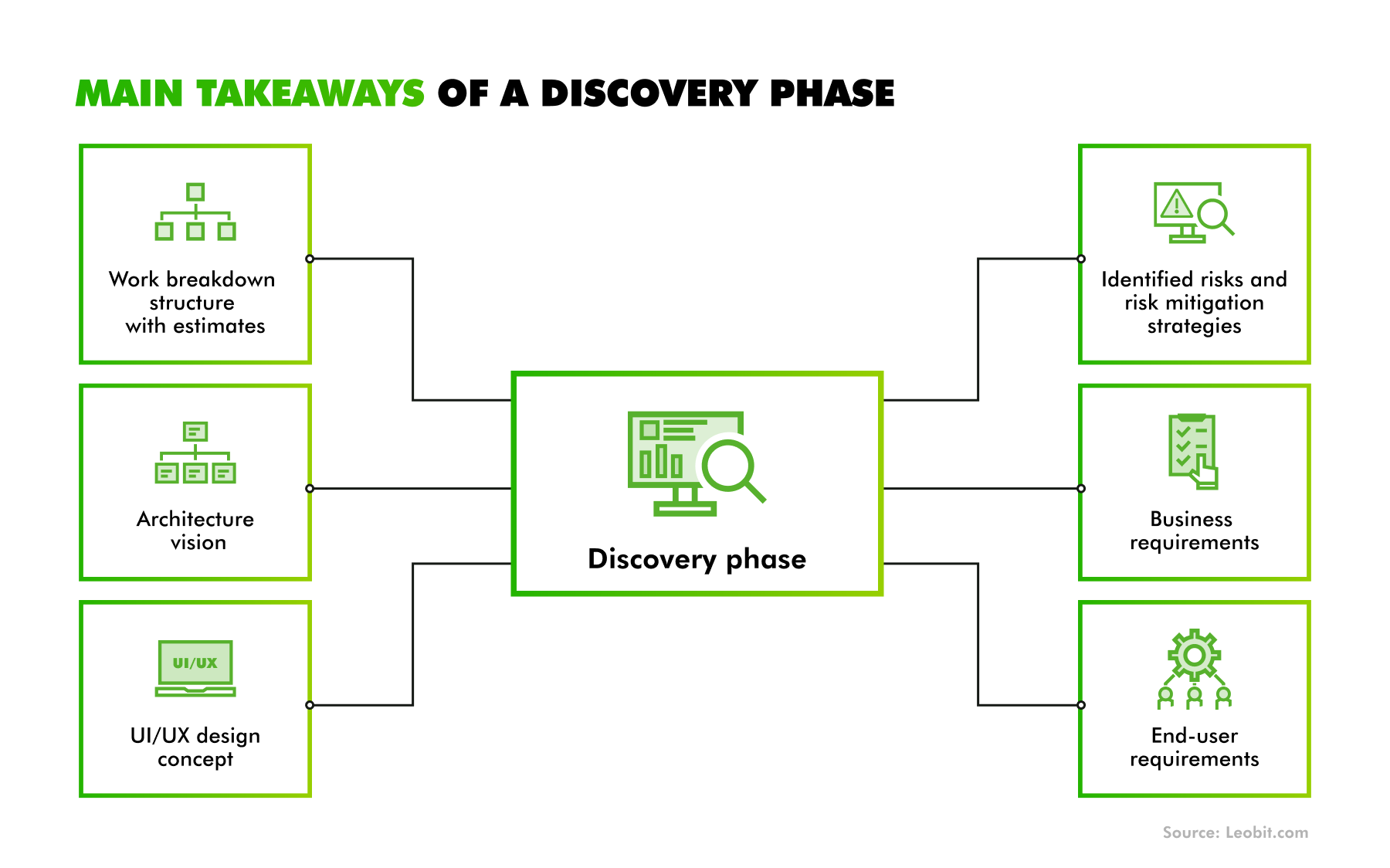
If you are confident about adopting agentic AI, the next step is to shape a clear and realistic business case. A discovery phase helps you validate assumptions before committing to development and define a tailored agentic AI strategy. The ultimate takeaways of a discovery phase are illustrated in the image below.
Project discovery phase: Key takeaways
At a high level, a project discovery phase provides answers to most of the questions mentioned in the previous subchapter. In particular, it helps you:
Map workflows and identify where agentic AI adds value
Define success metrics, such as cost reduction, speed, and accuracy
Assess data availability and quality
Identify risks and outline mitigation strategies
Estimate costs versus expected ROI
The key role here is a business analyst who can bridge business needs and technical implementation. They analyze end-user requirements, clarify expectations, and ensure the solution solves a real problem instead of introducing additional complexity.
After that, the discovery phase moves beyond mere business planning, helping you create critical project documentation, project roadmap, UI/UX design concept for the solution, architecture vision, etc. In some cases, it can even involve the development of a proof of concept (PoC) — a small and simple version of the solution designed primarily to validate the technical assumptions and their feasibility.
Common Pitfalls to Consider Before Adopting Agentic AI
From our experience at Leobit, there are certain pitfalls that are very common to agentic AI adoption initiatives. Here are some of them.
Overengineering in simple use cases
Even when an agentic AI approach is justified, teams often make the system more complex than necessary. Common problems include:
Using too many AI agents within your system
Applying overly granular task decomposition
Creating a sophisticated planning layer where a simpler orchestration would work just as well.
The more complex your system, the harder it is to coordinate. The execution of some tasks takes more time, and debugging becomes more challenging. Some companies also hurry to introduce advanced capabilities, such as dynamic tool selection or multi-step reasoning loops, before they are actually needed. These features may increase latency, cost, and unpredictability without delivering relevant value at early stages.
A more effective approach is to start with the minimal viable agent setup that includes a limited number of clearly defined agents, simple workflows, and constrained decision boundaries. We recommend adding layers for planning and evaluation gradually as your needs evolve over time.
Agentic systems depend on your setup, which may include multiple APIs, a database, and third-party tools. Sometimes, problems can emerge due to legacy system integration issues or just poorly planned and executed integration points. As a result, some agentic AI workflows may crash, data exchange will be inconsistent, and your overall operations will be less efficient.
A thorough preparation of your infrastructure matters a lot. You should ensure that your data architecture, APIs, and other AI integration points are ready for the adoption of an agentic solution. That’s where a comprehensive technical audit aimed at evaluating your system’s AI readiness will be relevant. If you need to update legacy parts of your infrastructure, consider a comprehensive software modernization.
Non-deterministic behavior is one of the critical benefits of agentic AI because it ensures that the system adapts to changing conditions. However, such a peculiarity also introduces additional issues. Sometimes, it may be really challenging to track what the system is doing and why. This lack of control can make you miss some critical problems, such as system inefficiencies, AI model biases, or poor resource allocation.
To deal with this challenge, you should establish proper practices for logging, monitoring, and control. This includes:
Tracking decision paths
Monitoring system performance and resource allocations
Implementing basic guardrails to limit unexpected behavior
As a result, you will detect issues early and keep your solution reliable as it evolves.
Expecting full autonomy too early
Some businesses aim for fully autonomous agents from the start. This can cause problems, as, despite the rapid evolution of AI models, bias and poor outputs are still relevant issues. For example, in HR management, 15% of AI systems do not meet fairness thresholds for all demographic groups. Errors and implicit model biases can compound quickly, making the system less reliable and increasingly costly to correct over time.
Most agentic AI systems need time to mature. We recommend increasing their autonomy gradually. Start with human-in-the-loop setups and controlled environments to reduce risks and improve system quality as it evolves.
How to Assess the Impact of your Agentic AI Initiative
At some point, the key question is whether it paid off. The most reliable way to answer it is your agentic AI ROI. In the context of agentic AI, this is not just about direct cost savings; other critical metrics include:
Elimination of repetitive decision-making
Faster iteration cycles
Measurable improvements in workflow quality and accuracy
System maintenance overhead (e.g., cost of monitoring, number of bugs and fixes required, etc.)
The ability to run operations continuously, without downtime
Additionally, understanding the indirect impact of agentic AI adoption initiatives helps set realistic expectations. While AI-supported workflows may show similar speed and accuracy metrics to non-AI processes, they often make work smoother for your team. This, in turn, boosts their satisfaction and motivation. People remain central to AI-powered workflows, so it is crucial to continuously gather their feedback on workplace improvements associated with agentic support.
Keep in mind that early implementations may not deliver instant results. Agentic systems often require continuous tuning, better data, and improved workflows before they reach full efficiency. Costs may be higher at the beginning due to setup and experimentation. That’s why we recommend focusing on trends over time rather than immediate returns. If metrics show the system growing faster, more consistently, and less dependent on manual effort, you are on the right track.
How Can Leobit Help You Find an Optimal Agentic AI Business Case and Implement It?
One of the key obstacles to the adoption of agentic AI systems is the lack of expertise. In fact, 55% of organizations reported the shortage of skilled professionals capable of developing and maintaining agentic AI solutions. To define an optimal business case for your agentic AI adoption initiative and build a solution in strict adherence to this business case, you need a team with a deep understanding of modern artificial intelligence trends and hands-on experience with agentic solutions.
Leobit is ready to provide you with an experienced AI development team. We can run a comprehensive agentic AI discovery phase, helping you clearly align your business needs with an agentic AI adoption initiative, defining the most reliable architecture for your solution, and creating a roadmap for its long-term growth.
Our AI developers are ready to use advanced models and services, such as ChatGPT or OpenAI API, Google Gemini, and GitHub Copilot, to help you build advanced agentic AI systems.
Final Thoughts
Agentic AI can unlock real business value, but not every project actually needs it. This technology shines where things get messy: multi-step workflows, dynamic environments, and too many tools that require orchestration. That’s where it starts to feel less like automation and more like a system that actually does the work.
To find optimal agentic AI use cases and understand their business value, you should clearly define your needs by answering the questions regarding your business needs and expectations. Possibly, you will also need to run a comprehensive discovery phase.
Leobit can help you map this out before anything is built. From shaping the use case to outlining the architecture, we focus on making sure the solution makes sense before it exists. Contact us to build a comprehensive agentic AI strategy before jumping straight into implementation.
FAQ
Agentic AI can deliver value in many cases, but we suggest you focus primarily on the cases when you need assistance with:
Complex decision chains
Highly-dynamic environments
Multi-took orchestration
From our experience, common mistakes and issues faced by organizations include:
Excessive overengineering
System integration challenges
Poor observability and control
Expecting autonomy too early
To define an optimal agentic AI business case, you need to get answers to the critical questions about your business needs and the capabilities of the solution you would like to adopt. In many cases, a discovery phase will be useful for defining an agentic AI strategy.
To measure agentic AI value, focus on ROI, such as:
Elimination of repetitive decision-making
Faster iteration cycles
Measurable improvements in workflow quality and accuracy
System maintenance overhead (e.g., cost of monitoring, number of bugs and fixes required, etc.)
The ability to run operations continuously, without downtime
Also, consider the indirect impact of such solutions, such as increased employee satisfaction.
Roman has a deep passion for a wide array of subjects, spanning from market insights to in-depth technical examinations of complex projects. He dives deep into technical aspects of various solutions to extract valuable insights for business purposes, and he enjoys sharing tips and tricks with business owners to help them leverage advanced technologies effectively.
Vitalii is an experienced solution architect with a strong background in designing scalable, high-performance architectures. He uses modern technologies, including AI, .NET, and cloud-native services to help Leobit customers design and build software solutions tailored to their business needs. In addition to his technical expertise, Vitalii takes part in the company’s R&D efforts, drives internal excellence initiatives, and plays a key role in presales activities.
Choosing the right front-end framework is no longer just a technical decision. It directly affects development speed, hiring, scalability, and long-term costs. ...
Microsoft Azure stands at the forefront of the growing AI adoption and analytics market. In particular, nearly 60% of CIOs across industries plan to increase ...
In the race to innovate and deliver software faster, quality is often pushed to the back burner. But this strategy carries real financial consequences. ...
The growing AI adoption helps businesses automate and enhance many workflows, but it also has a downside. By accelerating software development lifecycles, AI ...
The insurance industry could unlock $50 billion to $70 billion in revenue through AI, according to McKinsey.
However, not every insurtech business that adopts ...
Research from Bain & Company shows that 44.9% of executives see a clear correlation between flexible, modular architecture and improved productivity. ...
Lviv, Ukraine, February 2026 — Leobit, a full-cycle .NET, AI, and web application development provider, is excited to announce its upcoming webinar ...
Leobit, a .NET, AI, and web application development company, is excited to announce the expansion of its partnership with Microsoft by earning the Microsoft ...
The global cross-platform application development market is expected to reach $546.7 billion by the end of 2033, thriving at around 16.7% CAGR. With its mature ...
19 mins read
We use cookies to enhance your browsing experience. By agreeing, you accept our Privacy and Cookies Policy.
By ignoring or closing this banner, we will only collect essential cookies necessary for the website to function properly.
 Leobit