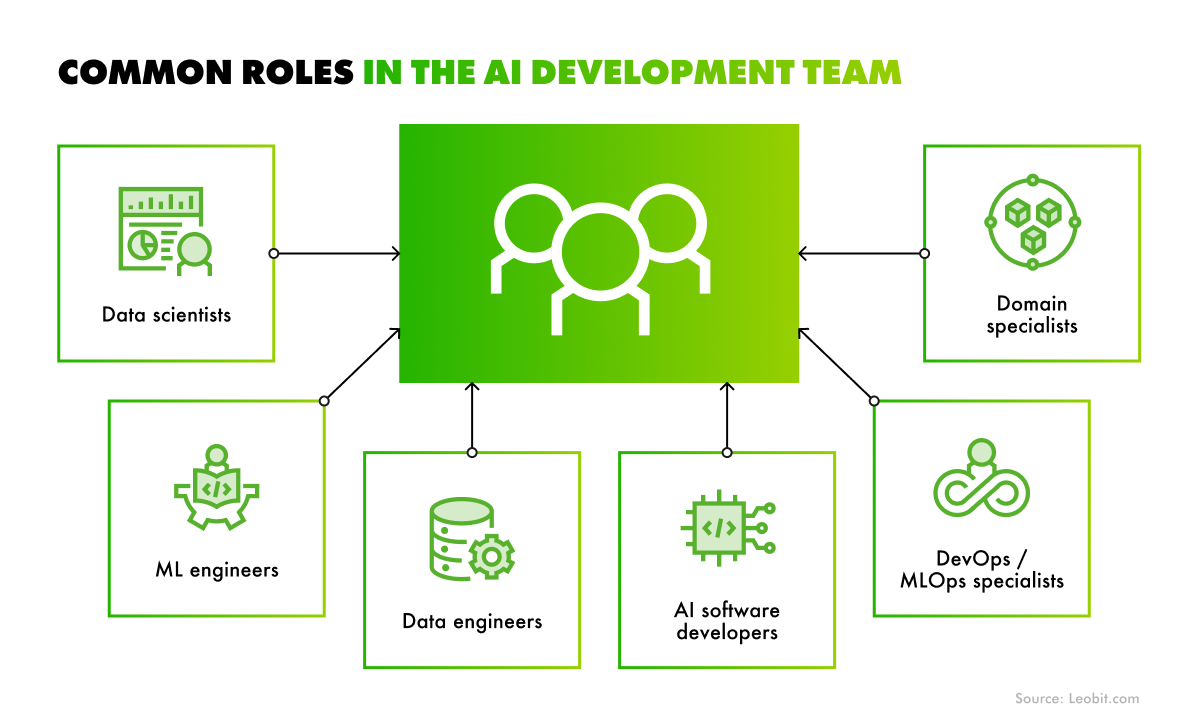
Over time, organizations evolve from applying ready-made AI tools to developing, operating, and governing AI systems as part of their core operations. That transition almost always requires a dedicated AI development team. Here is a more detailed overview of such cases.
AI lies at the core of your product or covers multiple workflows
If you expect AI to drive the core value of your product, its quality and capabilities determine whether the product succeeds or fails. This is especially relevant to solutions like recommendation systems, predictive analytics platforms, fraud detection engines, personalization systems, or agentic solutions that handle multiple workflows and show autonomous reasoning. In particular, McKinsey’s State of AI report shows that 23% of business executives report their organizations have scaled agentic AI systems capable of handling sequential processes.
In such cases, generic, off-the-shelf models struggle due to the lack of training on proprietary data or multi-step reasoning capabilities. Training models to fit core business use cases, or building a more complex AI solution, including an agentic system, becomes a vital objective that requires the involvement of an experienced AI team.
You need domain-specific intelligence and security
Many industries operate with specialized terminology, unique edge cases, and data that cannot be shared externally. Finance, healthcare, and logistics are prime examples. In such domains, generic models frequently misunderstand context, delivering poor outputs.
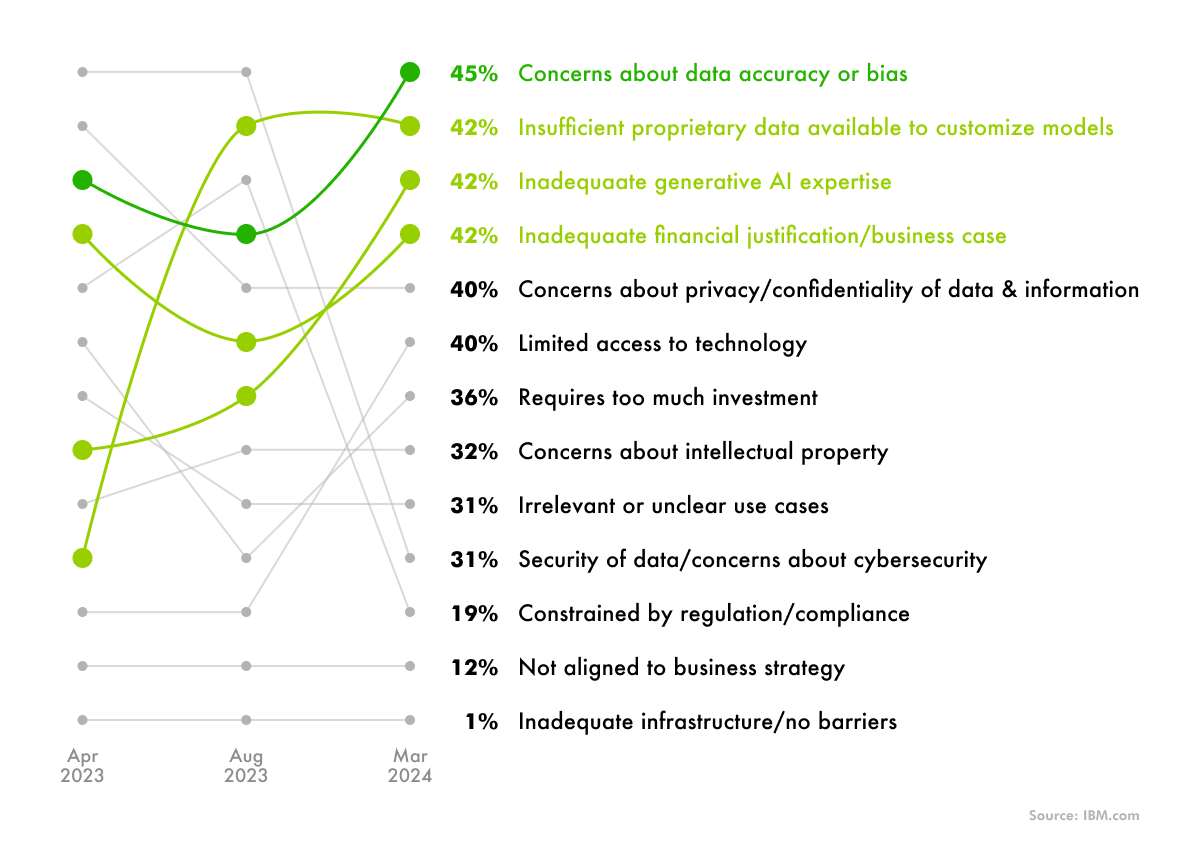
Security becomes another concern, as specific domains like fintech and healthcare require an in-depth focus on security. In fact, 40% of business executives cite concerns over data privacy and confidentiality among the most significant barriers to AI adoption.
To build a domain-specific AI intelligence, you need a custom model trained on proprietary or sensitive datasets. You will also need to implement mechanisms for explainability and auditability because this transparency will help identify errors faster, address biases, and ensure compliance with regulations.
Another important objective is to establish efficient security practices to safeguard domain-specific sensitive data. Ensure your AI-powered software is secure by building reliable and observable pipelines, monitoring and limiting API usage, and protecting data at the system’s key connection points.
Delivering this level of intelligence and security typically involves a dedicated AI team.
You require high accuracy and low error tolerance
Around 45% of business executives cite model bias among the most significant AI adoption challenges. This problem becomes especially relevant in industries and workflows with low error tolerance. For instance, HR management, where 15% of AI systems do not meet fairness thresholds for all demographic groups.
To address this problem, you need to build a custom model or extensively customize an existing one to ensure consistent accuracy and minimize bias. Achieving this level of reliability requires careful data curation, continuous model testing, and close collaboration between AI specialists and domain experts. In such cases, involving an AI/ML software development team is essential to provide the necessary expertise and establish efficient collaboration and model monitoring workflows.
You need complex data integrations
Issues with data management are very common in the AI development domain. In fact, Gartner predicts that through 2026, organizations abandon 60% of AI projects unsupported by AI-ready data. To build a mature AI system capable of handling business-specific workflows and multiple steps, you need to establish efficient data management practices. This means creating a system that collects data from multiple sources, processes it in real time, and transforms it for AI consumption.
In such cases, AI development goes far beyond a simple integration of an off-the-shelf model. Even if you integrate an API that feeds necessary data to the model, data distribution can shift over time. This will eventually make your model’s performance degrade – a phenomenon known as model drift.
To manage a complex system where an AI model, whether custom or off-the-shelf, is integrated with diverse data sources, you need specialists skilled in system-level design. They will help you establish:
- Pipeline monitoring workflows
- Real-time inference infrastructure
- Drift detection practices
- Model feedback loops
Things become even more complex when you need to build agentic AI solutions where different AI agents cover varying responsibilities, each powered by a corresponding dataset. In such cases, it is no longer integration. AI development requires system design specialists capable of building a coherent and consistent data architecture.
 Leobit