However, not every insurtech business that adopts artificial intelligence will automatically become more profitable. Without a clear vision of how AI fits into your business, adoption efforts can waste resources and fail to meet strategic goals.
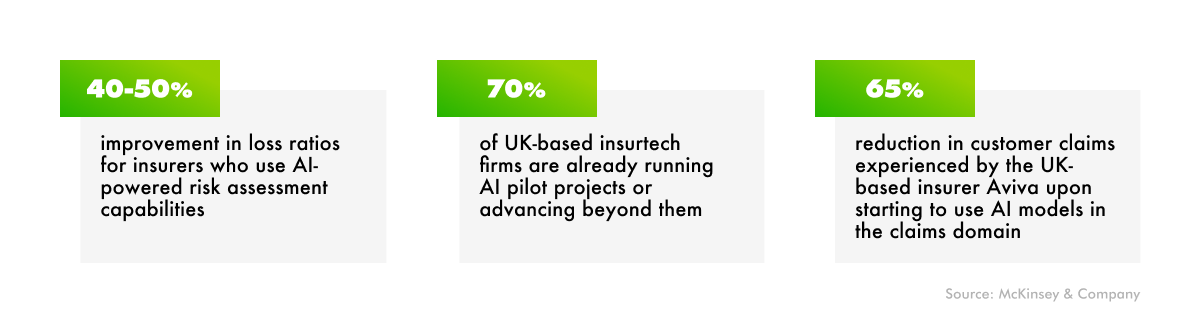
Important statistics on AI adoption in the insurtech industry
To convert AI initiatives into measurable results, insurtech organizations should find the right strategy. Its key component is understanding the business case for AI development and adoption.
In this article, we will discuss the most effective and widely adopted use cases of this kind in the insurance industry.
Let’s take a closer look at these key AI use cases in insurance.
Workflow automation
AI solutions can speed up various workflows by using fast processing capacities and minimizing human involvement. For instance, Claude, an agentic AI assistant used for tasks ranging from customer communication to coding support, is reported to speed up certain individual tasks by about 80%.
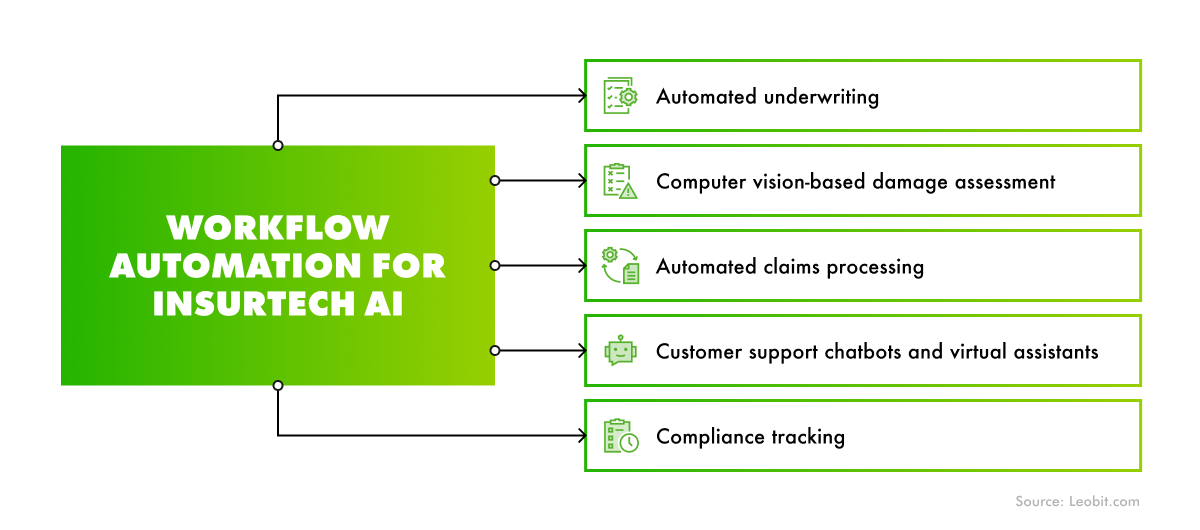
Below we provide an overview of common use cases for AI automation in insurance.
Automated claims processing
Managing insurance claims is typically a time-consuming process, as insurers must handle large volumes of documents while ensuring they are properly formatted, consistent, and error-free. Meanwhile, AI features included in a claims management system (CMS) can enhance nearly all steps of claims processing, from categorization to formatting and review. In fact, solutions powered with artificial intelligence can:
Automatically extract key data from FNOL (First Notice of Loss) submissions.
Route claims to the correct team based on complexity and risk level
Suggest settlement amounts using historical claims and policy rules
Automate routine approvals for low-risk, low-value claims
By supporting these and other workflows, AI-powered tools can help insurance agents process claims faster while maintaining accuracy.
This AI capability is especially relevant for claim management systems in property and automobile insurance. Insurers can use computer vision algorithms to assess physical damage to buildings, vehicles, and other assets based on customer-uploaded photos or drone footage. Such systems still require human supervision, but they can speed up claims processing and by minimizing in-person inspections, particularly in straightforward cases.
Automated underwriting
AI-powered claims management systems can significantly enhance underwriting by automating data collection and decision support. Such tools can collect and organize customer data from apps, third-party sources, and medical records. As a result, AI-driven insurance underwriting automation helps insurers generate quotes more quickly, particularly in dynamic, data-intensive areas like small and medium-sized enterprise (SME) insurance.
Customer support
AI-powered chatbots and virtual assistants can lead to an 11% increase in the number of prospective customers who ended up buying policies. By providing a 24/7 coverage of common questions, such as basic information on coverage and billing, or claim status checks, AI enhances customer satisfaction and engagement with quick responses. In some cases, artificial intelligence can even provide responses that clients perceive as clearer and more empathetic than those from human agents.
Conversational interfaces can also guide customers through regular workflows, such as claim filing. Additionally, some AI-powered insurance chatbot solutions categorize customer requests, route them to the appropriate specialists, and escalate or de-escalate request priority levels. One of the key advantages of using AI chatbots and virtual assistants is that such an approach reduces the load on human specialists, ultimately decreasing customer support costs.
Compliance tracking
The insurance industry is bound by multiple domain- and region-specific regulations. To name a few:
Solvency II Directive (2009/138/EC). Key prudential framework for insurers in the EU. It encompasses process requirements, governance, risk modeling, and reporting.
GDPR (General Data Protection Regulation). A regulation essential to businesses that operate in the EU. In insurtech, it covers the protection of underwriting data, profiling, and claims records.
Own Risk and Solvency Assessment (ORSA). US-based regulation for larger insurers to assess enterprise risk.
HIPAA (Health Insurance Portability and Accountability Act). A set of rules and regulations that are essential for the healthcare domain in the US. Relevant to health insurance companies in the country.
AI-powered insurtech solutions can monitor workflows for regulatory breaches or missing disclosures, automatically track adherence to jurisdiction-specific requirements, and ensure documentation and reporting consistency. Overall, AI models trained on domain-specific data can both automate regulation-related workflows and ensure their greater precision and reliability.
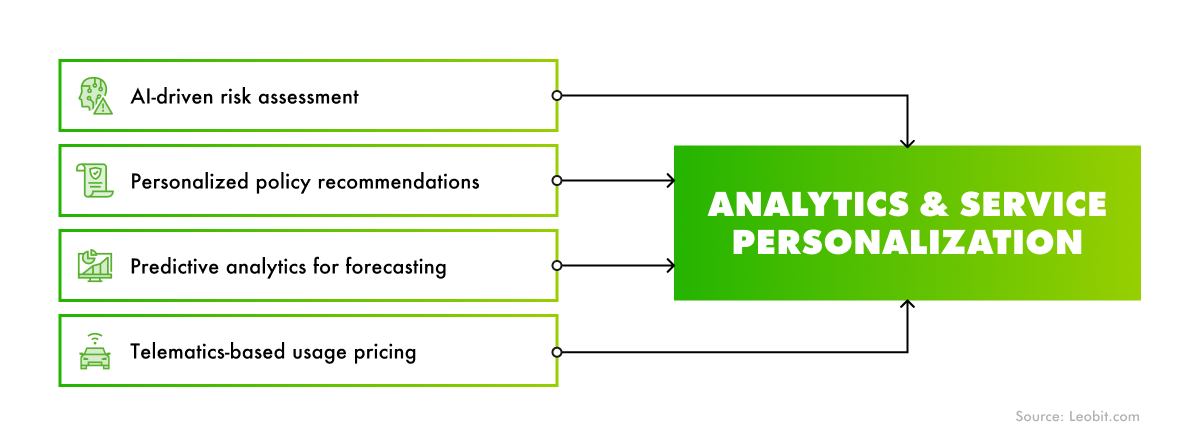
Analytics and service personalization
According to McKinsey, AI helps insurance brokers reduce churn by up to 50%. All thanks to its capabilities to analyze customer needs and engage them with the right messaging. Artificial intelligence algorithms provide insurers with granular, real-time insights through continuous analysis of behavioral, transactional, and contextual data.
Insurech analytics and personalization with AI
Here are the key personalization and analytics use cases in which AI helps insurers shift from reactive decision-making to more proactive and data-driven strategies.
Risk assessment
AI models can generate detailed risk models and simulate various scenarios to better assess potential losses. While basic generative AI typically relies on demographic factors or historical claims, more advanced systems, such as agentic AI solutions, can assess complex combinations of variables from multiple sources. In addition to demographical and historical data, such tools process data from IoT devices, transaction history, climate, geographical data, etc.
AI models with strong capabilities for analysis and calculation can create accurate risk scores and monitor risks on a continuous basis. This is especially relevant to the areas where traditional methods struggle, such as SME insurance, cyber risk, or emerging property threats.
Personalized policy recommendation
The use of AI in the insurance industry can enhance customer satisfaction scores by 36%. Solutions powered with artificial algorithms can recommend coverage options dynamically by considering a customer’s profile, life events, and behavioral patterns. In fact, AI-driven recommendation engines can:
Suggest relevant add-ons based on customer needs
Personalize deductibles or coverage limits
Identify uninsured or overinsured policyholders
By offering more adaptive and customer-centric insurance products, insurtech companies boost operational efficiency and increase customer engagement through personalized communication and services.
Predictive analytics for forecasting
Predictive analytics is another major area where AI technologies are rapidly developing. For example, specialty property and casualty (P&C) models can automatically assess the likelihood of winning a policy and set accurate pricing in just one to two hours, instead of the usual two to three days.
AI-powered predictive analytics in the insurance industry help insurers:
Anticipate claim volume spikes after major events
Detect emerging portfolio risks before they escalate
Optimize reserves and capital planning
Improve pricing strategies over time
Loss forecasting algorithms also help insurance specialists stay resilient during unprecedented events, such as supply chain disruptions, emergencies, or innovative fraud tactics.
AI provides strong support for vehicle insurance. It collects driving behavior data through mobile apps or in-vehicle sensors. In particular, AI algorithms can collect data on a driver’s speed patterns, braking intensity, mileage, driving times, and even location-specific risk factors.
By using these insights, insurers can shift from fixed premiums to individualized pricing that rewards low-risk drivers while improving loss ratios. This approach helps insurance companies reduce risks while providing more transparent and personalized insurance policies to the customers.
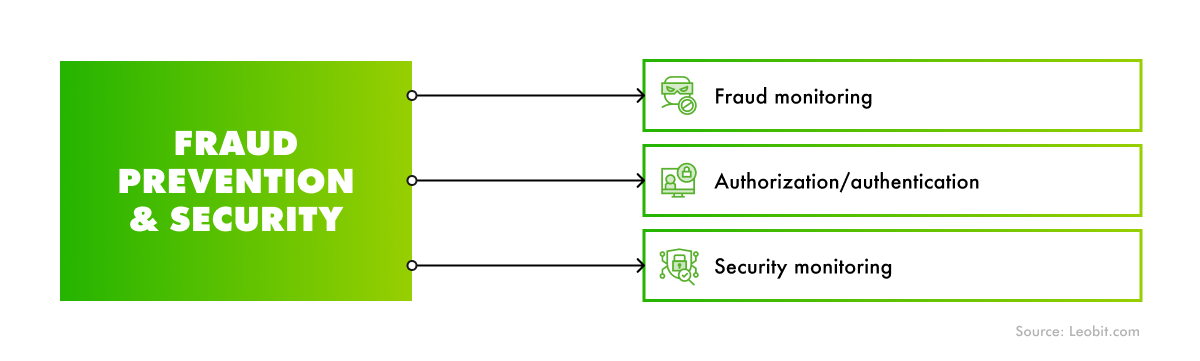
Fraud prevention and security
AI for insurance companies also plays an important role in keeping insurtech software secure. In fact, models can process large volumes of data from multiple sources, making them effective tools for detecting fraud, identifying suspicious activity, and monitoring system security.
Insurtech security and fraud detection with AI
The following are common AI use cases in the insurance industry focused on security.
Fraud detection
In 2025, the US economy suffered $308.6 billion in insurance fraud losses. As fraudulent activities evolve, so should fraud prevention technologies. Modern solutions for AI fraud detection in insurance go far beyond static rules like “flag claims over X amount.” Such models can process a significant variety of sources, as well as run multiple workflows simultaneously. They consider data like historical claims, behavioral signals, device data, transaction timing, document metadata, and any other suspicious signs in claims to identify anomalies.
This approach helps insurance agents reduce fraud threats by analyzing dynamic risk scores provided by AI and focusing on the most alarming cases. Additionally, the model can learn from confirmed fraud cases, significantly improving its analytical capabilities over time.
Authorization and authentication
AI can enhance identity verification at every stage of the customer journey. It can analyze the user’s typing patterns and navigation habits to flag suspicious cases.
AI solutions for insurance can also improve the efficiency and reliability of biometric authentication in insurtech apps. In fact, various AI services, such as Azure AI Face, Azure AI Vision, or Amazon Rekognition, can adapt to the evolving fraudulent technologies and analyze identity signals in real time to detect suspicious activity early.
Security monitoring
Beyond customer-facing fraud, AI plays a critical role in protecting internal systems and sensitive data. AI algorithms can monitor various software parameters, including:
API traffic
Logs
Data leaks
Access patterns
Abnormal data downloads
Suspicious activity by internal users or partners
Additionally, AI’s ability to detect deviations from normal behavior makes it effective against previously unseen threats. For insurtech platforms running on cloud infrastructure with a web of partners and integrations, this kind of always-on monitoring helps spot threats sooner and react before a small incident turns into a serious breach.
Challenges of Adopting AI in Insurtech
Despite multiple promises of AI adoption, there are still many concerns, particularly important to industries that require high precision, such as insurtech. For example, McKinsey’s 2025 State of AI report shows that 51% of organizations using AI have faced at least one negative outcome as a result of adoption. Meanwhile, nearly one-third of respondents from the same study report consequences stemming from AI inaccuracy.
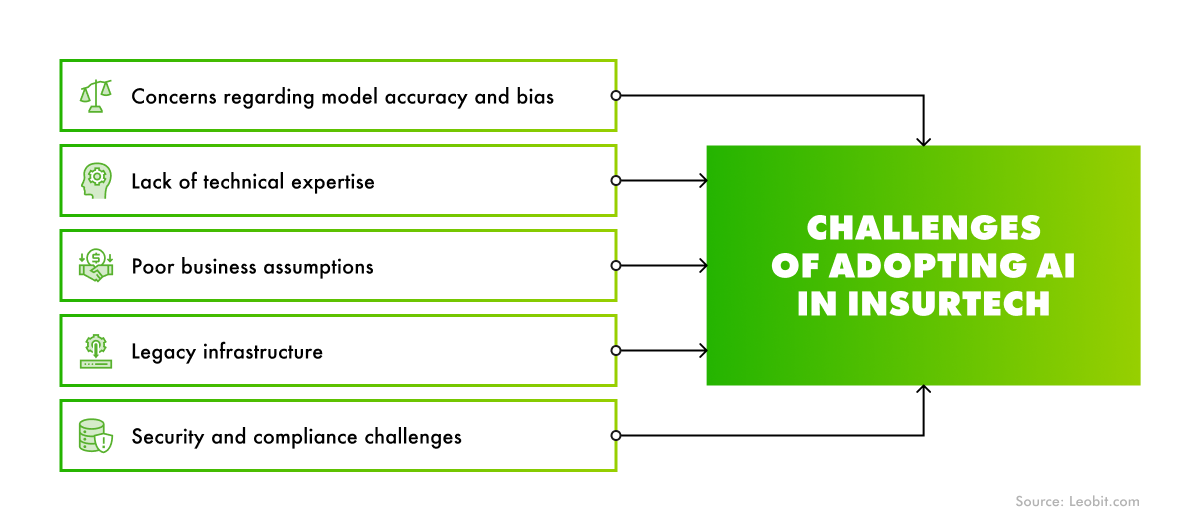
Key AI adoption challenges in insurtech
Even with established frameworks and best practices, implementing AI successfully is still challenging. Let’s explore the key AI adoption challenges in more detail.
Concerns regarding model accuracy and bias
According to IBM’s survey on the ingenuity of generative artificial intelligence, 45% of business executives cite this problem among the biggest obstacles to AI adoption. Issues with model bias and accuracy may be particularly impactful to insurtech companies because AI systems often influence high-stakes decisions. Even minor errors in estimates or forecasting can lead to failed risk assessment, which often translates into significant losses. Additionally, biased models may result in unfair treatment of certain customer groups.
To deal with this problem, insurtech companies monitor AI models continuously. Other important practices include prompt and fine-tuning aimed at keeping the models relevant and accurate. One of the most important factors here is training models on unbiased and balanced proprietary data of high quality.
Lack of technical expertise
Finding specialists with solid experience in developing reliable and tailored AI solutions for insurtech remains a challenge. In fact, 46% of business leaders cite skill gaps as a major barrier to AI adoption. Without hands-on experience with modern AI technologies and a deep understanding of the insurtech industry, a team can fail to deliver a quality product that aligns with business goals.
A possible option is outsourcing insurtech AI development to a dedicated team with relevant experience. This approach allows companies to find the necessary expertise in relatively short terms. The key point here is to choose a vendor who has practical experience in building AI-powered solutions for the insurance industry.
Many companies fail to understand the practical ways for implementing AI, which makes their adoption initiatives fail. In fact, 42% of company executives believe poor financial justification or business case to be a significant barrier to AI adoption.
Some insurtech companies may treat AI as a quick fix rather than aligning it with measurable insurance initiatives. Some initiatives can also fail because insurance businesses underestimate integration complexity, data readiness, and the regulatory constraints.
The key to dealing with this problem is strong preparation, which may involve a comprehensive discovery phase. Insurance businesses should define measurable outcomes, such as loss ratio improvement, fraud reduction, or faster claims handling, before starting an AI adoption project. The ultimate goal here is to develop a clear financial case tied to core workflows.
Legacy infrastructure
To successfully implement insurtech AI, companies need secure, reliable, and modern infrastructures, which often becomes a significant challenge. For example, infrastructure constraints are ranked among the top three barriers to adopting agentic AI, since such solutions require multi-node architectures that allow agents to coordinate seamlessly across cloud environments and edge locations. If an insurance company relies on outdated core platforms and fragmented data environments, AI solutions can struggle to process data adequately and deliver real business value.
Whether you need to integrate basic AI features or rely on advanced agentic capabilities, you should ensure that your infrastructure is prepared. Clear data organization, modern AI integration points, efficient load balancing, and strong security practices are essential requirements. That’s why we suggest starting your path towards integrating your AI into your insurtech workflows with well-organized software modernization.
Around 40% of business executives state that concerns over data privacy and confidentiality are among the most significant AI adoption challenges. This issue is particularly relevant to the insurtech domain that deals with significant amounts of private information, including personal documents and health-related data.
Additionally, insurtech businesses should consider several rules and standards concerning data protection and AI adoption in the industry. For example, in the EU, the Artificial Intelligence Act classifies AI systems used in critical insurance functions, such as underwriting and risk assessment, as high-risk. Therefore, AI insurtech solutions must comply with strict requirements for transparency, documentation, human oversight, data quality, and auditability.
To address security and compliance concerns in the insurtech industry, it is essential to work with specialists who understand domain-specific risks and maintain a robust set of data and system protection practices. Regular technical audits, including thorough evaluations of system security, help protect against bugs and safety issues that can emerge over time.
As already mentioned, one of the key obstacles to AI adoption in the insurance industry is the lack of technical expertise. Meanwhile, a team of skilled AI development experts with domain-specific knowledge brings a solution to most challenges of insurtech AI adoption.
Leobit, a Microsoft Solutions Partner for Data & AI, as well as Digital & App Innovation, is ready to provide you with such a team. Our specialists have strong experience in working with major AI tools and technologies, such as OpenAI API, Microsoft OpenAI, Google Gemini, Llama 3, Mistral 7BGPT-J, Azure AI services, etc. Whether you need to build and train custom artificial intelligence models for insurtech or build task-specific agents that can be integrated into large agentic AI platforms, we are ready to help.
We also have significant experience in developing tailored software for the insurance industry. In particular, we have developed a comprehensive online disability insurance solution for a US-based insurtech company. This web application provides both customers and insurance brokers with a convenient interface for personalizing the processes of buying and selling disability insunrance.
We also have specific experience in developing AI solutions for insurance. Our specialists built a comprehensive car insurance platform enhanced with AI algorithms for workflow automation. Artificial intelligence helps with business-critical calculations. It supports price generation for car insurance packages, as AI algorithms analyze all input parameters from users and assess the risks associated with the coverage of a particular vehicle.
Widespread adoption of AI is one of the most impactful insurance industry innovations. With strong capabilities for workflow automation, analytics and personalization, as well as security enforcement and fraud prevention, artificial intelligence helps insurtech companies boost their business efficiency. In addition, AI in the insurance industry can help companies handle multiple workflows, from customer communication to risk assessment, much quicker and with greater accuracy.
However, to leverage the benefits of AI in insurance, you will have to handle common challenges, like model accuracy and bias concerns, lack of technical expertise, business planning complexities, legacy infrastructure issues, and security and regulatory compliance.
Leobit is ready to help you handle these challenges and build an AI-powered insurtech solution that delivers real business value. Contact us to discuss your needs and see how we can help you with an AI-driven insurance business transformation.
FAQ
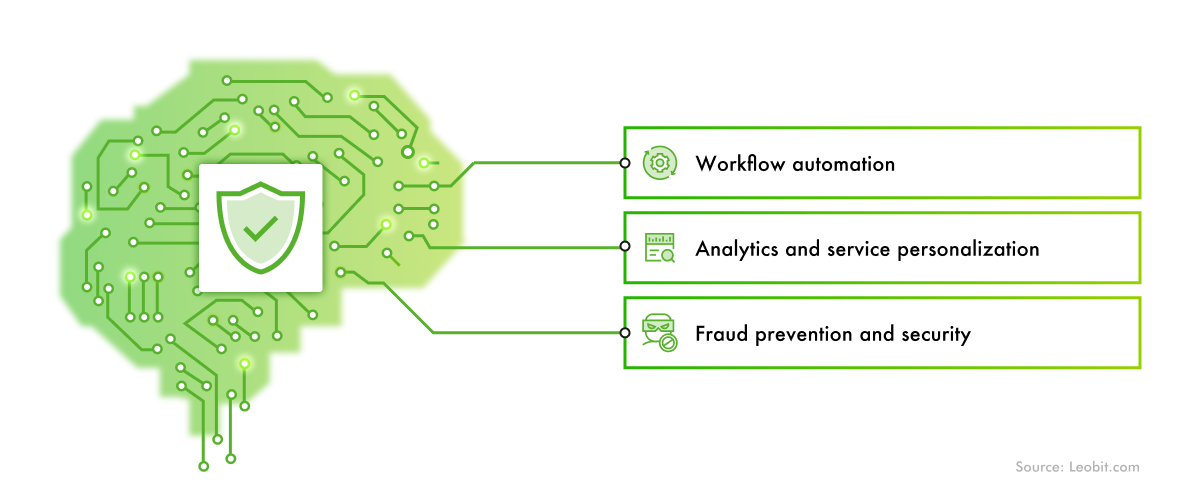
AI use cases in insurtech can be roughly divided into three major categories, each including several major use cases. It provides workflow automation for processes like claims processing, computer vision-based damage assessment, underwriting, customer support, and compliance tracking. AI also enhances analytics and service personalization, including risk assessment, personalized policy recommendation, predictive analytics for forecasting, and telematics-based usage pricing. Finally, artificial intelligence plays a vital part in fraud prevention and security workflows, such as fraud detection, authorization and authentication, and security monitoring.
Some of the key obstacles that insurance companies encounter while adopting AI include:
Concerns about model accuracy and bias
Lack of technical expertise
Poor business assumptions
Legacy infrastructure
Software security and compliance
While there is no universal solution to all AI adoption challenges in insurtech, support from an experienced team with strong expertise in AI development and the insurance domain will help you mitigate most of them.
Skilled specialists will ensure that your model is accurate and can help you monitor its performance over time. They will also help you align the project with your business goals, modernize your legacy infrastructure if needed, and ensure that your software is secure and compliant.
We are experienced in helping businesses implement tailored AI solutions and have a proven track record of successful projects for the insurance industry. In particular, we can help you build a tailored AI model from scratch or integrate AI-powered features into your existing insurtech software.
Our specialists can also help you prepare your existing infrastructure for AI integration. Additionally, we provide continuous support to keep your AI-powered insurtech platform accurate, efficient, secure, and compliant.
Roman has a deep passion for a wide array of subjects, spanning from market insights to in-depth technical examinations of complex projects. He dives deep into technical aspects of various solutions to extract valuable insights for business purposes, and he enjoys sharing tips and tricks with business owners to help them leverage advanced technologies effectively.
Vitalii is an experienced solution architect with a strong background in designing scalable, high-performance architectures. He uses modern technologies, including AI, .NET, and cloud-native services to help Leobit customers design and build software solutions tailored to their business needs. In addition to his technical expertise, Vitalii takes part in the company’s R&D efforts, drives internal excellence initiatives, and plays a key role in presales activities.
The growing AI adoption helps businesses automate and enhance many workflows, but it also has a downside. By accelerating software development lifecycles, AI ...
Lviv, Ukraine, February 2026 — Leobit, a full-cycle .NET, AI, and web application development provider, is excited to announce its upcoming webinar ...
Leobit, a .NET, AI, and web application development company, is excited to announce the expansion of its partnership with Microsoft by earning the Microsoft ...
According to McKinsey’s State of AI global survey, nearly nine in ten specialists from companies across industries say their organizations use AI for at ...
The pace of change in software development has never been higher, and 2026 will raise the bar again. We are quickly approaching a world where AI feels as ...
According to the McKinsey US CSO survey, more than 90% of companies are already using generative AI. This technology facilitates a wide range of workflows, ...
Gartner predicts that by 2028, 33% of enterprise software applications will include agentic AI. The reasons are obvious, since agentic AI can autonomously ...
AI-powered optical character recognition (OCR) once started as a simple neural network barely capable of analyzing text layout. Now it has evolved into an ...
15 mins read
We use cookies to enhance your browsing experience. By agreeing, you accept our Privacy and Cookies Policy.
By ignoring or closing this banner, we will only collect essential cookies necessary for the website to function properly.
 Leobit