Contact us

“How-Not-To” Guide: 5 Common Mistakes with LLMs and Their Impact on Business

15 mins read

How Not to Use LLMs for Your Business “How-Not-To” Guide: 5 Common Mistakes with LLMs and Their Impact on Business
Want a quick tech consultation?
Yurii Shunkin | R&D Director

Yurii Shunkin

R&D Director

Contact us

Today, businesses stand in the middle of a massive “LLM Gold Rush.” The excitement surrounding generative AI is driving a significant increase in investment. In fact, corporate AI investment has already reached $252.3 billion in 2024, with private investment climbing 44.5%. This has created a powerful “fear of missing out”, pressuring businesses to adopt AI immediately or risk falling behind.

But here’s the core problem: acting on this fear often leads to expensive, poorly planned projects that can eventually fail. Despite billions of dollars being invested, the reality is that success is not guaranteed. Data from industry professionals shows that a shockingly small number of machine learning projects, as low as 0-20%, are ever successfully deployed. That’s a lot of wasted time, money, and effort.

This article is designed to help you cut through the noise. We’ll expose the most common mistakes businesses make when rushing into AI and provide a clear framework to help you implement LLMs in a way that creates real, measurable value for your company.
5 Major Mistakes Businesses Make When Adopting LLMs

It is easy to get lost in debates about architecture, parameters, and the latest technical nuances. However, while teams obsess over complex “best practices,” they frequently overlook the simple, fundamental rules that actually determine success or failure. The most expensive errors usually stem not from code, but from strategy.

Below are the foundational elements you must prioritize first to avoid significant business problems.

1. Developing a custom product from scratch without a clear need

A common impulse is to immediately build something completely new, for instance, a standalone AI product or a deeply complex, custom solution. The assumption is that a unique business problem requires a unique solution. As a result, they often overlook the powerful tools and platforms already available that could solve the problem faster and more efficiently.

The smarter strategy is to start by enhancing what you already have. Before launching a massive new AI initiative, look at your existing applications and workflows. The most efficient first step to add valuable AI functionality is to integrate a powerful, pre-existing model, whether through an API or an open-source tool. This allows you to test the impact with real users and deliver value in weeks, not years.

2. Hiring an expensive, in-house AI/ML team prematurely

Hiring a full-time team creates a massive fixed cost in an environment where project viability is increasingly uncertain. Recent data reveal a disturbing trend: the share of companies abandoning most of their AI initiatives has increased to 42%, up from 17% the previous year.

When you hire expensive in-house talent before validating your use case, you could end up with high long-term payroll costs tied to a project that never makes it past the testing phase. Outsourcing AI/ML software development to companies with hands-on experience lets you test the waters and validate the product first, protecting your budget from the high cost of abandonment.

3. Over-relying on AI for any and all tasks

When companies view AI as a universal tool, they often fall into the trap of delegating critical work without understanding that large language models are probabilistic systems. They are designed to predict the next likely word, not to verify facts like a calculator or a database.

This reliance becomes dangerous when human oversight is removed and can lead to costly public embarrassments when the AI confidently generates false or misleading information. A prime example of this risk occurred when Deloitte Australia had to refund the government $290,000 for a report that contained “AI-generated errors,” including references to non-existent academic research papers and a completely fabricated quote from a federal court judgment.

This incident serves as a stark reminder that while AI can accelerate drafting, treating it as an autonomous expert for high-stakes outputs can backfire. What should be a productivity tool can quickly become a liability that can damage both your budget and your professional reputation.

4. Neglecting essential, company-wide employee training

A major strategic mistake companies make is treating AI solely as a technical product to build, rather than a core skill to develop across your company. This mindset often leads to neglecting essential training. While leadership often focuses resources on developing a single, complex AI tool, they miss out on the immediate, cumulative productivity gains that come from having every employee understand how to leverage LLMs to improve their day-to-day work.

McKinsey states in their latest report on AI that half of the employees receive moderate or less support in transitioning to AI-powered tools. This means a vast portion of the workforce is being left to struggle or ignore the technology entirely. To avoid such mistakes, your goal shouldn’t just be to deploy a centralized solution, but to ensure broad LLM literacy. When the entire team is empowered to automate their own routine work, the aggregate efficiency boost for the company is far greater than any single software launch could achieve.

5. Failing to validate LLM outputs with human experts

Relying solely on AI generation without human review is a quick way to damage client trust . Beyond the serious risk of hallucinations, where the model invents facts, there is the subtle but damaging issue of tone. If clients realize they are interacting with generic, machine-written responses, they often feel undervalued and dismissed.

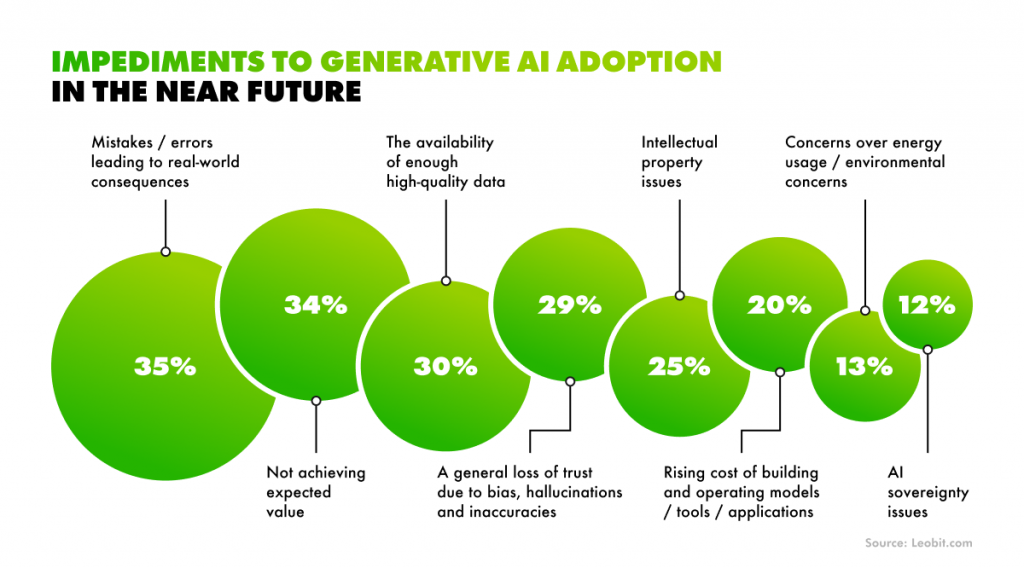
This lack of quality control is a significant industry concern. Deloitte’s State of Generative AI in the Enterprise Quarter four report indicates that 35% of businesses cite mistakes with real-world consequences as a top barrier to adoption. Human oversight acts as the necessary safety layer. It ensures that outputs are not only factually accurate but also carry the nuance and personal touch required to maintain professional trust.

Common impediments to Generative AI adoption, statistics

Matching the Tool to the Task: Good vs. Bad Use Cases for LLMs

Efficiency isn’t just about using AI; it is about knowing when not to use it. Attempting to offload every corporate function to an LLM often leads to costly errors and hallucinations. To ensure your implementation adds value rather than liability, you must distinguish between the creative, unstructured tasks where LLMs excel and the precise, deterministic tasks where traditional software is still superior.

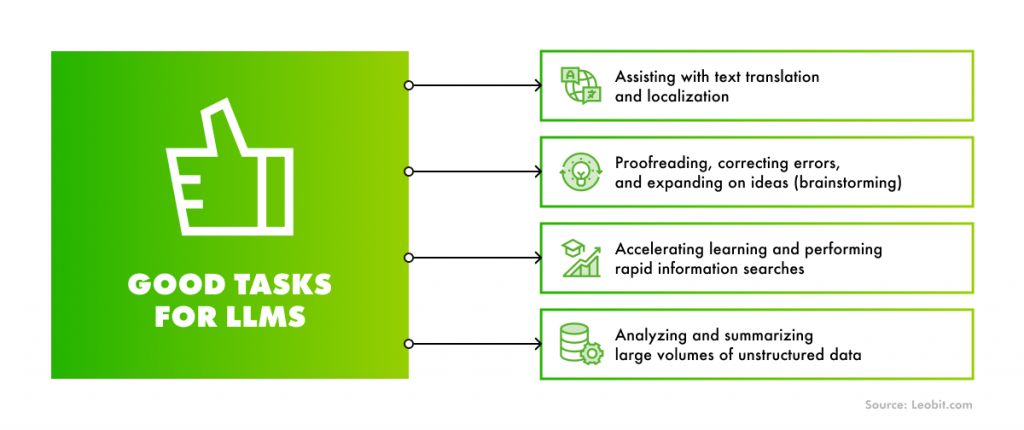
Good tasks for LLMs

To maximize the return on your AI investment, you should deploy LLMs where they naturally excel as powerful engines for processing, refining, and synthesizing information. They are exceptionally effective at handling large-scale text operations, such as translating and localizing content for global markets, or analyzing and summarizing massive volumes of unstructured data that would take humans days to sift through.

Combining established industry standards with insights from our own practical experience, we have identified the following core tasks as the most effective ways to utilize LLMs:

  • Assisting with text translation and localization
  • Proofreading, correcting errors, and expanding on ideas (brainstorming)
  • Accelerating learning and performing rapid information searches
  • Analyzing and summarizing large volumes of unstructured data

On an individual level, LLMs serve as an “always-on” intellectual partner. They can accelerate learning through rapid information searches and serve as a creative co-pilot to proofread work, correct errors, and brainstorm complex ideas.

Good tasks for LLMs
Good tasks for LLMs

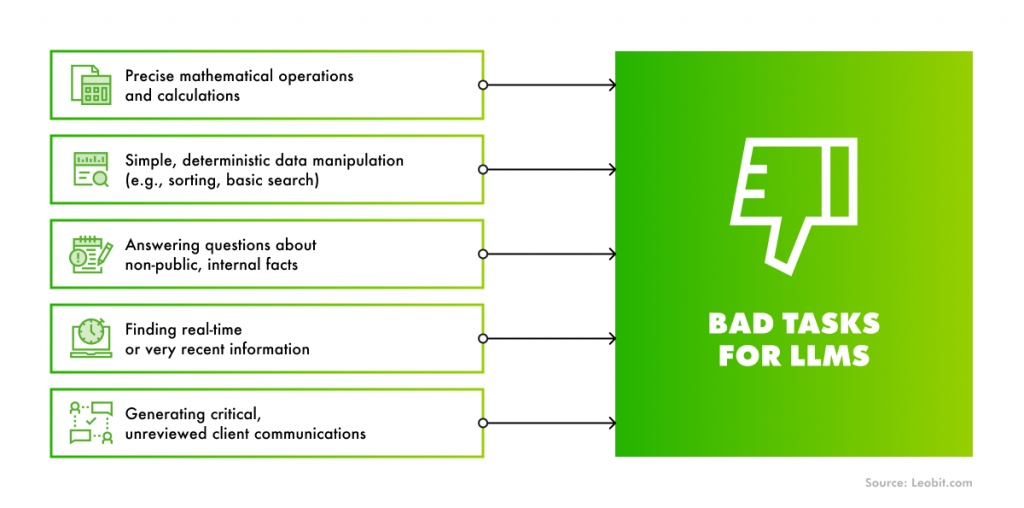
Bad tasks for LLMs

LLMs are the wrong tool for tasks that require absolute precision or up-to-the-minute accuracy. Since they function as probabilistic engines designed to predict plausible text rather than compute truth, they frequently fail at precise mathematical calculations and simple, deterministic data manipulation, such as sorting jobs, where standard software is far superior.

They also operate with a “frozen” worldview, making them incapable of retrieving real-time information or answering questions about non-public, internal company data without complex integrations.

Most importantly, LLMs should never be used to generate critical, unreviewed client communications, where their tendency to hallucinate facts or adopt a robotic tone can create significant legal and reputational liability.

Our experience, combined with established industry safety standards, highlights the following areas as high-risk or unsuitable for standard LLM adoption:

  • Precise mathematical operations and calculations
  • Simple, deterministic data manipulation (e.g., sorting, basic search)
  • Answering questions about non-public, internal facts
  • Finding real-time or very recent information
  • Generating critical, unreviewed client communications

Avoiding these operational pitfalls is only the first step. A widespread misconception remains that simply subscribing to the latest, most powerful model or relying on standard “best practice” prompting techniques guarantees success. Spoiler: it does not.

Bad tasks for LLMs
Bad tasks for LLMs

In fact, our research findings show that even widely accepted methods can yield mediocre or dangerous results if they aren’t calibrated to the specific reasoning capabilities of the model you are using. Real value isn’t unlocked by the tool itself, but by the domain expertise you use to guide it. To prove that success comes from the rigorous integration of human knowledge rather than raw computing power, we conducted our own research into a complex engineering challenge.

Let’s take a closer look.

Why a “One-Size-Fits-All” AI Strategy Fails: Insights from Leobit’s Research

To illustrate the difference between “using AI” and “engineering with AI”, let’s look at the recent research performed by one of Leobit’s experts. We conducted a rigorous study to solve a specific, high-stakes problem in software architecture: Event-Schema Evolution.

This case study reveals why a “one-size-fits-all” strategy doesn’t work and how deep expertise can transform a generic tool into a precise solution.

Challenge: automating senior-level architecture decisions

We focused on a critical pain point for modern software systems: managing complex data changes without compromising system integrity or corrupting history. If mishandled, the result is application crashes and irreversible data loss. Traditionally, this task falls to senior software architects. It is manual, slow, and prone to human error.

Our approach: Standard prompting vs. Expert-driven reasoning

We wanted to see if we could automate this decision-making process with 100% reliability. We developed and tested three distinct strategies:

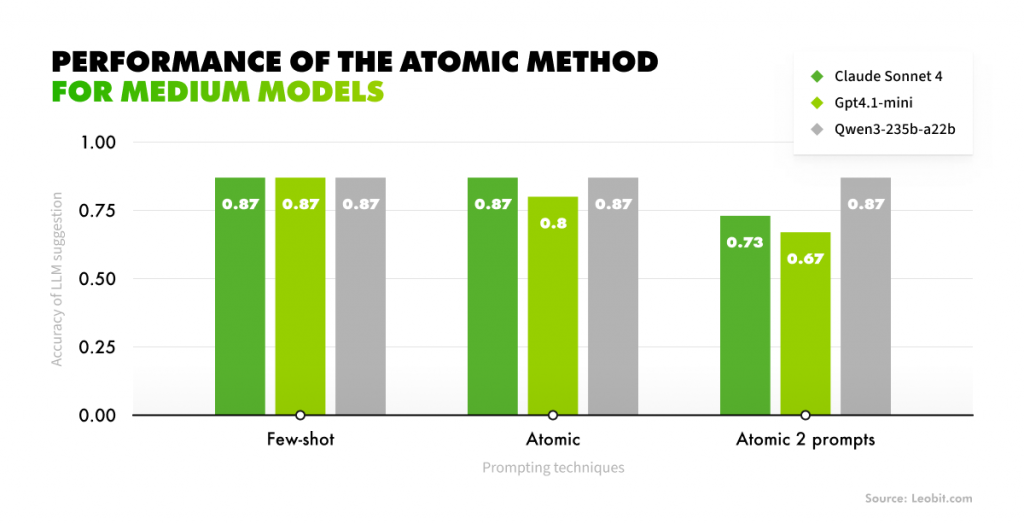
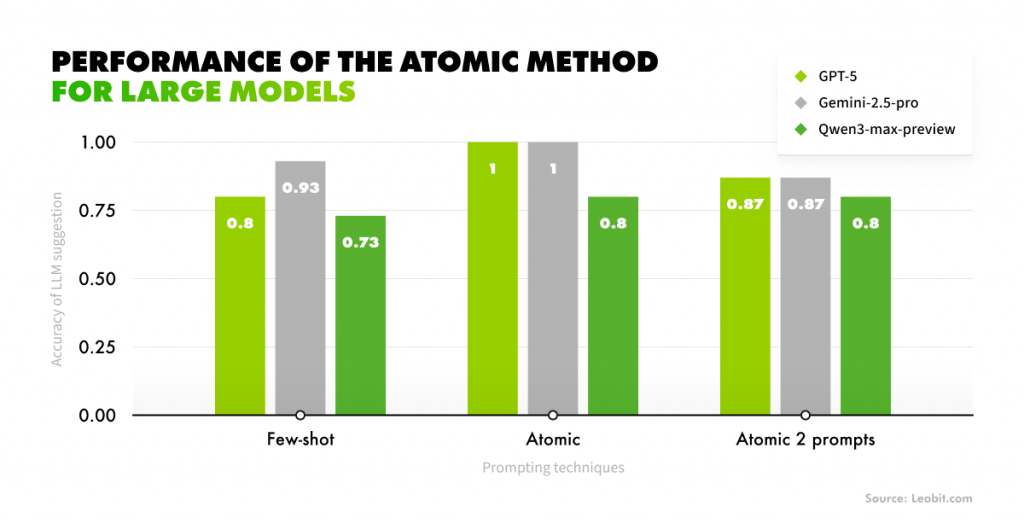
  • The standard approach (Few-Shot): We provided the LLM with AI examples of past migrations and asked it to follow the pattern. This is how most businesses currently deploy LLMs.
  • Our expert approach (Atomic Taxonomy): Instead of relying on pattern-matching, we applied our domain expertise to develop a rigorous, rule-based framework. We forced the model to deconstruct the problem into atomic steps and follow a specific decision matrix we created.
  • Task Decomposition (two-step atomic): We also tested a variation where we split the complex reasoning process into two separate, sequential prompts. This let us check a common assumption in prompt engineering that breaking a complex task into smaller, discrete steps always improves accuracy.
Performance benchmarks for the atomic method for medium models
Performance benchmarks for the atomic method for large models

Research outcome: strategy must match capability

Our findings exposed a critical nuance that most businesses miss:

  • With large models (GPT-5 class). Our expert approach unlocked the model’s full reasoning potential. Guided by our structured reasoning framework, the model achieved 100% accuracy. The model didn’t just mimic an answer; it accurately reasoned through our logic.
  • With Medium Models (GPT-4-mini class). The exact same expert prompts caused performance to drop. These models couldn’t handle the complexity and actually performed better with the simple, few-shot prompt.

Our research proves three things that are vital for your ROI:

  • AI needs your experts. LLMs don’t reach 100% reliability on their own. Our example achieved it because we designed the logic map to guide it. If we had simply trusted the black box without our domain knowledge, the system would have been unreliable for production.
  • Calibration is key. Swapping to a smaller model won’t deliver the same results without adjusting your approach. Similarly, paying for a top-tier model is wasteful if you’re not guiding it with expert-level prompts that make use of its full reasoning capabilities.
  • Task decomposition isn’t a magic wand. We learned that for tasks involving highly coupled logic, like schema evolution, splitting the workflow disrupts the model’s context. Sometimes, keeping the chain of thought in a single, cohesive prompt is more effective than breaking it apart.

Conclusion: moving from hype to value

As our research demonstrates, an expert-crafted approach can yield significantly better results than simply providing a model with extensive context. This creates a powerful partnership: the LLM accelerates the process, and the human expert provides the final verification and nuanced judgment.

Leobit follows this philosophy in its own work. Our company was named a winner of the Global Tech Award in the Artificial Intelligence category, recognized for building a corporate LLM powered by AI agents tailored for sales, marketing, and HR. This achievement reflects our hands-on expertise and our belief that AI should solve real business problems, not create new ones.

The Science Behind the Success

Why did our “Atomic Taxonomy” approach succeed where standard methods failed? The answer lies in understanding that a prompt is not merely a conversation starter, but a complex interface for engineering.

In real-world applications, the prompt serves as the defining input of the utilized model. As our research demonstrates, modifying the structure (e.g., the length and arrangement of input instances) and the content (e.g., phrasing, illustrations, and directives) has a significant impact on the model’s behavior. This is where the discipline of prompt engineering becomes essential.

Prompt engineering refers to the systematic design and optimization of input prompts to rigorously guide LLM responses. It has evolved from an empirical practice of trial and error into a well-structured research domain. This process is crucial for ensuring:

  • High accuracy and relevance, so the model solves the specific business problem at hand.
  • Coherence, guiding the model to maintain logical consistency.
  • Hallucination reduction, effectively constraining the model to stay within factual boundaries.

The influence of this discipline extends far beyond simple chatbots. As seen in our case study, systematic prompt engineering enables the creation of robust feature extractors, significantly improving effectiveness in complex tasks such as defect detection, classification, and architectural decision-making. To harness the full potential of these models, businesses must stop treating prompts as text and start treating them as code.

Are You Ready to Stop Experimenting and Start Generating Value?

The rush to adopt LLMs has pushed many companies into costly detours, but the lesson is simple. Success with AI is not about chasing the latest model or copying generic “best practices.” It comes from matching the tool to the task, pairing AI with real human expertise, and engineering your approach with the same precision you apply to any mission-critical system.

Our research shows that the difference between failure and meaningful ROI often comes down to three things:

  • Choosing the right use case
  • Calibrating the model to your actual needs
  • Guiding the model with expert-built logic rather than hoping it will “figure it out”

When those pieces come together, AI becomes a force multiplier that accelerates delivery and supports better decisions.

The companies that win in this new landscape won’t be the ones that move the fastest, but the ones that move the smartest. That means validating ideas early, using structured prompt engineering, and treating AI as a partnership between your domain experts and the model, not a replacement for them.

If you’re ready to move beyond hype and build AI that delivers measurable value, the first step is a clear, strategic assessment of where LLMs can genuinely improve your business and where they can’t. Leobit can help you identify the most valuable and achievable LLM use cases and calibrate the right model size and prompting strategy for your specific business needs.

Contact us and we’ll help you power your processes with AI.

FAQ

Most failures stem from choosing the wrong use case or skipping early validation. Businesses often jump into AI due to hype, adopt models that don’t match their needs, or rely on generic prompting instead of structured, expert-driven approaches. Without a strategy, even strong models produce unreliable results.

You’re ready when you have a clear business problem, access to relevant data, and internal processes that support human oversight. You don’t need an in-house AI team to start, but you do need a clear plan and realistic expectations. A structured AI Opportunity Assessment can confirm readiness and reduce risk.

Ideal use cases involve tasks that are unstructured, text-heavy, and require pattern recognition or synthesis rather than precise computation. Examples include summarization, localization, knowledge extraction, and rapid content generation. These tasks naturally align with how LLMs reason.

Yes. Leobit developed its own corporate LLM powered by four specialized AI agents. This internal system gives us firsthand expertise in designing, deploying, and optimizing multi-agent AI workflows that mirror real-world business needs.