Just three years after the introduction of generative AI tools, nearly nine out of ten companies are already regularly using AI. No wonder since agentic AI systems, which can make decisions and act autonomously, are already outperforming traditional AI approaches. Recent studies show that agentic AI can offer a 34.2% reduction in task completion time, a 7.7% increase in accuracy, and a 13.6% improvement in resource utilization. In some sectors, like the technology industry, productivity gains can reach up to 45%.
These numbers point to a clear shift. Companies that rely solely on predefined workflows risk falling behind, especially as competitors adopt more adaptive, goal-driven systems. At the same time, jumping straight into advanced AI can be risky without the right foundation. Not every problem requires an autonomous agent, and not every process benefits from full flexibility.
This is where the real question emerges: When is traditional automation enough, and when do you need agentic AI?
In this article, we’ll break down the differences between traditional automation vs. agentic AI using a real-world example from Leobit’s portfolio. We’ll also show how businesses can evolve from basic automation to intelligent, agent-driven systems in a practical, step-by-step way.
But let’s start from the beginning.
Traditional Automation: What Is It And What Does It Solve?
At its core, automation is about using rule-based systems to execute tasks in a predictable, repeatable way. It means you need to define the logic upfront so the system follows it consistently, without deviation. Such systems rely on deterministic workflows, so the path from input to output is fixed. In a nutshell, if a specific condition is met, a predefined action is triggered. There’s no interpretation or reasoning involved, just clear instructions being executed step by step.
In practice, traditional automation often takes the form of:
API integrations that connect different systems
Dashboards that centralize data and trigger actions
Back-end processes that move information from one tool to another
This approach works extremely well for repetitive, structured tasks. Another strong use case is standardized processes. When a workflow follows clear rules and rarely changes, traditional automation can handle it with high accuracy and reliability. The strength of this approach is its predictability. It’s stable, easy to control, and works well at scale. But as soon as a process becomes less structured or requires judgment, traditional automation may struggle.
Limitations of traditional automation
The major problem is that most real-world processes don’t stay that neat for long. And that way can become an obstacle for regular automation. Here we’ve gathered the main limitations you can encounter with traditional automation.
Rigid logic. These systems only do what they’re explicitly told. Every rule, condition, and exception has to be defined in advance. If something falls outside those rules, the system has no way to handle it.
Breaks in unpredictable scenarios. A missing field, a new document format, or an unexpected customer request can stop the process entirely or send it down the wrong path. Fixing this usually means going back and adding more rules, which quickly becomes hard to manage.
Cannot reason or adapt. Traditional automation doesn’t understand context. It can’t interpret unstructured data or adjust its behavior based on new information. It simply follows instructions, even when those instructions no longer make sense for the situation.
As processes grow more complex and dynamic, these limitations become more visible. This is where adding intelligence through AI starts to make a real difference.
Introducing AI Into Automation
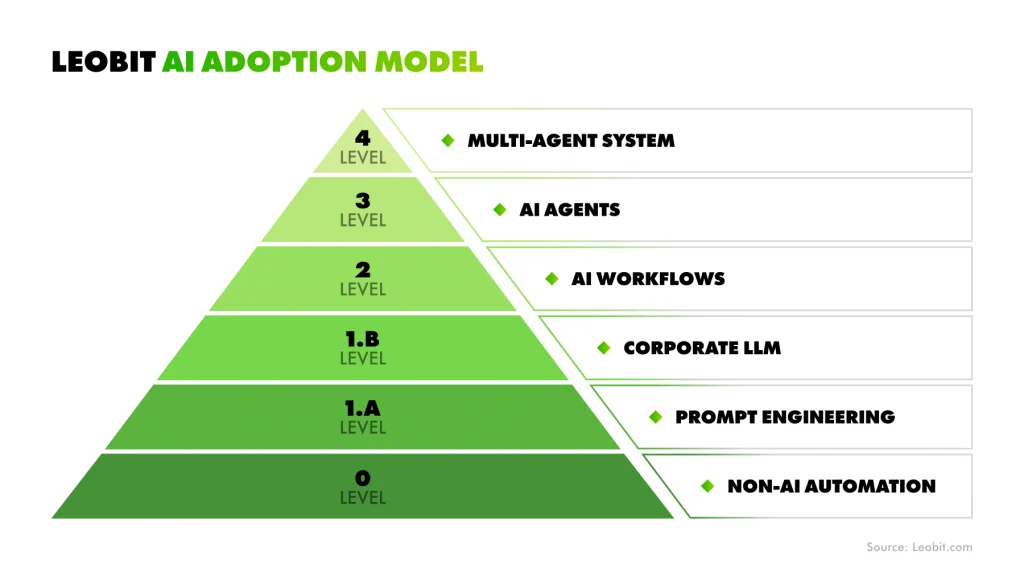
Adopting AI isn’t about replacing everything you already have. In most cases, it’s an evolution built on top of traditional automation. It extends what you already have and makes it more flexible over time. You can imagine it as a set of levels. Each step adds new capabilities, but also depends on what came before it.
Leobit AI adoption model: scheme
Level 0: Non-AI automation
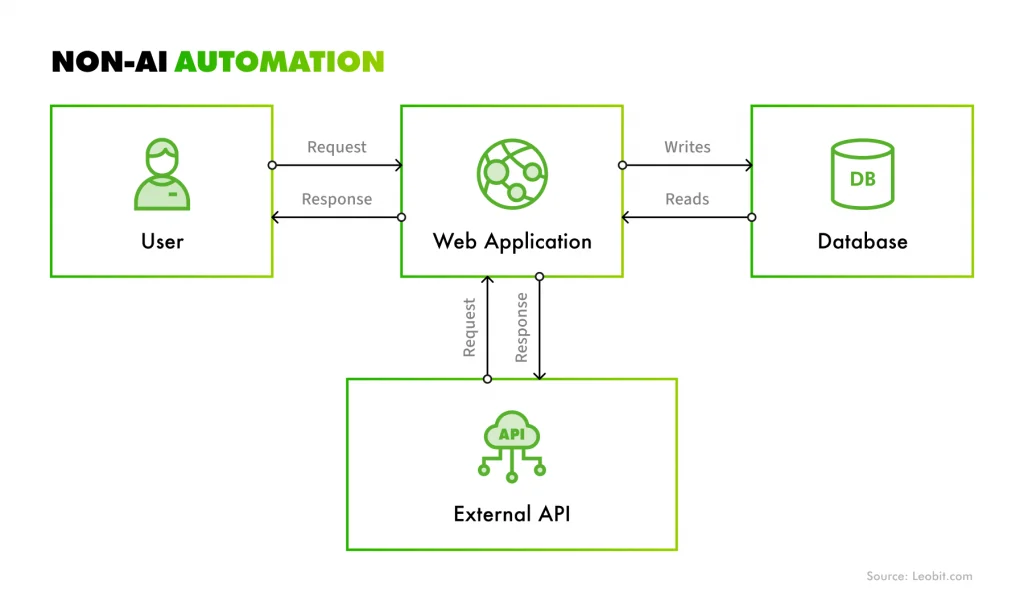
Every successful AI initiative starts here. Before introducing any intelligence, you need a solid operational foundation. Level 0 is all about automating what you already understand well. At this stage, the focus is on removing manual work and connecting systems through clear, rule-based logic. This includes building integrations between tools, setting up data pipelines, and creating workflows that handle routine tasks without human involvement.
Non-AI automation scheme
In practice, non-AI automation may often look like:
Syncing data between systems (e.g., CRM, ERP, external APIs)
Triggering actions based on events (e.g., new order, status change)
Generating standard documents or reports
Sending notifications when specific conditions are met
Automatically pulling order data from an internal system
Connecting to carrier APIs to retrieve tracking updates
Displaying shipment status in a centralized dashboard
Notifying customers when a delivery status changes
Even though there’s no AI involved, this step delivers immediate value. It reduces manual effort and gives teams better visibility into their processes. Just as importantly, this step prepares the ground for everything that comes next. It establishes clean and accessible data together with a set of reusable actions and workflows. These become the building blocks for AI later on. That’s why skipping the non-AI automation step may often lead to frustration since AI needs a foundation.
Level 1: Prompt engineering or corporate LLM
Once the foundation is in place, AI can be introduced in a way that delivers value quickly without adding too much complexity. Level 1 is where most organizations see their first tangible results. Instead of rebuilding systems, you enhance them by adding a layer of intelligence on top.
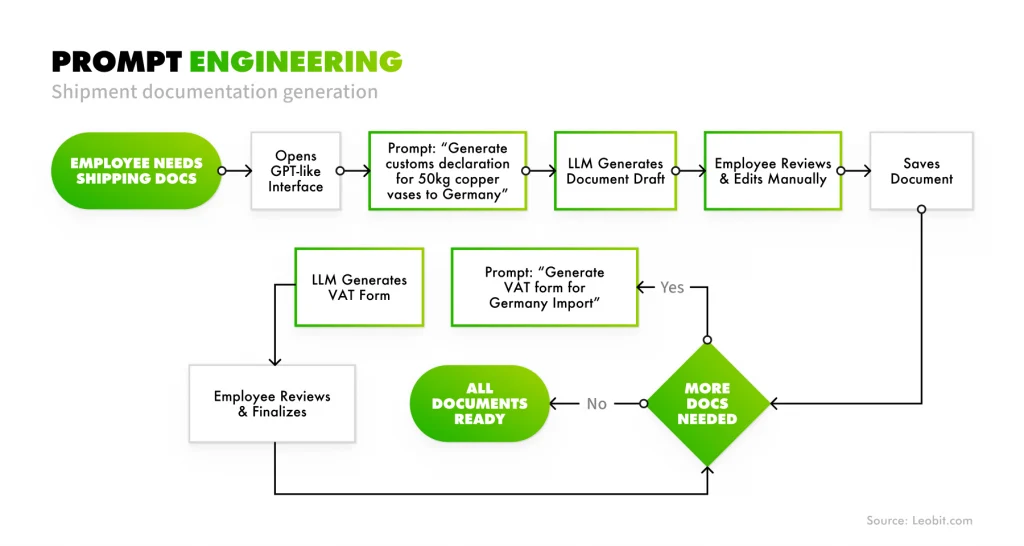
The simplest way to do this is through prompt engineering. Here, you use existing large language models and guide them with clear instructions. In practice, this often looks like a lightweight interface where a user submits a request in plain language, and the system turns it into a structured output using predefined prompts.
This works especially well for text-heavy tasks. For example, in the shipping orchestration platform we delivered, employees no longer need to manually prepare shipment documents from scratch. They can describe the shipment in a few lines, and the system generates a draft document instantly. The human role shifts from creating to reviewing and refining.
Prompt engineering example
The main advantage of this approach is speed. You can quickly deploy an initial version, test whether the use case makes sense, and iterate from there. It’s a practical way to prove value without committing to a large implementation upfront. However, prompt engineering has its limits. The model only knows what it was trained on, which means it lacks awareness of your internal processes, rules, and data. This is where the next step comes in.
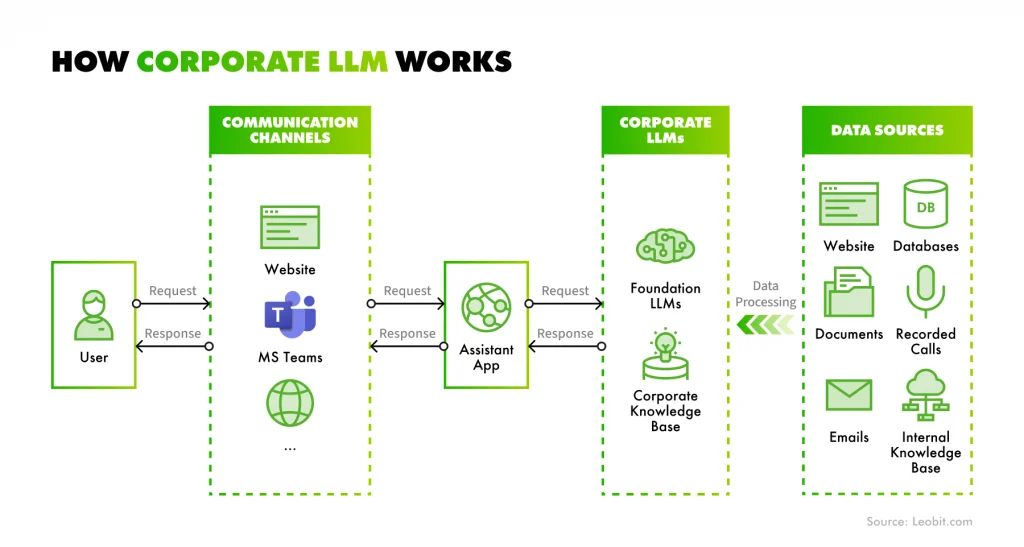
A corporate LLM builds on the same idea but connects the model to your organization’s knowledge. Instead of relying solely on general training data, it can access internal documents, databases, and other sources using techniques such as retrieval-augmented generation. The result is a system that doesn’t just generate fluent responses, but grounded and context-aware ones.
How corporate LLM works
In the same shipping platform project Leobit was working on, the corporate LLM enabled a support assistant. So when a user asks a question, the system retrieves relevant information from internal sources and uses it to produce an accurate answer. This reduces guesswork and also changes how people interact with company knowledge. Instead of searching through documents or systems, they can simply ask questions and get clear, conversational responses. Over time, this becomes a layer that sits across your entire data ecosystem.
In practice, these two approaches often complement each other. Prompt engineering is a fast way to get started and validate ideas. Corporate LLMs take it further by adding depth, accuracy, and integration with real business data. So, in a nutshell, this level is where AI moves from experimentation to everyday use. It doesn’t replace your existing systems, but it makes them significantly more useful.
Level 2: AI workflows
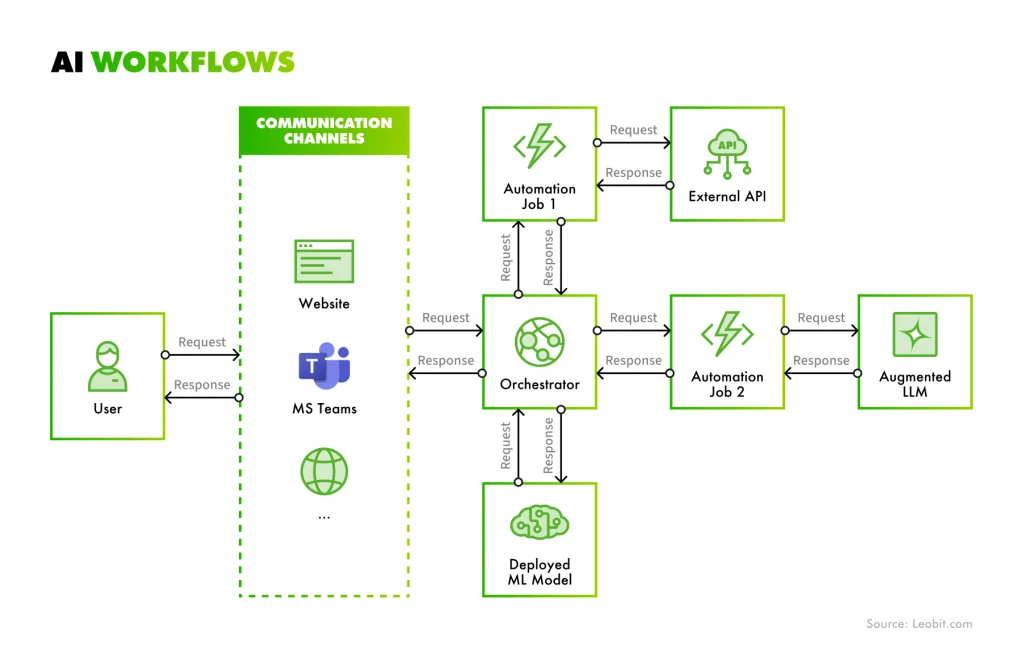
Instead of using AI for isolated tasks like generating text or answering questions, you create AI workflows and start embedding AI into end-to-end workflows that connect systems, make decisions, and execute actions. This is where things begin to feel like real automation.
AI workflows are usually built around an orchestrator. This component acts as the coordinator of the entire process. It receives a request, triggers different steps, collects results, and decides what happens next. Some of those steps are traditional automation tasks, while others involve AI.
The key difference between AI and automation from earlier levels is that AI now plays multiple roles within the same workflow. First, it can act as a decision-maker. Instead of relying solely on fixed rules, the system can evaluate context and dynamically choose the next step. For example, it can analyze a document and decide whether it’s valid, needs revision, or should be escalated for manual review. Second, AI acts as a worker within the process. It can extract information from unstructured data, classify inputs, or even generate outputs.
AI workflows scheme
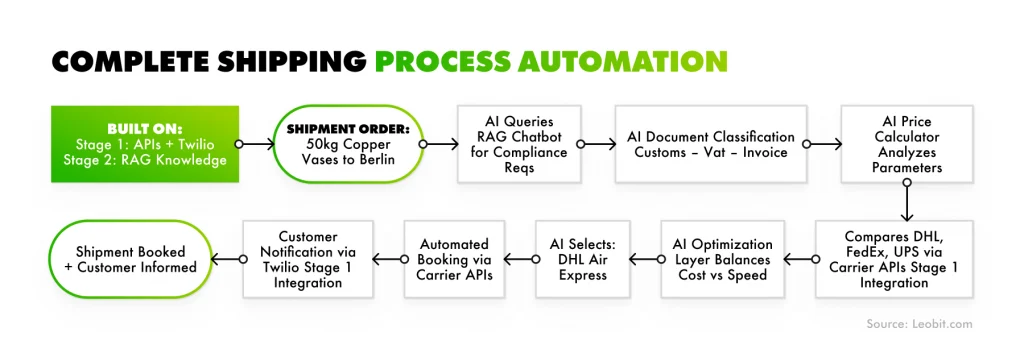
In the logistics shipping platform Leobit had been working on, this was where the entire shipping process became automated. Once an order was created, the workflow could:
Retrieve compliance requirements from a knowledge base
Generate shipment documentation
Evaluate delivery options and pricing
Book shipments through external carrier APIs
Send personalized notifications to customers
All of this happens within a single coordinated flow. Each step builds on the previous one, and the orchestrator ensures everything runs in the right sequence.
Complete shipping automation process scheme
One of the biggest advantages of AI workflows is the integration of systems that were previously difficult to link. It allows individual workflows to be reused and combined into larger systems. In a nutshell, you can build smaller automation units and then chain them together into more complex processes as your needs grow.
However, despite this flexibility, AI workflows are still fundamentally structured. The overall process is predefined, even if some decisions inside it are dynamic. This makes them reliable and easier to control, but also limits their ability to handle completely unpredictable scenarios. That limitation is what leads to the next step: moving from predefined workflows to fully adaptive, goal-driven systems with AI agents.
Level 3 is where the shift really happens. Instead of building systems that follow predefined steps, you start working with systems that can figure out the steps themselves. AI agents are fundamentally different from workflows. In a workflow, you define the process, and the system executes it. With an agent, you define the goal, and the system decides how to achieve it. This makes agents far more flexible, but also more complex.
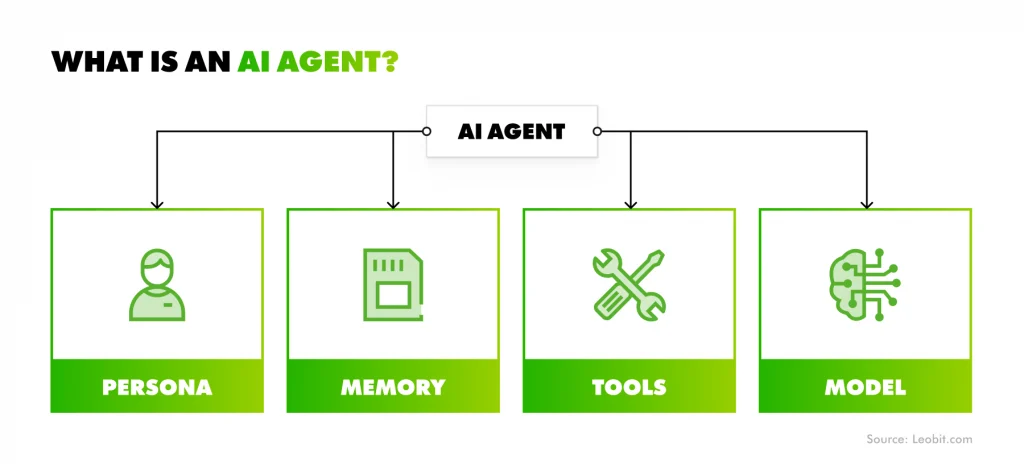
At a high level, an AI agent operates by combining four key elements: persona, memory, tools, and model. Persona defines how the agent behaves and what it’s responsible for. It has access to memory, which includes past interactions and external data sources. It uses tools that allow it to take action, such as calling APIs or triggering workflows. And it relies on a model to interpret requests, reason through problems, and decide what to do next.
What is an AI agent?
What makes this approach powerful is how these pieces work together. When given a task, the agent doesn’t follow a fixed path. It evaluates the situation, builds a plan, selects the tools it needs, executes actions, and adjusts along the way if something doesn’t work.
In a shipping orchestration project, for example, this is where automation becomes truly adaptive. Instead of following a predefined shipping process, an agent can respond to real-world events. If a shipment is delayed, the agent can:
Check alternative delivery options
Evaluate constraints like cost, timing, or regulations
Re-route the shipment if needed
Notify the customer with updated information
Update internal systems
All of this happens without a predefined sequence. The agent decides what to do based on the situation. This makes agents especially useful in scenarios where inputs are unpredictable or decisions depend on multiple changing factors. A common example is customer support, where each request is unique and can’t be fully mapped to a static workflow.
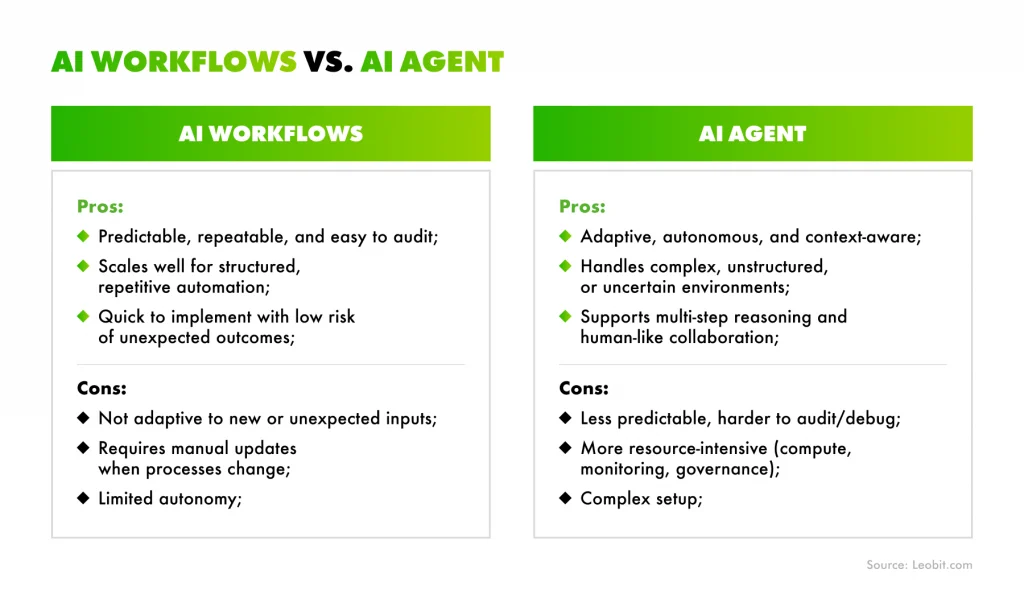
That said, this flexibility comes with trade-offs. AI agents are harder to control, test, and debug. They can make mistakes, take unexpected paths, or use tools incorrectly if not properly designed. Building a reliable agent requires carefully defining its role, access to the right data, and a well-balanced set of tools. Plus, you should not forget about human oversight and monitoring.
Because of this, agents are rarely used in isolation. In most real systems, they sit on top of workflows and automation layers built earlier. Those structured components provide stability, while agents add adaptability where it’s needed.
Let’s take a closer look at agentic AI vs. workflow automation.
AI workflows vs. AI agents comparison
When you don’t know which option will work better in your scenario: AI workflows vs. AI agents, follow a simple rule of thumb: use workflow automation for known processes and AI agents for unpredictable processes. Also, feel free to use a combination of these two options, a so-called hybrid approach.
Level 4: Multi-agent systems
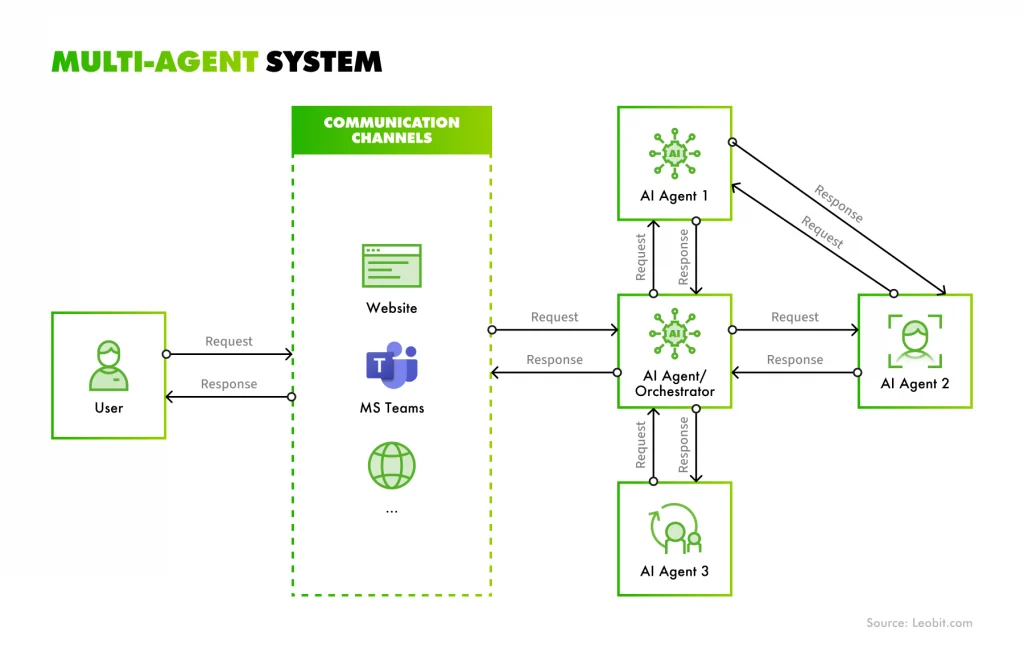
Recent studies show that enterprises that use multi-agent deployments report up to 40% productivity gains. In a multi-agent system, several specialized agents work together to solve a problem. Each agent is designed with a clear role. Rather than trying to handle everything, it focuses on a specific domain.
These agents don’t operate in isolation. They coordinate through an orchestrator or communicate directly with each other, depending on how the system is designed. The result is a setup that mirrors how real organizations operate, with teams handling distinct responsibilities.
This approach solves one of the key limitations of single-agent systems. Large language models have limits in terms of context, reasoning depth, and tool management. When one agent is given too many responsibilities, performance may become unpredictable. By splitting the workload, each agent can operate more effectively within a narrower scope.
Multi-agent system, scheme
In a shipping orchestration project that Leobit was working on, a multi-agent setup could handle shipment disruptions, including the following:
The logistics agent identifies alternative delivery options
The finance agent recalculates costs and fees
The customer agent prepares and sends updated notifications
The orchestrator ensures everything stays in sync and updates internal systems
Compared to a single-agent approach, this structure is easier to scale and maintain. You can improve or replace individual agents without redesigning the entire system. At the same time, it introduces new challenges. As coordination becomes more complex, communication between agents needs to be well-defined. In this case, governance is critical to avoid conflicts or inconsistent decisions.
Between traditional automation and fully autonomous agents, there is an important middle ground: AI-enhanced automation. This is where most companies see the biggest immediate impact.
At this stage, you are not replacing your existing workflows. Instead, you are making them smarter by embedding AI into specific steps where rigid logic used to fall short.
Traditional automation handles structure well, but struggles with variability. AI fills that gap. It allows systems to work with unstructured data, interpret context, and make limited decisions without requiring a complete redesign of the process.
In practice, this means taking an existing workflow and upgrading key parts of it. For example, instead of relying on fixed rules to process documents, AI can extract relevant information even when formats vary. Instead of routing tasks based only on predefined conditions, AI can evaluate content and decide the most appropriate path.
This approach is especially useful in areas like:
Document processing, since formats and inputs may be inconsistent
Customer communication, since requests are not standardized
Compliance checks, where interpretation is required
Reporting and analysis, where summaries and insights are needed
It also provides a natural path forward. Once AI is embedded into individual steps, those components can later be connected into larger workflows or reused by agents. In that sense, AI-enhanced automation acts as a bridge between simple rule-based systems and more advanced, goal-driven architectures. For many organizations, this is the point at which AI moves from experimentation to real operational value.
AI Agents in Practice
The concept of AI agents can feel abstract until you see how it works in a real scenario. In practice, the value of agentic AI becomes clear when processes become unpredictable and require constant adjustment.
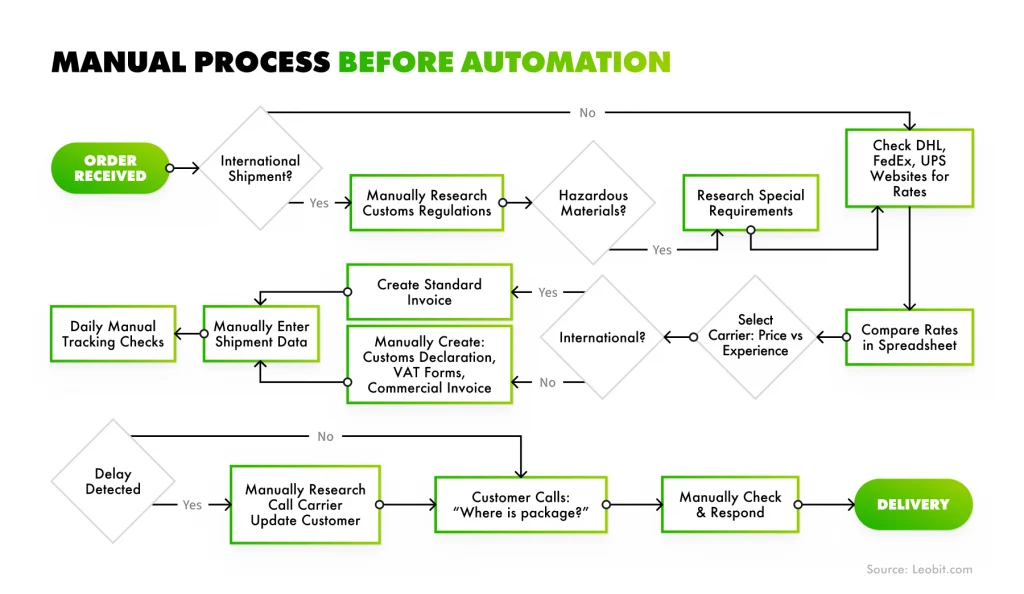
A good example is an intelligent shipping orchestration platform that Leobit developed for a global logistics and delivery enterprise company. After building a solid automation foundation and introducing AI through a RAG-based system, the team enabled accurate, context-aware responses using internal data and GPT-based models. They also automated document classification, which helped our customer reduce manual review time by nearly 64%. The biggest shift, however, came with the introduction of AI agents.
The customer’s manual process before automation
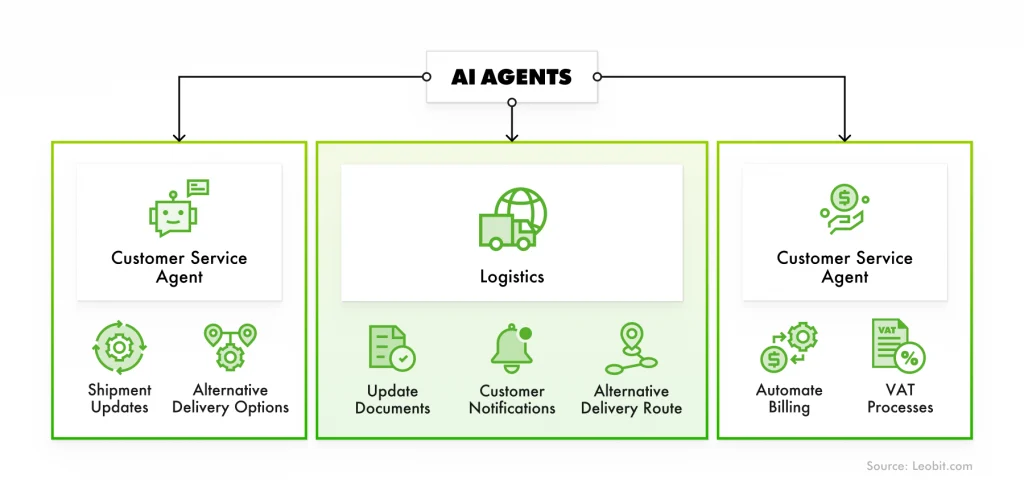
Leobit designed specialized agents for different domains. These agents were connected through a shared orchestration layer, allowing them to coordinate actions and operate as one system. Such a setup turned a fragmented, manual process into a dynamic, self-adjusting workflow. The result is not just automation, but a system that can understand, decide, and act in real time across complex operations.
AI agents in an intelligent shipping orchestration platform
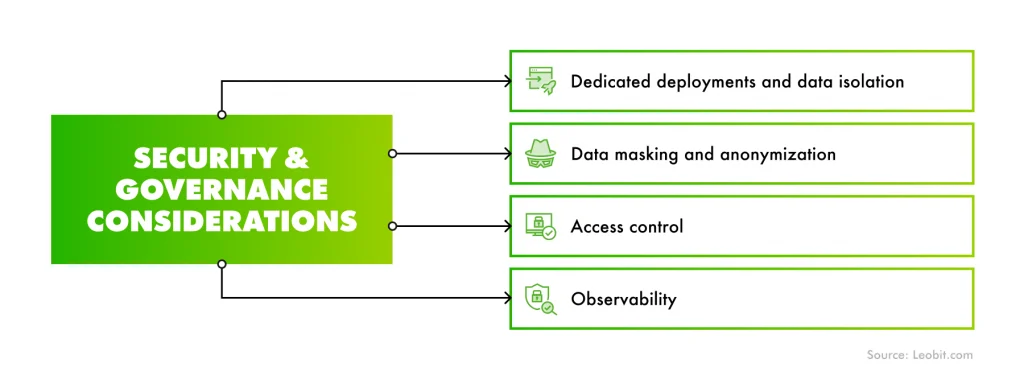
As AI systems become more capable, they also introduce new risks. Unlike traditional automation, AI doesn’t just move data. It interprets it, generates new outputs, and in some cases makes decisions on its own. That makes security and governance a core part of the design, not an afterthought.
This is one of the biggest barriers to AI adoption today. Around 40% of business executives cite data privacy and confidentiality as major concerns, and 42% point to the lack of proprietary data as a key challenge when implementing AI. These concerns are not theoretical. They directly affect whether AI systems can be trusted in real business environments.
To address this, several principles need to be built into the system from the start.
Dedicated deployments and data isolation. Businesses need to ensure that their data is not exposed to public models or reused for training. This often means using enterprise-grade environments or private deployments where data stays fully controlled.
Data masking and anonymization. In many cases, AI does not need access to sensitive details to perform a task. Personal identifiers, financial data, or confidential fields can be masked before being processed, and then restored later if needed. This reduces risk without limiting functionality.
Access control. AI systems should operate under the same permissions as the user interacting with them. If a user does not have access to certain data, the AI solution should not be able to retrieve or expose it either. This prevents scenarios where the system unintentionally bypasses internal security policies.
Observability. Every action an AI system takes, from data retrieval to decision-making, should be logged and traceable. This makes it possible to audit behavior, debug issues, and continuously improve performance. Without visibility, even small errors can become hard to detect and fix.
Security and governance considerations
NB! These measures cannot be layered on later. AI systems, especially agentic ones, interact deeply with data and processes. If security and governance are not built into the architecture from the beginning, fixing them afterward becomes complex, costly, and sometimes impossible without starting over.
How to Start: A Practical Adoption Path
Adopting AI can feel overwhelming, especially with how fast the technology is evolving. The key is not to aim for the most advanced solution from day one, but to follow a practical, step-by-step path that builds momentum and reduces risk.
Here are five major steps you should take to introduce AI agents to your workflow.
Step 1. Discovery phase. This is where you take a close look at your existing processes and identify where automation or AI can make a real impact. The goal is not to map everything, but to find the areas with the highest potential, repetitive work, bottlenecks, or tasks that depend heavily on manual effort. At this stage, it’s also important to align on expected outcomes and define what success looks like.
Step 2. Building the foundation. This means preparing your data, setting up integrations, and ensuring your systems can communicate reliably. In many cases, you need to connect internal platforms, organize data sources, and create reusable actions that future AI components can rely on. Without this layer, even the most advanced AI will struggle to deliver consistent results.
Step 3. Starting with simple AI. Prompt engineering is often the best entry point. It allows you to quickly test ideas, automate specific tasks like document generation or summarization, and validate whether AI actually improves the process. This stage is about learning what works in your context.
Step 4. Adding AI workflows. This is where individual AI capabilities are combined into structured processes. Instead of solving isolated tasks, you start automating entire flows, connecting systems, and introducing AI-driven decisions within a controlled framework.
Step 5. Introducing AI agents. Agents are most valuable in scenarios that are dynamic, unpredictable, or too complex for predefined workflows. They should extend your system, not replace everything that came before.
The most successful AI initiatives follow a few consistent principles.
Start measuring quick outcomes early. Early results build confidence, demonstrate value, and help secure buy-in across the organization.
Build incrementally. Each step should add value on its own while also preparing for the next one. Trying to do everything at once usually leads to unnecessary complexity.
Reuse components across stages. Integrations, data pipelines, and workflows created early on should become the foundation for more advanced capabilities later. This not only reduces effort but also ensures consistency as your system evolves.
AI adoption is not a single project. It’s a progression. The more structured and intentional that progression is, the more sustainable and impactful the results will be.
Key Takeaways
Despite the growing popularity of agentic AI systems, traditional automation still remains the best practice for automating processes that are well understood. For dynamic processes, however, relying on fixed rules alone is no longer enough. This is where AI extends the picture by adding intelligence to the structured processes.
Agentic AI goes even further. It introduces a new level of flexibility, where systems are no longer limited to predefined paths but can pursue goals, adapt to changing conditions, and make decisions in real time. This opens the door to automating scenarios that were previously out of reach.
At the same time, the most effective solutions are not built by replacing one approach with another. They are built by combining them. That said, together, they form a layered system that is both stable and responsive. The path forward is about starting with clear use cases, building step by step, and evolving your capabilities over time.
Whether you’re just beginning or looking to scale existing solutions, working with an experienced partner can significantly accelerate that journey. If you’re exploring how to apply AI in your organization, contact us, and we’ll guide you from the initial discovery and system design to implementing AI workflows and agentic solutions.
FAQ
Traditional automation follows predefined rules and executes fixed workflows. It works well for predictable, structured tasks. Agentic AI, on the other hand, is goal-driven. Instead of following a set path, it decides how to achieve an objective, adapting to changing conditions and unexpected inputs.
No, you don’t. In most cases, AI adoption is an evolution, not a replacement. Existing systems, integrations, and workflows become the foundation that AI builds on. The most effective approach is to enhance what already works rather than start from scratch.
AI workflows are best for processes that are well-defined but require some intelligence, such as document processing or decision support. AI agents are more suitable when processes are unpredictable, dynamic, or require flexible decision-making, like customer support or real-time logistics optimization.
Simple agents can be built quickly, sometimes in days. However, production-ready agents require more effort. They need proper data integration, clearly defined tools, security controls, and ongoing monitoring. Without these, agents can become unreliable or difficult to manage.
Inna loves making complex tech feel simple. With a strong eye for innovation, she helps businesses turn complicated ideas and data into clear strategies they can actually use. Whether it’s new tools or big trends, she’s all about making technology work for people.
Vitalii is an experienced solution architect with a strong background in designing scalable, high-performance architectures. He uses modern technologies, including AI, .NET, and cloud-native services to help Leobit customers design and build software solutions tailored to their business needs. In addition to his technical expertise, Vitalii takes part in the company’s R&D efforts, drives internal excellence initiatives, and plays a key role in presales activities.
Yurii holds an MS degree in Applied Mathematics and is a Microsoft Certified Professional. As an R&D Director, he is responsible for developing tech expertise, data management, security, and compliance.
The global demand for artificial intelligence keeps growing, as 88% of organizations reported regular AI use in at least one business function in 2025. The ...
Choosing the right front-end framework is no longer just a technical decision. It directly affects development speed, hiring, scalability, and long-term costs. ...
Microsoft Azure stands at the forefront of the growing AI adoption and analytics market. In particular, nearly 60% of CIOs across industries plan to increase ...
In the race to innovate and deliver software faster, quality is often pushed to the back burner. But this strategy carries real financial consequences. ...
The growing AI adoption helps businesses automate and enhance many workflows, but it also has a downside. By accelerating software development lifecycles, AI ...
The insurance industry could unlock $50 billion to $70 billion in revenue through AI, according to McKinsey.
However, not every insurtech business that adopts ...
Research from Bain & Company shows that 44.9% of executives see a clear correlation between flexible, modular architecture and improved productivity. ...
Lviv, Ukraine, February 2026 — Leobit, a full-cycle .NET, AI, and web application development provider, is excited to announce its upcoming webinar ...
Leobit, a .NET, AI, and web application development company, is excited to announce the expansion of its partnership with Microsoft by earning the Microsoft ...
4 mins read
We use cookies to enhance your browsing experience. By agreeing, you accept our Privacy and Cookies Policy.
By ignoring or closing this banner, we will only collect essential cookies necessary for the website to function properly.
 Leobit